Kistefos Museum & The Twist: Norway's Most Extraordinary Art Experience
An hour from Oslo, Kistefos Museum combines a 19th-century industrial landmark with a world-class sculpture park and The Twist, a BIG-designed gallery that doubles as a bridge spanning the Randselva river. This is one of the most architecturally inventive art destinations in Scandinavia.
Quick Facts
- Location
- Kistefossveien 24, 3520 Jevnaker, Norway – approx. 1 hour from central Oslo
- Getting There
- Vy express bus VY66 from Oslo Bus Terminal (approx. 1h 30min, NOK 250 one way, pre-booking required); or ~1 hour by car from Oslo or Oslo Airport Gardermoen
- Time Needed
- 3–4 hours for a full visit; allow more if you linger in the sculpture park
- Cost
- Adults NOK 200; Seniors NOK 170; Ages 20–25 NOK 100; Under 20 free. Area-only ticket (outside season) NOK 100
- Best for
- Contemporary art lovers, architecture enthusiasts, families, and day-trippers from Oslo
- Official website
- www.kistefosmuseum.com
What Is Kistefos Museum?
Kistefos Museum and Sculpture Park occupies a preserved industrial site along the Randselva river in Jevnaker, roughly an hour's drive northwest of Oslo. What began as a pulp mill in the late 19th century has transformed, over several decades of private patronage, into one of Norway's most significant contemporary art destinations. The original mill building still stands at the heart of the complex, its red-brick chimney visible from every corner of the grounds, acting as a constant reminder that this landscape carries real industrial history beneath its artistic ambitions.
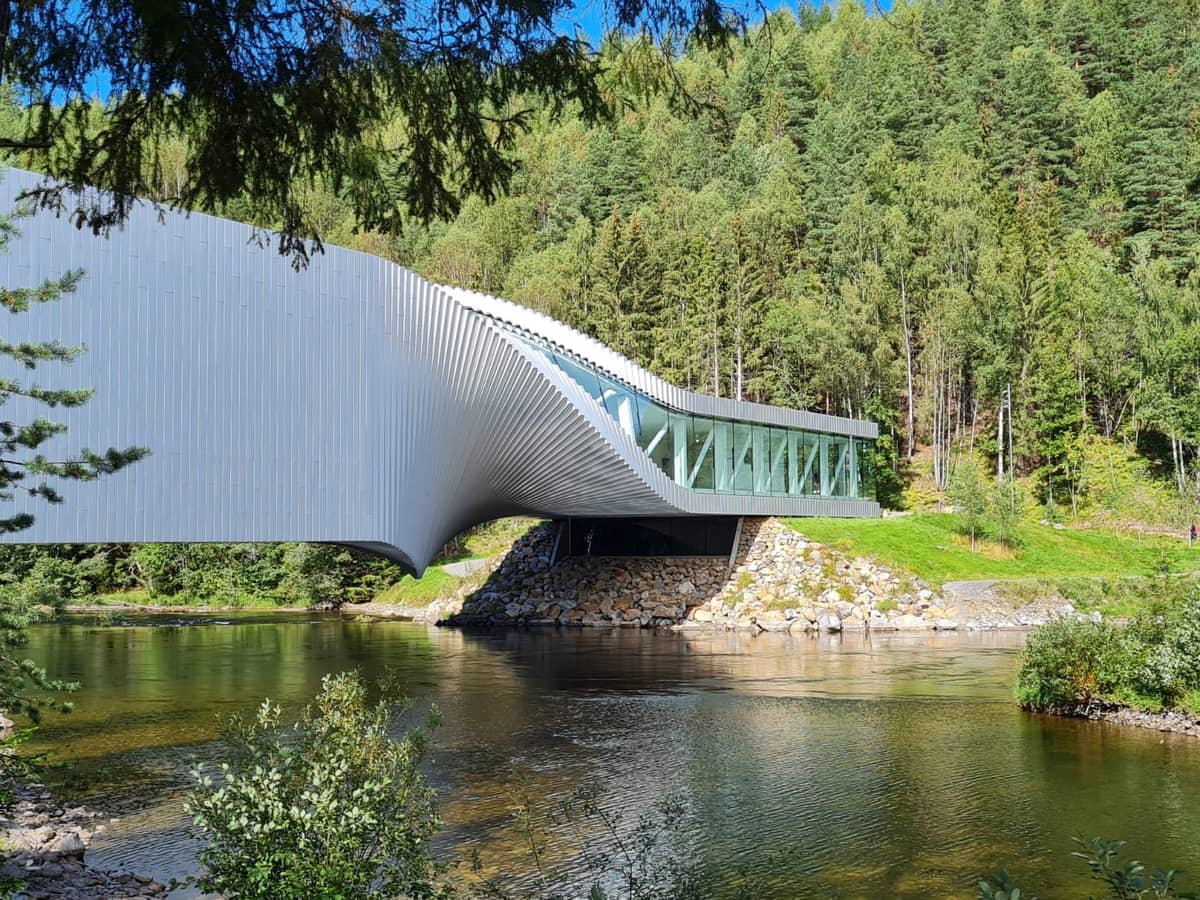
The sculpture park spreads across a wooded, river-threaded landscape and currently holds works by internationally recognized artists. But the attraction that has put Kistefos on the global architecture and art circuit is The Twist, a gallery-bridge-sculpture designed by BIG (Bjarke Ingels Group) that opened on 18 September 2019. It is not hyperbole to say there is nothing else quite like it in Scandinavia. The building crosses the river, rotating 90 degrees along its length, so that what enters as a floor exits as a ceiling. The effect, experienced from inside, is genuinely disorienting in the best possible way.
ℹ️ Good to know
The sculpture park is accessible outside the official season with a NOK 100 area ticket. If you visit between mid-October and early May, you can still walk the grounds, though the indoor galleries and The Twist interior will be closed.
The Twist: Architecture as Experience
Described by Kistefos itself as 'a gallery, a bridge, and a sculpture, all in one,' The Twist is the kind of building that changes depending on where you are standing. From the river bank, it reads as a sculptural object: a white rectangular volume that appears to wrench itself apart at the midpoint, the two halves offset by a clean 90-degree rotation. From inside, that geometry becomes spatial drama. The gallery floor tilts, flattens, and tilts again as you cross from one bank to the other, and the views through the end glazing frame the river and forest like two enormous photographs.
The building is 60 meters long and spans the Randselva river. The structural logic is exposed throughout: the interior feels raw and precise at the same time, with white walls that work well for large-scale contemporary works. The changing exhibitions here have included pieces that respond directly to the building's geometry, which rewards artists willing to engage with the space rather than simply hang work on its walls.
For visitors interested in the broader context of innovative Norwegian architecture, The Twist fits into a decade-long pattern of ambitious public and cultural buildings in Norway. The Oslo Opera House and the Deichman Bjorvika library are both striking examples in the capital itself, but The Twist arguably pushes further into sculpture territory than either.
Tickets & tours
Live prices and dates from our booking partner. If you book, we may earn a commission at no extra cost to you.
Oslo Fjord sightseeing audio-guided electrical boat tour
From 35 €Instant confirmationFree cancellationFjord cruise with live jazz music
From 64 €Instant confirmationFree cancellationLuggage Storage in Oslo
From 6 €Instant confirmationFree cancellationPicturesque dinner cruise in Oslo
From 137 €Instant confirmationFree cancellation
The Sculpture Park: What to Expect on the Ground
The sculpture park is designed for walking, and the terrain is worth understanding before you arrive. Paths wind through mixed woodland and open riverbank meadows, crossing the Randselva at several points. The ground is uneven in places, with gravel paths and some sloped sections. Visitors with reduced mobility should arrive via Entrance South (Kistefossveien 24), where the terrain is considerably flatter than the northern entrance.
In summer, the park has a particular quality in the late afternoon, when the light comes in low through the birch trees and catches the surfaces of the outdoor sculptures at an angle that midday visits simply don't offer. Many of the works are large-scale and material-heavy: steel, bronze, weathering Corten, polished stone. They sit in the landscape rather than on pedestals, which means the context shifts with the seasons. In early May, when the trees are just coming into leaf, the sculptures read differently than they do in August when the vegetation is at its fullest.
Allow at least 90 minutes just for the outdoor park if you want to walk it properly. The paths are signed, but part of the experience is following the river rather than a prescribed route.
💡 Local tip
Wear shoes with grip. The riverside paths can be damp and slippery even on dry days, and sections near the water are unpaved.
The Mill Building and Industrial History
The original Kistefos pulp mill, established in 1890, gives the entire site its name and its emotional anchor. The preserved mill building functions as an exhibition space and houses machinery that has been left in place, creating an unusual layering of industrial archaeology and contemporary art. Standing inside, you can see the scale of what was once a working factory: the ceiling height, the remnant equipment, the quality of light through industrial-scale windows.
This industrial heritage is not merely a backdrop. It is what distinguishes Kistefos from a purpose-built art campus. The friction between the rough industrial fabric and the polished contemporary work on display is genuine and deliberate. The mill context also explains why the river feels so central to the site: the Randselva powered the original mill, and the entire landscape was shaped by that industrial relationship with water.
Visitors with an appetite for Oslo's own industrial and cultural layers might find useful context in the Akerselva River Walk, where Oslo's own industrial history plays out along a similar river-and-mill geography, now embedded in the city itself.
Opening Hours, Season, and Tickets
Kistefos operates seasonally. The 2026 season runs from 9 May to 11 October. Hours vary within the season: from 9 May to 31 May, the museum opens Tuesday to Sunday, 10:00 to 17:00. From 4 June to 20 September, it opens Thursday to Sunday, 10:00 to 17:00. From 26 September to 11 October, it opens Saturday and Sunday, 10:00 to 17:00. Always check the official website before traveling, as these schedules are confirmed annually.
Adult admission is NOK 200, seniors NOK 170, and visitors aged 20 to 25 pay NOK 100. Children and young people under 20 enter free. A short guided introduction tour costs an additional NOK 90. Outside the season, a NOK 100 area ticket allows access to the sculpture park grounds.
⚠️ What to skip
Kistefos does not have a T-bane (metro) connection. If you are traveling without a car, you can take the seasonal Vy express bus VY66 from Oslo Bus Terminal (pre-booking required) or arrange your own transport. Taxis from Oslo are expensive over this distance.
Getting There from Oslo
By car, Kistefos is approximately one hour from central Oslo and roughly the same from Oslo Airport Gardermoen, making it a realistic stop for travelers with a hire car and a flight later in the day. The southern entrance at Kistefossveien 24 is the recommended arrival point for visitors coming from Oslo, and it is also the correct address for GPS navigation.
Without a car, the Vy express bus VY66 departs from Oslo Bus Terminal, calling at Filipstad and Lysaker before heading to Kistefos. The journey takes approximately 1 hour 30 minutes and costs around NOK 250 one way. Pre-booking is required. The Vy ticket also includes a shuttle connection between Hadeland Glassverk and Kistefos, which means you can combine both sites in a single day trip if you time it correctly.
Planning a longer day out of the city? The day trips from Oslo guide covers Kistefos alongside other worthwhile destinations within a 2-hour radius.
Clear Assessment: Is It Worth the Trip?
The honest answer is: yes, but only if you engage with what Kistefos actually is rather than treating it as a scenic outing with art as a backdrop. The drive or bus journey through inland Viken is unremarkable. The site itself is not a grand estate or a dramatic mountain setting. What it offers is concentrated and specific: excellent rotating contemporary exhibitions inside The Twist and the mill building, a sculpture park that rewards slow walking rather than quick ticking-off, and a building in The Twist that is genuinely worth seeing for anyone interested in how architecture and space can produce meaning.
Visitors who come hoping for a nature walk with incidental art will find the landscape pleasant but not spectacular by Norwegian standards. Those who come for the art and stay for the landscape will find the combination adds up to something more than either element alone.
If your Oslo trip is focused primarily on the city's own world-class museum offer, the Oslo museums guide is a better starting point before you commit a half-day to traveling out to Jevnaker.
Who Should Consider Skipping
Travelers on a single day in Oslo will almost certainly find the city's own concentration of major museums more efficient. Kistefos requires half a day minimum once travel time is included, and it is not covered by the Oslo Pass. If your interest in contemporary art is limited, the admission price and travel effort may not feel proportionate. Those who are mobility-impaired should note that while the southern entrance is the flatter option, the sculpture park still involves uneven ground and some inclines.
Insider Tips
- Arrive when the museum opens rather than mid-afternoon. The Twist's interior light is dramatically different depending on cloud cover and time of day, and morning visits before groups arrive mean you can spend time in the gallery without competing for sightlines.
- The bus ticket on VY66 includes a shuttle between Hadeland Glassverk and Kistefos. If you want to see both sites, plan around the shuttle schedule so you do not need to backtrack to Oslo in between.
- Photography inside The Twist is generally permitted for personal use, but the most interesting shots are from the exterior, on the riverbank downstream, where the full rotation of the building is visible in a single frame. Early morning mist off the river adds considerably to these shots.
- The café on site is a practical lunch stop rather than a destination in itself. Bring a snack if you plan to spend more than two hours, especially if traveling with children.
- Children under 20 enter free, which is one of the more generous admission policies of any significant Norwegian art institution. The outdoor sculpture park also works well for younger visitors who need space to move between gallery visits.
Who Is Kistefos Museum & The Twist For?
- Contemporary art enthusiasts who want to see The Twist's BIG-designed interior at its best
- Architecture fans tracking Scandinavian design beyond the Oslo city limits
- Families with children: under-20s enter free and the outdoor park gives kids room to roam
- Day-trippers with a hire car looking for a destination that combines art, industrial history, and landscape
- Visitors who have already covered Oslo's main museums and want something genuinely different for a second or third day
Nearby Attractions
Combine your visit with:
- Drøbak
Drøbak is a compact coastal town on the eastern shore of the Oslofjord, about an hour south of Oslo by bus. Known for its well-preserved wooden architecture, Sunday shopping tradition, and proximity to the historic Oscarsborg Fortress, it offers a genuine change of pace from the capital without requiring an overnight stay.
- Ekeberg Viewpoint
Perched on Ekebergåsen hill southeast of central Oslo, Ekebergparken combines one of the city's most sweeping viewpoints with an open-air sculpture park, ancient rock carvings, and forested walking trails. It is free to enter, open around the clock, and far less crowded than most Oslo attractions.
- Ekebergparken Sculpture Park
Ekebergparken Sculpture Park sits on a wooded hillside southeast of Oslo's city center, combining a rotating collection of contemporary sculpture with sweeping views over the Oslofjord. Entry is free, the park is open around the clock, and the experience shifts dramatically depending on what time of day and season you visit.
- Emanuel Vigeland Mausoleum
Tucked into a quiet residential street in the Slemdal neighborhood, the Emanuel Vigeland Mausoleum is one of Oslo's most singular and least-visited art experiences. A barrel-vaulted chamber covered floor-to-ceiling in frescoes depicting the human life cycle, with acoustics so extreme that a whisper lingers for twenty seconds. Open Sundays only, with timed entry slots and advance booking recommended.
Planning a trip? Discover personalized activities with the Nomado app.