SEA LIFE Kelly Tarlton's Aquarium: Auckland's Underwater World, Honestly Reviewed
Built inside a repurposed sewage tank on the Tāmaki Drive waterfront, SEA LIFE Kelly Tarlton's Aquarium has been drawing visitors below the waterline since 1985. From a moving conveyor through a shark tunnel to a colony of king and gentoo penguins kept in sub-zero conditions, it offers a genuine encounter with marine life that works well for families and curious adults alike.
Quick Facts
- Location
- 23 Tamaki Drive, Ōrākei, Auckland 1071 — approximately 6 km east of the CBD along the waterfront road
- Getting There
- TāmakiLink bus from Britomart Transport Centre; the official guide estimates 20–30 minutes. Limited free on-site parking is available.
- Time Needed
- 1.5 to 2.5 hours for most visitors; allow extra time if you plan to attend a feeding talk or penguin encounter
- Cost
- Adults NZ$34–49, children (2–15) NZ$24–39, students/seniors NZ$29–44, infants under 2 free. Prices vary by booking timing and school/public holidays. Booking online in advance is generally cheaper.
- Best for
- Families with young children, rainy-day plans, first-time Auckland visitors, marine biology enthusiasts
- Official website
- www.visitsealife.com/auckland
What Is SEA LIFE Kelly Tarlton's, and Why Does It Matter?
SEA LIFE Kelly Tarlton's Aquarium opened on 25 January 1985 as Kelly Tarlton's Underwater World, making it one of the longest-running marine attractions in the Southern Hemisphere. Its founder, Kelly Tarlton, was a New Zealand diver and treasure hunter who pioneered the concept of a walk-through underwater tunnel at a time when the format was almost unknown outside of specialist oceanographic facilities. The original tunnel measured 2.4 metres in diameter and was constructed inside a disused sewage storage tank beneath the Ōrākei foreshore — a pragmatic piece of engineering that kept costs down while creating an unusually intimate sense of submersion.
That industrial origin still shapes what the aquarium feels like inside: the ceilings are curved rather than rectangular, the corridors have a slightly compressed quality, and the whole experience has a more underground, cave-like atmosphere than modern purpose-built aquariums. Whether that is a feature or a limitation depends on your expectations. It is not a sprawling open-plan complex with floor-to-ceiling ocean tanks. It is a compact, well-curated collection of exhibits that rewards a couple of attentive hours rather than a full day.
💡 Local tip
Book tickets online before you visit. The official site typically offers lower prices than the door rate, and the price bracket you land in can vary significantly depending on whether it is a school holiday period. Arriving at the counter on a wet Saturday in July — peak school holidays — without a booking can mean both a longer wait and a noticeably higher price.
The Shark Tunnel: The Centrepiece of the Visit
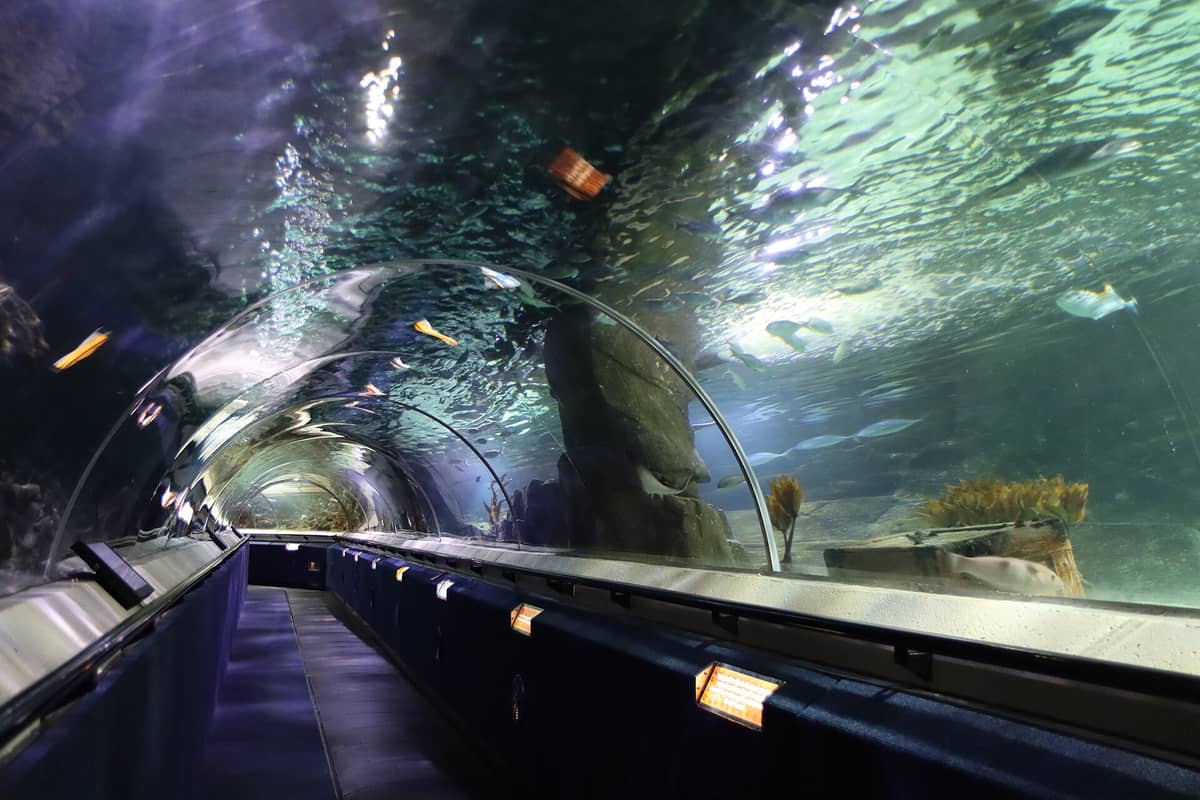
The main draw for most visitors is the shark and stingray tunnel, where a slow-moving conveyor belt carries you through a curved acrylic tube surrounded on three sides by open water. Sand tiger sharks, school sharks, and stingrays pass overhead and at eye level, occasionally close enough that you can see the detail of their skin texture. The water in this tank has a slightly greenish cast from the filtered light, and the sound environment is quieter than you might expect — mostly the hum of filtration systems and the occasional murmur from other visitors.
The tunnel works best when it is not crowded. Early on a weekday morning, around 9:30 to 10:30 a.m., the conveyor often runs with only a handful of people on it, which means you can stand still (the belt allows this) and watch the sharks circle at your own pace. By mid-afternoon on weekends or school holidays, groups of children create a compressed queue, and the experience becomes less contemplative. If you are visiting primarily for the shark tunnel, arrive at opening time.
ℹ️ Good to know
The aquarium is open daily from 9:30 a.m. to 5 p.m., with last entry at 4 p.m. Check the official hours page before visiting, as times may vary during special events.
Tickets & tours
Live prices and dates from our booking partner. If you book, we may earn a commission at no extra cost to you.
Antarctic Encounter: The Penguin Zone
Tucked within the facility is the Antarctic Encounter zone, which houses a colony of king penguins and gentoo penguins kept in a refrigerated enclosure that replicates sub-Antarctic conditions. The temperature drop as you enter is immediate and sharp — it is genuinely cold in there, and the contrast with the rest of the aquarium is jarring in the best way. The penguins are housed in a recreated Antarctic landscape with artificial snow and blue-tinted lighting designed to approximate polar light conditions.
The penguins are viewable from a viewing area and also from a slow-moving snowcat-style vehicle that passes through the enclosure. This ride element is popular with younger children, though the educational signage in the zone does a decent job of grounding the spectacle in actual natural history. King penguins are the second-largest penguin species in the world, and the facility explains their biology and breeding behaviour in accessible terms.
If you are visiting with children under five, factor in that the cold zone can be uncomfortable for small bodies if you linger. Bring a light layer even in summer. Photographers should note that the blue-tinted artificial lighting makes colour balance difficult: manual white balance settings produce more accurate results than auto.
The Rest of the Aquarium: What Else You Will See
Beyond the tunnel and the penguin zone, the aquarium covers a range of marine environments. There is a touch pool where younger visitors can handle starfish and sea cucumbers under staff supervision. Separate tanks display seahorses, jellyfish in cylindrical kreisel tanks, and a variety of reef fish. The jellyfish display in particular is worth slowing down for: the animals are lit from below against a dark background, and their translucent bell shapes shift constantly as they pulse through the water. It is one of the more genuinely beautiful moments in the facility.
There is also a section focused on New Zealand's endemic marine species, which gives the aquarium some local identity beyond the international SEA LIFE brand formula. Species like the spotted black grouper and various New Zealand eels appear here, alongside explanations of local conservation challenges. This section tends to get less visitor attention than the shark tunnel or penguins, which is a shame — it is one of the more informative parts of the facility for anyone interested in the ecology of the Hauraki Gulf.
For deeper context on the marine environment surrounding Auckland, the Goat Island Marine Reserve north of the city offers an above-water complement to what you see here: snorkelling among species you may recognise from the tanks.
Getting There: The Tāmaki Drive Approach
The aquarium sits on Tāmaki Drive, the scenic coastal road that runs east from the city centre along the waterfront. The road passes Mission Bay, Kohimarama, and several other harbour beaches before reaching Ōrākei. Taking the TāmakiLink bus from Britomart is the most straightforward public transport option, with the journey estimated at 20 to 30 minutes depending on traffic. The bus stop is directly outside the aquarium entrance.
If the weather cooperates, cycling along Tāmaki Drive from the CBD is a practical alternative that takes roughly 25 to 35 minutes at a relaxed pace and lets you stop at Mission Bay Beach on the way. The road has a dedicated cycle lane for much of its length.
Limited free parking is available on-site, but it fills quickly on weekends and during school holidays. Street parking along Tāmaki Drive is an alternative, though you should check signage carefully for time limits. Arriving by bus or bike on busy days avoids the parking frustration entirely.
Accessibility and Practical Logistics
The aquarium provides wheelchair access throughout, with lifts at two stairways. Wheelchairs can be borrowed on a first-come basis. Accessible parking bays and accessible toilets are available. Carers holding a valid Companion Card receive free entry. If accessibility is a specific concern, it is worth calling ahead to confirm wheelchair availability on the day you plan to visit, particularly during busy holiday periods.
Strollers and prams are permitted inside the aquarium. Lockers are available near the entrance for bags. The gift shop at the exit is unavoidable in the standard route through the facility — a common design choice in family attractions — so manage expectations with younger visitors accordingly. There is a café on site for food and drinks.
⚠️ What to skip
The aquarium is entirely indoors, which makes it a logical choice on rainy days — but it also means that on wet weekends during school holidays it becomes one of the busiest indoor attractions in Auckland. If you are visiting in July or September and the forecast shows rain, book in advance and arrive early to avoid significant queues at peak times.
Is Kelly Tarlton's Worth It? An Honest Assessment
For families with children between roughly four and twelve, the answer is almost certainly yes. The shark tunnel is a genuinely impressive piece of immersive design that holds up decades after it was built, the penguins are crowd-pleasers, and the touch pool gives younger children something hands-on. The facility is compact enough that it does not exhaust anyone, and the indoor environment removes weather from the equation entirely.
For adults visiting without children, the calculation is more nuanced. The ticket price sits in a range where expectations naturally rise. The aquarium is not in the same category as the large flagship SEA LIFE centres in London or Sydney in terms of scale or spectacle. What it does offer is a coherent, well-maintained collection with some genuine highlights — the shark tunnel and the jellyfish displays in particular — and a local conservation focus that gives it some intellectual substance. If you have already been to several major international aquariums, it may feel familiar. If this is your first serious aquarium experience in New Zealand, it is a strong one.
Visitors looking to combine the aquarium with other waterfront experiences should know that Tāmaki Drive itself offers beaches, cafés, and harbour views within easy walking distance. Planning the aquarium as one stop on a half-day eastern waterfront itinerary is a sensible way to balance the indoor time.
If marine conservation is a specific interest, pair Kelly Tarlton's with the New Zealand Maritime Museum back in the Viaduct Harbour area for a fuller picture of New Zealand's relationship with the sea.
Insider Tips
- Arrive within the first 30 minutes of opening on a weekday for the best experience of the shark tunnel — you can stand still on the conveyor without anyone crowding behind you, and the sharks' behaviour is often more active in the morning.
- The Antarctic Encounter zone is cold enough to be uncomfortable without a layer. Even in summer, tuck a light jacket or cardigan into your bag before you go.
- Feeding talks and penguin encounter sessions run at scheduled times and are included in standard admission. Check the daily schedule board at the entrance as soon as you arrive and plan your route through the exhibits around the timing of those sessions.
- The online booking price is almost always lower than the walk-up counter rate, and the gap widens significantly during school and public holiday pricing windows. Buying even a day in advance can save a meaningful amount on a family ticket.
- Photography in the shark tunnel is challenging due to the curved acrylic and the moving conveyor. Turn off your flash entirely — it reflects back off the tunnel walls — and use the widest aperture your camera allows. Stabilise your phone against the handrail for sharper low-light shots.
Who Is Kelly Tarlton's Sea Life Aquarium For?
- Families with children aged 4 to 12 looking for an engaging, fully indoor activity
- Rainy-day contingency plans — the aquarium is entirely weatherproof and located conveniently along the Tāmaki Drive corridor
- First-time Auckland visitors who want an accessible introduction to New Zealand's marine environment
- Anyone with a specific interest in sharks, penguins, or jellyfish who wants closer access than any New Zealand beach provides
- Visitors combining a half-day eastern waterfront itinerary with Mission Bay, Tāmaki Drive cycling, or Bastion Point
Nearby Attractions
Combine your visit with:
- Auckland Botanic Gardens
Spread across 64 hectares in Manurewa, the Auckland Botanic Gardens offer free entry every day of the year, with themed garden collections, 10 hectares of native forest, and a visitor centre on site. It sits south of the city centre and rewards a longer visit than most people initially plan for.
- Auckland Zoo
Auckland Zoo has been part of the city's fabric since 1922, sitting in the Western Springs precinct with a collection that spans native New Zealand wildlife and international species. This guide covers everything from ticket prices and transit options to the best time of day to arrive and which exhibits deliver the most.
- Bastion Point (Takaparawhau)
Takaparawhau, known widely as Bastion Point, is a grassy headland in Ōrākei where Māori history, colonial conflict, and sweeping Waitematā Harbour views converge. It costs nothing to visit, carries centuries of significance, and rewards visitors who take time to understand what they are standing on.
- Bethells Beach (Te Henga)
Bethells Beach, officially Te Henga (Bethells Beach), is a raw, dramatic stretch of black-sand coastline about 45 minutes west of central Auckland. With rolling dunes, a freshwater lagoon, strong surf, and zero phone coverage, it delivers a genuine wilderness experience rare for a city of 1.6 million people.
Planning a trip? Discover personalized activities with the Nomado app.