Kamppi Chapel of Silence: Helsinki's Pocket of Calm in the City's Loudest Corner
The Kamppi Chapel of Silence sits on Narinkka Square in central Helsinki, a curved wooden capsule designed for quiet reflection directly beside one of the city's busiest transport hubs. Admission is €5 for adults, and the experience of stepping inside is distinctive among places in the Finnish capital.
Quick Facts
- Location
- Simonkatu 7, Narinkka Square, Kamppi, Helsinki
- Getting There
- Kamppi metro station and bus terminal — both steps away
- Time Needed
- 15–30 minutes inside; allow extra time to absorb the square
- Cost
- €5 adults; free for under-18s, Helsinki residents, and Helsinki Card holders
- Best for
- Travelers seeking quiet, architecture lovers, rainy-day refuge
- Official website
- www.kampinkappeli.fi/en
What the Kamppi Chapel of Silence Actually Is
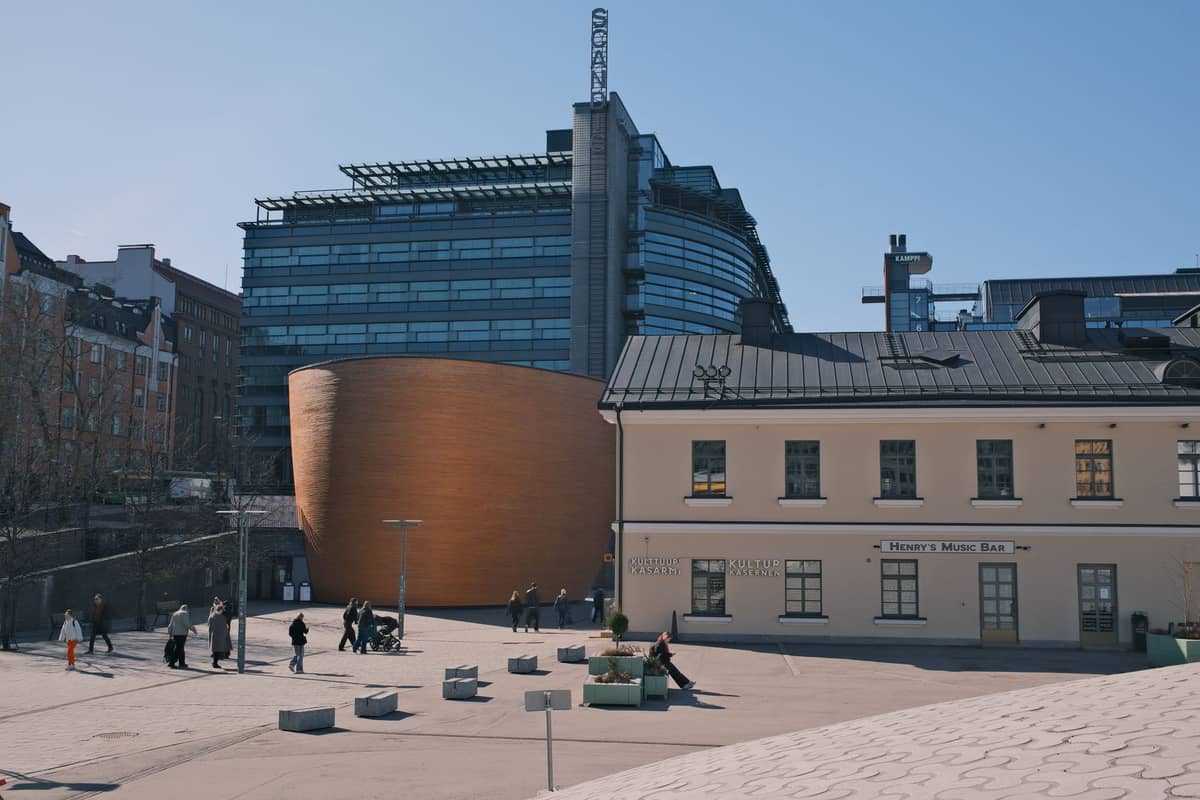
The Kamppi Chapel of Silence, known in Finnish as Kampin kappeli, is a small contemporary wooden chapel completed in 2012 and set on Narinkka Square in Helsinki's Kamppi district. It has no regular church services during visiting hours. It is not used as a conventional parish church for weekly worship. It is, in the simplest terms, a room for quiet — designed so that anyone can walk off the street, sit down, and be completely undisturbed.
That premise sounds modest until you see where it sits. Narinkka Square is ringed by the Kamppi shopping centre, one of the busiest bus terminals in northern Europe, tram lines, and a metro station. The foot traffic outside is relentless on any weekday. The chapel does not fight this context — it exploits it. The contrast between the noise of the square and the silence inside the curved timber shell is the entire point, and it lands harder than any amount of description can prepare you for.
ℹ️ Good to know
Opening hours: Tuesday–Saturday, 11:00–18:00. Ticket sales end 15 minutes before closing. The chapel is closed Sundays and Mondays. Hours may differ in summer — check the official site before visiting.
The Architecture: What You See From Outside and In
From Narinkka Square, the chapel reads as a smooth, egg-shaped form in pale spruce, roughly three storeys tall but compact in footprint. The exterior cladding is made from thin, overlapping wooden strips that curve continuously from ground level to roof with no hard corners and no straight lines. In morning light the surface looks almost warm, like driftwood; by late afternoon in winter it takes on a cooler, greyer tone. Rain darkens the wood noticeably, which is worth seeing if you happen to visit during wet weather.
The entrance is deliberately understated: a low doorway set into the curve, no signage that shouts. Inside, the geometry surprises. The interior height is greater than the exterior suggests, and the walls bow outward and then inward in a continuous curve. The primary material throughout is alder wood, a lighter, finer-grained timber than the spruce outside. Light enters from above through a circular opening, diffused and soft. There are no windows at eye level. The floor is concrete, the benches are wooden, and the entire room smells faintly of timber and wax. It holds up to 60 visitors at once, though on most weekday mornings the space feels far more private than that.
The chapel was designed by Helsinki architects Kimmo Lintula, Niko Sirola, and Mikko Summanen of K2S Architects. It was commissioned jointly by the parishes of Helsinki's Evangelical Lutheran congregation and the City of Helsinki as a public space open to people of all faiths and none. The design won the Finlandia Prize for Architecture in 2010 and drew significant international attention before the building was even completed.
Tickets & tours
Hand-picked options from our booking partner. Prices are indicative; availability and final rates are confirmed when you complete your booking.
Helsinki Beautiful Canal Route, archipelago cruise
From 26 €Instant confirmationFree cancellationHelsinki Panorama Sightseeing Bus Tour With Audio Guide
From 35 €Instant confirmationFree cancellationHelsinki Pasila Street art district tour with a local
From 99 €Instant confirmationFree cancellationSurvival suit floating experience
From 125 €Instant confirmationFree cancellation
How the Experience Changes by Time of Day
Morning visits, especially on weekdays in the first hour after opening at 11:00, are the quietest. The square outside is already busy with commuters transferring between buses and metro, which makes the silence inside feel even more pronounced. The overhead light at this hour is cool and even, good for noticing the grain and layering of the alder walls.
Midday brings more visitors, and in peak summer months the chapel can feel noticeably crowded given its small capacity. Even so, the convention among visitors is well-established: people enter quietly, sit or stand briefly, and leave without conversation. Staff are present but unobtrusive. If you arrive and find more than a handful of people inside, waiting five minutes outside generally resolves it.
Late afternoon in winter is worth singling out. The light through the overhead opening shifts to a deep gold in the final hour before closing at 18:00, and the timber interior absorbs and reflects it differently than at any other time. The square outside is noisier again with end-of-day traffic, which sharpens the acoustic contrast once you step inside. If you are visiting Helsinki in winter — and the city rewards winter visits considerably — this is one of the more genuinely moving things you can do with half an hour.
Getting There and Practical Logistics
The chapel is about as easy to reach as any attraction in Helsinki. Kamppi metro station has exits leading directly toward Narinkka Square, and the chapel is visible from just outside the station. Multiple tram routes stop nearby, as do regional and long-distance buses from the adjacent Kamppi terminal. If you are staying anywhere in the city centre, this is almost certainly on your walking route between other places anyway.
Admission for adults is €5, paid inside the chapel. Entry is free for visitors under 18, Helsinki residents, and holders of the Helsinki Card. There are no timed entry slots — you simply arrive and enter when space allows. Given the 60-person capacity limit, weekends around midday in summer are the only times you might need to wait. The ticket desk is just inside the entrance and the transaction takes about 30 seconds.
The chapel is accessed at street level from the pedestrian square, making it physically accessible without steps. Groups of more than a few people are asked to notify the chapel in advance by email if they plan to visit together, which is relevant for school groups or anyone requiring specific accessibility arrangements. For solo travelers or small groups, no booking is needed.
💡 Local tip
Photography inside is permitted but flash and tripods are not appropriate here — and most people instinctively understand that. The overhead light and the wood tones photograph well in the 15 minutes after opening when the interior is empty, provided you are respectful of other visitors.
Cultural and Urban Context
Helsinki is not a city that makes much noise about spiritual or contemplative spaces. The Lutheran tradition is reserved and visually plain. The Kamppi Chapel fits that temperament precisely: there is no ornamentation, no iconography, no altar of any kind. What it offers instead is a deliberate withdrawal from the pace of city life, available to everyone regardless of whether they have any religious intention.
This quality makes it an interesting counterpoint to Helsinki's more monumental religious architecture. Helsinki Cathedral on Senate Square is imposing and civic-scaled. Temppeliaukio Church, the rock-hewn Lutheran church in Töölö, is dramatic in a very different way. The Kamppi Chapel is neither — it is intimate, almost secretive, and its setting in the commercial heart of the city rather than a historic district is a deliberate statement about where quiet ought to be available.
The chapel is also occasionally used for small ceremonies, including baptisms, funerals, and quiet moments of personal significance. On any given Tuesday morning you might sit alongside a tourist from Japan, a Helsinki professional on a lunch break, and a local who clearly comes regularly. The mix is part of what makes it feel genuinely public rather than touristic.
Is It Worth Your Time?
The honest answer depends entirely on what you are looking for. As a piece of architecture, the Kamppi Chapel of Silence is exceptional for its size and context, and worth seeing even if you spend only ten minutes inside. As an experience of genuine urban silence, it is remarkably effective — more so than most dedicated meditation spaces because the contrast with the surrounding chaos is built into its location.
If your Helsinki itinerary is built around major museums, the waterfront, and the design district, the chapel is small enough to fit between two larger stops without rearranging your day. It pairs naturally with the Esplanadi Park a short walk south, or with the Helsinki Central Library Oodi, another piece of bold Finnish public architecture a few minutes' walk north.
Who should probably skip it: travelers who are primarily interested in panoramic views, busy markets, or activity-based attractions will find the chapel unrewarding. The experience is entirely interior and contemplative. Children under about ten are also likely to find the mandatory silence difficult to maintain, which could detract from other visitors' experience and their own.
⚠️ What to skip
The chapel is closed Sundays and Mondays. Double-check before making it a planned stop.
Insider Tips
- Arrive within the first 20 minutes of opening on a Tuesday or Wednesday morning. Narinkka Square is already in full commercial swing, making the silence inside feel more extreme — this is when the chapel's concept works best.
- The exterior is best photographed from the northwest corner of Narinkka Square in the late afternoon, when the low Helsinki sun catches the curvature of the spruce cladding from the side.
- You do not need to sit or meditate to get value from the visit. Simply standing and listening to the absence of traffic noise for two minutes after the door closes behind you is the core experience.
- The Helsinki Card covers free admission during the summer months, and the chapel has no admission fee in the rest of the year. Check the current card inclusions and seasonal policy before assuming this applies.
- If you are visiting in winter, the chapel's warm timber interior provides a genuine physical reprieve from cold. It is not heated aggressively but the wood envelope retains a noticeably warmer temperature than the outside air.
Who Is Kamppi Chapel of Silence For?
- Architecture and design enthusiasts curious about contemporary Finnish timber construction
- Travelers who want a genuine pause between busier sightseeing stops
- Visitors to Helsinki in winter who appreciate contrasts between cold outdoor environments and warm interior spaces
- Anyone building a walking route through central Helsinki who wants something beyond the standard museum circuit
- Budget travelers: at €5 or free during certain periods with the Helsinki Card, it is one of the most affordable architectural experiences in the city
Nearby Attractions
Other things to see while in Kamppi & Southern Helsinki:
- Cable Factory (Kaapelitehdas)
Once the largest cable manufacturer in the Nordic countries, the Cable Factory (Kaapelitehdas) in Helsinki's Ruoholahti district is now one of Finland's biggest cultural centers. Multiple museums, galleries, studios, and event spaces occupy the sprawling brick complex — entry to the building itself is free, making it easy to explore at your own pace.
- Helsinki Art Museum (HAM)
Housed in a converted 1930s sports arena next to Kamppi, Helsinki Art Museum (HAM) is the city's dedicated venue for modern and contemporary art, plus the official custodian of Helsinki's public art collection. It rewards unhurried visits and surprises people who write it off as a secondary stop.
- Kaivopuisto Park
Kaivopuisto is Helsinki's oldest public park, a roughly 16-hectare coastal green space on a peninsula in the southern city. Free to enter at any hour, it draws locals for morning runs, lunch breaks, and one of the city's best May Day celebrations. The views across the Gulf of Finland are quietly impressive.
- Löyly Seaside Sauna
Löyly is a contemporary wooden sauna and restaurant complex on Helsinki's Hernesaari waterfront, where traditional Finnish sauna culture meets award-winning architecture. Whether you're after a two-hour steam session with a Baltic Sea plunge or a waterfront meal at sunset, this is one of the most distinctive experiences in the city.