Cable Factory (Kaapelitehdas): Helsinki's Industrial Cultural Hub
Once the largest cable manufacturer in the Nordic countries, the Cable Factory (Kaapelitehdas) in Helsinki's Ruoholahti district is now one of Finland's biggest cultural centers. Multiple museums, galleries, studios, and event spaces occupy the sprawling brick complex — entry to the building itself is free, making it easy to explore at your own pace.
Quick Facts
- Location
- Kaapeliaukio 3, 00180 Helsinki (Ruoholahti area)
- Getting There
- Ruoholahti metro station, then a short walk; several HSL bus lines also serve the area — confirm current routes at hsl.fi
- Time Needed
- 1–4 hours depending on how many museums or exhibitions you visit
- Cost
- Building and Glass Courtyard: free. Individual museums and events charge their own admission in euros — check each venue's site before visiting
- Best for
- Culture lovers, photography enthusiasts, rainy-day plans, families with older children
- Official website
- www.kaapelitehdas.fi/en
What Is the Cable Factory?
The Cable Factory, known in Finnish as Kaapelitehdas, is a former industrial plant that manufactured cables for Nokia and its predecessor companies from the 1940s until the late 1980s. When production wound down, the City of Helsinki took over the massive red-brick complex and converted it into a cultural center. Today it is one of the largest cultural venues in Finland, hosting a rotating mix of museums, permanent collections, dance studios, rehearsal spaces, event halls, restaurants, and galleries spread across multiple floors and staircases.
The building is located in the Ruoholahti area, on the western edge of central Helsinki near the waterfront. It does not announce itself with flashy signage. From the outside, it reads as exactly what it was: a serious piece of industrial architecture, long and low, with thick walls and wide loading bays repurposed into entrances. That restraint is part of the appeal. There is no theme-park atmosphere here, only the slightly worn, functional charm of a working creative campus.
ℹ️ Good to know
Entry to the Cable Factory building and its Glass Courtyard is free. You only pay to enter individual museums or ticketed events. This makes it easy to explore the corridors and public spaces without committing to anything upfront.
The Building: Architecture and Atmosphere
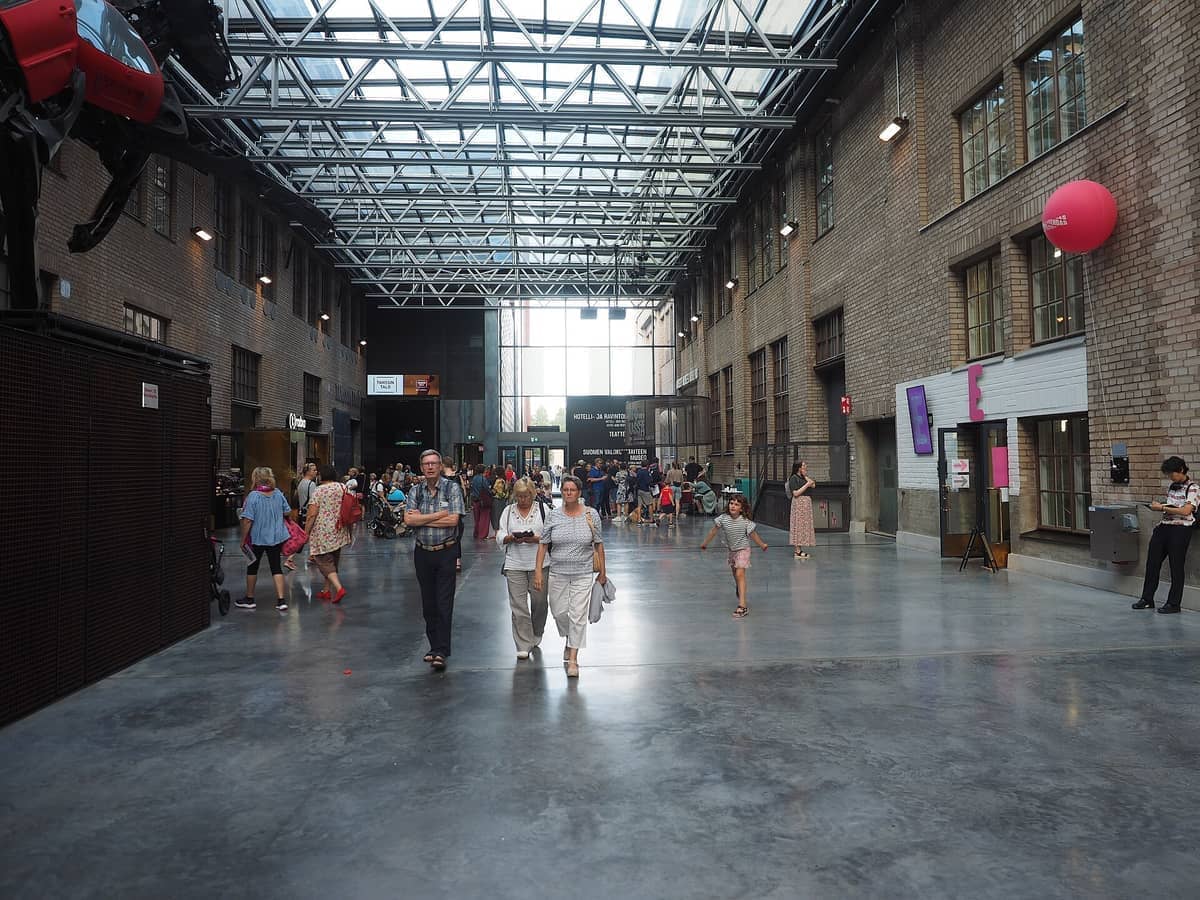
The complex spans a city block along Tallberginkatu and Kaapeliaukio. Its industrial bones are still visible everywhere: exposed concrete ceilings, wide corridors built to move heavy equipment, oversized windows that flood the interior with northern light. The Glass Courtyard at the center of the building is the social heart of the complex. It is a tall, glassed-in atrium where the building's original courtyards were enclosed, creating a sheltered gathering space that functions as a cafe, meeting point, and informal exhibition area.
Visiting on a weekday morning, the building feels calm and purposeful. Dance students move through corridors carrying bags, artists carry equipment, and the smell of coffee drifts from the courtyard cafe. On weekends, particularly when a major exhibition opens or a public event is scheduled, the complex fills with a broader public: families, tourists, and art-goers. The atmosphere shifts but never becomes overwhelming. The building is large enough to absorb crowds comfortably.
The corridors can feel labyrinthine on a first visit. Signs are present but the building's logic only becomes clear after a few turns. Pick up a floor plan from the info point in the Glass Courtyard on arrival — it saves time.
Tickets & tours
Hand-picked options from our booking partner. Prices are indicative; availability and final rates are confirmed when you complete your booking.
Helsinki Beautiful Canal Route, archipelago cruise
From 26 €Instant confirmationFree cancellationHelsinki Panorama Sightseeing Bus Tour With Audio Guide
From 35 €Instant confirmationFree cancellationHelsinki Pasila Street art district tour with a local
From 99 €Instant confirmationFree cancellationSurvival suit floating experience
From 125 €Instant confirmationFree cancellation
Museums and Permanent Collections Inside
The Cable Factory houses several permanent museum tenants, each with independent ticketing and opening hours. The most internationally relevant is the Finnish Museum of Photography (Suomen valokuvataiteen museo), which holds a significant national archive of photographic art and presents rotating exhibitions of Finnish and international photographers. Its gallery spaces feel intimate and carefully lit — exactly what photographic work needs. Standard admission applies and tickets stop being sold 30 minutes before closing.
The Hotel and Restaurant Museum occupies another section of the building, covering the history of Finnish hospitality culture through objects, furnishings, and archival material. It is a niche collection but a well-curated one, interesting for anyone who wants to understand how Finnish public life and dining culture evolved over the last century.
Beyond these permanent institutions, the Cable Factory hosts an ongoing schedule of temporary exhibitions, international art shows, design fairs, and cultural events in its larger halls. The programming calendar changes frequently, so checking the official website before your visit is essential if you want to catch something specific rather than exploring at random.
💡 Local tip
Check the events calendar at kaapelitehdas.fi before your visit. Some of Helsinki's most significant design and art fairs — including major dance events and photography festivals — are held here, and they transform the atmosphere of the entire building.
Getting There and Getting Around
The Cable Factory is a 10-15 minute walk from the Ruoholahti metro station, heading toward the waterfront. Several HSL bus routes also serve the area — confirm current line numbers and stops at Helsinki's public transport network before you travel, as routes change. By bike, the complex is easily reached from central Helsinki along the western waterfront cycling paths, which pass directly through Ruoholahti.
The main visitor entrance for most purposes is from the Kaapeliaukio side of the building. Wheelchair users and visitors with strollers or rollators should use the accessible entrance from Tammasaarenkatu (entrance G). There are two accessible parking spaces near staircase D with a four-hour limit, and a wheelchair is available to borrow at the complex. Elevators connect all floors, and accessible toilets are distributed across staircases A, B, C, and D.
The accessible route to the inner courtyard passes through the Tallberginkatu gateway, where speed bumps can be bypassed for wheelchair access. The path to the entrance is level, wide, and lit — one of the more reliably accessible cultural venues in the city.
When to Visit and What to Expect by Season
Because the Cable Factory is an indoor venue, it functions year-round with no dependence on good weather. This makes it particularly useful during Helsinki's winter months, when outdoor options shrink and indoor cultural life intensifies. Winter evenings bring a particular warmth to the Glass Courtyard, its lighting catching the frost on the courtyard windows outside.
In summer, the surrounding Ruoholahti waterfront comes to life, and a visit to the Cable Factory can be combined with a walk along the canal or toward the harbor areas. Helsinki summers bring a full calendar of outdoor and indoor events, and the Cable Factory typically sees its highest event frequency from May through September. If you are visiting during a major fair or festival, expect more energy and more crowds — but also more to see.
Weekday mornings are consistently the quietest time. Museum galleries are nearly empty, the courtyard cafe is relaxed, and you can move through the building at your own speed. Weekend afternoons, especially when a public event is scheduled, are noticeably busier but rarely overcrowded given the scale of the complex.
Practical Information: Hours, Tickets, and What to Bring
The Cable Factory office (staircase C, 2nd floor) operates Monday through Friday 9:00–15:00. Individual museums and services in the Glass Courtyard follow their own schedules — the Finnish Museum of Photography, for example, is commonly open Tuesday through Friday 11:00–19:00 and Saturday through Sunday 11:00–18:00. Always verify directly with each museum before visiting, as hours and courtyard services shift on public holidays and events.
There is no dress code and no security screening for entry to the building. Wear comfortable walking shoes — the corridors are long. If you plan to visit multiple museums in one trip, budget more time than you think you need. The building rewards wandering.
Photography inside the public corridors and courtyard is generally unrestricted, but individual exhibitions may have their own rules about cameras and phones. If photography matters to you, the Finnish Museum of Photography inside the complex is worth prioritizing alongside a broader look at Helsinki's best museums.
⚠️ What to skip
Ticket prices for individual museums are updated regularly and are not centrally coordinated. Always check the specific museum's website for current admission costs before your visit, rather than relying on any third-party source including this page.
Honest Assessment: Is It Worth Your Time?
The Cable Factory rewards visitors who come with some curiosity and willingness to explore without a rigid agenda. If you arrive expecting a polished, single-narrative tourist attraction, you may feel adrift. The building is large, the programming is spread across many tenants, and the quality of any given visit depends heavily on what is showing during your trip.
For anyone interested in Finnish contemporary art, design, or photography, it is one of the most genuinely interesting venues in Helsinki. For visitors focused primarily on historic landmarks or outdoor experiences, it is less essential. Families with young children may find the building engaging if a family-friendly event is on, but the permanent collections skew toward adult interests.
As part of a broader itinerary, the Cable Factory pairs naturally with a walk through the nearby Ruoholahti waterfront and the broader Kamppi and southern Helsinki area. It can fill a half-day or anchor a full cultural day depending on the exhibitions running.
Insider Tips
- The Glass Courtyard cafe is a genuinely pleasant place to stop mid-visit. It is used primarily by people who work in the building, which means the clientele is local and the atmosphere is quiet — nothing like a tourist-facing cafe.
- If you are visiting Helsinki on a tight schedule, check the Cable Factory events calendar for the week of your trip. One of Helsinki's most significant cultural events (a dance festival, design fair, or photography exhibition) may coincide with your visit and justify prioritizing the complex over other options.
- The building's corridors between museum entrances are worth walking even if you skip the paid exhibitions. Artists' studio signage, bulletin boards advertising local creative events, and the industrial architecture itself tell you a great deal about how Helsinki's creative community actually functions.
- Accessible parking near staircase D has a four-hour limit — enough for most visits, but arrive early on event days when spaces fill quickly.
- The Finnish Museum of Photography stops selling tickets and admissions 30 minutes before closing. If you arrive late in the day, time your entry to that cutoff rather than to the posted closing time.
Who Is Cable Factory (Kaapelitehdas) For?
- Visitors interested in Finnish photography, contemporary art, and design culture
- Travelers looking for a substantive indoor activity on a cold or rainy Helsinki day
- Anyone curious about adaptive reuse of industrial architecture
- Culture-focused visitors who want to experience Helsinki beyond the standard historic center circuit
- Wheelchair users and visitors with limited mobility, thanks to strong accessibility infrastructure
Nearby Attractions
Other things to see while in Kamppi & Southern Helsinki:
- Helsinki Art Museum (HAM)
Housed in a converted 1930s sports arena next to Kamppi, Helsinki Art Museum (HAM) is the city's dedicated venue for modern and contemporary art, plus the official custodian of Helsinki's public art collection. It rewards unhurried visits and surprises people who write it off as a secondary stop.
- Kaivopuisto Park
Kaivopuisto is Helsinki's oldest public park, a roughly 16-hectare coastal green space on a peninsula in the southern city. Free to enter at any hour, it draws locals for morning runs, lunch breaks, and one of the city's best May Day celebrations. The views across the Gulf of Finland are quietly impressive.
- Kamppi Chapel of Silence
The Kamppi Chapel of Silence sits on Narinkka Square in central Helsinki, a curved wooden capsule designed for quiet reflection directly beside one of the city's busiest transport hubs. Admission is €5 for adults, and the experience of stepping inside is distinctive among places in the Finnish capital.
- Löyly Seaside Sauna
Löyly is a contemporary wooden sauna and restaurant complex on Helsinki's Hernesaari waterfront, where traditional Finnish sauna culture meets award-winning architecture. Whether you're after a two-hour steam session with a Baltic Sea plunge or a waterfront meal at sunset, this is one of the most distinctive experiences in the city.