Kamakura: Tokyo's Best Day Trip for History, Temples, and Coastal Scenery
Kamakura is a coastal city about 50 km south of Tokyo that served as Japan's political capital during the Kamakura shogunate (1185–1333). Today it draws visitors with its concentration of medieval temples, Zen gardens, forested hiking trails, and a shoreline that feels worlds away from the city. Most travelers do it as a day trip, and it rewards that format well.
Quick Facts
- Location
- Kamakura City, Kanagawa Prefecture — approx. 50 km south of central Tokyo
- Getting There
- JR Yokosuka Line from Tokyo Station to Kamakura Station, approx. 55–60 minutes
- Time Needed
- Full day (6–8 hours); half-day possible for a single circuit
- Cost
- City entry free; individual temples/shrines typically ¥200–¥500 per site; train round-trip from Tokyo approx. ¥1,800–¥2,200
- Best for
- History lovers, walkers, photographers, first-time Japan visitors, autumn foliage seekers
- Official website
- www.city.kamakura.kanagawa.jp/visitkamakura/en
What Kamakura Actually Is
Kamakura is not a theme park or a single attraction. It is a small city of roughly 170,000 people, built into a ring of forested hills on the coast of Sagami Bay. For about 150 years during the medieval period, from 1185 to 1333, it served as the seat of Japan's first military government — the Kamakura shogunate. That political history left behind an extraordinary density of Buddhist temples, Shinto shrines, and stone monuments that have survived into the present with remarkable integrity.
The city's layout still reflects its defensive geography. Hills wrap around the central valley on three sides, with the sea closing the fourth. Temples were often built into the hillsides themselves, which means many visits involve climbing stone staircases through bamboo groves and mossy cedar forests before arriving at a courtyard or hall. This is not an accident of topography — it was deliberate, and it shapes the experience of visiting even now.
ℹ️ Good to know
Kamakura is classified as a city (市, shi), not a single attraction with opening hours or admission fees. You enter freely and pay per site. Budget ¥1,000–¥3,000 for temple admissions across a full day, depending on how many you visit.
Getting There from Tokyo
The most direct route from central Tokyo is the JR Yokosuka Line, departing from Tokyo Station (or Shimbashi, Shinagawa). The train runs direct to Kamakura Station in approximately 55–60 minutes, no transfers required. This is the easiest option and the one most travelers use. You can also reach Kamakura via the Shōnan–Shinjuku Line from Shinjuku or Shibuya, which takes around 60 minutes and avoids Tokyo Station. See our guide to getting around Tokyo for IC card setup and ticketing basics before you go.
A third option, better suited to a loop itinerary: travel to Fujisawa Station first (via Shōnan–Shinjuku Line from Shibuya, about 50 minutes), then ride the Enoshima Electric Railway — universally called the Enoden — along the coast into Kamakura. The Enoden is a narrow, single-track tram that passes through residential streets so close to the houses you could almost touch the laundry. It takes about 30 minutes from Fujisawa to Kamakura, stopping at beaches and small neighborhoods along the way. If you plan to ride it multiple times in a day, the Enoden 1-Day Pass (verify current pricing before travel) is worth considering.
💡 Local tip
Leave Tokyo before 8:30 AM on weekends to arrive ahead of the tourist wave. By 11:00 AM, Kamakura Station's east exit and the path toward Tsurugaoka Hachimangū is noticeably crowded. Midweek visits in spring and autumn feel substantially calmer.
Tickets & tours
Hand-picked options from our booking partner. Prices are indicative; availability and final rates are confirmed when you complete your booking.
Mount Fuji, Kamakura, Lake Ashi and Big Buddha Day Tour
From 153 €Instant confirmationFree cancellationKamakura private half-day walking tour with local guide
From 132 €Instant confirmationFree cancellationKamakura full-day tour with private driver and local guide
From 683 €Instant confirmationFree cancellationKamakura Old Capital walking tour with the Great Buddha
From 53 €Instant confirmationFree cancellation
The Anchor Sites: Tsurugaoka Hachimangū and the Daibutsu
Tsurugaoka Hachimangū is the spiritual and geographical center of Kamakura. The shrine is dedicated to Hachiman, the deity of warriors, and was the patron shrine of the Minamoto clan who founded the shogunate. From Kamakura Station's east exit, you walk directly up Wakamiya-ōji, a broad avenue flanked by three rows of cherry trees, toward the main approach. The shrine complex sits on a hill, so the final approach is a long staircase that opens onto a wide, reddish-lacquered precinct. The main shrine buildings are free to enter and the precinct is open from 06:00 to 20:00 year-round. The Treasure Hall (Homotsuden) charges a small admission fee (adults ¥200, children ¥100 as of the most recent official listing) and is generally open from around 08:30 to 16:00.
Early morning at the shrine has a quality that disappears by 10 AM. Priests in formal white robes cross the stone courtyard. There is incense in the air from the smaller auxiliary shrines, mixed with the cool smell of old cedar. The lotus pond at the base of the hill hosts white and pink blooms from mid-July through August — a detail that significantly changes the atmosphere depending on when you visit.
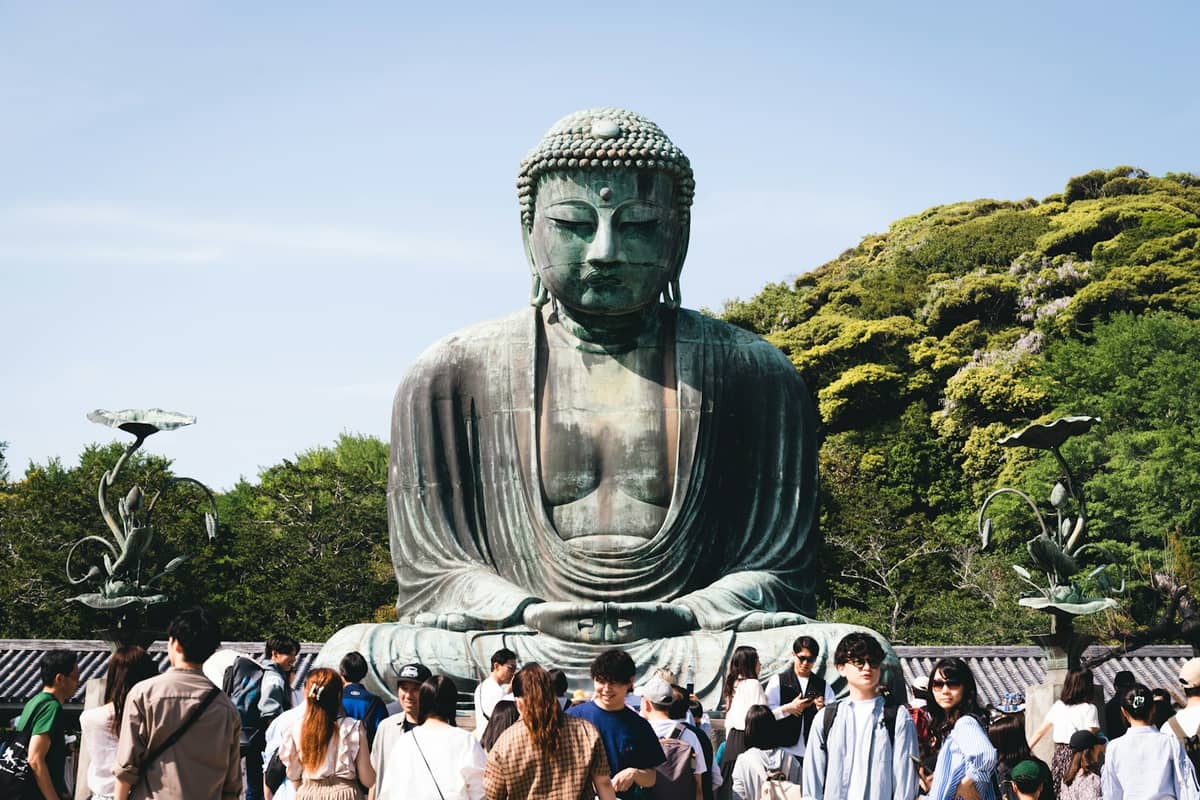
The Great Buddha of Kamakura — the Kotoku-in Daibutsu — is about 2.5 km west of Kamakura Station, most conveniently reached by the Enoden (get off at Hase Station). The bronze statue stands 11.3 meters tall, cast in 1252, and has sat in the open air since the late 15th century when the wooden hall surrounding it was destroyed by a severe earthquake. It is one of the most recognized images in Japan and for good reason: the scale is more impressive in person than in photographs, and the weathered green patina of the bronze conveys genuine age. You can enter the interior of the statue for a small additional fee. The surrounding temple grounds (Kotoku-in) charge an entrance fee; check the official site for current pricing.
Temples Worth the Detour
Kamakura has more than 65 temples and 19 shrines, which sounds overwhelming but in practice means you choose a circuit based on your interests and pace. A few sites stand out for specific reasons.
Engaku-ji, just a two-minute walk from Kita-Kamakura Station (one stop north of Kamakura on the Yokosuka Line), is one of the five great Zen temples of Kamakura. The approach requires crossing the train tracks and climbing a mossy stone path through towering cedar trees. The complex is large enough to feel unhurried even on busy days, with a bell tower housing the largest temple bell in Kamakura, cast in 1301 and designated a National Treasure. This is a working Zen monastery and functions differently from tourist-oriented sites.
Kencho-ji, the oldest dedicated Zen training monastery in Japan (founded 1253), is a short walk south from Engaku-ji. Behind the main hall, a path climbs through a juniper forest to a hilltop viewpoint that shows Kamakura's valleys and the sea beyond. Most visitors who reach this point report it as the moment the city's geography finally makes sense. The climb takes about 20 minutes from the gate and is moderately steep.
Hase-dera, near the Great Buddha, contains a 9.18-meter carved wooden statue of Kannon (the bodhisattva of mercy) and a garden with timed hydrangea blooms in June that draw significant crowds. The garden terrace also provides an unobstructed view over Yuigahama Beach and Sagami Bay. If you are planning a day around the hydrangeas, note that Hase-dera's garden may operate timed entry reservations during peak bloom periods — check in advance. For those interested in Japanese gardens more broadly, our Tokyo gardens guide covers comparable green spaces closer to the city.
The Daibutsu Hiking Course and the Bamboo Trails
One of Kamakura's least-crowded pleasures is its network of hiking trails through the surrounding hills. The Daibutsu Hiking Course connects Kita-Kamakura to the Great Buddha area through about 2.5 km of forested ridge trail. The path runs mostly through mixed woodland, with periodic views down into the city valleys. It takes roughly 60–90 minutes depending on pace and is suitable for regular walking shoes, though proper footwear helps after rain when some sections become slippery clay.
The Tenen Hiking Course, branching from Zeniarai Benzaiten shrine area, connects several mountain temples and runs along the ridge east of the city. These trails are genuinely quiet on weekdays and in winter. You are unlikely to hear tour guides or crowd noise up here — mostly wind in bamboo, crows, and the occasional wooden temple bell from the valley below.
⚠️ What to skip
Trails can become muddy and slick after heavy rain, particularly in June during the tsuyu rainy season. If you visit in June, the hydrangeas at Hase-dera and Meigetsu-in are spectacular, but carry a compact umbrella and expect soft trail surfaces. Hard-soled shoes are strongly recommended.
Kamakura's Coast: Yuigahama and Zaimokuza
Most visitors to Kamakura treat it purely as a temple circuit and ignore the beaches. That is understandable — the temples are the reason to come — but the coast adds a completely different register to the day. Yuigahama Beach is a wide, sandy stretch running west from Zaimokuza. In summer (July–August) it operates as a full beach resort with rental equipment, beach houses serving cold beer, and significant crowds. Outside summer, the beach is nearly empty and the contrast with the crowded temple areas is striking: flat grey sand, the smell of salt and seaweed, kites over the water, Mount Fuji sometimes visible on clear winter mornings to the northwest.
The walk from Hase Station along the coast road toward Kamakura Station takes about 25 minutes and passes several small cafes and seafood restaurants. This route makes for a natural end to the day if you have been walking the western temple circuit.
Kamakura by Season
Spring (late March to early May) brings cherry blossoms to the avenues and temple gardens, and this is the single most crowded period. Weekend crowds in early April can be severe around the Wakamiya-ōji approach. Autumn (late October to late November) offers maple and ginkgo foliage across the temple precincts and is generally considered the most atmospherically rich season, with lower crowd pressure than spring. For broader seasonal context, see our guides to Tokyo in spring and Tokyo in autumn.
June is rainy season, but the payoff is hydrangea blooms that are genuinely exceptional, particularly at Meigetsu-in (called the 'hydrangea temple') and Hase-dera. Crowds thin on weekdays. Winter (December to February) is the quietest period and, for certain visitors, the best: the bare cedar branches and moss-covered stone under low winter light have a character that spring's crowds obscure. Mount Fuji is most frequently visible from the coast and hilltops in winter when the air is clearest.
Practical Notes
Kamakura Station is the central rail hub. The east exit leads toward Tsurugaoka Hachimangū and the eastern temples. The west exit connects to the Enoden tram, which runs along the south side of the city toward Hase (Great Buddha, Hase-dera) and eventually Fujisawa. Coin lockers are available at Kamakura Station for storing bags while you walk — useful if you have come with overnight luggage on a day trip from Tokyo.
Food options are plentiful around the main approach (Komachi-dori, a shopping street parallel to Wakamiya-ōji, is dense with cafes and small restaurants) and near Hase Station. Shirasu — small whitebait fish — is the local specialty, typically served as a don (rice bowl) or on pizza at coastal restaurants. Prices are tourist-facing but not unreasonable. Tap water is safe to drink throughout Japan.
Accessibility varies significantly by site. The central Tsurugaoka Hachimangū precinct has broad paths but also prominent staircases with no ramp alternative for the main approach. The Great Buddha site is relatively flat. Hiking trails are not wheelchair-accessible. Visitors with mobility considerations should check individual shrine and temple websites for current accessibility information, as details differ by facility.
Kamakura is also the natural launch point for Enoshima, a small island connected to the mainland by a bridge, about 20 minutes west by Enoden. If you want to combine both destinations, plan an early start and accept that you will see each place at moderate pace rather than in depth. Our full Enoshima guide covers that island in detail, and our day trips from Tokyo overview compares Kamakura against other options including Nikko and Hakone.
Insider Tips
- Kita-Kamakura Station, one stop before Kamakura on the Yokosuka Line, is the better starting point if you plan to walk south through the Zen temples (Engaku-ji, Kencho-ji, then into the city). This way you walk downhill with the morning light behind you and arrive at the busier areas after the quiet ones.
- Zeniarai Benzaiten Ugafuku Shrine is a cave shrine tucked into a rocky hillside west of the city center, accessible through a tunnel in the rock. The custom of washing coins in the spring water inside the cave (said to multiply your money) has made it a local favorite. It is rarely overcrowded and the cave interior — damp, smoky with incense, dimly lit — is unlike anything else in the city.
- Komachi-dori, the shopping street east of Kamakura Station, is busiest after 11 AM. If you walk it before 9:30 AM, most shops are still shuttered but a few cafes are open, the street is completely empty, and you can photograph the architecture and lanterns without crowds.
- The viewpoint at the top of the Kencho-ji rear trail (past the juniper forest) is marked on Google Maps as 'Hansobo' and is one of the best vantage points in the city. Most visitors stop at the main temple hall and miss it entirely.
- On clear days in winter, particularly January through February, Mount Fuji is visible from Yuigahama Beach and from several hilltop trail points. This combination — medieval temple circuits in the morning, Mount Fuji over the sea in the afternoon — is seasonally specific and genuinely exceptional.
Who Is Kamakura For?
- First-time visitors to Japan who want historical and cultural depth within a day trip distance of Tokyo
- Walkers and hikers comfortable with 8–12 km on varied terrain including forest paths and stone staircases
- Photographers, particularly those visiting in late October to November (autumn foliage) or June (hydrangeas)
- Travelers seeking a slower, quieter pace after time in central Tokyo's more intense neighborhoods
- Families with older children (middle school age and up) interested in history, temples, and coastal scenery
Nearby Attractions
Combine your visit with:
- Akasaka Palace (State Guest House)
The State Guest House, Akasaka Palace is Japan's principal diplomatic residence and one of the few Western-style palaces in Asia open to the public. Built in neo-baroque style for the Crown Prince in the early 20th century, it now receives heads of state and, on select days, ordinary visitors. The combination of ornate gilded interiors, formal French gardens, and a Japanese-style annex makes it one of the most architecturally unusual stops in Tokyo.
- Edo-Tokyo Open Air Architectural Museum
Spread across the grounds of Koganei Park, the Edo-Tokyo Open-Air Architectural Museum rescues and reassembles more than 30 historic structures spanning the Edo period through the early 20th century. From a dismantled farmhouse to a reconstruction of a Showa-era Tokyo streetscape, it is one of the most thoughtful and undervisited cultural sites in the metropolitan area.
- Enoshima
A small island off the Shonan coast of Kanagawa Prefecture, Enoshima packs a surprising amount into a short walk: a three-part Shinto shrine, ancient sea caves, a hilltop botanical garden, a lighthouse observation tower, and seafood stalls lining a stone-paved shopping street. It works as a half-day excursion or a full day if you combine it with nearby Kamakura.
- Gotokuji Temple
Gotokuji Temple in Setagaya is a working Soto Zen Buddhist temple that happens to be one of the claimed birthplaces of the maneki-neko, Japan's iconic beckoning cat. Hundreds of white ceramic cats line the shelves of a dedicated shrine, creating one of Tokyo's most quietly striking visual spectacles. Entry is free, crowds are manageable, and the surrounding grounds offer genuine calm.