Kaiser Wilhelm Memorial Church: Berlin's Ruin That Became a Symbol
Standing at the heart of Breitscheidplatz, the Kaiser Wilhelm Memorial Church is one of Berlin's most recognizable landmarks: a shattered neo-Romanesque tower deliberately left as a ruin, flanked by a striking 1960s modernist church complex. Entry is free, and the contrast between old and new makes it one of the most thought-provoking sites in western Berlin.
Quick Facts
- Location
- Breitscheidplatz, 10789 Berlin (Charlottenburg)
- Getting There
- S+U Zoologischer Garten (S3, S5, S7, S75, S9, U2, U9) — approx. 300 m walk; Bus 100, 109, 245 stop at Breitscheidplatz
- Time Needed
- 30–60 minutes for exterior and interior; allow extra time if joining a service or concert
- Cost
- Free admission
- Best for
- History, architecture, WWII memorials, photography, quiet reflection in the middle of a busy shopping district
- Official website
- www.gedaechtniskirche-berlin.de
What You're Actually Looking At
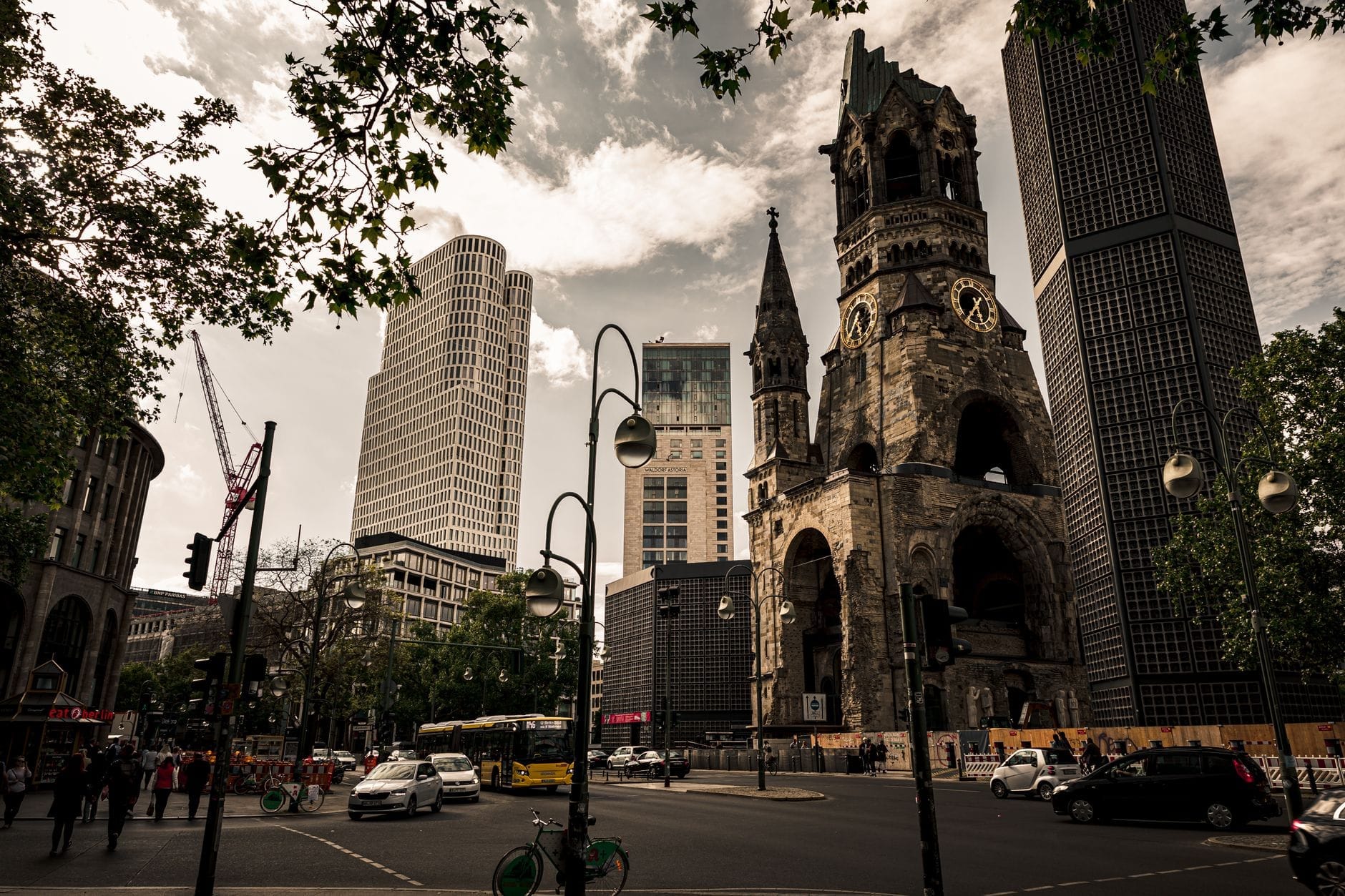
The Kaiser-Wilhelm-Gedächtniskirche sits on Breitscheidplatz at the western end of the Kurfürstendamm, surrounded by luxury shops, a Europa-Center, and streams of foot traffic. From a distance, the complex looks almost confrontational: a broken, hollow tower in pale stone, its top sheared off, standing beside two angular modernist structures clad in honeycombed blue glass. Nothing about it is accidental.
The original neo-Romanesque church was built between 1891 and 1895, commissioned by Kaiser Wilhelm II as a memorial to his grandfather, Kaiser Wilhelm I. At its tallest, the west tower reached 113 meters. A British air raid in November 1943 gutted the building and reduced the tower to a blackened stub. After the war, the decision was made not to demolish what remained but to preserve the ruined tower as a permanent anti-war memorial. Architect Egon Eiermann then designed the new complex, completed in 1963, to surround and complement it. The result is genuinely unusual in European religious architecture: a functioning modern church built in deliberate dialogue with its own destroyed predecessor.
The church sits just a few minutes' walk from the Kurfürstendamm, Berlin's main western shopping boulevard, and forms the symbolic center of the Charlottenburg district.
The Ruined Tower: Inside the Commemorative Hall
Most visitors photograph the exterior and move on. That's a mistake. The base of the old tower is open to visitors as a commemorative hall, and it rewards anyone willing to step inside. The walls still show the original mosaic decoration, remarkably intact in places, depicting scenes from Hohenzollern dynastic history alongside biblical imagery. The color palette is deep, Byzantine-influenced gold and ochre, and it feels dissonant against the surrounding evidence of destruction: scorched stone, missing sections, the raw edge of walls that once rose much higher.
The commemorative hall opens Monday to Saturday from 10:00 to 18:00, and Sunday from noon. A small exhibition inside documents the church's history and the deliberate decision to preserve the ruin. The silence inside is striking given the noise just outside. A small gift shop operates from the entrance.
💡 Local tip
Visits to the interior are not possible during services, prayers, or concerts. Check the official schedule at gedaechtniskirche-berlin.de before going if you want guaranteed access to the commemorative hall.
Tickets & tours
Hand-picked options from our booking partner. Prices are indicative; availability and final rates are confirmed when you complete your booking.
Sachsenhausen Concentration Camp Memorial in Berlin by Bus
From 60 €Instant confirmationFree cancellationExcursion to Sachsenhausen concentration camp by train from Berlin
From 0 €Instant confirmationFree cancellationExcursion to Sachsenhausen concentration camp by train from Berlin
From 0 €Instant confirmationFree cancellationSachsenhausen Concentration Camp Tour by Private Vehicle
From 59 €Instant confirmationFree cancellation
The New Church: Eiermann's Blue Interior
The modern nave, completed in 1963, is the bigger architectural surprise. From the outside it reads as a concrete octagon punched with a grid of small square openings. Step inside and those openings reveal themselves as over 21,000 individual pieces of blue glass, assembled from a Chartres glass studio into walls of deep cobalt and violet. On a bright afternoon, the entire interior glows. The quality of light is unlike anything else in Berlin: cool, diffuse, intensely colored, almost submarine. It takes a moment to adjust.
The effect is not purely aesthetic. The blue light was chosen to create a contemplative, otherworldly atmosphere, a deliberate break from the burnished gold of the ruined tower nearby. The two spaces are physically close but spiritually miles apart. Moving between them gives a compressed sense of what was lost and what was built in its place.
The new church is open daily from 10:00 to 18:00. Seating is limited, and it functions as an active place of worship. Regular visitors come to pray, not just look, so keep noise low and photography unobtrusive during services.
How the Experience Changes by Time of Day
Morning visits, before 10:30, catch the exterior in softer light and without the midday crowd that gathers around the fountain at Breitscheidplatz. The plaza fills quickly on weekdays with commuters cutting through from the U-Bahn and tourists starting their Ku'damm walk. By mid-morning there are often street musicians and market stalls around the base of the church, which adds life but also noise.
The blue interior of the new nave is at its best when sun is hitting the western or southern faces, which typically means late morning to early afternoon. On overcast days the blue glass reads as grey-green rather than the famous cobalt, and the atmosphere shifts from ethereal to simply dim. If light matters to you, check the forecast and aim for a clear afternoon visit.
Evening visits are worth considering for photography: the tower is lit at night and the contrast between the warm floodlit stone and the dark sky is one of the more photographed views in western Berlin. The plaza itself stays active late, as it sits between a cinema complex and several restaurants.
ℹ️ Good to know
The platform on which the church complex stands is accessible via a ramp on the Kurfürstendamm side, between the new church and the old tower. Accessible restrooms are available in the basement.
Getting There and Practical Logistics
The church is extremely easy to reach. S+U Zoologischer Garten station is roughly 300 meters away and served by S3, S5, S7, S75, S9, U2, and U9 lines, making it accessible from almost any point in Berlin with at most one change. Bus lines 100, 109, 110, 200, 204, 245, 249, M45, and X10 stop directly at or very near Breitscheidplatz.
If you're combining this with other western Berlin sights, it pairs naturally with a walk down the Kurfürstendamm toward KaDeWe, or a short trip north to Charlottenburg Palace. Both are within easy reach by U-Bahn or on foot.
Admission to the church complex is free. There is no queue, no timed entry, and no ticket to book in advance. The main practical constraint is avoiding service times if you want uninterrupted access to the interior spaces. The church holds regular religious services and occasional evening concerts; full schedules are posted on the official website.
Photography, Crowds, and Managing Expectations
This is one of the most photographed buildings in Berlin, and Breitscheidplatz can feel chaotic at peak hours. The plaza often hosts market stalls, political demonstrations, and street performers simultaneously, which adds character but can complicate clean architectural shots. A wide-angle lens helps with the exterior; the composition works best from across the plaza, with the full ruin and new structures in frame together.
Inside the new nave, photography is generally permitted but be aware of other visitors and anyone in prayer. The blue glass walls photograph better than they appear on most Instagram feeds: the color requires some exposure adjustment to render accurately. Shooting toward the altar with a window behind the subject will blow out the blue entirely, so position carefully.
If you're building a broader itinerary around Berlin's WWII and Cold War history, the church fits naturally alongside sites like the Topography of Terror and the Holocaust Memorial. For a structured approach to all of Berlin's memorials, the Berlin memorials guide covers the full landscape.
⚠️ What to skip
The area around Breitscheidplatz sees significant foot traffic and, like any busy urban plaza, requires normal urban awareness. The plaza was also the site of the December 2016 terror attack, which is marked with a memorial nearby. Be respectful of that context.
Who Should Skip This
Travelers primarily interested in richly preserved medieval or baroque church interiors may find the Kaiser Wilhelm Memorial Church less rewarding than expected. The ruined tower has fragments of original mosaic but is largely stripped and austere. The new nave's appeal depends almost entirely on the light quality on a given day. If you have limited time in Berlin and a heavy museum schedule, the 30 minutes here may not be the highest-priority stop compared with Museum Island or the major war memorial sites.
It's also not a good choice for anyone seeking quiet. Breitscheidplatz is one of the noisier public spaces in western Berlin, and the interior calm of the church can be disrupted by tour groups moving through simultaneously.
Insider Tips
- The commemorative hall inside the ruined tower is consistently undervisited compared to the exterior. Give it at least 10 minutes: the surviving mosaics and the burned stone wall textures tell a more specific story than any photograph of the tower from the outside.
- Clear afternoons are dramatically better than overcast days for the blue glass interior. The color shift between bright-sun and grey-sky visits is significant enough to change the whole character of the space.
- The church hosts regular evening organ concerts and special services. These are open to the public and offer a completely different experience of the acoustics and atmosphere. Check the official website for current scheduling.
- The memorial fountain in the center of Breitscheidplatz, nicknamed 'Wasserklops' (water meatball) by Berliners, is a local landmark in its own right. It's a useful meeting point if you're with a group.
- For the least-crowded exterior experience, come before 10:00 and walk the full perimeter of the platform. The architectural relationship between the old tower and Eiermann's two new structures (nave and belfry) is clearest when you can step back and take in all three without people in the way.
Who Is Kaiser Wilhelm Memorial Church (Gedächtniskirche) For?
- Architecture and design enthusiasts interested in the post-war dialogue between ruin and reconstruction
- History-focused travelers exploring WWII Berlin and the city's deliberate memory culture
- Photographers looking for dramatic contrasts: burned stone against blue glass, ruin against modernity
- Budget travelers: free entry and central location make it easy to include without planning
- Visitors wanting a brief, meaningful pause during a Ku'damm shopping day
Nearby Attractions
Other things to see while in Charlottenburg:
- Berlin Zoological Garden
Germany's oldest zoo, opened in 1844, spreads across 35 hectares in the heart of Charlottenburg and houses one of the largest animal collections on earth. Whether you have two hours or a full day, this guide tells you exactly what to expect, when to go, and how to make the most of it.
- Charlottenburg Palace (Schloss Charlottenburg)
Schloss Charlottenburg is Berlin's largest surviving royal palace, tracing Hohenzollern court life from the 17th to early 20th century. The complex includes the ornate Old Palace, the New Wing, sprawling formal gardens, and several pavilions. It sits in western Berlin and rewards a half-day visit.
- KaDeWe (Kaufhaus des Westens)
Kaufhaus des Westens, known universally as KaDeWe, is one of Europe's largest and most storied department stores. Open since 1907 in the heart of Schöneberg, it draws visitors as much for its extraordinary sixth-floor food hall as for its fashion floors. Entry is free, and the experience runs the full spectrum from window-shopping to serious luxury retail.
- Kurfürstendamm (Ku'damm)
Kurfürstendamm, known to locals as Ku'damm, is Berlin's most storied commercial boulevard, stretching 3.5 kilometres from Breitscheidplatz to Rathenauplatz through Charlottenburg-Wilmersdorf. Originally a 16th-century riding path to the Grunewald hunting grounds, it was transformed into a 53-metre-wide boulevard in the late 19th century. Free to walk at any hour, it rewards visitors with layers of history, architecture, and street life that most shopping streets simply do not carry.