Kurfürstendamm (Ku'damm): Berlin's Grand Boulevard Explained
Kurfürstendamm, known to locals as Ku'damm, is Berlin's most storied commercial boulevard, stretching 3.5 kilometres from Breitscheidplatz to Rathenauplatz through Charlottenburg-Wilmersdorf. Originally a 16th-century riding path to the Grunewald hunting grounds, it was transformed into a 53-metre-wide boulevard in the late 19th century. Free to walk at any hour, it rewards visitors with layers of history, architecture, and street life that most shopping streets simply do not carry.
Quick Facts
- Location
- Charlottenburg-Wilmersdorf, Berlin (Breitscheidplatz to Rathenauplatz, ~3.5 km)
- Getting There
- U-Bahn & S-Bahn: Zoologischer Garten station nearby; several bus lines serve Breitscheidplatz
- Time Needed
- 1–3 hours for a full walk; half a day if combining shops, cafés, and the Kaiser Wilhelm Memorial Church
- Cost
- Free to walk. Individual shops, restaurants, and theatres charge separately.
- Best for
- Architecture enthusiasts, window shoppers, first-time Berlin visitors, cold-weather walkers
What Kurfürstendamm Actually Is
Kurfürstendamm is a public boulevard, not a mall, market, or ticketed attraction. It is a 3.5-kilometre street with wide stone pavements, multiple rows of plane trees, tram-era architecture, and a continuous frontage of shops, hotels, restaurants, theatres, and galleries. You walk it, sit in its cafés, observe its buildings, and absorb how Berlin's western commercial identity was shaped over more than a century. There is no entrance, no queue, and no closing time.
That openness is also its challenge. Unlike a museum, the Ku'damm does not curate your experience. The eastern end near Breitscheidplatz is loud, commercialised, and ringed by chain stores. Walk ten minutes further west and the boulevard quiets, the facades gain height and detail, and independent businesses start appearing between the international brands. The full character of the street only reveals itself if you walk most of its length.
💡 Local tip
Start your walk at Breitscheidplatz (Zoologischer Garten station) and head west. The quieter, architecturally richer sections begin roughly after Uhlandstrasse.
History: From Riding Path to Bismarck's Boulevard
The street's origins are firmly practical. In the mid-16th century, it was laid out as a riding path connecting the Berlin City Palace with the Grunewald hunting grounds used by the Hohenzollern prince-electors. The name reflects this directly: Kurfürstendamm means roughly 'Elector's Causeway.' For roughly three centuries, it remained a dirt track of limited urban significance.
The transformation came in the late 19th century, driven by Reich Chancellor Otto von Bismarck, who wanted Berlin to have a boulevard to rival Paris's Champs-Élysées. The street was widened to approximately 53 metres, planted with trees, and rapidly developed with theatres, grand cafés, and Wilhelminian apartment buildings. By the early 20th century, Ku'damm had become the social and cultural spine of western Berlin: a place where writers, artists, and the emerging bourgeoisie gathered.
World War II bombing reduced much of the street to rubble, and the postwar reconstruction left visible scars and awkward gaps in the building line that are still readable today if you know what you are looking at. During the Cold War era, West Berlin used the Ku'damm as a deliberate showcase of Western consumer culture, directly contrasting with East Berlin's socialist construction programme. Many of the large department stores and flagship boutiques along the street date from this period of Cold War competition.
After reunification in 1990, the Ku'damm lost some prestige to the revitalised centre of the city, particularly around Friedrichstrasse and Potsdamer Platz. But it retains its role as Charlottenburg's main artery and remains one of Berlin's most architecturally layered streets. For the full picture of how Cold War geography shaped Berlin's commercial districts, the Cold War Berlin guide is worth reading alongside a walk here.
Tickets & tours
Hand-picked options from our booking partner. Prices are indicative; availability and final rates are confirmed when you complete your booking.
Skip-the-line ticket for Gemaldegalerie Berlin
From 14 €Instant confirmationPanoramapunkt Berlin ticket with skip-the-line option
From 9 €Instant confirmation1-Hour Berlin Spree River Cruise with On-Board Guide
From 21 €Instant confirmationFree cancellationSamurai Experience Berlin skip-the-line ticket
From 15 €Instant confirmation
The Walk: What You Actually See
Breitscheidplatz and the Eastern Anchor
The walk effectively begins at Breitscheidplatz, the open square at the boulevard's eastern end. The square is anchored by the Kaiser Wilhelm Memorial Church, whose bombed-out original tower has been deliberately preserved alongside a modern hexagonal addition built in the 1960s. The contrast between the blackened ruin and the angular new structure is intentional: a permanent reminder of wartime destruction at the heart of a commercial district. The mosaics inside the modern chapel glow an intense blue that catches many visitors off guard.
Breitscheidplatz itself is busy at most hours. Street musicians, food carts, and a large fountain occupy the square, which also hosts the famous Berlin Christmas market from late November through December. The square can feel chaotic during peak hours, particularly weekend afternoons, but it earns attention as one of the few places in Berlin where a war ruin sits in literal physical dialogue with postwar reconstruction and contemporary retail.
The Middle Stretch: Architecture and Commerce
Between Breitscheidplatz and Olivaer Platz, the boulevard carries its heaviest concentration of international retailers, cinemas, and restaurants. The building facades here vary enormously in age and quality: Wilhelminian-era buildings with ornate stucco work stand between postwar concrete infill and 1990s glass insertions. This unevenness is not an accident or a failure of planning. It is a physical record of what happened to this street across two world wars and a Cold War division.
Look upward regularly. Many ground-floor shopfronts have been modernised beyond recognition, but the upper storeys of pre-war buildings retain elaborate cornice work, balconies with cast-iron railings, and sculptural details that reflect the ambition of late 19th-century Berlin. The plane trees lining the central reservation also deserve attention: they are substantial, with thick trunks and wide canopies that provide genuine shade in summer and a stripped, structural quality in winter.
The Western Stretch: A Calmer Rhythm
Past Uhlandstrasse, foot traffic drops noticeably, the retail offering becomes more independent, and the pavement widens perceptibly. Art galleries, specialist bookshops, jewellers, and mid-range restaurants occupy this section. The building stock here suffered less severe wartime damage, and longer runs of intact Wilhelminian facades give the western Ku'damm a more coherent character. This is the section to walk slowly.
The boulevard terminates near Halensee at Rathenauplatz, where the city transitions toward the green edge of the Grunewald. The contrast with the departure point at Breitscheidplatz is considerable: what begins as a commercial showcase ends in relative quiet, with a roundabout and the first suggestion of suburban Berlin.
How Ku'damm Changes by Time of Day
Early morning, before 9:00, the boulevard belongs almost entirely to dog walkers, joggers, and delivery drivers. The plane trees catch whatever light is available, and the lack of crowds allows the architecture to read clearly. This is the best time for photography of the facades and the Kaiser Wilhelm Memorial Church, which is dramatically lit in low winter sun.
From mid-morning through early afternoon, the street operates at full commercial pace. Weekends are significantly more crowded than weekdays. Saturday afternoons on the eastern section near KaDeWe and the church can feel genuinely congested, with coach-tour groups adding to the foot traffic. If you are primarily here to shop at the larger stores, weekday mornings are noticeably more manageable.
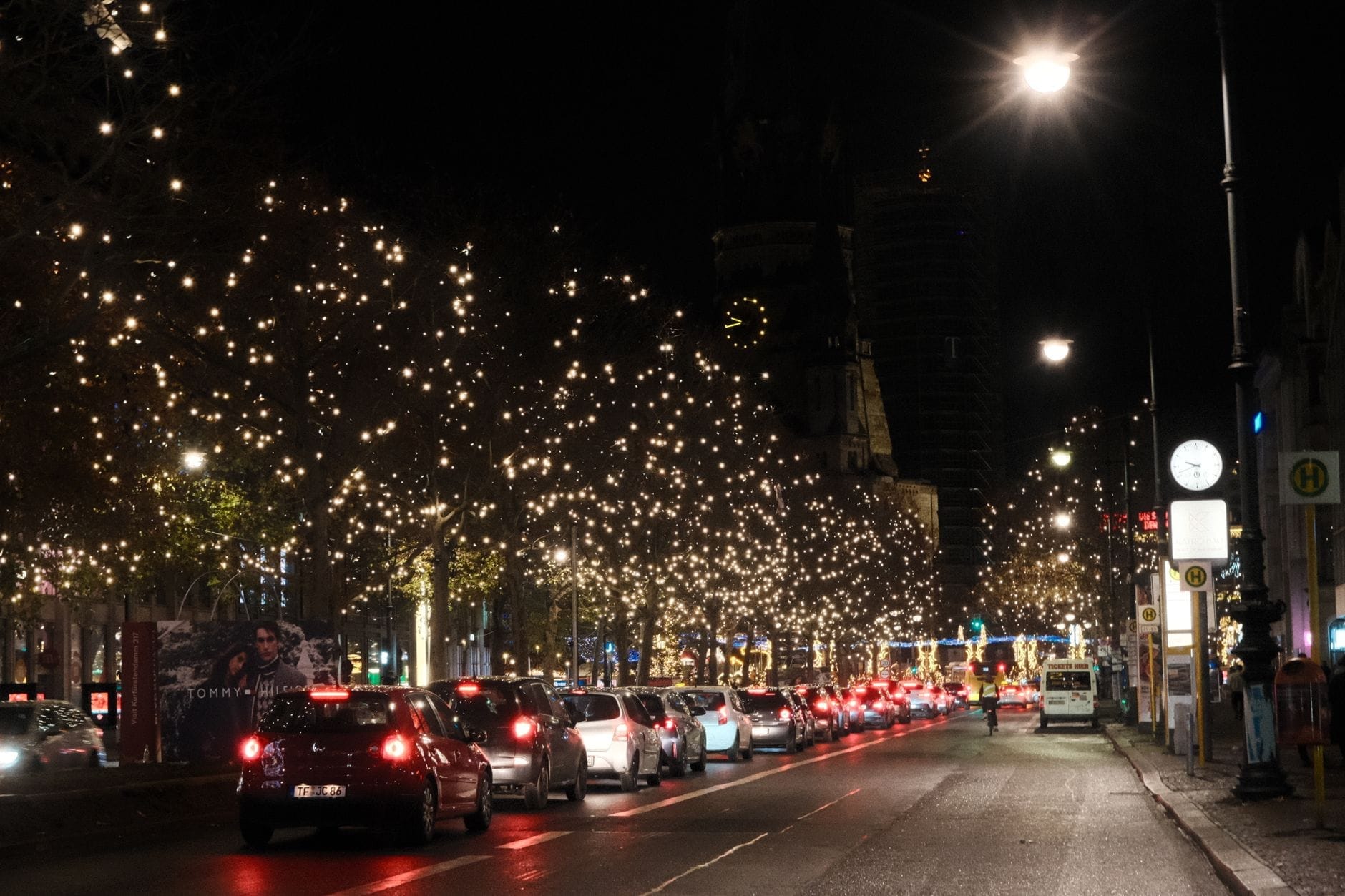
Evening on the Ku'damm has its own character. Restaurant terraces fill from around 7:00 PM, and the street's theatre cluster generates pre-show and interval foot traffic. The plane trees are strung with lights in winter, and the boulevard takes on a different, warmer quality after dark. The cinemas and theatres along the street keep the eastern section active until well after midnight on weekends.
ℹ️ Good to know
Ku'damm is a public street and is accessible at all hours year-round. Individual shops generally open around 10:00 and close between 19:00 and 20:00. Restaurants and entertainment venues follow their own schedules. The boulevard itself never closes.
Practical Guide: Getting There, Getting Around
The most convenient arrival point is Zoologischer Garten station, served by U-Bahn and S-Bahn lines, with bus connections to Breitscheidplatz nearby.
From central Mitte, the S-Bahn journey to Zoologischer Garten is short. The Berlin public transport network is run by BVG and S-Bahn Berlin; a standard AB zone ticket covers this journey. For wider context on moving around the city, the covers day tickets, zone rules, and app options in detail. The Berlin public transport network is run by BVG and S-Bahn Berlin; a standard AB zone ticket covers this journey. For wider context on moving around the city, the getting around Berlin guide covers day tickets, zone rules, and app options in detail.
The boulevard is approximately 53 metres wide, with wide pavements on both sides. Pedestrian crossings are frequent and signalised. Accessibility inside individual shops and restaurants varies and should be confirmed directly with each venue.
Comfortable walking shoes are advisable for the full 3.5-kilometre length. In summer, the plane trees provide meaningful shade, but stretches of open pavement can be warm in direct sun. In winter, the wide exposed boulevard is susceptible to wind chill, and the ground can be icy after overnight frost. Layering is sensible from October through March.
What to Do Along the Way
The most significant single stop on the boulevard is the Kaiser Wilhelm Memorial Church at Breitscheidplatz. Entry to the memorial hall is free, and the juxtaposition of the preserved ruin with the modernist chapel is genuinely powerful. Budget at least 20 minutes here, more if you enter the chapel.
A short walk south along Tauentzienstrasse from Breitscheidplatz brings you to KaDeWe, the Kaufhaus des Westens, one of Europe's largest department stores. The food hall on its upper floors is well worth seeing even if you are not buying. For more focused shopping context in Berlin, the KaDeWe guide covers it in detail.
Café culture on the Ku'damm is genuine, if variable in price. The traditional Konditorei model, combining a bakery with a sit-down café serving coffee and cakes in the afternoon, survives in a few spots along the boulevard and the side streets. These are the places to sit for an hour and watch the street operate. The outdoor terraces on the western section are less crowded and better for a long sit.
If the Ku'damm's commercial pace feels like too much, the side streets between Uhlandstrasse and Leibnizstrasse lead into quieter residential Charlottenburg blocks with a noticeably different character. Charlottenburg Palace is approximately 2 kilometres north, making a logical extension to a morning walk.
Who Will and Won't Enjoy Ku'damm
The Ku'damm is regularly listed among Berlin's top attractions, which creates expectations it cannot always meet. If you are expecting something comparable to Paris's Champs-Élysées in terms of grandeur, the Bismarck ambition is readable but the postwar patchwork and chain-store-heavy frontage will feel anticlimactic. This is not a flaw to apologise for: it is exactly what a street looks like after wartime destruction, Cold War division, and rapid commercial development.
Visitors primarily interested in Berlin's alternative culture, nightlife, or street art scene will find very little here that speaks to those interests. The Ku'damm is historically and architecturally western, commercial, and relatively conventional. For those priorities, the areas around Kreuzberg, Friedrichshain, and Prenzlauer Berg offer a completely different register.
For first-time visitors or anyone interested in how Berlin's divided history shaped its geography, the boulevard is genuinely worthwhile. It works best as part of a half-day in Charlottenburg rather than as a standalone destination. Combining it with the Charlottenburg Palace to the north and an exploration of the side streets gives the visit real depth.
Insider Tips
- The sections of Ku'damm between Uhlandstrasse and Adenauerplatz receive a fraction of the foot traffic of the eastern end but contain some of the street's best-preserved pre-war facades. Walk this section at a slower pace and look above the ground floor.
- For photography of the Kaiser Wilhelm Memorial Church's ruin tower, the light is best in the early morning from the northwest side of Breitscheidplatz, before coaches arrive and the square fills.
- The Ku'damm side streets, particularly Fasanenstrasse and Bleibtreustrasse, contain independent galleries, specialist shops, and quieter cafés that feel genuinely local. Neither is more than a block off the main boulevard.
- Berlin's Christmas market at Breitscheidplatz is one of the city's oldest and operates from late November through late December. The market extends partially along the opening section of Ku'damm itself and is most atmospheric in the hour before closing, when crowds thin but lights remain on.
- The U-Bahn station at Uhlandstrasse provides a convenient exit point if you want to walk only the more interesting western half of the boulevard, working back east rather than fighting the crowd flow.
Who Is Kurfürstendamm (Ku'damm) For?
- First-time Berlin visitors building a mental map of the city's east-west geography
- Architecture enthusiasts interested in Wilhelminian-era facades and Cold War reconstruction layers
- Travellers visiting in winter who want a walkable outdoor route with café stops and covered shopping options
- Anyone combining a morning at Charlottenburg Palace with an afternoon walk toward central Berlin
- Shoppers looking for a mix of international flagships and the department store KaDeWe in one walkable corridor
Nearby Attractions
Other things to see while in Charlottenburg:
- Berlin Zoological Garden
Germany's oldest zoo, opened in 1844, spreads across 35 hectares in the heart of Charlottenburg and houses one of the largest animal collections on earth. Whether you have two hours or a full day, this guide tells you exactly what to expect, when to go, and how to make the most of it.
- Charlottenburg Palace (Schloss Charlottenburg)
Schloss Charlottenburg is Berlin's largest surviving royal palace, tracing Hohenzollern court life from the 17th to early 20th century. The complex includes the ornate Old Palace, the New Wing, sprawling formal gardens, and several pavilions. It sits in western Berlin and rewards a half-day visit.
- KaDeWe (Kaufhaus des Westens)
Kaufhaus des Westens, known universally as KaDeWe, is one of Europe's largest and most storied department stores. Open since 1907 in the heart of Schöneberg, it draws visitors as much for its extraordinary sixth-floor food hall as for its fashion floors. Entry is free, and the experience runs the full spectrum from window-shopping to serious luxury retail.
- Kaiser Wilhelm Memorial Church (Gedächtniskirche)
Standing at the heart of Breitscheidplatz, the Kaiser Wilhelm Memorial Church is one of Berlin's most recognizable landmarks: a shattered neo-Romanesque tower deliberately left as a ruin, flanked by a striking 1960s modernist church complex. Entry is free, and the contrast between old and new makes it one of the most thought-provoking sites in western Berlin.