Kaiping Diaolou and Villages: A Complete Guide to Guangdong's UNESCO Watchtower Country
Kaiping Diaolou and Villages is a UNESCO World Heritage Site in Jiangmen, Guangdong, featuring hundreds of multi-storey fortified towers that fuse Cantonese village traditions with Chinese and Western architectural styles. Spread across four distinct village clusters, the site is one of the most architecturally distinctive day-trip destinations reachable from Guangzhou.
Quick Facts
- Location
- Kaiping City, Jiangmen, Guangdong Province — approx. 140 km southwest of Guangzhou
- Getting There
- Coach from Guangzhou to Kaiping; local bus or taxi to individual villages
- Time Needed
- Full day minimum; overnight stay recommended to visit multiple clusters
- Cost
- Tickets vary by site: CNY 5 (South Tower/Chikan) to CNY 100 (Li Garden); five-spot package CNY 180
- Best for
- Architecture enthusiasts, history travelers, photographers, Cantonese diaspora heritage seekers
- Official website
- whc.unesco.org/en/list/1112
What Kaiping Diaolou Actually Is
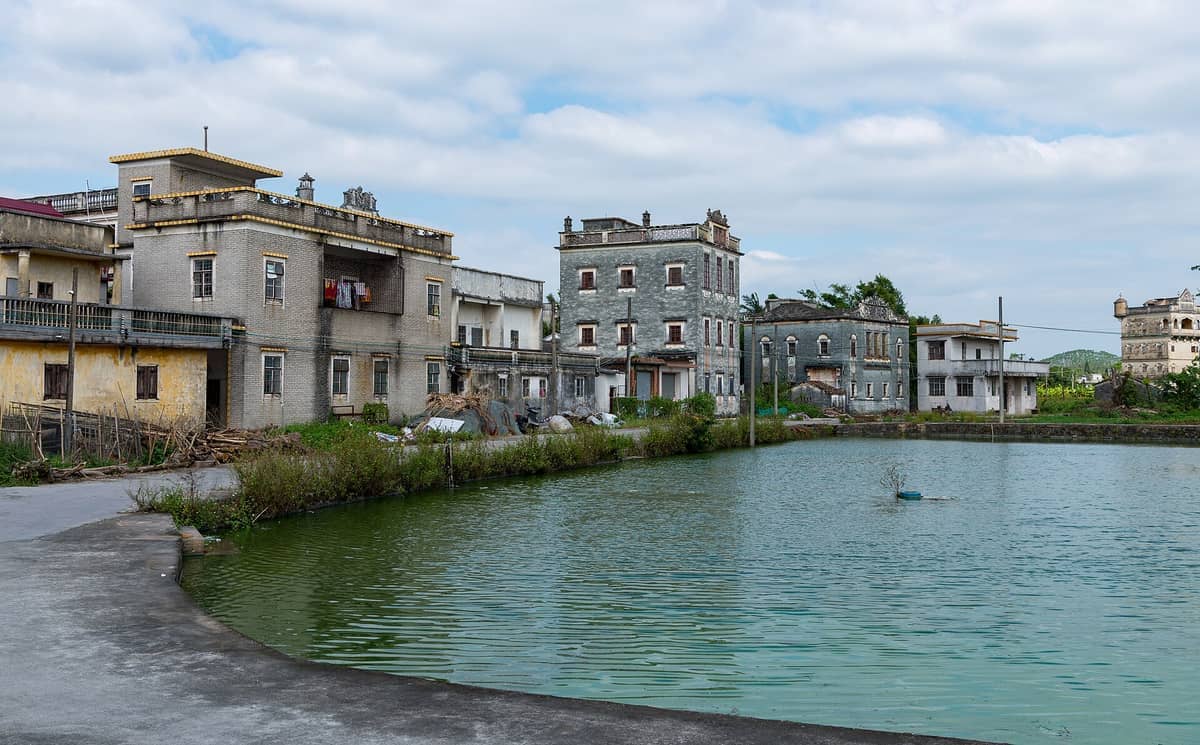
Kaiping Diaolou and Villages is not a single attraction with a ticket booth and a tidy path. It is a living rural landscape scattered across Kaiping City in Jiangmen, Guangdong, where about 1,833 multi-storey fortified towers rise above rice paddies, bamboo groves, and low-slung ancestral halls. The towers, known as diaolou, were built primarily between the late 19th century and the 1930s by Cantonese emigrants who had made money in North America, Southeast Asia, and Australia and returned — or sent money back — to protect their families and display their success.
UNESCO inscribed the site on its World Heritage List in 2007, citing the outstanding fusion of Chinese and Western architectural forms. The listing covers four core village areas: Sanmenli, Zilicun (Zili Village), Jinjiangli, and the Majianglong village cluster. Each has a distinct character. Visiting all four in a single day is technically possible but exhausting; most travelers pick two or three and slow down.
ℹ️ Good to know
The official name of the site is 开平碉楼与村落 (Kāipíng Diāolóu yǔ Cūnluò). Kaiping is a county-level city under the jurisdiction of Jiangmen prefecture, not part of Guangzhou municipality — so this is a day trip or overnight excursion from the city, not something within Guangzhou itself.
The Architecture: Why These Towers Look Like Nothing Else in China
Stand in front of any diaolou and you will immediately notice the contradiction: the base is a Cantonese rural watchtower, thick-walled and narrow-windowed, built to repel bandits. The upper floors might feature Roman arches, Baroque cornices, Gothic battlements, or Moorish domes. Some towers have castle-like crenellations borrowed from European medieval fortresses. Others look almost Art Deco. Many combine multiple styles on a single facade, in arrangements that no European architect would recognize as intentional but that feel entirely coherent in context.
This stylistic collision is not accidental or naive. The emigrant builders were working from postcards, illustrated magazines, and memories of buildings seen in San Francisco, Vancouver, or Penang. Local craftsmen interpreted those images through Cantonese construction techniques and materials. The result is something genuinely original: a regional vernacular architecture that absorbed global influences without being dominated by any single one.
For travelers already interested in Guangzhou's architectural range, the diaolou offer a striking rural counterpoint to the colonial streetscapes of Shamian Island or the Qing-dynasty craft traditions visible at the Chen Clan Ancestral Hall. The same era of overseas wealth shaped all three, but the diaolou represent its most dramatic and defensive expression.
The Four Village Clusters: What to Expect at Each
Zili Village (Zilicun)
Jinjiangli is the most frequently visited cluster and the most photographed. Many diaolou stand in a compact area behind the rice fields, close enough together that you can frame multiple towers in a single shot. Ruishi Tower, standing nine storeys, is particularly detailed, its upper floors crowded with cornices, balconies, and a rooftop gazebo that looks like a gazebo someone designed from a description they once heard.
Ticket price for Zili Village is CNY 78. Opening hours are reported at approximately 08:40 to 17:40, though these can vary seasonally. Ticket price for Zili Village is CNY 78. Opening hours are reported at approximately 08:40 to 17:40, though these can vary seasonally.
Li Garden (Liyuan)
Li Garden is a private garden and diaolou complex built in the 1930s. It was never fully completed — Xie died before he could return permanently — and it has been frozen in a state of mid-20th-century suspension ever since. The overgrown paths, intact period furnishings, and faded family photographs create something closer to a film set than a conventional heritage attraction. Admission is CNY 100. Opening hours are reported as approximately 08:30 to 17:45.
Majianglong Village Cluster
Majianglong is the most atmospheric of the four clusters. Towers rise above a canopy of bamboo so dense that the structures emerge dramatically from the green as you walk the village paths. The combination of the bamboo rustling overhead, the narrow earthen lanes, and the sudden appearance of a fortified tower with a cannon port at eye level produces an effect that is genuinely hard to replicate elsewhere. It is quieter here than at Zili, and the lack of heavy tourist infrastructure makes the rural context feel more intact. Admission is CNY 60; opening hours are reported at approximately 08:50 to 17:30.
Jinjiangli and South Tower (Chikan)
Jinjiangli is a smaller cluster in a flat agricultural setting. It is less visited than Zili or Majianglong but offers some of the clearest views of individual tower details without crowds. Admission is CNY 50; hours are reported as approximately 09:00 to 17:15. The South Tower in Chikan, with its CNY 5 entry fee, is a good low-cost orientation point if you arrive in Chikan first. It is less visited than Zili or Majianglong but offers some of the clearest views of individual tower details without crowds. Admission is CNY 50; hours are reported as approximately 09:00 to 17:15. The South Tower in Chikan town, with its CNY 5 entry fee, is a good low-cost orientation point if you arrive in Chikan first. Chikan itself is a small historic market town with 19th-century shophouse arcades that are worth a short walk.
How the Site Changes by Time of Day
Early morning, roughly 08:00 to 10:00, is the best time to photograph the diaolou. The light at Zili Village in particular comes from the east, catching the towers against the rice paddies while the fields are still misty. By mid-morning the tour groups begin arriving, and at Zili the walkways and the main viewing platform fill up. If you are visiting on a weekend or during Golden Week, the crowds at Zili become genuinely dense by 10:30.
Majianglong is less affected by peak-time crowds because it requires more effort to reach and has less infrastructure for large groups. Visit it after lunch, when most day-trippers are at Zili or heading back to Kaiping town. The bamboo canopy also provides shade, making the midday walk more tolerable in the warmer months.
Late afternoon light at Li Garden turns the stone and plaster facades warm amber, and the garden paths become quieter after 15:00. Most sites close between 17:15 and 17:45, so plan your last stop accordingly and do not assume you can linger past closing time.
💡 Local tip
October to early December is the most comfortable season to visit. The harvest season brings golden rice fields around Zili Village, which greatly improves the landscape photography. Summer visits (June to August) are hot and humid, and afternoon thunderstorms are common — bring a compact umbrella and expect some towers to be partially obscured by haze.
Getting There from Guangzhou
Kaiping is approximately 140 kilometres southwest of central Guangzhou. The most practical public transit option is a long-distance coach from one of Guangzhou's coach stations — Fangcun Coach Station and Tianhe Coach Station both serve Kaiping. Journey times are typically around two hours, though traffic on the highway can extend this. There is no direct high-speed rail station in Kaiping city centre that puts you within easy reach of the village clusters, so most travelers rely on coaches and then take local buses, motorcycle taxis, or hire a driver for the final legs between villages.
If you are travelling with a group or have specific photography goals, hiring a private car or van with a driver for the day from Guangzhou is a common approach. This gives you flexibility over timing at each site and eliminates the complexity of finding local transport between clusters, which are not all close to each other.
For context on planning the broader trip, the day trips from Guangzhou guide covers logistics for this and other excursions, including how to balance the diaolou with other destinations in Guangdong.
⚠️ What to skip
Local transport between village clusters is not well-organised for independent travelers. Some clusters are several kilometres apart and not connected by frequent bus services. Confirm local transport options before you arrive, or arrange a driver in advance. Relying on ride-hailing apps in rural Kaiping is less reliable than in Guangzhou.
Photography and Practical Walkthrough
The site rewards wide-angle lenses and patience. At Zili, the classic composition is from the wooden viewing platform at the north end of the village, where you can frame five or six towers receding into the distance above the paddy terraces. Arrive before 09:00 for the best light and before the viewing platform becomes occupied. At Majianglong, a telephoto lens helps separate individual towers from the bamboo canopy. At Li Garden, the garden paths and the original interior furnishings invite detail photography; a fast prime lens performs better here than a wide zoom in the low-light interior rooms.
Wear shoes you do not mind getting dusty or muddy. The paths between towers and through the villages are unpaved in sections, and after rain the ground around the rice paddies can be soft. Comfortable walking shoes with grip are sufficient; specialist hiking footwear is not necessary.
No detailed accessibility information is publicly available for the individual sites. The unpaved paths, narrow tower staircases, and uneven terrain at Majianglong in particular are likely to be difficult for visitors with mobility limitations. The exterior views at Zili Village can be appreciated without climbing any towers, but the staircases inside diaolou are steep and narrow by design.
Practical Assessment: Is It Worth the Effort?
For travelers with a genuine interest in architecture, overseas Chinese history, or rural Lingnan landscapes, the answer is clearly yes. The diaolou are unlike anything else in China, and the UNESCO designation is well-earned. The combination of historical weight and visual strangeness gives the site a quality that photographs alone do not fully convey.
For travelers primarily interested in urban Guangzhou and looking to add a cultural checkbox, the two-hour journey each way and the complexity of moving between clusters may feel disproportionate to the payoff. The site also requires more independent navigation than most Guangzhou-area attractions, and the interpretive signage at the villages is primarily in Chinese.
Travelers who enjoy this kind of living-heritage rural landscape may also find value in Shawan Ancient TownTravelers who enjoy this kind of living-heritage rural landscape may also find value in other Lingnan vernacular architecture sites closer to central Guangzhou.Huangpu Ancient Port, both of which are closer to central Guangzhou and offer Lingnan vernacular architecture in a more accessible format, even if neither approaches the scale or UNESCO significance of Kaiping.
Insider Tips
- Buy the CNY 180 five-spot package only if you genuinely plan to visit all five sites. If you are focusing on Zili Village and Majianglong, individual tickets will cost less and you will not feel compelled to rush between sites to justify the package.
- Zili Village sells a combined ticket with Li Garden for CNY 150 — good value if you want to cover the two most distinctive sites in a single outing without committing to the full five-spot circuit.
- Chikan's South Tower (CNY 5) and the adjacent arcade streetscape are a genuinely low-cost orientation stop. Arrive in Chikan first, walk the historic shophouse street, then head to the village clusters. It calibrates your eye for the architectural vocabulary before you reach the main sites.
- The village clusters are spread out and not walkable between each other. Ask your accommodation in Kaiping town to arrange a local driver for the day — hotel front desks in Kaiping are accustomed to this request and can often connect you with drivers who know which clusters are quietest at which times.
- If you stay overnight in Kaiping town, the morning light at Zili Village on a weekday is noticeably quieter than any weekend slot. The first coach loads of day-trippers typically arrive around 10:00, giving you roughly ninety minutes of near-solitude at the main viewing platform.
Who Is Kaiping Diaolou and Villages For?
- Architecture and design travelers seeking something with no Western equivalent
- Photographers who want dramatic rural landscapes with strong geometric subjects
- Travelers interested in overseas Chinese (Huaqiao) history and the Cantonese diaspora
- Anyone looking for a genuinely full-day excursion that takes them out of Guangzhou's urban environment
- History-focused travelers who want a UNESCO site with genuine depth rather than polished spectacle
Nearby Attractions
Combine your visit with:
- Nansha Tianhou Palace
Nansha Tianhou Palace is one of the largest Mazu temples in the Pearl River Delta, spread across the southeastern slope of Dajiao Mountain in Guangzhou's southernmost district. Covering roughly 18 hectares of terraced courtyards, incense halls, and forested hillside, it draws both devoted worshippers and curious travellers looking for a different side of Guangzhou.
- Nansha Wetland Park
Nansha Wetland Park protects about 10,000 mu of tidal flats, mangrove forest, and reed beds at the southern tip of Guangzhou, where the Pearl River meets the sea. It is the largest coastal mangrove wetland in the city, best known as a staging ground for migratory birds and as a rare place to slow down inside one of China's most energetic metropolises.
- Whampoa Military Academy Memorial Site
The Whampoa Military Academy Memorial Site on Changzhou Island preserves the buildings where China's most consequential military officers were trained in the 1920s. Free to enter and open six days a week, it rewards visitors with well-preserved Republican-era architecture, detailed exhibition halls, and an unusual island setting that keeps crowds thin even on weekends.