Nansha Tianhou Palace: Guangzhou's Grand Temple to the Sea Goddess
Nansha Tianhou Palace is one of the largest Mazu temples in the Pearl River Delta, spread across the southeastern slope of Dajiao Mountain in Guangzhou's southernmost district. Covering roughly 18 hectares of terraced courtyards, incense halls, and forested hillside, it draws both devoted worshippers and curious travellers looking for a different side of Guangzhou.
Quick Facts
- Location
- No. 88 Tianhou Road, Nansha District, Guangzhou
- Getting There
- Bus Nan 3 / Nan 18 / Nan 19 / Nan 53 to Nanshawan stop, then walk south ~10 minutes
- Time Needed
- 2 to 3 hours for the full site; 1 hour for the main halls only
- Cost
- CNY 20 per person
- Best for
- Temple architecture, cultural festivals, scenic hillside walking, photography
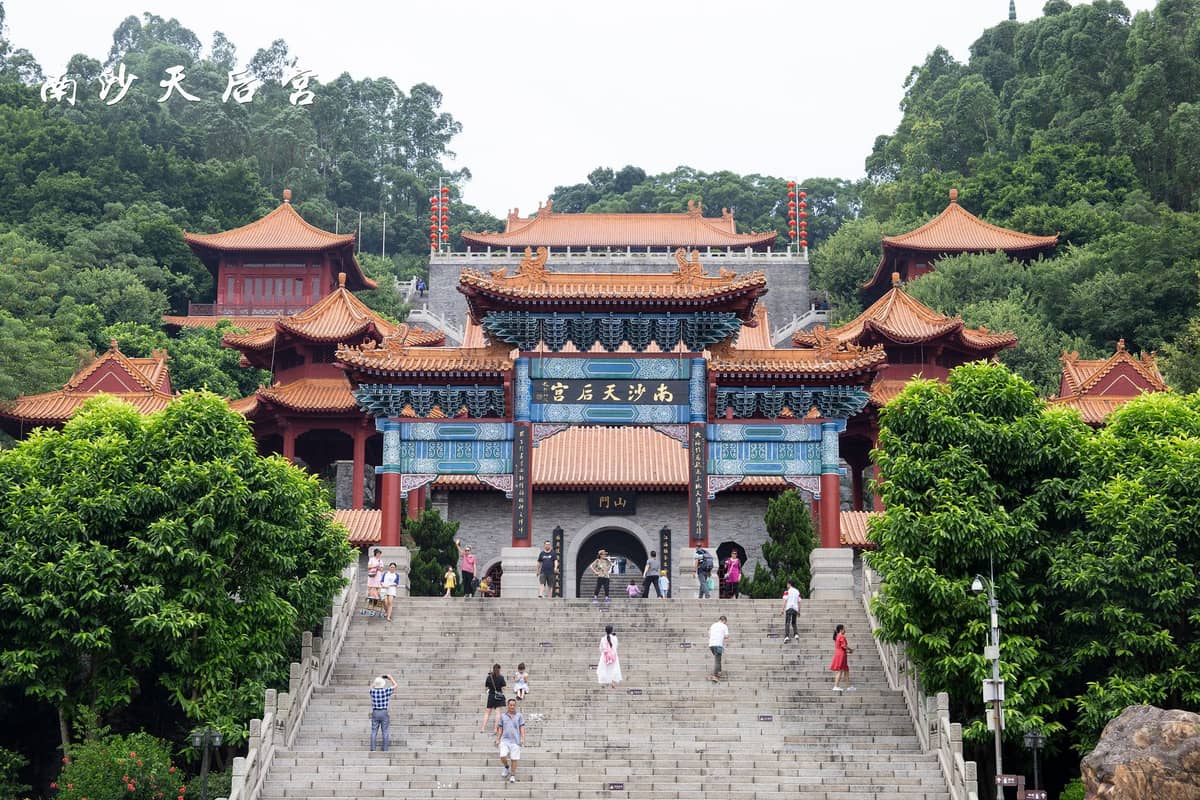
What Nansha Tianhou Palace Actually Is
Nansha Tianhou Palace, known in Chinese as 南沙天后宫, is a large-scale Mazu temple complex built on the southeastern slope of Dajiao Mountain in Nansha District, roughly 60 kilometres south of central Guangzhou near the mouth of the Pearl River estuary. Mazu is the sea goddess venerated across coastal southern China, Taiwan, Hong Kong, Macau, and Chinese diaspora communities worldwide, and this temple is one of the most architecturally ambitious dedications to her in the entire Pearl River Delta region.
The site covers approximately 18 hectares of landscaped grounds, which is substantial even by the standards of large Chinese religious complexes. That scale means you are not simply visiting a single shrine: the complex includes multiple ceremonial halls, ascending terraced plazas, forested walking paths, and elevated viewpoints over the surrounding waterways. At its core, the main temple halls follow the formal grandeur of southern Chinese palatial religious architecture, with sweeping upturned eaves, ornate ridge decorations, and colonnaded gateways.
ℹ️ Good to know
Opening hours appear to vary by season and source, with reported ranges between 08:30 and 16:00. Confirm current hours before making the trip, especially if you are travelling from central Guangzhou.
The Setting: Dajiao Mountain and the Pearl River Estuary
The temple's position on Dajiao Mountain is not incidental. Mazu temples are traditionally sited on elevated coastal ground where the goddess can watch over sailors and fishermen, and Nansha's version honours that logic directly. From the upper terraces and the hillside pathways behind the main complex, you look out over a wide panorama of the Pearl River estuary, with cargo ships and smaller vessels moving across the water below. On clear autumn or winter mornings, the view extends far toward the horizon.
The mountain vegetation is dense and green for most of the year. Between the temple buildings, stone-paved paths wind through stands of banyan and other subtropical trees, and the air carries the mingled scent of incense from the main halls below and the faint salt carried in from the estuary. In the early morning, before the day's visitors arrive in numbers, the combination of birdsong, distant boat horns, and the low drone of incense coils creates an atmosphere that is genuinely distinct from Guangzhou's urban temples.
Nansha District as a whole sits at the southernmost edge of Guangzhou municipality, bordered by waterways on multiple sides. If you are building an itinerary around the area, the Nansha Wetland Park is nearby and offers a contrasting, open-air natural environment that pairs well with a temple visit on the same day.
Architectural and Cultural Significance
The current complex was built in the 1990s, which means it lacks the visible age of some of Guangzhou's older religious sites. The construction was large-scale and deliberate, drawing on classical southern Chinese palatial temple design rather than vernacular village-shrine tradition. The main hall dedicates its central altar to Mazu herself, flanked by attending deities, and the decorative programme throughout, from the ceramic ridge figurines to the carved stone balustrades, follows Cantonese religious architectural conventions with considerable attention to craft.
For travellers already familiar with the older temples closer to central Guangzhou, this context matters. Nansha Tianhou Palace does not offer the patina and accumulated centuries of a site like the Temple of the Six Banyan Trees or the Chen Clan Ancestral Hall. What it offers instead is architectural ambition and scale, a working ceremonial complex that functions as a genuine centre of Mazu devotion for coastal Guangdong, and a location that connects the religious tradition to its actual maritime geography.
If older Guangzhou religious architecture is a priority for your visit, the Temple of the Six Banyan Trees and the Chen Clan Ancestral Hall in central Guangzhou offer deeper historical layering. Nansha Tianhou Palace serves a different purpose: it is a living temple on an impressive scale, not a museum piece.
How the Experience Changes by Time of Day
Arriving close to opening time, around 08:30, gives you the clearest sense of the complex as an active place of worship. Elderly worshippers are typically the first on site, moving quietly between halls with incense bundles and prayer items. The morning light strikes the rooftiles at a low angle that is flattering for photography, and the terraced courtyards have not yet filled with tour groups.
Midday, particularly on weekends and public holidays, brings noticeably more visitors. The larger ceremonial halls can feel crowded around the main altar during peak hours, and the incense smoke thickens in enclosed spaces. This is not a problem for the outdoor areas, which are expansive enough to absorb the volume, but it does affect the atmosphere inside the halls.
The late afternoon window, in the final hour before closing, tends to be quieter again. Light from the west falls across the hillside terracing and the upper-level gateways in a way that rewards photographers willing to stay late. Keep the variable closing time in mind, however. If sources indicate a 16:00 close on certain days, do not plan on a leisurely late arrival.
💡 Local tip
Weekday mornings between October and January are considered the most comfortable visiting conditions: cooler temperatures, lower humidity, fewer crowds, and better visibility over the estuary. Guangzhou's summer months, June through August, bring high humidity and regular afternoon rain that can make the hillside paths slippery.
Festivals and Peak Periods
Nansha Tianhou Palace sees its heaviest attendance during the Mazu birthday festival, which falls on the 23rd day of the third lunar month, typically in late April or May. During this period, the complex becomes a destination for pilgrims from across the Pearl River Delta and from as far as Hong Kong, Macau, and Southeast Asia. The ceremonial atmosphere during the festival is genuinely compelling, with processions, ritual performances, and the full courtyard filled with worshippers. For most visitors, however, the festival period also means significantly heavier crowds, louder surroundings, and more difficult logistics.
Lunar New Year and the major Chinese national holidays also bring elevated visitor numbers. If your goal is peaceful exploration of the grounds and hillside, these periods are worth avoiding. If your goal is to witness the temple as a functioning religious and community institution at full intensity, these are precisely the times to come.
For broader planning around Guangzhou's festival calendar, the guide to Chinese New Year in Guangzhou covers what to expect citywide during the peak holiday period.
Getting There and Practical Logistics
Nansha District is geographically distant from central Guangzhou, and the journey requires planning. The most commonly cited public transit route involves taking buses Nan 3, Nan 18, Nan 19, or Nan 53 to the Nanshawan stop, followed by a walk south of approximately 10 minutes to reach the temple entrance. Guangzhou Metro Line 4 serves Nansha District; from Nansha Passenger Port Station, bus or ride-hailing connections are available toward the temple area, but you should verify current connections given that Nansha's transport infrastructure continues to develop.
Ride-hailing via DiDi is a practical option for the final stretch, particularly for those travelling with children or in the midday heat. The address, No. 88 Tianhou Road, Nansha District, is specific enough to input directly into navigation apps.
The site covers significant ground with uneven terrain on the upper hillside portions. Comfortable, closed-toe walking shoes are appropriate. The main lower courtyards are paved and accessible, but the full hillside circuit involves steps and inclined paths. Wheelchair access to the upper areas is not confirmed by available sources; the lower ceremonial complex is likely more navigable.
⚠️ What to skip
Nansha is a long way from central Guangzhou. Budget plenty of time for the journey each way using public transit, and factor that into your overall day plan. Combining this visit with Nansha Wetland Park on the same day makes the trip more time-efficient.
Who Should Consider Skipping This
Travellers with only one or two days in Guangzhou will likely find the long journey to Nansha a poor trade against the concentration of temples, museums, and historic streets available within the central districts. The site's construction date means it will not satisfy visitors specifically seeking ancient or historically layered religious architecture. And those easily fatigued by heat and incline should note that the upper hillside circuit is physically demanding in warm months.
First-time visitors to Guangzhou who want to cover the city's highlights efficiently will find more concentrated value in the central districts. The 3-day Guangzhou itinerary outlines a practical sequence for those with limited time.
Insider Tips
- The upper hillside walking paths behind the main complex provide the best views over the Pearl River estuary, but they are easy to miss if you only follow the main courtyard axis. Look for stairway paths leading uphill from the rear of the upper terrace.
- Incense is sold near the entrance and at internal stalls. If you plan to offer incense, buying on-site is standard practice and supports the temple. Large bundle offerings are common during festival periods.
- The light on the main gate facade is best in the morning when facing southeast. Afternoon light falls behind the main structure and produces stronger contrast on the hillside trees instead.
- Combining Nansha Tianhou Palace with a visit to Nansha Wetland Park on the same day makes the long journey from central Guangzhou far more worthwhile. The two sites are in the same district and cover very different ground.
- Dress modestly for the temple interiors. While there is no strict formal dress code enforced at the entrance, sleeveless tops and very short shorts are out of place in the main worship halls, particularly during active ceremony periods.
Who Is Nansha Tianhou Palace For?
- Travellers with a specific interest in Mazu culture and coastal southern Chinese religious tradition
- Photographers looking for large-scale temple architecture with hillside and estuary backdrops
- Visitors planning a full-day Nansha District excursion combining the wetland park and temple
- Those visiting during the Mazu birthday festival who want to see one of the Pearl River Delta's major pilgrimage events
- Travellers on longer Guangzhou stays who have already covered the central historic sites
Nearby Attractions
Combine your visit with:
- Kaiping Diaolou and Villages
Kaiping Diaolou and Villages is a UNESCO World Heritage Site in Jiangmen, Guangdong, featuring hundreds of multi-storey fortified towers that fuse Cantonese village traditions with Chinese and Western architectural styles. Spread across four distinct village clusters, the site is one of the most architecturally distinctive day-trip destinations reachable from Guangzhou.
- Nansha Wetland Park
Nansha Wetland Park protects about 10,000 mu of tidal flats, mangrove forest, and reed beds at the southern tip of Guangzhou, where the Pearl River meets the sea. It is the largest coastal mangrove wetland in the city, best known as a staging ground for migratory birds and as a rare place to slow down inside one of China's most energetic metropolises.
- Whampoa Military Academy Memorial Site
The Whampoa Military Academy Memorial Site on Changzhou Island preserves the buildings where China's most consequential military officers were trained in the 1920s. Free to enter and open six days a week, it rewards visitors with well-preserved Republican-era architecture, detailed exhibition halls, and an unusual island setting that keeps crowds thin even on weekends.