Nansha Wetland Park: Guangzhou's Mangrove Wilderness at the Pearl River Estuary
Nansha Wetland Park protects about 10,000 mu of tidal flats, mangrove forest, and reed beds at the southern tip of Guangzhou, where the Pearl River meets the sea. It is the largest coastal mangrove wetland in the city, best known as a staging ground for migratory birds and as a rare place to slow down inside one of China's most energetic metropolises.
Quick Facts
- Location
- No. 1 Xingang Avenue, Wanqingsha Town, Nansha District, Guangzhou
- Getting There
- Metro Line 4 to Jiaomen Station, then Bus No. 23 or Bus G1 to the park entrance
- Time Needed
- 2–4 hours on foot; add 1–2 hours if you take the boat ride
- Cost
- Walk-in area RMB 20; combined boat-ride ticket RMB 120. Verify current prices at the gate or official site before visiting. Verify current prices at the gate or official site before visiting.
- Best for
- Birdwatchers, families with young children, photographers, nature walkers seeking quiet
- Official website
- http://www.nssd.com.cn
What Nansha Wetland Park Actually Is
Nansha Wetland Park (南沙湿地公园) sits at the far southern edge of Guangzhou, in Wanqingsha Town, Nansha District, where the Pearl River fans out into its estuary before reaching the South China Sea. The park protects about 10,000 mu of tidal wetlands and a dedicated mangrove forest zone of around 400 mu. In ecological terms it functions as a transition zone between freshwater river systems and brackish coastal habitat, which is precisely why it draws such a varied range of bird species, particularly during the East Asian-Australasian Flyway migration seasons in spring and autumn.
The landscape is flat and open in a way that feels genuinely different from Guangzhou's dense urban interior. Reeds stand several metres tall along some channels, tall enough to block sight lines and create a corridor effect on the elevated boardwalks. The air carries the mild salinity of tidal water, mixed with the green, slightly fermented scent of decomposing reed litter. Underfoot, the boardwalks creak faintly as the wood absorbs humidity. These are not the polished surfaces of a city park, and that slightly rough quality is part of what makes the place feel credible as a nature reserve rather than a decorative garden.
ℹ️ Good to know
Admission prices vary by source and may be adjusted seasonally. The walk-in sightseeing zone and the combined boat-ride ticket are sold separately at the gate. Verify current rates at http://www.nssd.com.cn/ or on arrival, as published figures range from RMB 20 to RMB 50 for the foot area and RMB 120 to RMB 150 for the combined ticket.
The Landscape in Detail: What You Will Actually See
The park divides loosely into two main zones. The pedestrian sightseeing area is a network of raised wooden walkways threading through reed beds, lotus ponds, and tidal channels. The second zone, accessed by the optional boat ride, takes visitors deeper into the mangrove forest, where the prop roots of the mangroves drop into the water and the canopy closes overhead. The boat route gives a perspective that the boardwalks cannot: from the waterline, the density of the mangrove roots becomes apparent, and egrets often stand in the shallows just metres from the vessel.
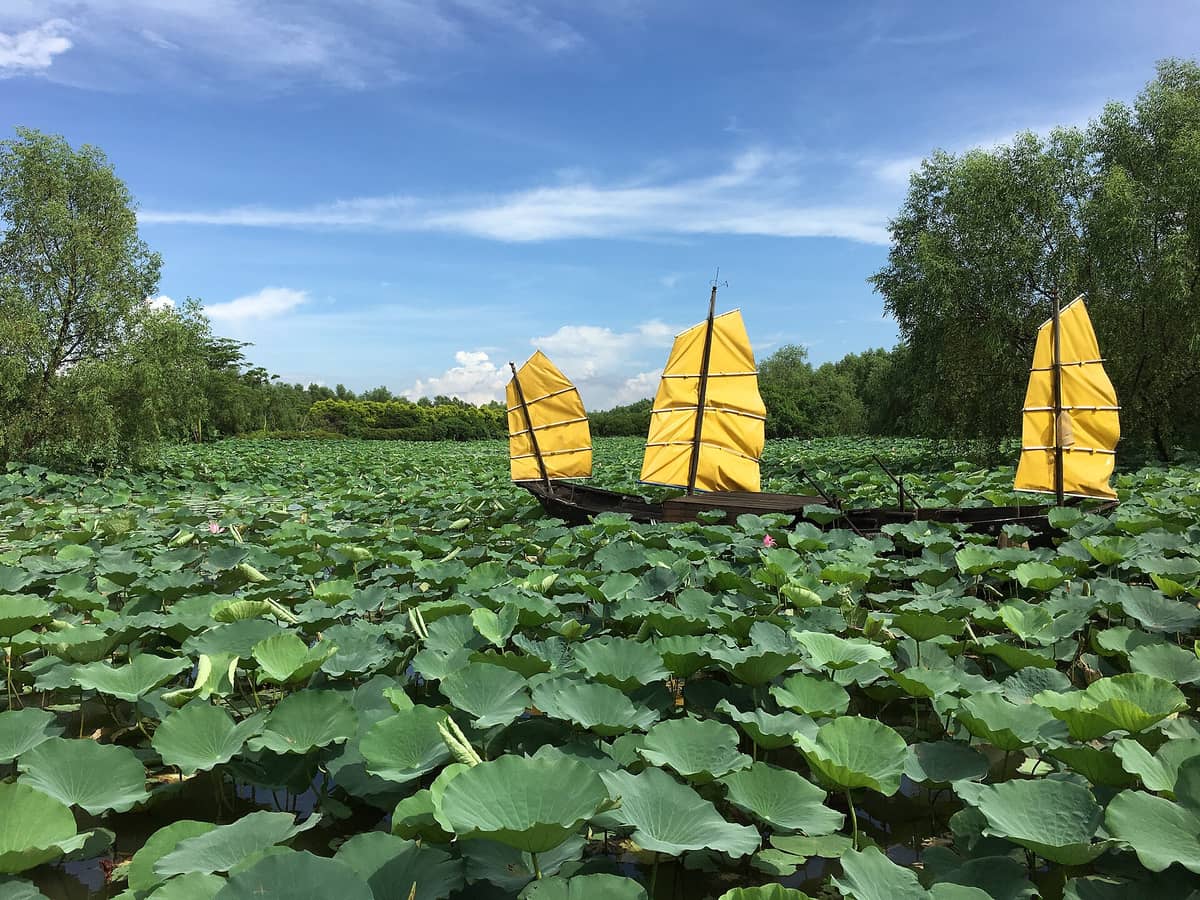
Lotus coverage is substantial in the warmer months. From late June through August, large sections of the ponds are covered in broad green leaves and pink flowers, and the visual contrast with the grey-green reed beds on either side is striking. By November, the lotus beds have died back and the reeds have turned gold and amber, which produces a different but equally photogenic quality. Winter mornings, when low mist sits over the water, are among the most atmospherically rewarding times to visit, even if the temperature requires a light jacket.
Wildlife viewing is concentrated around the tidal channels and the mudflats at low tide. Herons and egrets are present year-round. The larger migratory pulses arrive in October through November and again in March through April, when species from northern breeding grounds pass through the Pearl River Delta on their way south. Spotting quality depends on how early you arrive: by mid-morning, visitor foot traffic and ambient noise levels push the more skittish waders back from the main boardwalk areas.
How the Experience Changes Through the Day
The park opens at 9:00 and closes seasonally, with official sources listing hours as 9:00 a.m.-5:00 p.m. or 9:00 a.m. to 6:30 p.m./7:00 p.m. depending on season. Arriving shortly after opening gives you the quietest walking conditions and the best bird activity along the boardwalks. The light at that hour is low and angled, which is useful for photography over open water. By 10:30, tour groups and families begin arriving in larger numbers, particularly on weekends, and the main boardwalk spine becomes noticeably noisier.
Midday in summer (June through August) is the hardest window to enjoy. Temperatures in the mid-thirties Celsius, combined with high humidity and no shade cover on the open sections of the boardwalk, make it genuinely uncomfortable. Bring water, a hat, and sunscreen, or plan to retreat to a shaded shelter during the peak heat hours. The boat ride, which operates on the shaded mangrove channels, is actually more tolerable at midday than the exposed boardwalk sections.
Late afternoon, roughly from 15:30 to closing, sees a second window of lower crowd density and softer light. The closing time varies by season: The closing time varies by season: 18:30 in summer and 19:00 in spring, autumn and winter according to park sources. Confirm on arrival or via the official website before planning a late afternoon visit.
⚠️ What to skip
Opening hours are listed inconsistently across sources — Opening hours are listed seasonally — 9:00 to 18:30 in summer and 9:00 to 19:00 in spring, autumn and winter. Check the official site (http://www.nssd.com.cn/) before planning your visit, especially if you intend to arrive in the late afternoon.
Getting There: The Logistics Are Real but Manageable
Nansha District sits at the southern extreme of Guangzhou's administrative area, and the journey from the city centre takes time. Metro Line 4 connects Nansha more directly to the urban core for public transit, with Jiaomen Station the usual transfer point; Bus 23 or Bus G1 goes to the park. Wanqingsha Station on Metro Line 18 is also used, with Bus 25 to the park entrance. Either way, budget at least 60 to 90 minutes of transit time each way from central Guangzhou. An alternative route uses Metro Line 4 to Jiaomen Station, then Bus 23 to the park. Either way, budget at least 60 to 90 minutes of transit time each way from central Guangzhou.
The distance and transit requirement mean Nansha Wetland Park is realistically a half-day or full-day excursion, not a quick stop. If you are planning a day in the southern part of the city, it pairs naturally with other Nansha destinations. For a broader picture of the area and how to allocate your time in Guangzhou, the 3-day Guangzhou itinerary and the day trips guide both help put the journey in context.
Ride-hailing via DiDi is an option from Wanqingsha Station if you want to avoid the bus transfer, and it may be faster on weekdays. However, driver availability in Wanqingsha Town can be limited, so do not rely on it as your only return option. Confirm you have the app loaded and working with a local SIM or data plan before arriving.
Practical Preparation: What to Bring and Wear
Footwear with grip matters. The boardwalks are generally well-maintained but can be slippery when wet, particularly after rain or in the early morning when dew settles on the wood. Flat, closed shoes are more practical than sandals. In summer, lightweight and breathable clothing is essential; the heat on the open sections of the boardwalk is unrelenting. In winter and on cooler autumn days, a light layer is sufficient as the park sits at low elevation and sees minimal wind chill.
Binoculars significantly improve the birdwatching experience, especially if you visit during migration season. The park does not appear to rent equipment on site, so bring your own if that is a priority. A zoom lens of at least 200mm is useful for bird photography from the boardwalks; getting close to wading birds on the open mudflats is not reliably possible.
Guangzhou's rainfall peaks between April and September, with intense downpours common in summer afternoons. A compact umbrella or light rain jacket is advisable from spring through early autumn. For a broader sense of how weather should shape your timing, the best time to visit Guangzhou guide covers the seasonal breakdown in detail.
Ecological and Historical Context
Mangrove forests in the Pearl River Delta were historically far more extensive than they are today. Rapid urbanization, land reclamation for agriculture and development, and aquaculture expansion through the late twentieth century reduced the regional mangrove cover significantly. Nansha Wetland Park represents a deliberate conservation effort to protect and expand what remains of the coastal mangrove ecosystem within Guangzhou's administrative territory. In that context, the park carries a significance beyond recreation: it is functioning coastal habitat in a heavily developed delta.
The mangrove species present in the park are characteristic of the South China coast, including species adapted to brackish and tidal conditions. The root systems visible from the boat are more than visually interesting: they stabilize sediment, filter runoff, and provide nursery habitat for fish and invertebrates. The ecological connection between healthy mangrove forest and productive coastal fisheries is well-established, and the park's existence in Nansha District, which is also a major port and development zone, reflects a practical as well as environmental rationale.
For visitors interested in Guangzhou's broader relationship with water and its river systems, the Pearl River guide provides useful geographical and cultural context for how the estuary and delta have shaped the city.
Who Should Probably Skip This
Nansha Wetland Park will disappoint visitors who come expecting formal garden design, ornate structures, or the kind of dramatic scenery associated with mountain or coastal cliff landscapes. The terrain is flat, the dominant palette is green and grey-brown, and the main activity is walking and observing. There are no temples, no significant architectural features, and no food market energy. If you have limited days in Guangzhou and your interests lean toward history, architecture, or urban food culture, the significant transit time to reach this park is difficult to justify. The city has other nature options closer to the centre.
Visitors primarily interested in scenery with urban drama may find Haizhu Wetland Park more convenient as a nature option, since it sits within the inner city and is directly accessible by metro. It lacks the mangrove forest and tidal scale of Nansha, but the transit barrier is much lower.
Insider Tips
- Arrive at opening time (9:00) on a weekday for the best combination of quiet, low light, and active bird movement along the channels. Weekend mornings after 10:00 can feel crowded on the main boardwalk spine.
- The boat ride is worth budgeting for if you visit during autumn migration (October to November). The mangrove channel section of the boat route brings you closer to roosting egrets and herons than the boardwalks allow.
- The lotus pond sections are at their visual peak from late June through early August. If lotus photography is a priority, this is the window to target — though it coincides with the hottest, most humid conditions of the year.
- Carry cash for the entrance gate. Card and mobile payment acceptance should be confirmed on arrival, especially for the combined boat-ride ticket, where split pricing at the counter can create confusion.
- Bus No. 25 from Wanqingsha Station (Metro Line 18, Exit B) is the more straightforward connection based on current visitor reports. Confirm the bus number and stops on the day, as local service routes can be adjusted without wide announcement.
Who Is Nansha Wetland Park For?
- Birdwatchers visiting during spring or autumn migration along the East Asian-Australasian Flyway
- Families with children who will engage with open-water landscapes, lotus ponds, and boat rides
- Photographers working in the golden hours of early morning or late afternoon, particularly in winter when mist sits over the tidal channels
- Travellers who want a genuine nature experience distinct from the urban texture of central Guangzhou
- Visitors with a full day to spend in Nansha District, combining the wetland with other southern Guangzhou destinations
Nearby Attractions
Combine your visit with:
- Kaiping Diaolou and Villages
Kaiping Diaolou and Villages is a UNESCO World Heritage Site in Jiangmen, Guangdong, featuring hundreds of multi-storey fortified towers that fuse Cantonese village traditions with Chinese and Western architectural styles. Spread across four distinct village clusters, the site is one of the most architecturally distinctive day-trip destinations reachable from Guangzhou.
- Nansha Tianhou Palace
Nansha Tianhou Palace is one of the largest Mazu temples in the Pearl River Delta, spread across the southeastern slope of Dajiao Mountain in Guangzhou's southernmost district. Covering roughly 18 hectares of terraced courtyards, incense halls, and forested hillside, it draws both devoted worshippers and curious travellers looking for a different side of Guangzhou.
- Whampoa Military Academy Memorial Site
The Whampoa Military Academy Memorial Site on Changzhou Island preserves the buildings where China's most consequential military officers were trained in the 1920s. Free to enter and open six days a week, it rewards visitors with well-preserved Republican-era architecture, detailed exhibition halls, and an unusual island setting that keeps crowds thin even on weekends.