Igreja de Santo Ildefonso: Porto's Iconic Azulejo Facade
Standing at Praça da Batalha, Igreja de Santo Ildefonso is one of Porto's most photographed churches, its west-facing facade wrapped in approximately 11,000 hand-painted blue-and-white azulejo tiles. Entry is free, the location is central, and the interior holds more than most visitors expect.
Quick Facts
- Location
- Praça da Batalha, s/n, 4000-101 Porto
- Getting There
- São Bento railway station (10-min walk); multiple STCP bus lines serve Praça da Batalha
- Time Needed
- 30–60 minutes for the exterior and interior; longer if visiting the Sacred Art Museum
- Cost
- Free entry to the church; confirm Sacred Art Museum fee on-site or via parish
- Best for
- Architecture lovers, tile enthusiasts, photography, and anyone following Porto's azulejo trail
- Official website
- santoildefonso.org
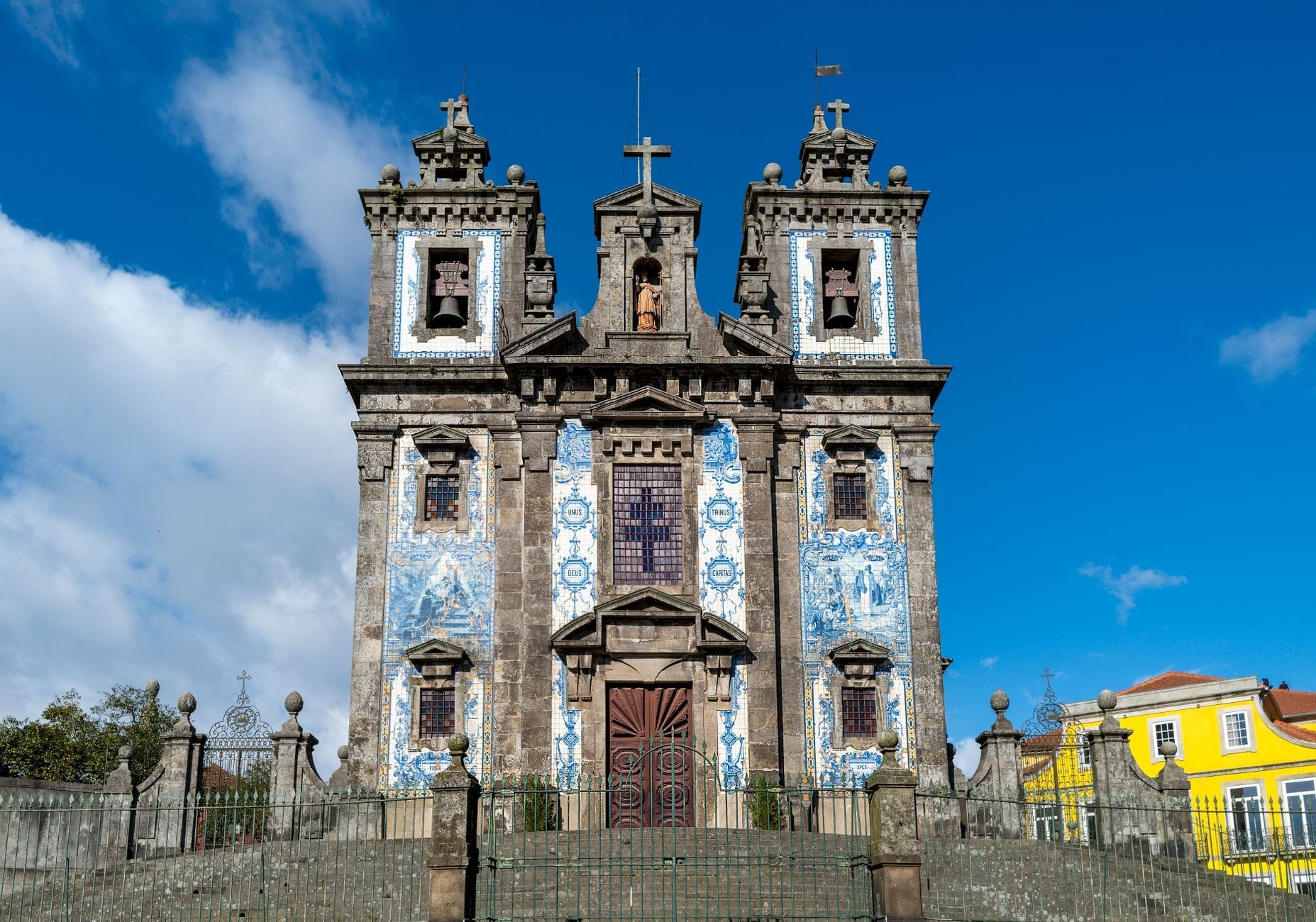
What You're Looking At: The Facade That Stops Pedestrians
From across Praça da Batalha, the Igreja de Santo Ildefonso reads less like a church and more like an enormous outdoor painting. The west-facing facade, from base to bell towers, is covered in approximately 11,000 blue-and-white azulejo tiles, created by artist Jorge Colaço and installed in 1932. The panels depict allegorical and biblical scenes — the life of Saint Ildefonso, scenes from the Gospels, and allegories of the Eucharist — arranged in dense narrative rows that reward close inspection.
Colaço's style sits between folk illustration and academic painting, and the tiles carry a graphic sharpness that still looks precise nearly a century after installation. The cobalt-blue pigment against white tin glaze produces the kind of tonal contrast that photographs well in almost any light, which partly explains why this facade appears in more travel images of Porto than almost any other single surface in the city.
💡 Local tip
For the best facade photographs, arrive in the morning when the light falls directly on the tile panels from the east. By early afternoon, the square casts partial shadows across the lower sections. Overcast days actually work well here — diffused light eliminates glare and reveals the tile details more clearly than direct sun.
If you want to understand the broader tradition behind what you're seeing, Porto's azulejo culture extends well beyond this one church. The Porto azulejo tiles guide covers the history, the key sites, and how the tile-making tradition evolved from Moorish influence into the distinctly Portuguese art form it is today.
History and Architecture: Built in 1739, Tiled in 1932
The church was completed in 1739, built in a proto-Baroque style that was characteristic of Porto's ecclesiastical construction in the first half of the 18th century. The structure predates the tile cladding by nearly two centuries. The bell towers flanking the upper facade and the twin-towered composition were part of the original design, and their proportions give the building a solidity and vertical emphasis that makes the tile installation feel contained rather than chaotic.
The church is dedicated to Saint Ildefonso (Ildephonsus) of Toledo, a Visigoth bishop of the Iberian Church who served as Archbishop of Toledo from 657 to 667 AD. He is especially remembered for his defense of Marian doctrines and his theological writings in the Iberian Peninsula. This Spanish ecclesiastical connection made sense in Porto's colonial and religious context, and the church has served the Batalha parish continuously since the 18th century.
The decision to clad the facade in azulejos in the 20th century was not unusual for Porto. Tile-covered church facades were common throughout the city during the 18th and 19th centuries, and Santo Ildefonso's 1932 installation represented a continuation of that tradition rather than an innovation. What distinguishes it is the scale and the narrative ambition of Colaço's program — very few facades in the city carry this much pictorial content across their full surface.
Tickets & tours
Hand-picked options from our booking partner. Prices are indicative; availability and final rates are confirmed when you complete your booking.
Santiago de Compostela Full-Day Tour
From 79 €Instant confirmationFree cancellationSantiago de Compostela guided tour from Porto
From 110 €Instant confirmationFree cancellationSerralves All-Access Pass
From 24 €Instant confirmationFree cancellationPeneda Geres park full-day tour from Porto
From 100 €Instant confirmationFree cancellation
Inside the Church: What to Expect Beyond the Tiles
The interior of Santo Ildefonso is significantly quieter and less visited than the facade. Once inside, the noise from Praça da Batalha drops away, and the space reveals a single-nave layout with carved wooden features, gilded altar work, and side chapels in various states of restoration. The interior light is low and warm, particularly in the late afternoon when light enters from the upper windows at an angle that catches the gold surfaces.
Dress modestly when entering — shoulders should be covered and shorts should reach at least the knee. The church is an active parish, and Masses are held on a regular schedule, so you may arrive to find a service in progress. In that case, respectful quiet is expected, and photography inside during Mass is not appropriate. Outside of service times, the interior is generally open for individual visitors during the posted hours.
The parish also maintains a Sacred Art Museum within the building complex. This is a small collection of religious objects, vestments, and artworks associated with the parish's history. It is not a large collection, and travelers with limited time or no specific interest in ecclesiastical objects can reasonably skip it. If you do want to visit, confirm any entrance fee and current hours on-site or through the parish website at santoildefonso.org, as this information is not consistently updated on third-party platforms.
How the Experience Changes Through the Day
Early morning at Santo Ildefonso is noticeably different from midday. Before 10:00, Praça da Batalha is mostly local — commuters crossing to the bus stops, a few residents with coffee from the nearby cafes on Rua de Santa Catarina. The tile facade is lit clearly from the east, and you can stand in front of it without competing for space. This is the window for photography without crowds in the foreground.
By late morning and through the early afternoon, the square fills with tour groups and independent visitors. The church is one stop on most walking tour routes through central Porto, and the combination of the azulejo facade, the proximity to São Bento station, and the free entry makes it a near-universal inclusion. If you arrive between 11:00 and 14:00, expect to share the steps and forecourt with a steady flow of other travelers.
Late afternoon brings a different atmosphere. The square quiets somewhat after 17:00, the light comes from the west at a low angle, and the tiles pick up a warmer tonal quality. This is less ideal for legible tile photography but produces more atmospheric shots. It is also the window when the Saturday hours extend to 19:30, giving visitors extra time without the midday pressure.
⚠️ What to skip
Opening hours vary significantly by day. The church has limited Sunday hours (09:00–11:00) and is closed on Monday mornings. If your visit window is narrow, check the current schedule before making this a fixed point in your itinerary. Hours are subject to change around public holidays and parish events.
Getting There: Location and Practical Logistics
Santo Ildefonso sits on Praça da Batalha in the Batalha/Bonfim area of central Porto. From São Bento railway station, the walk takes roughly 10 minutes along Rua 31 de Janeiro, heading uphill toward the square. Several STCP bus lines also stop directly at or near Praça da Batalha, making this one of the more accessible churches in the city without needing the metro.
The square itself is elevated relative to the lower city, which means there are steps from street level up to the main church entrance. Visitors with mobility limitations should be aware that step-free access to the main facade is not guaranteed, and no official accessibility information is published by the parish. For broader logistical planning across the city, the getting around Porto guide covers bus routes, metro lines, and walking distances between major areas.
The location at Praça da Batalha places Santo Ildefonso naturally into a walking circuit that includes São Bento railway station — whose interior hall is covered in its own extraordinary azulejo panels — and Rua de Santa Catarina, Porto's main pedestrianized shopping street, which runs directly past the square.
Is It Worth Your Time?
If you're in the Batalha area at all, yes, without question. The facade is genuinely impressive at close range, the entry is free, and even a 20-minute stop gives you a thorough look at the tile panels and a few minutes inside. This is not the kind of attraction that requires planning or special effort.
As a standalone destination with a dedicated trip across the city, it is less compelling. The interior, while pleasant, is not among Porto's most spectacular church interiors. Travelers who are specifically tracing Porto's azulejo tradition will find it essential; travelers who have already visited São Bento station and the Igreja do Carmo may find the tile experience somewhat overlapping.
If your time in Porto is short — two days or fewer — Santo Ildefonso works best as part of a wider walking loop rather than a primary destination. A well-structured two-day Porto itinerary can incorporate it naturally alongside São Bento station and the surrounding central neighborhoods without requiring a separate trip.
Travelers who are primarily interested in port wine, river views, or beach time will find little here that competes with those alternatives. The church does not suit visitors who are uncomfortable with active religious spaces, or anyone who finds tile panels less interesting than the guidebooks suggest.
Insider Tips
- Stand at the far end of Praça da Batalha, not directly in front of the steps, to get the full facade in frame. Most visitors crowd the base and lose the upper tile panels and tower proportions in their shots.
- The tile panels tell specific stories: the scenes from the life of Saint Ildefonso are on the upper register, while allegorical panels representing the arts and sciences appear lower. Most visitors walk past without reading them — slow down and treat them as the narrative paintings they are.
- Saturday is the best single day to visit: hours run until 19:30 on Saturdays, later than any other day, giving you a late-afternoon light window that weekday hours don't allow.
- Sunday hours are extremely limited (09:00–11:00 only), and the church will likely be in use for Mass during much of that window. Sunday is the worst day to plan a visit if you want unhurried interior access.
- Combine this stop with Rua de Santa Catarina, which is immediately adjacent. The street's cafes and historic shopfronts extend the experience into the surrounding neighborhood without adding significant walking time.
Who Is Igreja de Santo Ildefonso For?
- Architecture and tile enthusiasts following Porto's azulejo tradition
- Photographers looking for a well-lit, graphically strong facade in central Porto
- Budget travelers: free entry makes this an easy inclusion on any day
- Walkers building a central Porto circuit from São Bento to Batalha
- Travelers interested in Iberian ecclesiastical history and Baroque church design
Nearby Attractions
Other things to see while in Batalha & Bonfim:
- Campo 24 de Agosto
Campo 24 de Agosto is a relaxed public square in Porto's Bonfim neighborhood, sitting directly above one of the city's busiest metro hubs. Free to enter at any hour, it offers an honest slice of Porto's daily life, shaded benches, and a quietly fascinating backstory stretching back to the Liberal Revolution of 1820.
- FC Porto Museum & Estádio do Dragão
Home to one of Portugal's most decorated football clubs, the FC Porto Museum and Estádio do Dragão offer an immersive look at a century of silverware, passion, and stadium architecture. Whether you follow the sport or simply appreciate ambitious design, this complex in eastern Porto rewards a half-day visit.