Hūnua Falls: Auckland's Closest Dramatic Waterfall
Hūnua Falls is a 30-metre waterfall set deep in the Hūnua Ranges Regional Park, roughly an hour's drive south of Auckland. The short walk from the car park, the volume of the drop, and the native forest framing it make this an easy half-day escape that rewards the effort far more than the distance suggests.
Quick Facts
- Location
- Falls Road, Hunua, south of Auckland (approx. 60 km from the CBD)
- Getting There
- Private vehicle required: SH1 south to the Papakura exit, then follow Beach Road and Settlement Road toward Hunua village, turning onto White Road and then Falls Road. No regular public transport serves the falls.
- Time Needed
- 1.5–3 hours including the drive from the city; the falls are 2 minutes from the car park, with the loop taking about 20 minutes
- Cost
- Free entry and free parking in the Auckland Council-managed car park.
- Best for
- Nature lovers, families with kids, photographers, day-trippers from Auckland
What Is Hūnua Falls?
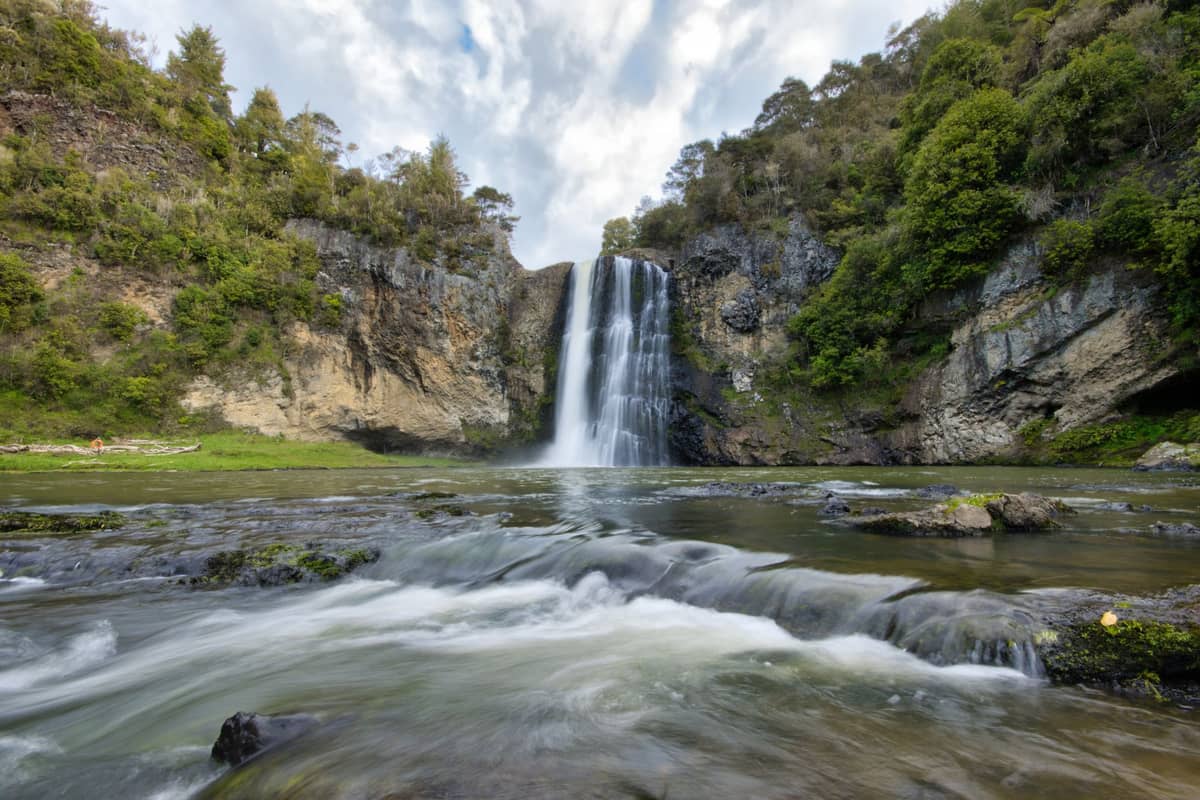
Hūnua Falls, known in te reo Māori as Hūnua, is a 30-metre waterfall located within the Hūnua Ranges Regional Park on the southern edge of the Auckland region. The falls drop off a basalt ledge into a broad, dark pool framed by nikau palms, ponga tree ferns, and dense stands of native bush. It is one of the largest single-drop waterfalls accessible within an hour of central Auckland, which goes a long way to explaining why it draws weekend crowds in summer.
Unlike many waterfall destinations in New Zealand that demand a multi-hour hike to earn the view, Hūnua Falls is a two-minute walk from the car park. That accessibility is genuinely unusual. The falls are not a consolation prize for the effort-averse; the drop is substantial and the forest setting is mature enough that the place has real character.
ℹ️ Good to know
Vehicle gate hours vary by season: 6am–9pm during daylight saving, 6am–7pm outside daylight saving. Pedestrian access is available 24 hours, but Vehicle gate hours vary by season: 6am–9pm during daylight saving, 6am–7pm outside daylight saving. Pedestrian access is available 24 hours, but there is no access to the park after closing hours..
The Experience: What You Actually See and Hear
The first thing you notice is the sound. Before you see the falls at all, the low, consistent roar carries through the canopy and orients you along the short gravel path from the car park. The volume of noise scales with recent rainfall: after a wet week, the falls become a thundering curtain that sends spray drifting ten metres in front of the drop. On a dry summer stretch, the flow thins but remains visually impressive, with water channelling into defined ribbons down the dark rock face.
The pool at the base sits in shadow for much of the morning, particularly in winter. The rocks around it are perpetually slick from spray and the constant moisture in the air. The smell is clean and earthy, a mix of wet stone, leaf litter, and the faint mineral quality of moving fresh water. If you have not visited New Zealand bush before, this is a compact introduction to what mature native forest actually feels and sounds like.
The lower lookout is the standard viewing point, and it puts you close to the falls. There are steps to navigate to reach it, which means wheelchair users and visitors with limited mobility may not be able to access the best vantage point. Auckland Council notes that wheelchair-accessible toilets are located at Mangatawhiri, not at the falls themselves.
Tickets & tours
Live prices and dates from our booking partner. If you book, we may earn a commission at no extra cost to you.
Luggage Storage in Auckland
From 5 €Instant confirmationFree cancellationNew Zealand West Coast discovery tour
From 100 €Instant confirmationFree cancellation13,000ft skydiving experience in Auckland
From 195 €Instant confirmationFree cancellationDiscover Auckland City Tour
From 88 €Instant confirmationFree cancellation
Time of Day: When to Go and What Changes
Early morning on a weekday is the quietest period. The car park is nearly empty before 9am, and the light filtering through the canopy creates a diffused, photogenic softness around the pool. Bird calls are louder and more layered in the early hours, tui and kereru are active in the canopy, and the absence of other visitors makes the falls feel genuinely isolated despite the easy access.
Weekend afternoons in summer are a different story. The car park fills, families spread out along the gravel paths, and the pool area becomes lively, particularly if children are in the group. The atmosphere is not unpleasant, but it is more picnic destination than wilderness encounter. If solitude matters to you, plan for a weekday morning or arrive before 8:30am on weekends.
Photography works best in overcast conditions. Bright midday sun creates hard contrast between the white water and the dark rocks that is difficult to expose correctly. An overcast sky acts as a natural diffuser and brings out the greens of the ferns and the texture of the basalt. A circular polarising filter helps reduce glare on the pool.
💡 Local tip
If you visit after heavy rain, the falls are at their most dramatic, but the paths become slippery and the pool can discolour. Wear shoes with grip rather than sandals or jandals.
Trails Beyond the Falls
The immediate falls loop takes under ten minutes. If that feels insufficient, the Hūnua Ranges Regional Park has an extensive track network that branches from the same car park. The Cossey-Massey Loop is one longer option in the regional park, taking visitors deeper into the ranges where the forest thickens and foot traffic drops away almost immediately.
The Hūnua Ranges are not as well-known as the Waitākere Ranges to the west of the city, which means the trails feel genuinely quiet. For context on what Auckland's west coast ranges offer, the Waitākere Ranges Regional Park provides a useful comparison, though access conditions there have been significantly affected by kauri dieback restrictions in recent years.
The Hūnua Ranges have also been the subject of kiwi reintroduction efforts, which gives the park ecological significance beyond its scenic appeal. Kiwi are nocturnal and very unlikely to be seen on a daytime visit, but the programme reflects how seriously Auckland Council and community groups have invested in restoring native biodiversity here.
Getting There and Practical Logistics
Hūnua Falls is approximately 60 kilometres from central Auckland by road. The standard route heads south on State Highway 1 to the Papakura exit, The standard route heads south on State Highway 1 to the Papakura exit, then follows Beach Road and Settlement Road toward Hunua village, turning left onto White Road and right onto Falls Road to reach the car park. and right onto Falls Road to reach the car park. Allow at least 50 to 60 minutes from the CBD, more during peak commute hours through the southern motorway corridor.
There is no regular public transport to the falls. This is a car-dependent destination, which immediately rules it out for visitors without access to a vehicle. A hire car or a private tour is the practical alternative. Some day tour operators include Hūnua Falls as part of broader Auckland region day trips, though it is not as commonly packaged as destinations like Hobbiton or Waiheke Island.
If you are organising a longer day trip that combines the falls with other southern Auckland attractions, it is worth reading the day trips from Auckland guide to understand how to sequence the drive efficiently.
⚠️ What to skip
Mobile coverage in the Hūnua Ranges is patchy. Download an offline map before you leave the city, and let someone know your plans if you intend to walk further than the main falls area.
Who Will Enjoy This, and Who Might Not
Families with young children consistently find Hūnua Falls rewarding because the payoff is immediate. You park, you walk two minutes, and children see a large, loud waterfall. You park, you walk two minutes, and children see a large, loud waterfall. Picnic tables are provided at Hunua Falls, so there is space to stop and eat without needing to carry everything deep into a trail.
Hikers looking for a full-day wilderness challenge will find the falls themselves underwhelming as a destination, though the wider range network partially addresses that. The falls are most accurately described as the centrepiece of a half-day nature excursion rather than a serious tramping objective.
Visitors focused entirely on Auckland's inner-city and waterfront attractions may find the drive time hard to justify unless they are specifically seeking a nature fix. In that case, closer alternatives like Auckland Domain or the volcanic cone walks described in the Auckland volcanic cones guide might better suit a tighter itinerary.
Visitors with mobility limitations should note that the lower lookout requires steps and the path surface is uneven near the falls. The car park and the initial approach are more manageable, but accessing the best viewpoint is not straightforward for everyone.
What to Bring
- Closed-toe shoes with grip; the path near the falls is permanently damp
- Layers: the gorge is noticeably cooler than the surrounding farmland and can feel cold in the shade
- Water and food: bring food, as there are no cafés or shops at the falls
- Offline map downloaded before departure
- Rain jacket: the Hūnua Ranges receive higher rainfall than central Auckland and weather can shift quickly
- Camera with a polarising filter if you are serious about photography
Insider Tips
- Arrive before 8:30am on summer weekends and you may have the falls almost entirely to yourself. The car park fills quickly once families start arriving mid-morning.
- After sustained heavy rain, the volume of water roughly doubles and the sound is extraordinary. Check the Auckland Council park page or local weather forecasts to time a post-rain visit.
- The pool at the base is not a designated swimming area. Currents and submerged rocks make it dangerous, and signage reflects this. Do not enter the water.
- If you plan to extend into the wider trail network, download the Auckland Council park map before you leave the city. Signage on secondary tracks is present but sparse, and mobile data is unreliable in the ranges.
- The road into the car park is unsealed and narrow in sections. Passing another vehicle on Falls Road requires care, particularly on blind corners. Drive slowly and use your horn on sharp bends. Passing another vehicle on Falls Road requires care, particularly on blind corners. Drive slowly and use your horn on sharp bends.
Who Is Hunua Falls For?
- Families with children who want an easy, rewarding nature stop south of Auckland
- Photographers seeking native forest and waterfall subjects, especially on overcast mornings
- Day-trippers combining the falls with a drive through the rural Hunua district
- Nature walkers who want to extend into the broader Hūnua Ranges track network
- Visitors wanting a genuine native bush experience without committing to a full-day hike
Nearby Attractions
Combine your visit with:
- Auckland Botanic Gardens
Spread across 64 hectares in Manurewa, the Auckland Botanic Gardens offer free entry every day of the year, with themed garden collections, 10 hectares of native forest, and a visitor centre on site. It sits south of the city centre and rewards a longer visit than most people initially plan for.
- Auckland Zoo
Auckland Zoo has been part of the city's fabric since 1922, sitting in the Western Springs precinct with a collection that spans native New Zealand wildlife and international species. This guide covers everything from ticket prices and transit options to the best time of day to arrive and which exhibits deliver the most.
- Bastion Point (Takaparawhau)
Takaparawhau, known widely as Bastion Point, is a grassy headland in Ōrākei where Māori history, colonial conflict, and sweeping Waitematā Harbour views converge. It costs nothing to visit, carries centuries of significance, and rewards visitors who take time to understand what they are standing on.
- Bethells Beach (Te Henga)
Bethells Beach, officially Te Henga (Bethells Beach), is a raw, dramatic stretch of black-sand coastline about 45 minutes west of central Auckland. With rolling dunes, a freshwater lagoon, strong surf, and zero phone coverage, it delivers a genuine wilderness experience rare for a city of 1.6 million people.
Planning a trip? Discover personalized activities with the Nomado app.