Heuriger Wine Taverns: Vienna's Most Authentic Drinking Tradition
Heuriger wine taverns are a category of venue unique to Vienna, where licensed winemakers serve their own freshly pressed wine alongside simple cold-buffet food. Found on the green fringes of the city in districts like Grinzing, Nussdorf, and Stammersdorf, they offer something no city-centre bar can replicate: wine poured by the people who grew the grapes, in the garden where those vines still grow.
Quick Facts
- Location
- Outskirts of Vienna, mainly Grinzing, Nussdorf, Neustift am Walde, Stammersdorf, and Kahlenbergerdorf (19th, 21st, and other outer districts)
- Getting There
- Varies by tavern; tram and bus to Grinzing or Nussdorf; U-Bahn plus bus to Stammersdorf. Check individual tavern location before travelling.
- Time Needed
- 2–4 hours for a relaxed visit; many guests stay for an entire evening
- Cost
- No entry fee. Pay only for wine and food consumed. Prices vary by tavern.
- Best for
- Wine lovers, slow-travel visitors, couples, anyone wanting to experience everyday Viennese culture away from the tourist centre
- Official website
- www.wien.info/en/dine-drink/wine/viennese-heurige-347736
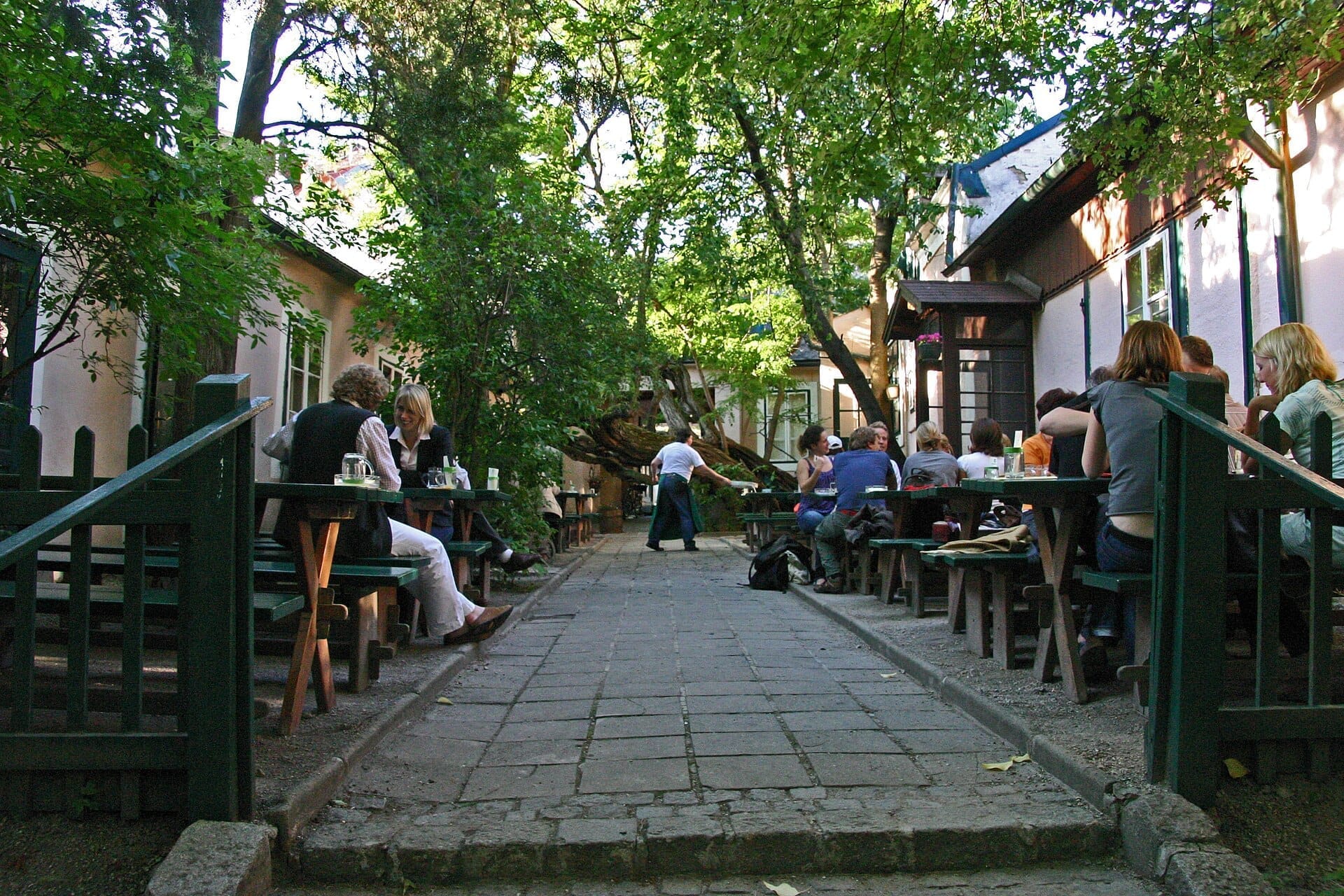
What a Heuriger Actually Is
The word Heuriger comes from the Viennese German for 'this year's wine,' and that etymology explains the concept precisely. A Heuriger is a licensed wine tavern where the winemaker serves their own current vintage directly on their own property. This is not a wine bar stocking labels from across Austria. The wine in your glass was grown, pressed, and bottled within walking distance of the table you are sitting at.
Under Austrian law, genuine Buschenschank-style Heuriger operate under a special licence that restricts them to serving their own wine during designated opening periods known as Aussteckzeiten. The name Buschenschank refers to the pine branch (Buschen) that winemakers traditionally hang above the door when the new wine is ready to serve. You will still see this pine branch at many traditional taverns today, a signal that the place is open and the wine is flowing.
The legal geography of authentic Heuriger is also specific. By regulation, Buschenschank taverns may only operate in certain outer districts of Vienna: the 10th, 16th, 17th, 18th, 21st, 23rd, and the entire 19th district, which encompasses the traditional wine villages of Grinzing, Nussdorf, Heiligenstadt, Neustift am Walde, Sievering, and Kahlenbergerdorf. Any 'Heuriger' you find in the city centre is, at best, a wine restaurant borrowing the name.
💡 Local tip
Look for the pine branch above the door. If it is there, the tavern is officially open for its current Aussteckzeit (designated serving period). No branch, no service. This is a centuries-old signal that remains in use today.
Where the Vineyards Meet the City
Vienna is one of the very few capital cities in the world with working vineyards within its municipal boundaries. The vine-covered slopes of the Wienerwald foothills on the city's northwestern and northern edges have been cultivated since Roman times, and today around 700 hectares of vineyard still exist within Vienna's city limits. Standing in a Heuriger garden in Grinzing or Stammersdorf, you can look up the hillside and see the exact rows of vines that produced your wine.
The two most visited clusters of Heuriger are in the 19th district (Döbling), covering Grinzing, Nussdorf, and Neustift am Walde, and in Stammersdorf in the 21st district. Grinzing is the most famous name internationally and attracts a broad tourist crowd; Stammersdorf, across the Danube, tends to draw a more local Viennese clientele and has a slightly less polished feel. For those willing to combine a Heuriger visit with some walking, Nussdorf sits close to the riverbank and connects naturally with the Kahlenberg hilltop above.
Each village has its own character. Grinzing's main street is lined with larger, more commercial establishments that handle groups comfortably and operate more reliably year-round. Neustift am Walde and Sievering feel quieter and more residential, with smaller gardens and menus. Neither is better; they suit different moods and occasions.
Tickets & tours
Hand-picked options from our booking partner. Prices are indicative; availability and final rates are confirmed when you complete your booking.
Wachau Winery Bike Tour
From 139 €Instant confirmationFree cancellationPrivate Vienna wine tasting tour in an electric vehicle
From 0 €Instant confirmationFree cancellationSchlumberger wine cellars self-guided audio tour with tasting
From 11 €Instant confirmationFree cancellationHidden wine cellars of Vienna guided tour with wine tasting
From 95 €Instant confirmationFree cancellation
What the Experience Feels Like
Arriving at a Heuriger mid-afternoon on a warm spring day, the first thing you notice is the smell: cut grass, warm timber, and the faint sweetness of fermenting wine from somewhere near the cellar entrance. The tables in the garden are plain wood, often benches rather than chairs. There is almost no ambient music in traditional places. Conversations at neighbouring tables are in Viennese dialect. The pace is completely unhurried.
Food at an authentic Heuriger is cold-buffet style, meaning you go to a counter and load a plate yourself. Expect sliced meats, lard spreads on dark bread, pickled vegetables, hard cheese, and occasionally warm dishes at larger establishments. The food is simple and deliberate: it exists to accompany wine, not to compete with it. Ordering is straightforward. You ask for a Viertel (a quarter-litre) or Achtel (an eighth-litre) of Grüner Veltliner or Riesling, the two grape varieties most closely associated with Vienna's vineyards.
By early evening, the garden fills noticeably. Locals arrive after work: families with children at the long tables, couples with a half-litre carafe between them, older men who have clearly been coming to this specific garden for decades. The light in late summer turns golden over the vines at around 7 p.m., and this is the hour that justifies every tram connection it took to get here. The atmosphere at this point is genuinely convivial without becoming loud or chaotic. Bring cash, as many traditional Heuriger do not accept cards.
⚠️ What to skip
Many smaller, traditional Heuriger are only open during their Aussteckzeiten, which are not fixed and change each year. Always check the specific tavern's current schedule before making the trip. Arriving to find a closed door with no pine branch is a common mistake for first-time visitors.
When to Go and How the Experience Changes by Season
The classic Heuriger season runs from spring through late autumn, with late April through October being the most reliable window. In summer, garden tables fill quickly on Friday and Saturday evenings; arriving before 5 p.m. gives you a better choice of seats and a quieter atmosphere. Weekday visits in June or September are particularly pleasant: the gardens are less crowded, and the wine is the same.
Autumn has its own appeal. In September and October, the new wine from the current harvest begins to appear, and some Heuriger serve Sturm, a semi-fermented grape juice that sits between grape juice and wine in alcoholic content. It is sweet, slightly fizzy, and considerably more potent than it tastes. Autumn also coincides with the harvest walking trails through the vineyards, which pairs naturally with a Heuriger visit in Stammersdorf or Neustift. The broader context of Viennese wine culture is worth reading before you go if you want to understand the regional grape varieties and wine styles you are likely to encounter.
A minority of larger Heuriger operate through winter, but the experience changes fundamentally. You sit indoors, the garden is closed, and the relaxed outdoor atmosphere that defines the tradition is largely absent. The wine is still good, but visiting primarily in the warm months is strongly advisable for a first encounter with the format.
Getting There: Practical Transit from the City Centre
Reaching a Heuriger requires a willingness to use Vienna's outer tram and bus network, which is part of what keeps the experience local. For Grinzing, the most straightforward route from the city centre involves taking the D tram to Nussdorfer Strasse and then a bus connection toward Grinzing. For Nussdorf itself, tram D reaches Nussdorf directly from the Ring. Stammersdorf in the 21st district requires crossing the Danube, typically via U-Bahn and then a bus or tram connection. Wiener Linien's journey planner at wienerlinien.at provides current routes. For a broader overview of navigating the outer city, the guide to getting around Vienna covers tram and bus networks in practical detail.
The transit journey takes between 25 and 45 minutes from the inner city depending on your starting point and destination. This is not a short detour. Plan it as the purpose of an evening, not as an add-on to a day of museum visits. The journey itself is pleasant: the tram windows reveal a quieter, greener, more residential Vienna that most short-stay visitors never see.
💡 Local tip
Bring a Vienna City Card or have a valid transit ticket for the full zone. The outer wine villages are within Vienna's standard fare zone, so no additional ticket is needed beyond the regular Wiener Linien fare.
The Overhype Question: Is This Still Authentic?
It is honest to acknowledge that some Heuriger, particularly the larger, more famous establishments in Grinzing, have adapted significantly to tourist traffic. At these places you may find an extensive hot food buffet, musicians playing folk songs tableside, and menus in English prominently displayed. The wine is still local. The atmosphere is not uncomfortable. But it is a different experience from sitting in a small family garden where the winemaker's grandmother is carrying plates.
The most authentic encounters happen at smaller family-run establishments in Neustift am Walde, Stammersdorf, or Mauer, which see fewer tourists and maintain the original cold-buffet and self-service format. The trade-off is that these places may have shorter opening periods and can fill up quickly with local regulars on weekend evenings. If you are visiting Vienna with a focus on local culture rather than checked-off sights, pairing a Heuriger evening with a walk through the Grinzing, Nussdorf, and Kahlenberg area gives you the full picture of this side of the city.
Travellers who need reliable, consistent opening hours, full accessibility, a broad menu, and a central location may find the Heuriger format frustrating. The best ones require planning, transit time, and a tolerance for venues that close without notice when their seasonal allocation ends. Those constraints are also precisely what protects their character.
Photography and Practical Details
Heuriger gardens photograph best in the late afternoon, when the low sun catches the vine leaves and the garden has just begun to fill. The visual interest is in the textures: worn wooden tables, glass carafes, pine-branch signage, and the vineyard slope visible behind the fence. Wide angles work better than close-ups here. Flash photography indoors at a small family tavern will make you conspicuous and is generally unwelcome.
Wear comfortable walking shoes. Getting to and from the tram stop involves uneven pavements and, at some locations, a short uphill walk on cobblestones or gravel. The garden seating is often on slightly sloped ground. Bring a light layer for the evening: temperatures drop noticeably after sunset in the outer districts, especially in spring and September.
Accessibility varies considerably by tavern. Many traditional Heuriger have steps at the entrance, uneven cobbled courtyards, and no dedicated accessible facilities. Larger, more commercial establishments are more likely to have level access and indoor seating. Anyone with limited mobility should contact their chosen tavern directly before visiting to confirm the layout.
Insider Tips
- The pine branch above the entrance is not decorative: it means the tavern is currently open during its Aussteckzeit. No branch means it is closed, regardless of any printed schedule you may have found online. Always check current status before travelling.
- Order Sturm in September or October if you see it on offer. This semi-fermented new wine is only available during harvest weeks and is genuinely seasonal. It is sweeter and more alcoholic than it seems, so pace yourself.
- Stammersdorf in the 21st district is the place for a more local, less tourist-facing evening. The vineyards here are across the Danube from the more famous Döbling villages, which means fewer non-Viennese visitors and more of the unpretentious family atmosphere that defines the tradition at its best.
- At a traditional cold-buffet Heuriger, take a small portion first and return for more. Taking a large plate on the first visit is a common tourist mistake; the food is usually sold by weight or by the piece at the counter, and the etiquette is to graze slowly over two or three hours.
- Cash is strongly preferred at most traditional Heuriger, and some smaller ones do not accept cards at all. Bring euro notes in small denominations before you travel out to the wine villages.
Who Is Heuriger Wine Taverns For?
- Wine enthusiasts wanting to taste Viennese Grüner Veltliner and Riesling at source, poured by the winemaker
- Travellers spending three or more days in Vienna who want an evening that feels nothing like the tourist centre
- Couples looking for a relaxed, low-key evening with good wine and outdoor seating
- Anyone interested in Austrian food culture: the cold-buffet format and bread spreads are a distinctly local culinary experience
- Visitors combining the trip with a daytime walk in the Wienerwald or along the vineyard trails above Nussdorf and Grinzing
Nearby Attractions
Other things to see while in Vienna Wine Country (Grinzing, Nussdorf & Kahlenberg):
- Beethoven Museum Heiligenstadt
Housed in the Heiligenstadt building where Ludwig van Beethoven wrote his devastating 1802 Testament, this compact but deeply affecting museum explores one of classical music's most pivotal personal crises. Operated by Wien Museum and expanded in 2017, it sits in a quiet village-like corner of Vienna's 19th district, far from the tourist crowds of the centre.
- Kahlenberg
Standing at 484 metres above the Viennese basin, Kahlenberg offers one of the widest, most rewarding panoramas of any European capital. Free to access and reachable by public bus, it combines natural beauty, layered history, and genuine visual payoff in a single excursion.
- Wienerwald (Vienna Woods)
The Wienerwald, or Vienna Woods, is a UNESCO Biosphere Reserve covering roughly 135,000 hectares of forested hills west and southwest of Vienna. Access is free, trails range from gentle to steep, and the area rewards visitors across every season with panoramic viewpoints, wine-village walks, and deep quiet that the city centre cannot offer.