Kahlenberg: Vienna's Panoramic Hill Above the City
Standing at 484 metres above the Viennese basin, Kahlenberg offers one of the widest, most rewarding panoramas of any European capital. Free to access and reachable by public bus, it combines natural beauty, layered history, and genuine visual payoff in a single excursion.
Quick Facts
- Location
- Am Kahlenberg, 1190 Wien (Döbling, 19th district)
- Getting There
- U4 to Heiligenstadt, then bus 38A to Kahlenberg terminus
- Time Needed
- 2–4 hours including travel; longer if hiking
- Cost
- Viewpoint is free; standard Wiener Linien fare for bus 38A (verify current prices)
- Best for
- City panoramas, history, forest walks, clear-day photography
- Official website
- www.kahlenberg.wien
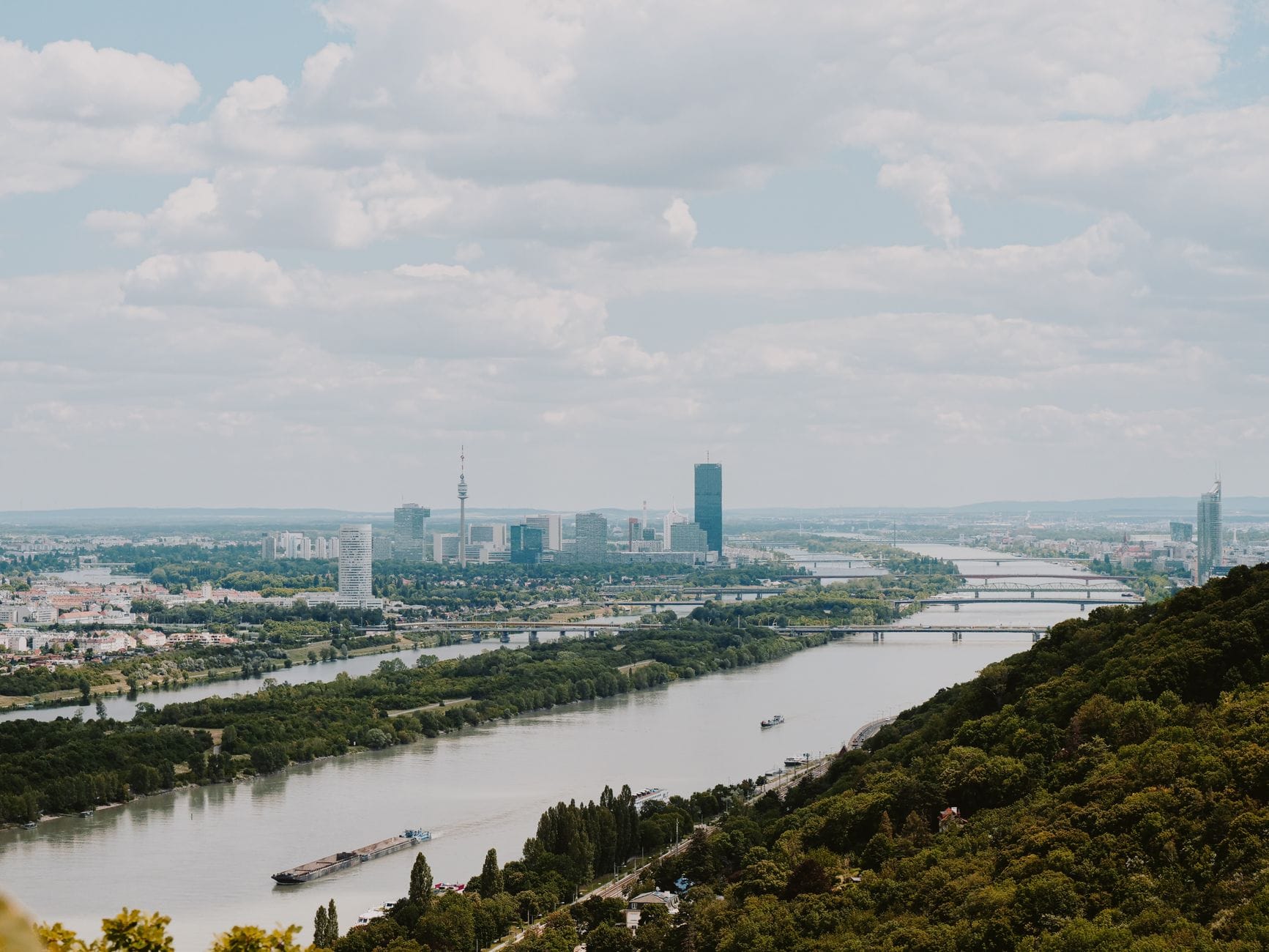
What Kahlenberg Actually Is
Kahlenberg is a forested hill in Vienna's 19th district, Döbling, rising to approximately 484 metres above sea level on the eastern edge of the Vienna Woods. It sits within the larger Wienerwald belt that forms a green crescent along the city's northwestern and western flanks. From the summit area, the entire Viennese basin spreads out below: the Ringstrasse curve, the Danube and its parallel New Danube channel, and on clear days, the outline of Schneeberg 80 kilometres to the south. It is not a mountain in any demanding sense. The summit is accessible by public bus, the main viewpoint is paved, and the surrounding paths are well-marked forest tracks. What makes Kahlenberg worth a half-day is the combination of altitude, history, and the rare sensation of seeing Vienna as a whole.
Kahlenberg sits in the Grinzing, Nussdorf and Kahlenberg area, which also includes some of Vienna's most traditional wine villages. The transition from urban street to forested hill takes surprisingly little time, which partly explains why Viennese residents have been coming here for day trips since the 19th century.
💡 Local tip
The 38A bus runs directly from the U4 Heiligenstadt station to the Kahlenberg terminus. No transfer needed. The ride winds up through Grinzing and along forested roads, giving you a preview of the hill before you arrive.
The View: What You Will and Won't See
The main viewpoint at the summit is a broad terrace facing southeast over the city. On a clear morning, the layout of Vienna reads almost like a map: the compact historic core, the wide green strip of the Prater, the silver threads of the Danube, and the flat urban sprawl extending eastward into Lower Austria. The Wiener Riesenrad ferris wheel in the Prater is often visible as a small red circle. Beyond the city, the Pannonian plain stretches toward Slovakia and Hungary.
Visibility is the variable you cannot control. On clear autumn days after rain has washed the air, the view is genuinely exceptional. In summer haze, particularly in July and August, the city can look milky and indistinct beyond a few kilometres. If sharp panoramic photography is your goal, morning visits in spring or autumn give the best results. Late afternoon light turns the city warm but increases atmospheric haze.
The Stefaniewarte, an observation tower near the highest point, adds several metres of elevation and a 360-degree perspective, including views northward into the wooded hills. Separate admission applies; check the current price on site before assuming it is free.
⚠️ What to skip
Summer weekends bring significant crowds to the summit terrace, especially between 10am and 2pm. If you want the view to yourself, arrive before 9am or come on a weekday. The 38A bus can also get crowded during peak hours.
Tickets & tours
Hand-picked options from our booking partner. Prices are indicative; availability and final rates are confirmed when you complete your booking.
Imperial Vienna 72-hour hop-on hop-off bus
From 55 €Instant confirmationFree cancellationSkip-the-Line Entrance with Guide to Schonbrunn Palace and Gardens
From 45 €Instant confirmationFree cancellationLuggage Storage in Vienna
From 6 €Instant confirmationFree cancellationStrauss Dinner Show
From 99 €Instant confirmationFree cancellation
The History Behind the Hill
Kahlenberg's place in European history is specific and significant. On the night of 11 September 1683, a relief army assembled on these slopes to break the Ottoman siege of Vienna. Led by Polish King Jan III Sobieski and supported by forces from the Holy Roman Empire, they launched their assault from Kahlenberg the following morning. The Battle of Vienna on 12 September 1683 ended the two-month siege and is widely considered a turning point in the Ottoman Empire's westward expansion into Europe. The city below had been under blockade since July.
A small church near the summit, the Church of St. Joseph (also known as the Polish church, reflecting the historical connection to Sobieski), commemorates this event. The interior contains paintings and inscriptions referencing the 1683 battle, and it remains an active place of worship. Polish visitors in particular treat this as a meaningful historical site rather than a casual tourist stop.
For travelers who want to understand how this battle fits into Vienna's broader imperial story, the Habsburg imperial history guide provides the wider context around Vienna's relationship with Ottoman expansion and the city's development in the years that followed.
How the Experience Changes Through the Day
Early mornings on Kahlenberg belong to joggers, dog walkers, and cyclists who come up from Grinzing or along the Höhenstraße. The air carries the smell of damp earth and pine, particularly after overnight rain. The summit terrace is quiet, the city below still half-shrouded in morning mist, and the only sounds are birdsong and the occasional bus engine. This is when the forest feels genuinely close to wild.
By mid-morning, the first tourist buses and private cars arrive. The terrace fills with visitors at the viewpoint railing, and the nearby café and restaurant begin service. The atmosphere shifts toward a relaxed excursion destination rather than a nature escape. Families spread out on the grass, older couples share coffee on the terrace, and small groups photograph the panorama. It is pleasant without being remarkable.
Sunset is the moment that divides opinion. On evenings when the western sky goes pink and the city lights begin to appear in the valley below, the view can be quietly spectacular. But cloud cover is unpredictable at elevation, and sunset hours depend on the season. If you are planning an evening trip specifically for sunset, check the weather forecast for the day and the cloud base in particular.
Getting There and Getting Around Once You Arrive
The most practical route is by public transport. Take the U4 metro line to Heiligenstadt, the northern terminus, then board bus 38A toward Kahlenberg. The bus climbs through the Grinzing wine district before entering the forested stretch of the Höhenstraße, arriving at the summit terminus near the viewpoint. The journey from Heiligenstadt takes roughly 30 to 40 minutes depending on traffic. Standard Wiener Linien fares apply; verify current pricing directly with Wiener Linien before your visit.
By car, Kahlenberg is accessible via the Wiener Höhenstraße, approachable from Grinzing in the south or from Klosterneuburg to the north. Parking is available near the summit. The Höhenstraße itself is a worthwhile drive, running along the ridge of the Vienna Woods and passing multiple viewpoints.
Walkers with time and energy can approach Kahlenberg on foot from the Nussdorf or Grinzing directions, following marked Wienerwald trails. The Vienna hiking and outdoor guide covers the main trail routes in the Vienna Woods, including approaches to Kahlenberg and the neighbouring Leopoldsberg.
ℹ️ Good to know
The hill itself has no gates or ticketed entry. The viewpoint terrace, forest paths, and picnic areas are free to access at any hour. Individual facilities (restaurant, rope park, Stefaniewarte tower) have their own pricing and seasonal hours.
What Else Is Up There
Beyond the main viewpoint and the church, Kahlenberg has a modest but useful cluster of facilities. A restaurant with terrace seating serves Austrian food and drinks throughout the year, though seasonal hours vary. A café near the bus terminus caters to day-trippers. The Kahlenberg Forest Rope Park is an outdoor activity course in the trees, aimed primarily at families with older children and adults; separate admission and age requirements apply.
The surrounding forest trails connect Kahlenberg to the neighbouring Leopoldsberg (a separate, slightly lower hill with its own views and a Romanesque-style church at the summit) and to longer Wienerwald circuits that can extend the walk considerably. Signage in the forest is generally clear and consistent with the standard Austrian hiking trail marking system.
If you are planning a wider excursion to the north of Vienna that combines natural scenery with local wine culture, the villages of Grinzing and Nussdorf in the valley below offer traditional Heuriger wine taverns. The Heuriger wine taverns page explains what to expect from these local institutions and how to tell an authentic one from a tourist-facing imitation.
Honest Assessment: Is It Worth the Trip?
Kahlenberg rewards visitors who understand what it offers: a free, accessible panoramic viewpoint above a major European city, with genuine historical significance and a surrounding forest that provides real breathing space from urban density. It is not a site with exceptional interior architecture, rare collections, or carefully curated visitor experiences. The summit facilities are functional rather than impressive. If you come expecting a polished attraction, you may feel the trip is longer than the payoff justifies.
Those who get the most from Kahlenberg are travelers who combine it with a walk through the vineyards below, a stop at a Grinzing Heuriger, or a longer hike along the Wienerwald ridge. Treated as a half-day excursion rather than a quick detour, it earns its place on the itinerary. Treated as a 20-minute selfie stop, it probably does not.
First-time visitors to Vienna deciding how to allocate limited days might find it useful to compare Kahlenberg against other viewpoints and half-day options in the 3-day Vienna itinerary, which places the hill in context against the city's other priorities.
⚠️ What to skip
Who should skip Kahlenberg: travelers with only one or two days in Vienna who have not yet seen the main city-center sites. The time investment (roughly 1.5 hours travel round trip plus time at the top) is better justified once you have covered the historic core. Also avoid on overcast or foggy days when the view is the entire reason for coming.
Insider Tips
- The 38A bus on Sunday mornings runs less frequently than on weekdays. Check the Wiener Linien schedule before you go, particularly if you are planning an early start or need to catch a specific departure back down.
- Leopoldsberg, the next hill along the ridge, is almost always less crowded than Kahlenberg and has its own distinct view corridor northward toward the Danube bend. The two summits are connected by a signed trail and make a natural pairing on the same half-day trip.
- The terrace restaurant and café occasionally close without notice in shoulder season (November and early March). Bring water and a snack if you are visiting outside peak summer months.
- Photography from the Stefaniewarte observation tower gives a cleaner sightline over the summit buildings and trees that can partially block the view from the main terrace. The cost of entry is modest; confirm the current price on arrival.
- If you are driving up via the Höhenstraße, there are two or three pull-off viewpoints along the road before the summit that are often completely empty even when the main terrace is crowded. These are worth a short stop.
Who Is Kahlenberg For?
- Travelers who want a free panoramic view of Vienna with minimal planning
- History enthusiasts interested in the 1683 Battle of Vienna and the Ottoman siege
- Hikers looking to combine a forest walk with a city view
- Families who want outdoor space and activities away from the urban center
- Visitors combining the hill with a Grinzing or Nussdorf wine village stop in the afternoon
Nearby Attractions
Other things to see while in Vienna Wine Country (Grinzing, Nussdorf & Kahlenberg):
- Beethoven Museum Heiligenstadt
Housed in the Heiligenstadt building where Ludwig van Beethoven wrote his devastating 1802 Testament, this compact but deeply affecting museum explores one of classical music's most pivotal personal crises. Operated by Wien Museum and expanded in 2017, it sits in a quiet village-like corner of Vienna's 19th district, far from the tourist crowds of the centre.
- Heuriger Wine Taverns
Heuriger wine taverns are a category of venue unique to Vienna, where licensed winemakers serve their own freshly pressed wine alongside simple cold-buffet food. Found on the green fringes of the city in districts like Grinzing, Nussdorf, and Stammersdorf, they offer something no city-centre bar can replicate: wine poured by the people who grew the grapes, in the garden where those vines still grow.
- Wienerwald (Vienna Woods)
The Wienerwald, or Vienna Woods, is a UNESCO Biosphere Reserve covering roughly 135,000 hectares of forested hills west and southwest of Vienna. Access is free, trails range from gentle to steep, and the area rewards visitors across every season with panoramic viewpoints, wine-village walks, and deep quiet that the city centre cannot offer.