Helsinki Swimming Stadium (Uimastadion): The Open-Air Pool at the Heart of the City
Helsinki Swimming Stadium — known locally as Uimastadion or Maauimala — is the city's iconic open-air Olympic-style pool complex in Taka-Töölö. Open from May to September, it draws early-morning lap swimmers, families on long summer afternoons, and everyone in between. Here is everything you need to know before visiting.
Quick Facts
- Location
- Hammarskjöldintie 5, 00250 Helsinki (Taka-Töölö neighborhood)
- Getting There
- Accessible by bus and tram from central Helsinki; use the HSL journey planner for current routes
- Time Needed
- 1.5–3 hours depending on whether you swim laps or spend the afternoon
- Cost
- Adults €6.00 / Reduced (children, students, pensioners, etc.) €3.30 — as of 2026; verify current rates
- Best for
- Lap swimmers, families with children, anyone wanting outdoor swimming near the city centre
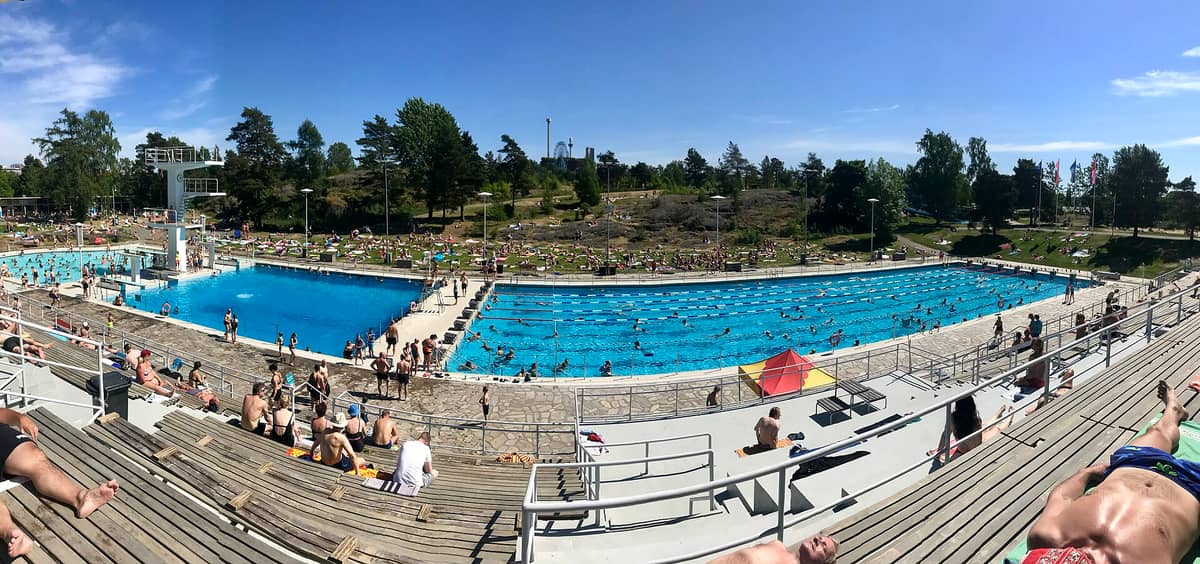
What Is the Helsinki Swimming Stadium?
Helsinki Swimming Stadium — Uimastadion in Finnish, sometimes called Maauimala — is an open-air Olympic-style pool complex in the Taka-Töölö district, beside Helsinki Olympic Stadium, in the same sports park. The facility was built as part of the sports infrastructure surrounding Helsinki's Olympic ambitions and remains a working public pool today, managed by the City of Helsinki.
Unlike the glassy indoor pools tucked inside sports centres, this is a proper outdoor complex: long lanes under open sky, the smell of chlorine mixing with summer air, and the sounds of splashing children competing with the distant hum of the city. It operates seasonally, typically from May to late summer (exact dates vary by year), and its relative affordability makes it one of the more democratic pleasures Helsinki offers in summer.
The stadium sits close to Töölönlahti Bay and is a natural addition to any day spent in the Töölö area. If you are planning a broader summer day out, pairing it with a walk around the bay or a visit to Helsinki Olympic Stadium nearby makes easy geographic sense.
ℹ️ Good to know
The 2026 season runs from 10 May to 11 September 2026. Monday–Saturday: 06:30–20:00; Sunday: 09:00–20:00. Admission ends at 20:00; swimming time at 20:30; washing time at 20:45; the area must be vacated by 21:00. Hours may differ on Midsummer and public holidays — always check the official City of Helsinki page before visiting.
The Experience: What You Actually See and Feel
Arriving at the Swimming Stadium on a clear June morning, the first thing you notice is the scale. The main pool is full competition-length, aligned in long straight lanes, and the surrounding area has the functional geometry of a facility built for performance rather than leisure aesthetics. The concrete and pale tiles are weathered in the honest way that comes from decades of public use. It does not look like a resort. It looks like a place people actually swim.
The water is heated, so it stays comfortable even on cooler days — this is Helsinki, not the Mediterranean — and the shock of it on warm skin is part of the appeal. Early mornings attract a regular crowd of lap swimmers who arrive at opening, claim their lanes with quiet efficiency, and complete their sets before most of the city has had breakfast. The atmosphere at 07:00 is almost meditative: the rhythmic sound of strokes, the light still low and golden over the water, lockers clanging softly in the changing rooms.
By midday on a warm day, the dynamic shifts entirely. Families spread out on the surrounding grass areas, children queue for the shallower sections, and the lanes become more contested. The smell of sunscreen thickens. The noise level rises considerably. It is still enjoyable, but it is a different experience from the early-morning version.
Tickets & tours
Hand-picked options from our booking partner. Prices are indicative; availability and final rates are confirmed when you complete your booking.
Helsinki Beautiful Canal Route, archipelago cruise
From 26 €Instant confirmationFree cancellationHelsinki Panorama Sightseeing Bus Tour With Audio Guide
From 35 €Instant confirmationFree cancellationHelsinki Pasila Street art district tour with a local
From 99 €Instant confirmationFree cancellationArchitecture tour of Helsinki
From 60 €Instant confirmationFree cancellation
History and Architectural Context
The Swimming Stadium was developed as part of Helsinki's broader Olympic infrastructure. Helsinki hosted the 1952 Summer Olympics — delayed from the originally planned 1940 Games due to World War II — and the city invested in a cluster of purpose-built sports facilities in the Taka-Töölö and Töölö areas during that era. The Swimming Stadium, Olympic Stadium, and the surrounding sports park were conceived as an integrated complex.
The functional architecture of the facility reflects the Functionalist ideals prevalent in Finnish design of that period: clean lines, unornamented concrete, form serving purpose. It lacks the decorative ambition of the Olympic Stadium proper, but it carries the same sense of civic seriousness — a publicly owned facility built to last and to be used by ordinary people, not just elite athletes.
For visitors interested in Finnish architecture and design history, this stretch of Töölö provides a concentrated lesson. The Finlandia Hall, Alvar Aalto's landmark concert and congress building, sits just a few minutes' walk away near Töölönlahti Bay, making the neighbourhood worth exploring on foot even for those not planning to swim.
Practical Walkthrough: Getting There and Getting In
The address is Hammarskjöldintie 5, 00250 Helsinki. From the city centre, the pool is reachable by tram and bus; the HSL journey planner (hsl.fi) will give you the fastest current route from your starting point. The walk from the area around Helsinki Central Station takes around 20 minutes on foot through pleasant neighbourhoods, which makes it a viable option on a fine day.
Admission is paid at the entrance. As of the 2026 season, a single adult ticket is €6.00 and a reduced ticket — covering children, pensioners, students, unemployed persons, conscripts, and other eligible groups — is €3.30. Multi-visit cards and 30-day passes are also available and reduce the per-visit cost if you plan to swim regularly during your stay. Prices should be confirmed at the official City of Helsinki page or at the ticket desk, as they are subject to change.
💡 Local tip
Bring your own towel and padlock. The changing facilities are functional but basic — lockers require a coin deposit or your own lock depending on the setup. Goggles are useful for the main lanes, especially when the afternoon sun hits the water at a low angle.
The City of Helsinki service map (palvelukartta.hel.fi) includes accessibility information for the Swimming Stadium, covering entrance details and facility access. Visitors with specific mobility requirements are advised to check those details before arriving, as the concrete-heavy setting of a 1950s outdoor facility may present practical limitations.
Best Time to Visit and Weather Considerations
The facility is only open in summer, so the question of when to visit is partly settled by the season. Within that window, the experience varies significantly depending on time of day and weather. Weekday mornings before 10:00 are consistently the quietest and most pleasant for swimming. Weekend afternoons in July are the most crowded, particularly when temperatures climb above 20°C — which, in Helsinki, constitutes a warm day that brings the entire city outdoors.
Helsinki's summer weather is genuinely variable. On overcast or cool days, attendance drops noticeably and the pool has a more solitary, almost contemplative quality. On sunny days, especially during Helsinki's long evenings in June and July when daylight stretches past 22:00, the pool becomes a social gathering point with a relaxed, unhurried atmosphere that is quite specific to Nordic summer culture.
If you want broader context on what Helsinki summers actually look and feel like before committing to a visit, the Helsinki in summer guide gives a realistic seasonal overview. Weather-sensitive planning is covered in more detail in the Helsinki weather guide.
Photography and Atmosphere Notes
The pool photographs well in the early morning when the light is soft and the lanes are empty or near-empty. The geometric repetition of the lanes, the pale concrete deck, and the surrounding greenery give the scene a calm, ordered quality that feels very Finnish. By midday, the mix of swimmers and sunbathers is livelier but harder to compose cleanly.
Be respectful of other swimmers and families when using a camera. Photographing children in a public swimming facility is a sensitive area in any country — keep the lens oriented toward the architecture, the water, and the wider scene rather than individuals.
Who Might Not Enjoy This
Visitors expecting a resort-style pool with loungers, a café, and attendants will be disappointed. The Helsinki Swimming Stadium is a functional public facility with minimal amenities. The changing rooms are clean but not luxurious. The outdoor pool is heated to about 27°C, so it stays swimmable even on cooler days, and on cool summer days it can feel bracingly cold.
If you are visiting Helsinki outside the May–September window, this attraction does not exist for you — the complex is closed. And if you are looking for a beach experience with sand and sea swimming, Helsinki has better options. The islands of the archipelago and places like Hietaniemi beach offer a more coastal feel.
For those seeking a more spa-like water experience, Helsinki's sauna culture offers a compelling alternative — the Helsinki sauna guide covers the best options across the city, including facilities that combine swimming with traditional Finnish bathing.
Insider Tips
- The absolute best time to swim is on a weekday between 06:30 and 09:00. The lanes are nearly empty, the light is beautiful, and you can complete a serious lap session before the family crowds arrive.
- The pool is within easy walking distance of Helsinki Olympic Stadium. If you are visiting the stadium for a tour or event, the Swimming Stadium makes a natural add-on to the same half-day.
- Multi-visit cards offer significantly better value than single tickets if you are staying in Helsinki for more than a week and plan to swim more than twice. Many of these passes are valid across City of Helsinki swimming facilities, not just this one.
- On days when the temperature in Helsinki crosses 25°C — rarer than you might think — the pool becomes extremely busy after 12:00. Arrive at opening or be prepared to wait for a lane.
- Midsummer weekend (around June 20–22) sees unusual hours or closures at many City of Helsinki facilities. Check the official page specifically for that weekend if your visit coincides with it.
Who Is Helsinki Swimming Stadium For?
- Lap swimmers and fitness-focused visitors who want a proper outdoor pool session
- Families with children looking for affordable, supervised summer swimming near the city centre
- Architecture and history enthusiasts interested in Helsinki's Olympic-era sports infrastructure
- Budget-conscious travellers wanting a genuine local experience rather than a tourist attraction
- Visitors spending a day in the Töölö area who want to combine swimming with nearby landmarks
Nearby Attractions
Other things to see while in Töölö:
- Finlandia Hall
Finlandia Hall is Helsinki's most architecturally significant congress and concert venue, designed by Alvar Aalto and completed on the western shore of Töölönlahti Bay. Whether you come for the permanent Aalto exhibition, a concert evening, or simply to study the building's striking white marble facade up close, the hall sits at the intersection of Finnish cultural identity and modernist design.
- Finnish National Opera and Ballet
The Finnish National Opera and Ballet, known locally as Kansallisooppera ja -baletti, is Finland's foremost performing arts institution, occupying a purpose-built house on the edge of Töölönlahti Bay. Whether you are new to opera or a longtime ballet devotee, the venue delivers a polished, accessible experience at the heart of Helsinki's cultural calendar.
- Helsinki Central Library Oodi
Opened on 5 December 2018, Helsinki Central Library Oodi is a landmark public building at Kansalaistori Square, steps from the Central Railway Station. It combines a working library with makerspaces, a cinema, a rooftop terrace, and a cafe, all free to enter. The architecture alone justifies a visit, but the building earns its reputation by being genuinely useful.
- Helsinki Olympic Stadium
Built for the 1952 Summer Olympics, the Helsinki Olympic Stadium in Töölö is Finland's most storied sports venue. Visitors can climb its landmark tower for sweeping city views, tour the TAHTO Sports Museum, and walk the same track that once hosted the world's greatest athletes.