Heddal Stave Church: Norway's Largest Stave Church, 117 km from Oslo
Standing in a quiet valley near Notodden in Telemark, Heddal Stave Church is the largest surviving stave church in Norway, built around 1200–1250. A striking day trip from Oslo, it rewards visitors with intricate Viking-age woodcarving, an active parish atmosphere, and one of Scandinavia's most atmospheric medieval interiors.
Quick Facts
- Location
- Heddalsvegen 412, 3676 Notodden, Telemark, Norway — approx. 117 km from Oslo city centre
- Getting There
- By car: E18 to Drammen, then E134 toward Notodden — approx. 1.5 hrs. By bus: Explore regional bus connections from Oslo to Notodden, then local transport; verify current routes before travel.
- Time Needed
- 1.5–2 hours on-site; allow a full day from Oslo including travel
- Cost
- Adults NOK 100 / Children under 16 NOK 30 / Students NOK 60 / Groups (15+) NOK 70 (as of May 2024; verify before visiting)
- Best for
- Medieval history, architecture, photography, cultural day trips
- Official website
- www.heddalstavkirke.no
What Is Heddal Stave Church?
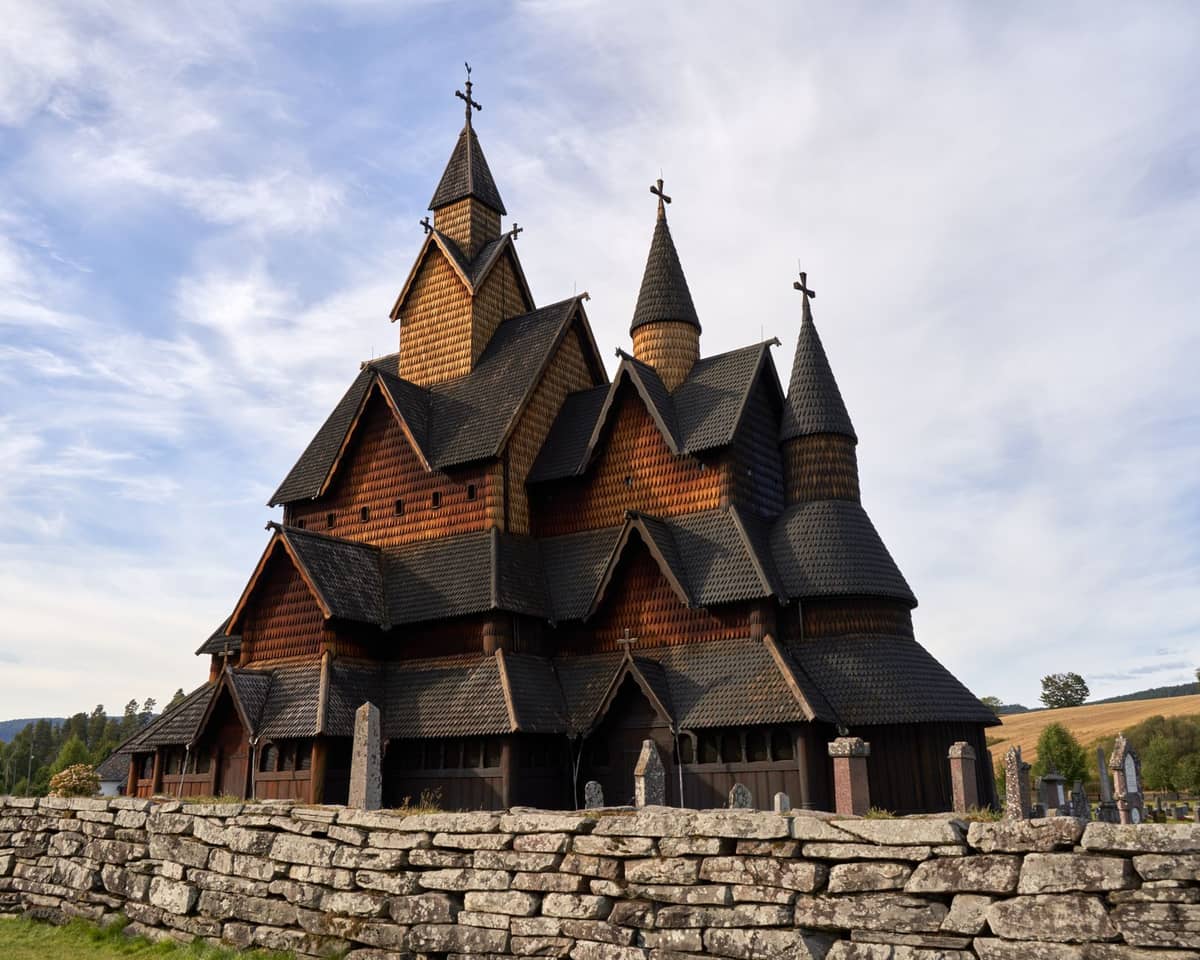
Heddal Stave Church (Heddal stavkirke in Norwegian) is the largest stave church in Norway and one of the most impressive surviving examples of medieval Scandinavian wooden architecture anywhere in the world. Built around 1200–1250 in the early 13th century, it stands in the small village of Heddal near the town of Notodden in Telemark county, southeastern Norway. Unlike the many stave churches that survive only as relocated or partially reconstructed structures in open-air museums, Heddal is a functioning parish church of the Church of Norway and has been in continuous use for over eight centuries.
The building is not just old — it is architecturally extraordinary. Three stave-framed nave sections rise in tiers, each slightly narrower than the one below, creating a layered silhouette that reads almost like a small wooden cathedral from a distance. The dragon-head finials at each gabled peak, the dark weathered timbers stained almost black with centuries of pine tar, and the low stone foundation give the church a presence that photographs rarely prepare you for. Arriving for the first time, most visitors slow their pace instinctively.
💡 Local tip
The church is an active place of worship. Services, weddings, and funerals can result in temporary closures without advance notice. Always check the official website at heddalstavkirke.no before making a special journey.
The Architecture: What You Are Actually Looking At
Stave church construction is a uniquely Norwegian building tradition in which the structural skeleton is formed from vertical load-bearing posts (staves) set on a sill frame, rather than laid-stone or horizontal log construction. Heddal represents the mature form of this tradition: a triple-nave layout with a polygonal apse, a separate bell tower, and a churchyard enclosed by a low fence. The entire structure is built from Norwegian pine, historically treated with pine tar to resist moisture and insects — a maintenance ritual that continues today and gives the exterior its characteristic deep, resinous smell on warm days.
The interior is compact but densely detailed. Medieval woodcarvings decorate the portals, and the bishop's chair inside the church is considered one of the finest pieces of medieval furniture in Norway, carved with runic inscriptions and intricate knotwork. The dim light inside — filtered through small windows, the air faintly scented with old timber — makes the ornamentation feel intimate rather than monumental. Bring a small torch or use your phone light to properly appreciate the carved details near the doorways.
The church underwent significant restoration in the 19th and 20th centuries, which added a number of painted decorations and structural reinforcements. Scholars have documented the layered building history carefully, and the on-site barn exhibitions provide context for how the structure evolved over time. Those exhibitions are included in the standard admission fee.
Tickets & tours
Live prices and dates from our booking partner. If you book, we may earn a commission at no extra cost to you.
Oslo Fjord sightseeing audio-guided electrical boat tour
From 35 €Instant confirmationFree cancellationFjord cruise with live jazz music
From 64 €Instant confirmationFree cancellationLuggage Storage in Oslo
From 6 €Instant confirmationFree cancellationPicturesque dinner cruise in Oslo
From 137 €Instant confirmationFree cancellation
Getting There from Oslo
Heddal is approximately 117 km from central Oslo by road. The standard route follows the E18 southwest toward Drammen, then turns onto the E134, which runs east through Telemark toward Notodden. Under good conditions, the drive takes around 1.5 hours, though summer weekend traffic on the E18 can extend this. The final approach through the Telemark landscape — rolling farmland, forested ridges, and scattered red-painted farmhouses — is pleasant in its own right and pairs well with other stops in the region. For context on planning a broader itinerary, the
Visitors without a car should research current regional bus connections between Oslo and Notodden before planning the trip, as timetables and operators change seasonally. The site itself is not walkable from Notodden town centre without local transport. If you are combining this with other Norwegian destinations, consider how Heddal fits into a broader day trip from Oslo — the E134 corridor also passes through landscapes relevant to Norway's industrial heritage.
ℹ️ Good to know
There is a free car park directly adjacent to the church. The site includes a café (Café Olea) where tickets are purchased. Plan to arrive before 14:00 if you want to avoid overlapping with afternoon group tours, which typically arrive by coach between midday and 15:00.
Opening Hours, Seasons, and Timing Your Visit
The church is open to visitors during the main season from mid-May to late September. Based on 2024 schedules, opening hours run 10:00–16:00 from 18 May to 20 June and again from 21 August to 20 September, expanding to 10:00–17:00 during the peak summer period of 21 June to 20 August. Winter visits are possible but limited to the exterior; interior access is generally not available outside the main season.
Sundays require particular attention: on days when a church service is held, the interior may open later than usual (sometimes from 12:15 onward), and access can be limited during the service itself. Some Saturdays are also affected by weddings. These closures are not always predictable weeks in advance, so checking the official website before travel is not optional — it is genuinely important.
The best time of day to visit is morning, ideally arriving at opening. The soft light from the east catches the weathered timber surfaces at a low angle, enhancing the texture of the woodwork on the exterior portals. The churchyard is also quieter in the first hour, allowing for photography without coach groups in frame. By mid-afternoon in July and August, the site can feel congested, particularly on the narrow path between the entrance gate and the church door.
Weather matters. In clear summer conditions, the church photographs beautifully against the green meadow backdrop; in overcast weather, the dark timbers absorb light in a way that makes the building look almost two-dimensional from a distance. Rain softens the pine tar smell and brings out the deep grain of the wood, which has its own appeal. For general guidance on Norway's seasons, see our overview of the best time to visit Oslo — much of the same seasonal logic applies to the wider region.
Inside the Church: What the Visit Actually Feels Like
Entering Heddal Stave Church requires ducking through a low doorway — a deliberate design choice in medieval church architecture intended to encourage a posture of humility on entering sacred space. Inside, the ceiling height is modest and the nave is narrow, creating a strong sense of enclosure. The carved wooden columns, the painted ceiling panels added during 17th-century restoration, and the bishop's chair with its runic inscriptions make the interior feel layered with time rather than simply old.
The famous bishop's chair, believed to date from the 13th century, sits near the front of the nave. The runic inscription on the chair is one of the more tangible connections to the culture that built the church, though interpretation of such inscriptions remains a specialist field. Plaques and information boards inside provide context in both Norwegian and English.
The barn exhibitions on the property display architectural models, recovered fragments, and historical documentation about the church's construction and successive restorations. These are worth twenty minutes of attention, particularly for visitors interested in how medieval wooden structures have been maintained and studied over centuries.
For those interested in how this fits into Norway's broader medieval heritage, the Viking history in Oslo guide provides useful context on the period in which Heddal was built, including the transition from Norse paganism to Christianity that stave churches physically embody.
Accessibility, Photography, and Practical Notes
The churchyard paths are mostly level and navigable for most visitors, but the church entrance involves a raised threshold and the interior has uneven wooden floors and low ambient light. The entrance doorway is low. Visitors with significant mobility limitations should be aware that interior access may be uncomfortable, and the church predates any modern accessibility adaptation. There are no facilities specifically designed for wheelchair users inside the historic structure itself.
Photography of the exterior is unrestricted. Interior photography policies may vary depending on whether a service or guided event is in progress — confirm with staff at Café Olea on arrival. The best exterior shots are from the low ground level to the southeast of the church in morning light, where the tiered roofline is most legible against the sky. A wide-angle lens is useful given the proximity constraints of the churchyard.
Café Olea serves light refreshments and is the point of ticket purchase. There is no large gift shop, but small souvenirs and publications about the church are available. The café has outdoor seating that looks directly at the church, which makes for a pleasant resting point after the visit.
⚠️ What to skip
Do not arrive without checking current opening hours. The church is closed in winter for interior visits, and summer closures for weddings and services do occur. The official site (heddalstavkirke.no) is the only reliable source for up-to-date schedules.
Is It Worth the Trip from Oslo?
Heddal is genuinely one of the most significant medieval structures in Scandinavia and the largest of its type anywhere in existence. That alone makes it worth serious consideration for anyone interested in history, architecture, or religious heritage. As a day trip from Oslo it demands commitment — approximately three hours of driving round-trip plus time on-site — which means it works best as a dedicated excursion rather than a casual detour.
Visitors expecting a polished heritage centre with modern interpretation facilities may find the experience understated. The on-site exhibitions are informative rather than spectacular, and the interior is small. The power of the visit lies in the building itself and in its continued use as a working church — not in surrounding infrastructure. For travelers who appreciate that distinction, Heddal is exceptional. For those expecting a comprehensive museum experience, expectations should be set accordingly.
If you are building a fuller itinerary and want to combine this with Oslo's own medieval and cultural sites, consider pairing it with a visit to the Norsk Folkemuseum on the Bygdøy peninsula, which includes several relocated stave church structures and provides strong architectural comparison. Our 3-day Oslo itinerary can help you structure a trip that incorporates this kind of day trip efficiently.
Insider Tips
- Arrive at opening time on a weekday in late May or early September. Crowds are minimal, the light is ideal, and the churchyard is quiet enough to hear the birds rather than other visitors.
- The carved portal on the north door is likely older than the main west entrance and shows the most intricate surviving knotwork on the exterior. Most visitors head straight for the main door and miss it entirely.
- If you are driving from Oslo on a summer Saturday, check the church's wedding calendar before departure. Saturday closures for weddings are common in July and August and can mean a wasted journey.
- Combine the visit with a stop at Notodden town, which has connections to Norway's early industrial history and is only a few kilometres from the church. It adds texture to the day without significant detour.
- The pine tar coating on the timber is reapplied periodically as part of ongoing conservation. If you visit shortly after a new application, the smell is noticeable and quite distinctive — warm, resinous, and slightly medicinal. It is not unpleasant, but those with sensitivities should be aware.
Who Is Heddal Stave Church For?
- History and architecture enthusiasts seeking one of Europe's finest surviving medieval wooden structures
- Photographers looking for a dramatically textured subject with strong natural surroundings
- Families with children interested in Norse and Viking-age history
- Road-trippers exploring the E134 corridor through Telemark
- Visitors who want to experience a living, functioning historic church rather than a museum replica
Nearby Attractions
Combine your visit with:
- Drøbak
Drøbak is a compact coastal town on the eastern shore of the Oslofjord, about an hour south of Oslo by bus. Known for its well-preserved wooden architecture, Sunday shopping tradition, and proximity to the historic Oscarsborg Fortress, it offers a genuine change of pace from the capital without requiring an overnight stay.
- Ekeberg Viewpoint
Perched on Ekebergåsen hill southeast of central Oslo, Ekebergparken combines one of the city's most sweeping viewpoints with an open-air sculpture park, ancient rock carvings, and forested walking trails. It is free to enter, open around the clock, and far less crowded than most Oslo attractions.
- Ekebergparken Sculpture Park
Ekebergparken Sculpture Park sits on a wooded hillside southeast of Oslo's city center, combining a rotating collection of contemporary sculpture with sweeping views over the Oslofjord. Entry is free, the park is open around the clock, and the experience shifts dramatically depending on what time of day and season you visit.
- Emanuel Vigeland Mausoleum
Tucked into a quiet residential street in the Slemdal neighborhood, the Emanuel Vigeland Mausoleum is one of Oslo's most singular and least-visited art experiences. A barrel-vaulted chamber covered floor-to-ceiling in frescoes depicting the human life cycle, with acoustics so extreme that a whisper lingers for twenty seconds. Open Sundays only, with timed entry slots and advance booking recommended.
Planning a trip? Discover personalized activities with the Nomado app.