Hamad International Airport Public Art Collection: World-Class Art Between Flights
Hamad International Airport houses one of the world's most ambitious airport art programmes, Hamad International Airport houses one of the world’s most ambitious airport art programmes, with more than 30 works spanning sculpture, installation, and digital art. Curated in partnership with Qatar Museums, the collection is free to view and accessible to passengers throughout the airport.
Quick Facts
- Location
- Hamad International Airport (DOH), Doha, Qatar
- Getting There
- Doha Metro Red Line to Hamad International Airport Terminal 1 station
- Time Needed
- 30 minutes to 2 hours depending on layover length
- Cost
- Free — no separate admission fee
- Best for
- Layover travellers, art lovers, photography, families
- Official website
- dohahamadairport.com
What the Hamad International Airport Art Collection Actually Is
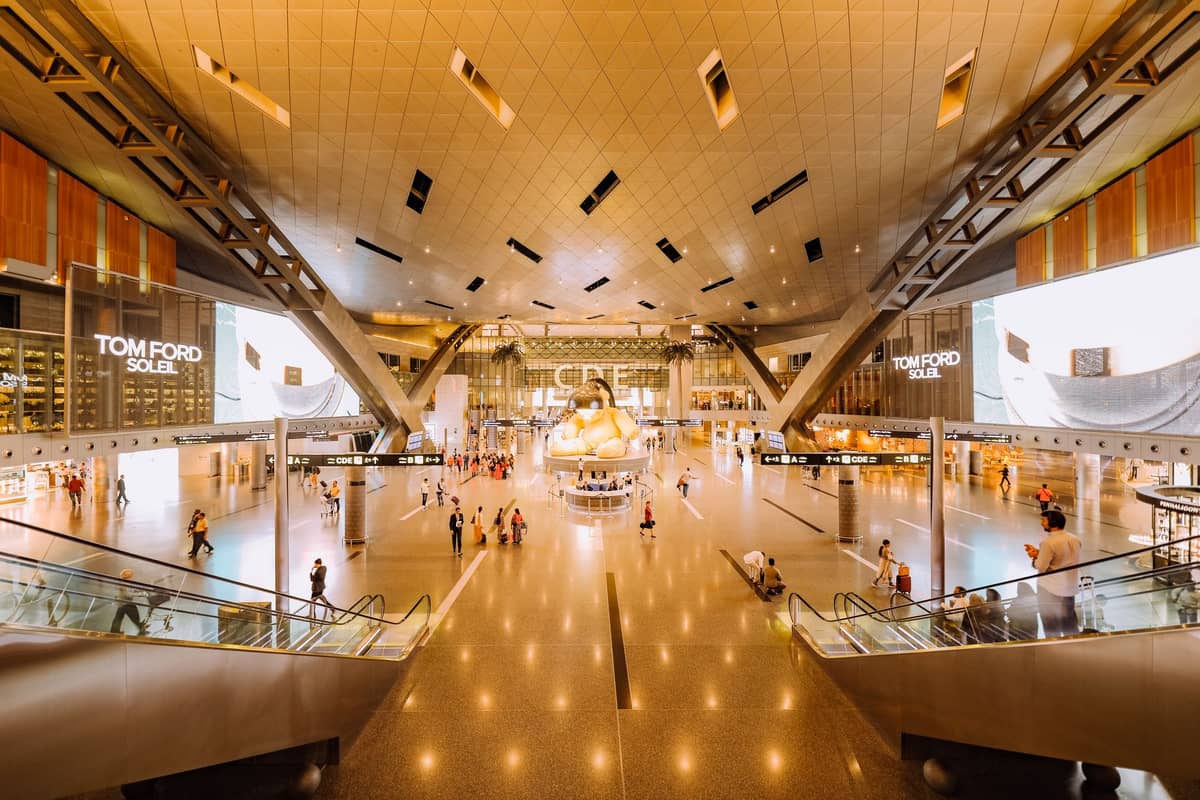
Most airports hang prints in corridors and call it culture. Hamad International Airport does something categorically different. The Hamad International Airport Public Art Collection is a curated, permanent programme of large-scale sculptures, site-specific installations, digital works, and found-object compositions The Hamad International Airport Public Art Collection is a curated, permanent programme of large-scale sculptures, site-specific installations, digital works, and found-object compositions spread across the terminal's arrivals hall, concourses, train stations, lounges, and the indoor garden known as The Orchard. The collection was developed in partnership with Qatar Museums and grew substantially in the years leading up to the 2022 FIFA World Cup, with Qatar Museums and Qatar Airways announcing a target of more than 100 artworks across airport and public art sites in Qatar.
The most talked-about single piece is SMALL LIE, a 10-metre-high sculpture by the American artist KAWS, unveiled at the airport in 2018. The work depicts KAWS's signature XX-eyed figure in a compressed, seated pose — the scale alone stops passengers mid-stride. It is the kind of artwork that rewires your sense of a space: suddenly you notice you are standing inside a building genuinely built to hold serious art, not just foot traffic.
ℹ️ Good to know
All artworks are free to view. You do not need a special ticket or museum pass — access is included with normal airport use, whether you are departing, arriving, or transiting.
The Orchard and the Terminal Environment
The physical setting matters here. Hamad International Airport opened in 2014 and the terminal expansion now includes The Orchard, an indoor garden at the heart of the airport. The Orchard is the spatial anchor for much of the art experience. It contains mature trees, soft lighting, and sculptural works integrated into the planting. The effect is genuinely calming in a way that most airport spaces are not.
The Wildlife Wonderscapes collection adds another layer: a series of permanent animal sculptures installed in and around The Orchard and connecting corridors. These range from quietly naturalistic to boldly stylised.
The transition between landside and airside does affect what you can access. Some works are positioned post-security in the departure concourses, so arriving passengers and visitors who have not cleared security will see a different subset of the collection than departing or connecting travellers. If you are on a long layover, the airside concourses hold some of the most significant pieces.
Time of Day and the Texture of the Experience
Because the airport operates around the clock, the art collection is available throughout the airport — but the quality of the experience shifts considerably depending on when you are there. — but the quality of the experience shifts considerably depending on when you are there. In the early hours, between roughly 2am and 5am, passenger density drops sharply in some concourses. SMALL LIE in particular has a different weight in near-silence: the pale ambient light of the terminal catches the sculpture's surface without the visual noise of crowds photographing it from every angle.
Peak times — typically mid-morning and late afternoon, when multiple intercontinental routes are boarding simultaneously — turn the concourses into rivers of rolling luggage and competing announcements. The art is still there, but negotiating it requires patience. Photography becomes difficult in the busiest corridors around SMALL LIE, as the viewing distance is compressed and other passengers constantly enter the frame.
💡 Local tip
For the best photography of SMALL LIE, try early morning or late night transits when passenger density is low. The sculpture's scale reads best from roughly 15–20 metres back, so position yourself at the far end of the space and use a wide-angle lens or your phone's ultra-wide mode.
Historical and Cultural Context
The collection did not emerge from nowhere. Qatar Museums, the government body overseeing the country's cultural institutions, has pursued an ambitious public art agenda since the mid-2000s, placing major works by international artists at sites across Doha. The airport collection is an extension of that strategy: using the world's highest-traffic point of entry into Qatar as a first statement about the country's cultural ambitions.
This connects to a broader landscape of public art in Doha that is worth understanding before you arrive. Works by Richard Serra, for example, are installed in the desert west of the city — the East-West/West-East installation is one of the most significant site-specific sculptures in the world. The airport collection is, in this sense, the opening chapter of a public art story that continues across the city and into the landscape.
For visitors who want to continue engaging with Qatar's art institutions after landing, the Museum of Islamic Art and the Mathaf: Arab Museum of Modern Art are the two anchor institutions in Doha, representing different ends of the curatorial spectrum — historical Islamic craft on one side, contemporary Arab and international practice on the other.
Practical Walkthrough: How to See the Collection
To see the collection more deliberately, start at The Orchard after clearing security and work outward through the concourses. Artworks are signposted with Qatar Museums labels giving the artist's name and title, though not always extended context.
Allow at least 30 minutes if you are on a short connection and want to see SMALL LIE and The Orchard. A thorough walk through the main concourses and satellite areas takes closer to an hour. Wear comfortable shoes — the terminal is genuinely large and the distances between works can be longer than airport maps suggest.
- SMALL LIE by KAWS: 10-metre-high wooden sculpture, a central landmark post-security
- Wildlife Wonderscapes sculptures: animal works in and around The Orchard
- The Orchard itself: indoor garden with integrated artworks and seating
- Digital and screen-based works in departure lounges and transit areas
- Smaller sculptures and installations throughout the concourse connections
⚠️ What to skip
Some artworks are located exclusively airside (post-security). If you are meeting someone or visiting only the landside arrivals area, you will see a limited portion of the collection.
Getting There and Accessibility
Hamad International Airport is connected to central Doha by the Doha Metro Red Line, which terminates at Hamad International Airport Terminal 1 station. The journey from major city-centre stops is efficient and avoids the variable traffic conditions on the airport road. Taxis and ride-hailing services also serve the airport directly.
For travellers planning a day in the city before or after their flight, Doha's public art experience extends well beyond the terminal. The MIA Park beside the Museum of Islamic Art and the Doha Corniche promenade are both accessible via the Metro and offer outdoor sculpture and architecture in a very different context from the airport.
The terminal is designed for high passenger volumes and is fully step-free along standard passenger routes, with elevators, wide corridors, and mobility assistance services available. The artworks are placed along routes that wheelchair users and passengers with reduced mobility would travel as a matter of course, so accessibility to the collection is not a separate concern.
Is This Worth Your Time on a Layover?
Honestly: yes, more than most airport diversions. The collection does not require art world knowledge to be engaging — SMALL LIE is visually arresting at any level of art familiarity, and The Orchard provides genuine rest in a space that does not feel like a waiting room. For travellers connecting through Doha with three to six hours between flights, this is a more rewarding use of time than a second trip to the duty-free corridor.
If your layover is long enough to exit the terminal, the airport's Red Line connection makes a quick visit to central Doha feasible. Our Doha airport layover guide covers how to structure different layover lengths, including which attractions are realistic given immigration clearance times and transit re-entry.
Who might not enjoy this: travellers with very short connections under 90 minutes will feel rushed, and the airport's scale can feel overwhelming if you are already fatigued. Those primarily interested in Qatari or Islamic art traditions specifically may find the international contemporary focus of the collection only tangentially relevant to their interests — in which case, the Museum of Islamic Art in the city is the better investment.
Insider Tips
- The Qatar Museums website (qm.org.qa) maintains a page for the airport art installations listing works currently associated with HIA — check it before your flight so you know what to look for rather than discovering pieces by accident.
- SMALL LIE is visible from two levels: the ground floor provides close-up scale, while the upper concourse walkway gives you the full figure from a distance. Both perspectives are worth taking before you settle on your photos.
- The Orchard seating is genuinely comfortable and far quieter than the main departure lounge areas. If you need to work, rest, or make calls during a layover, it is one of the better-kept functional secrets in the terminal.
- Many of the smaller works in satellite concourses are installed at eye level with minimal crowd attention — these are often the most intimate encounters in the collection, especially in the quieter hours.
- If you are departing on Qatar Airways and have lounge access, some premium lounge areas contain additional art pieces from the Qatar Museums programme not publicly listed on the airport's standard art map.
Who Is Hamad International Airport Public Art Collection For?
- Layover travellers with 2 or more hours between connections
- Art and design enthusiasts flying through Doha
- Families with children who respond well to large-scale sculpture
- Photographers interested in the intersection of architecture and contemporary art
- First-time visitors to Qatar wanting an immediate sense of the country's cultural ambitions
Nearby Attractions
Combine your visit with:
- Al Hazm Mall
Al Hazm Mall is not a typical shopping centre. Built in a classical European-inspired style with colonnaded stone arcades and soaring ceilings, this northern Doha landmark houses luxury boutiques, acclaimed restaurants, and art installations in a setting that feels more like a Milanese galleria than a Gulf mall. Entry is free, the architecture alone justifies the visit, and the restaurant scene is among the strongest in the city.
- Al Safliya Island
A small, uninhabited sand island off the Doha coast, Al Safliya Island draws visitors with clear Gulf waters, a quiet beach, and easy half-day boat access from The Pearl-Qatar or the Corniche. There are no facilities on the island, so what you bring is what you have.
- Al Shahaniya Camel Racetrack
Al Shahaniya Camel Racetrack is Qatar's principal venue for camel racing, a sport central to the country's Bedouin heritage. Located about 40–60 minutes west of central Doha along the Dukhan Highway, the track draws local families, Qatari enthusiasts, and curious visitors during its October-to-April season. Entry to regular race days is free.
- Al Thakira Mangroves
About 64 km north of Doha, the Al Thakira Mangroves protect one of Qatar's largest and most ecologically significant coastal habitats. Whether you paddle through the channels at sunset or simply walk the shoreline at low tide, this protected reserve offers a rare contrast to the capital's urban skyline.