Guanlan International Print Village: Shenzhen's Surprising Art District
Guanlan Original Printmaking Base is a working printmaking community built inside restored Hakka village houses in Longhua District. Free to enter and largely off the tourist circuit, it offers a rare combination of living art practice, rural heritage architecture, and genuine quiet in a city that rarely stands still.
Quick Facts
- Location
- 169 Yuxin Road, Guanlan Subdistrict, Longhua District, Shenzhen
- Getting There
- Metro Line 4, then bus 312, M338, Shenguan Line 2, B877, or M285
- Time Needed
- 2 to 4 hours
- Cost
- Free entry to the base; individual gallery purchases optional
- Best for
- Art lovers, architecture enthusiasts, anyone wanting quiet creative atmosphere
- Official website
- http://www.guanlanprints.com/en/
What Guanlan Print Village Actually Is
The China·Guanlan Original Printmaking Base, known officially in Chinese as 观澜版画原创产业基地, is a government-supported art district built inside a cluster of traditional Hakka village houses in Longhua District. Planned in 2006 and opened in May 2008, the base covers a core area of around 316,000 square meters. It combines working printmaking studios, artist residencies, exhibition galleries, and preserved heritage architecture into a single walkable site.
The concept was deliberately different from Shenzhen's typical development logic: instead of demolishing old Hakka structures to build something new, the village was restored and repurposed. The result is a place where you can walk between centuries-old courtyard homes and peer through open studio doors at artists working printing presses. It is legitimately one of the few places in Shenzhen where the built environment feels old, quiet, and considered.
For context on how this fits into Shenzhen's broader creative scene, theShenzhen contemporary art guidecovers several districts worth comparing, including the olderOCT-LOFT creative districtin Nanshan.
ℹ️ Good to know
Entry to the base itself is free. Individual galleries may have their own hours or ticketing. A third-party visitor guide reports the site operates Wednesday to Monday, 9:00 a.m. to 5:00 p.m., closed Tuesdays — but verify this before visiting, as gallery schedules vary and no single unified timetable is posted officially.
The Architecture: Hakka Villages Meet Print Studios
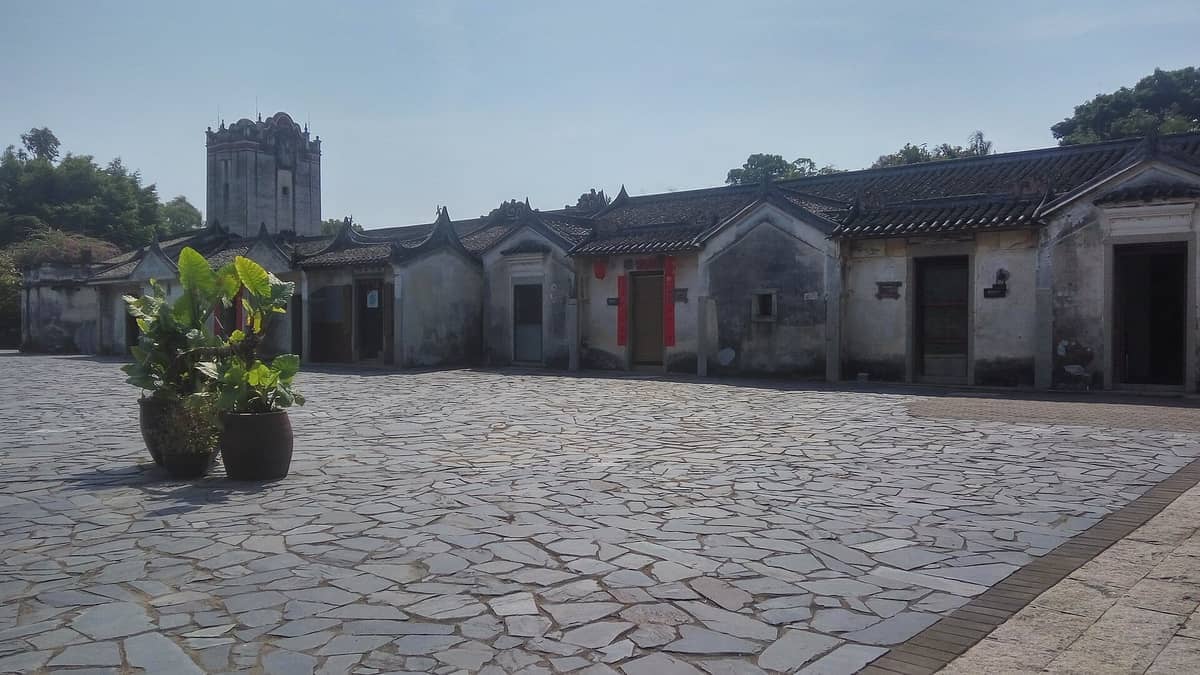
The physical setting is the strongest argument for coming here. The Hakka people built a distinctive style of village architecture across southern Guangdong, characterized by dense courtyard compounds, thick rammed-earth or brick walls, grey tile rooflines, and narrow internal lanes designed as much for defense and community as for living. At Guanlan, those structures have been carefully restored rather than reconstructed, which means you encounter genuine weathering, original masonry, and spatial proportions that no modern imitation captures.
Walking the internal lanes, the scale is deliberately intimate. Doorways are low, courtyards are small, and the transition between covered and open space is constant. Galleries have been fitted inside these rooms with minimal intervention — white walls, track lighting, timber floors — without disguising the original bones of each building. In some spaces you can see where new electrical conduit runs alongside exposed brick, a practical honesty that suits the site's character.
Exterior spaces between buildings include stone-paved paths, small ponds, and sections of original village wall. These outdoor areas are where the integration of old and new is most legible: a modern sculpture might sit at the end of a Hakka alleyway, or a large-format print might be mounted on a whitewashed gable wall. The juxtaposition is mostly successful, occasionally awkward, and always interesting.
Printmaking as a Living Practice
Printmaking has a specific meaning here: the base focuses on original fine-art printmaking, including woodblock, etching, lithography, screenprint, and relief methods. These are not reproductions or commercial work. Resident artists create limited-edition prints in studios open to the complex, and the site hosts the Guanlan International Print Biennial, which draws submissions and participants from dozens of countries. The biennial has built genuine international standing in the printmaking world and is a meaningful reason the base exists beyond tourism.
On a regular visiting day, you might hear the slow mechanical thud of a press, smell the sharp mineral edge of etching ink, or watch an artist pin a damp sheet of paper to a drying board. These are not staged demonstrations. Studios are working spaces that happen to be observable, and the pace is slow and methodical in a way that feels out of step with Shenzhen's usual register. That contrast is worth noting: this is one of the few places in the city where nothing appears to be moving urgently.
💡 Local tip
If you want to see studios in active use, aim for weekday mornings. Weekends attract more visitors and some studios may be closed for private events or biennial preparation. Ask at the main reception building about any open workshops or temporary exhibitions before you start walking.
How the Visit Unfolds: A Practical Walkthrough
The base has a main entrance area with signage in both Chinese and English. From there, the site spreads across several interconnected zones, each centered on a different cluster of restored buildings. There is no single prescribed route, and that is part of the point: you are meant to wander. However, first-time visitors benefit from knowing the rough layout — exhibition halls and the most prominent galleries tend to cluster near the main entrance, while artist studios and smaller residential buildings are further in.
Give yourself at least two hours. The physical area is large enough that a quick pass misses entire wings, and the work on display rewards slower looking. Original prints often have subtle tonal and textural qualities that only register up close, under natural or directed light. Rushing through is one of the most common ways to undervalue the visit.
Photography is generally permitted throughout the public areas. Natural light inside the courtyard buildings is often soft and directional, making early afternoon a reasonable time for interior shots. Outside, the grey tile rooflines against a blue sky photograph well in the cooler months from October to December, when Shenzhen's air is cleaner and more transparent.
Longhua District has more to offer beyond print art. TheLonghua neighborhood guideoutlines other reasons to make the trip north from central Shenzhen.
Getting There from Central Shenzhen
The base is in Guanlan Subdistrict, in the northern part of Longhua District. The recommended route uses Metro Line 4, then one of several connecting buses: lines 312, M338, Shenguan Line 2, B877, or M285. Budget this realistically — it is not a short trip.
The address is 169 Yuxin Road, Guanlan Subdistrict, Longhua District. Use this full address in a navigation app (Gaode Maps or Baidu Maps work well in China; Google Maps is less reliable without a VPN). Taxi and ride-hailing via Didi are also practical options from Longhua station, particularly on the return journey after your feet are tired.
⚠️ What to skip
The site is not central. Do not combine this with a full day of sightseeing in Futian or Nanshan unless you have very long days. It works best as a dedicated half-day trip, ideally paired with something else in Longhua.
If you are planning your time carefully, theguide to getting around Shenzhencovers metro line connections and transit card setup in detail.
Who This Is and Is Not For
Guanlan Print Village is genuinely unusual in the context of Shenzhen tourism. It is not commercial, not loud, and not designed to process high visitor volumes quickly. The work on display assumes some interest in fine art printmaking, or at least in careful looking. Visitors who arrive expecting an interactive experience, a souvenir market, or a photogenic backdrop for social media will find the site underwhelming.
People who will get the most from this visit are those who appreciate the specific craft of printmaking, who find restored historic architecture worth walking slowly through, or who are simply looking for a remarkably quiet afternoon in a city that offers very few of them. The distance from the tourist circuit is not a flaw — it is why the place still functions as a working artist community rather than a performance of one.
For travelers building a broader picture of Shenzhen's creative identity, bothDafen Oil Painting VillageandOCT-LOFToffer different angles on how art and commerce intersect in this city.
Practical Notes: Accessibility, Weather, and Timing
The site is a restored village, which in practice means uneven stone paving, steps into individual buildings, and narrow doorways in some structures. Wheelchair access to the outdoor spaces may be possible in parts, but interior gallery access cannot be guaranteed. Visitors with mobility considerations should contact the base directly before making the trip.
Weather matters here more than at most Shenzhen attractions. The outdoor elements of the site — courtyards, garden paths, inter-building lanes — make up a significant part of the experience, and heavy rain or summer heat reduces the visit considerably. October through December is the most practical window: temperatures are mild, rainfall is lower, and the afternoon light on the old brick and tile is at its best. Avoid summer visits unless you have a high tolerance for heat and humidity.
Insider Tips
- Weekday mornings are the best time to catch artists actually working in the studios. By early afternoon on weekends, group visits can crowd the main galleries and reduce the contemplative atmosphere that makes the site worth the journey.
- The base hosts the Guanlan International Print Biennial. Check the official site at guanlanprints.com before planning your visit — arriving during a biennial period means significantly more work on display and a livelier atmosphere throughout the complex.
- Bring cash if you want to buy prints. Card payment terminals are not guaranteed in smaller studios, and original limited-edition prints from resident artists are occasionally available at prices well below what equivalent work would cost in commercial galleries.
- The older Hakka village sections further from the main entrance are quieter and less visited. Push past the first cluster of exhibition spaces to find the areas where restoration feels more recent and the architecture is more intact.
- Navigation apps in English sometimes struggle with the specific address. Save the Chinese characters 观澜版画原创产业基地 on your phone and show them to a driver or bus passenger if you get turned around in the Guanlan area.
Who Is Guanlan International Print Village For?
- Fine art and printmaking enthusiasts who want to see the medium treated seriously
- Architecture and heritage travelers interested in Hakka building traditions
- Visitors looking for a slow, quiet afternoon away from Shenzhen's commercial districts
- Contemporary art researchers and students interested in China's biennial circuit
- Photographers seeking textured, unhurried subjects in restored historical settings
Nearby Attractions
Other things to see while in Longhua:
- Guanlan Ancient Town
Officially known as Guanlan Culture Town, this historic Hakka-style market town in Longhua District is one of Shenzhen's oldest surviving heritage areas. Admission is free, and the contrast with the factory-lined roads surrounding it is striking.