Guanlan Ancient Town: Shenzhen's Historic Hakka Market Town
Officially known as Guanlan Culture Town, this historic Hakka-style market town in Longhua District is one of Shenzhen's oldest surviving heritage areas. Admission is free, and the contrast with the factory-lined roads surrounding it is striking.
Quick Facts
- Location
- Xinlan Community, Guanlan Subdistrict, Longhua District, Shenzhen
- Getting There
- Guanlan Station, Metro Line 4, Exit B — approx. 9-10-minute walk
- Time Needed
- 1.5 to 2.5 hours
- Cost
- Free admission
- Best for
- History lovers, architecture enthusiasts, off-the-beaten-path explorers
- Official website
- www.szlhq.gov.cn/english/GuanlanCultureTown/mindex.html
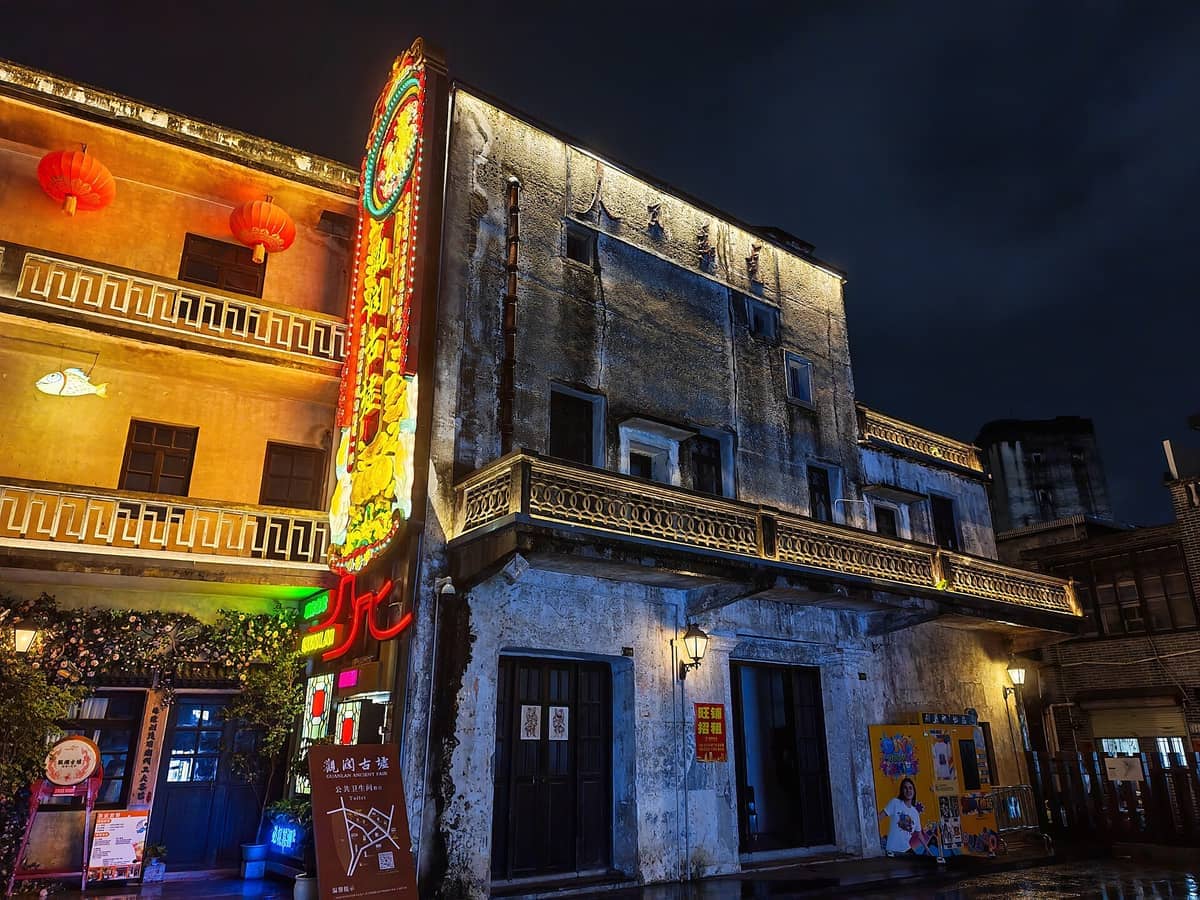
What Is Guanlan Ancient Town?
Guanlan Ancient Town, officially named Guanlan Culture Town (观澜古墟), is a large Hakka-style heritage market complex in Shenzhen. It is regarded as one of the city's oldest surviving historic market areas, and its preserved buildings reflect more than two centuries of change — a remarkable fact in a city that demolished most of its pre-modern fabric during the development boom of the 1980s and 1990s.
Guanlan is often counted among Shenzhen's historic ancient markets, alongside other heritage sites scattered across what were once rural Hakka villages. Guanlan retains enough contiguous streetscape to give a real sense of what a Qing-era market town looked like: grey-brick shop-houses fronting a narrow lane, ancestral halls at key junctions, clan temples with incense smoke curling through the rafters, and the occasional banyan tree whose roots have cracked through the old stone paving. Where those other sites are often smaller or more fragmentary, Guanlan retains enough contiguous streetscape to give a real sense of what a Qing-era market town looked like: grey-brick shop-houses fronting a narrow lane, ancestral halls at key junctions, clan temples with incense smoke curling through the rafters, and the occasional banyan tree whose roots have cracked through the old stone paving.
💡 Local tip
The site is free to enter and has no ticketing barrier. There is no single gate — you can approach the main lane from several directions, so orient yourself using the stone archway at the main entrance before wandering deeper.
The Hakka Architectural Character
The Hakka people — Han Chinese who migrated south over successive centuries and settled across Guangdong, Fujian, and Jiangxi — developed a distinctive building tradition that prioritized defensibility, clan solidarity, and ritual order. At Guanlan, this translates into thick grey-brick walls, narrow shopfront facades with deep interiors, and buildings arranged around shared courtyards where extended families once cooked, worshipped, and conducted business.
The decorative grammar is worth slowing down for. Look at the ridge tiles on the clan halls: many feature upturned swallow-tail ends, a Chaoshan and Hakka motif that signals prosperity and protection. The painted lintels above doorways use mineral pigments that have faded to soft ochres and terracottas. Carved wooden screen panels inside the ancestral halls show scenes from classical stories — cranes, pine trees, and scholars on horseback, worn smooth by decades of incense smoke.
For architectural context, Guanlan pairs well with a visit toNantou Ancient Cityin Nanshan, another surviving pre-modern settlement in Shenzhen, though Nantou's character is very different — more urban, more commercial, and busier. Abroader look at Shenzhen's architectural rangeshows just how rare Guanlan's scale of preservation is.
Walking the Site: What to Expect
The core of Guanlan Ancient Town is a single main lane running roughly east to west, flanked by shop-houses on both sides. At full length the lane takes about fifteen minutes to walk without stopping, but you will stop. Side alleys branch off at irregular intervals, leading to quieter residential courtyards where elderly residents still live. Some buildings are in active use as tea houses, small restaurants, or community spaces. Others stand empty, their wooden doors bolted and their interiors visible only through gaps in the planks.
The smells shift as you move through the lane. Near the entrance, there is usually the char of incense from the small temple just inside. Further in, the earthiness of old stone and damp brick takes over. If a tea house is open, the faint sweetness of pu-erh reaches the street. On weekday mornings, the sound profile is surprisingly quiet: birdsong, the distant hum of Longhua's traffic, and occasionally the clatter of a resident moving through their courtyard.
Weekend afternoons change the atmosphere considerably. Local families arrive with children, and a modest number of Shenzhen day-trippers explore the lane. There are food stalls selling traditional Hakka snacks near the entrance on busier days. Even so, this is not a heavily touristed site by Shenzhen's standards. You will not encounter queues, audio guide rentals, or the kind of managed flow you find at the city's commercial attractions.
⚠️ What to skip
Some buildings are structurally compromised and fenced off. Do not attempt to enter areas that are visibly blocked. The restoration work at the site is ongoing, and sections may be inaccessible depending on the phase of works at the time of your visit.
Best Time to Visit
Weekday mornings between 9am and 11am offer the clearest experience: good natural light for the east-facing shopfronts, minimal crowds, and a quieter soundscape. The lane runs roughly east-west, which means morning light falls directly onto the facades on the north side and fills the lane from the entrance end. For photography, this window is the most useful.
Seasonally, the coolest and driest months, typically October through December, make the walk noticeably more comfortable. Shenzhen's summer months bring high humidity and frequent rain. The site has limited covered sections, so a sudden downpour can make the stone lanes slippery and unpleasant. Check thebest time to visit Shenzhenbefore planning a trip that relies on outdoor heritage sites.
Avoid the site on national holiday weeks, particularly Golden Week in early October, when even niche heritage sites in Shenzhen see a notable uptick in domestic visitors. The rest of the year, it remains one of the quieter options for a half-day in the city.
Getting There and Practical Logistics
The most straightforward route is Metro Line 4 to Guanlan Station, Exit B. From there it is approximately a ten-minute walk to the site. Guanlan Station is served by trains running between Futian and Longhua, making it accessible from central Shenzhen in around thirty to forty minutes depending on your starting point.
Alternatively, if you are combining the visit with nearby Longhua attractions, Didi ride-hailing drops you at the lane entrance. For a broader itinerary, Guanlan pairs reasonably well with a morning atGuanlan Print Village, the international printmaking base located in the same subdistrict, which would give you an interesting contrast between historical preservation and contemporary arts infrastructure.
Footwear matters more here than at most Shenzhen attractions. The stone paving is uneven and can be slick after rain. Flat-soled, closed-toe shoes are strongly recommended. There are no formal restroom facilities inside the ancient lane itself; use facilities before you arrive or at the adjacent commercial area near the entrance.
ℹ️ Good to know
The site address is Xinlan Community, Guanlan Subdistrict, Longhua District, Shenzhen (龙华区观澜街道新澜社区). Showing this to a taxi driver or entering it into a map app will get you to the entrance without confusion.
Who Will Love This, and Who Won't
Guanlan Ancient Town rewards visitors who are interested in pre-modern Chinese architecture, Hakka culture, or the genuine texture of what Shenzhen looked like before it became a megacity. It is not curated for mass tourism. There are no English-language information panels at the time of writing, no audio guides, and no gift shops. The interpretation is thin, and without background knowledge the significance of what you are looking at can be easy to miss.
Travelers seeking polished theme-park heritage experiences, a type well represented in Shenzhen at places likeSplendid China Folk Village, will likely find Guanlan underwhelming. The buildings are genuine but worn. There is no performance schedule, no costumed staff, and no narrative arc to the visit. What it offers instead is texture, quietness, and a rare sense that you are standing in a space shaped by generations of ordinary commercial and domestic life rather than by modern reconstruction.
Travelers with limited mobility should note that the main lane has uneven stone surfaces throughout, and several of the more interesting side courtyards involve steps. There is no formal accessibility infrastructure reported at the site.
Photography Notes
Guanlan is a genuinely photogenic site, but it rewards patience over snap-and-move approaches. The most interesting images come from the interplay of decayed surfaces: moss on stone steps, peeling plaster revealing older layers of paint, timber frames darkened by decades of incense. A wide-angle lens handles the narrow lane well. For the clan halls, where interior light is dim and contrast with the bright lane outside is high, bracket your exposures or shoot in raw format.
Some residents still live within the complex. Ask before photographing people in their homes or courtyards. This is not a stage set; it is someone's neighborhood, and treating it accordingly usually results in warmer interactions and better photographs anyway.
Insider Tips
- The side alleys branching off the main lane are where the most intact residential architecture survives. Most visitors turn back at the midpoint of the main street — push further and the crowds thin noticeably.
- There is a small ancestral hall roughly two-thirds of the way down the lane on the left side. The courtyard in front of it is the best single vantage point for understanding the scale and layering of the complex. Spend time here rather than rushing through.
- Weekday mornings are significantly quieter than weekends. If you are coming specifically to photograph the site or simply want to absorb the atmosphere without interruption, Tuesday to Thursday before noon is the optimal window.
- Mobile signal is fine throughout the lane, but there is no public Wi-Fi. Download an offline map of the Guanlan Subdistrict before you arrive — the streets around the ancient market are not always clearly signed.
- If you are visiting on a weekend and food stalls are operating near the entrance, the traditional Hakka snacks available are worth trying. Sticky rice cakes and braised pork dishes are common offerings and reflect the culinary traditions of the communities who built the market.
Who Is Guanlan Ancient Town For?
- Architecture and heritage travelers who want to see genuine Qing Dynasty Hakka construction at scale
- Photographers looking for aged textures, natural light, and authentic street scenes outside the usual tourist circuit
- Travelers with half a day in Longhua who want to pair a heritage visit with Guanlan Print Village nearby
- Visitors interested in the contrast between Shenzhen's ultra-modern urban identity and its older, slower rural origins
- Budget travelers, since entry is free and the site is easily reached by metro
Nearby Attractions
Other things to see while in Longhua:
- Guanlan International Print Village
Guanlan Original Printmaking Base is a working printmaking community built inside restored Hakka village houses in Longhua District. Free to enter and largely off the tourist circuit, it offers a rare combination of living art practice, rural heritage architecture, and genuine quiet in a city that rarely stands still.