Splendid China & China Folk Culture Villages: A Complete Visitor Guide
Splendid China & China Folk Culture Villages packs the country's most iconic landmarks into miniature scale alongside full-size recreations of China's 56 ethnic minority villages. Located in OCT Shenzhen along Shennan Avenue, it is one of the city's oldest theme parks and remains an educational and visually striking experience for those willing to take it seriously.
Quick Facts
- Location
- No. 9005 Shennan Avenue, OCT, Nanshan District, Shenzhen
- Getting There
- Metro Line 1, Huaqiaocheng (OCT) Station, Exit C or D — walk east ~5 min
- Time Needed
- 3–5 hours; a full day if you stay for the evening show
- Cost
- CNY 220 adult all-day ticket (verify current pricing at official site)
- Best for
- Families, first-time visitors to China, cultural education, evening entertainment
- Official website
- www.szjxzh.com.cn/english
What Is Splendid China Folk Village, Exactly?
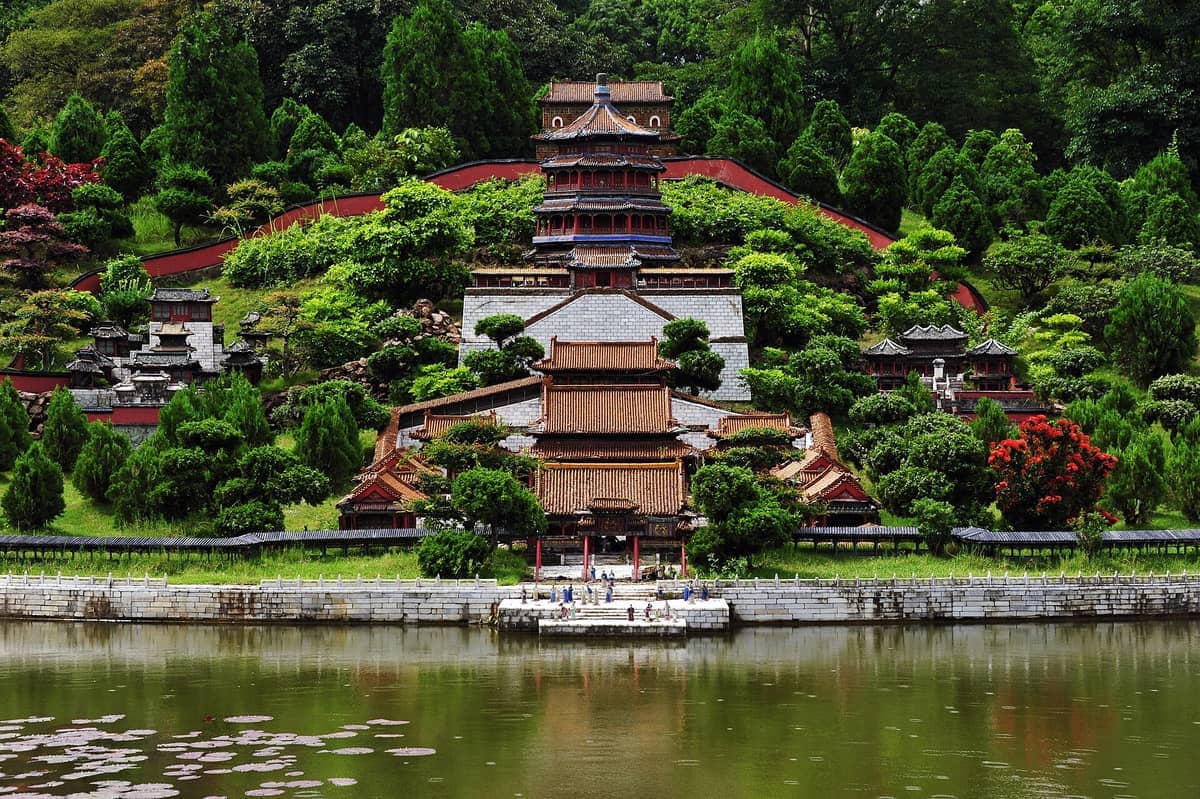
Splendid China·Folk Culture Villages (锦绣中华·民俗村) is technically two parks that have been integrated into one continuous experience. The Splendid China Miniature Scenic Area opened on September 21, 1989, covering 320,000 square meters, and presents scaled-down replicas of China's most recognizable landmarks: the Great Wall, the Forbidden City, the Terracotta Army, the Potala Palace, and dozens more. The adjacent Chinese Folk Culture Village Tourist Area opened in October 1991 across 200,000 square meters and takes an entirely different approach, with full-scale reconstructions of traditional village architecture representing all 56 of China's officially recognized ethnic groups.
Together they occupy a significant footprint along Shennan Avenue in the OCT development zone. The combined park is one of the earliest purpose-built tourist attractions in Shenzhen and helped define what tourism in the city could look like before the tech economy took over the narrative. That history is worth keeping in mind: this is not a polished international resort built in the last decade. It carries its age in certain corners, and that honest wear is part of what makes it interesting.
💡 Local tip
Buy tickets online through the official site or a verified booking platform before you arrive. On public holidays and summer weekends, queues at the gate can be long, and advance purchase often comes with a small discount.
The Miniature Scenic Area: China in a Single Afternoon
Walking through the Splendid China section feels disorienting at first. The models are precise enough to read as architecture rather than toys, yet everything is scaled to roughly 1:15, so you move past the Great Wall in a few minutes and crane your neck down at the Huangshan mountain peaks. The craftsmanship in the older sections is impressive — granite surfaces, hand-laid ceramic tiles, water features that mirror the positioning of the real sites. Some of the newer additions are less refined, and the scale occasionally shifts unexpectedly between adjacent exhibits, which breaks the illusion.
The layout roughly follows China's geography, so you move westward through the park from the eastern coastal landmarks toward the Tibetan Plateau and Xinjiang. If you know Chinese geography even loosely, the sequence rewards attention. If you do not, the signage in English is functional if not always elegant, and gives enough context to understand what each structure represents.
Morning light falls across the central miniature landscape in a way that suits photography well, particularly between 10:00 and 11:30 when the park opens and crowds are thin. The golden hour before closing is equally good but the park shifts focus toward live performance by then, so the miniature zone empties out and you can move through it almost alone.
The Folk Culture Villages: Architecture, Performance, and Craft
The Folk Culture Village section is the more substantial half of the park for most adult visitors. The village reconstructions range from Miao stilted wooden houses in the south to Mongolian yurts and Tibetan stone towers in the north and west. Each cluster is built around actual construction methods and materials of the period, and the scale here is human rather than miniature: you walk inside the structures, which gives a completely different understanding of space and proportion.
Throughout the day, performers in traditional dress demonstrate crafts, music, and dance specific to each group. The schedule varies and is posted at the park entrance; arrival before noon gives you the most flexibility to catch performances across multiple village sections without doubling back. Some demonstrations involve participation and are pitched toward families, while others are more formal presentations. Quality varies noticeably across sections: a few of the performances are genuinely skilled and worth pausing for; others feel perfunctory.
For context on how this fits into the broader cultural landscape of the city, theShenzhen Museumprovides a more historically rigorous introduction to local and regional history, while this park offers the visual and theatrical dimensions that a museum cannot.
The Evening Show: When the Park Transforms
The park's operating hours run until 21:00, and the evening program is a significant part of what justifies the ticket price. As daylight fades, the main performance venues run a large-scale show incorporating acrobatics, ethnic minority dance, light projections, and occasional pyrotechnics. The production values are higher than the daytime village performances and the staging is purpose-built for it.
The shift from afternoon to evening also changes the mood of the miniature zone. The models are illuminated after dark and the light plays differently across the contoured landscapes, making certain shots that were flat in midday light suddenly interesting. If photography matters to you, staying into the evening earns you two distinct sets of conditions in one visit.
ℹ️ Good to know
Opening hours are 10:00–21:00. Check the official site for current holiday and peak-season schedules, as closing times may vary during summer and major Chinese public holidays.
Getting There and Getting Around the Park
The most reliable route is Metro Line 1 to Huaqiaocheng Station, then Exit C or D. From the exit, the park entrance is a short walk along Shennan Avenue. The signage is clear and the walk is straightforward. Several bus routes also terminate near the park; look for stops labeled Jinxiu Zhonghua. Taxis and ride-hailing via Didi work fine for direct drop-off to the gate.
The OCT neighborhood is one of Shenzhen's most interesting districts beyond just this park. The creative cluster atOCT-LOFTis a short walk away and offers a sharp contrast: where the Folk Culture Village is curated and historic, OCT-LOFT is industrial, contemporary, and arts-focused. Combining both in a single day is practical and makes the geographic contrast between them more interesting.
Inside the park, the two zones are connected and you can move between them without re-entering. The terrain is mostly flat with paved paths, though some sections of the village area have uneven traditional paving stones. Comfortable walking shoes matter here: a thorough visit covers several kilometers. The park is large enough that midday heat in summer (June through August) can be tiring. Lightweight clothing, sunscreen, and water are essential in warm months.
⚠️ What to skip
Summer visits (June–August) involve high humidity and hot temperatures. Shaded seating is limited in parts of the miniature zone. Schedule those sections for morning, and keep afternoon time for the shaded interior village structures.
Who Gets the Most From This Park
Splendid China Folk Village works best as a cultural orientation rather than a theme-park experience. Travelers visiting China for the first time, or those who will only see Shenzhen and want a sense of the country's geographic and ethnic breadth, find it useful. The same applies to families with children in the eight to fourteen age range: the miniatures hold attention well and the village performances offer interaction that passive museum visits do not.
For visitors who have already traveled widely across China and seen the actual Great Wall, Forbidden City, and similar sites, the miniature section will feel redundant. That is a fair criticism and worth stating. Those visitors might be better served spending time at theShenzhen Contemporary Art Museumor exploring thearchitectural landmarksthat reflect what the city has become, rather than what China was.
The park also serves well as a single extended itinerary for visitors who want a structured day without logistical complexity: arrive at opening, work through the miniature zone, catch folk performances through the afternoon, stay for the evening show, leave after 20:00. That plan covers the park's full range and feels complete rather than rushed.
Photography and Practical Logistics
The miniature zone is the most photogenic part of the park and rewards a wide-angle lens or the equivalent phone setting. Getting low and shooting upward at the models against the sky removes most of the surrounding infrastructure from frame and makes the scale illusion work in photographs. Early morning and post-sunset illumination are the two strongest windows for this.
Food options inside the park include restaurants and stalls themed to different regional cuisines. Quality is variable, but the Sichuan and Yunnan options tend to be more authentic than the generic fast-food outlets near the main gate. Carrying cash in CNY is advisable.
If you are planning a broader day in the OCT area, theShenzhen travel guideand the dedicatedOCT neighborhood overviewcover the surrounding attractions and logistics in detail.
Insider Tips
- Arrive at 10:00 when the gates open. The miniature zone is essentially empty for the first 90 minutes and you can move through it at your own pace without other visitors blocking sightlines for photography.
- The evening performance schedule is posted near the main entrance. Pick it up on arrival and plan your afternoon route backward from the show time you want to catch, rather than discovering you missed it while still in the miniature zone.
- The village sections closest to the back of the park (further from the main entrance) tend to be less visited and are often where the more skilled craft demonstrations happen, away from the high-traffic central performance stages.
- On weekday mornings outside of Chinese school holidays, the park is noticeably quieter than on weekends. If your schedule allows a Tuesday or Wednesday visit, the experience is considerably more relaxed.
- Bring a portable charger. Between photos in the miniature zone, performance videos, and navigation, phone batteries deplete faster here than on a typical city walk. Charging points inside the park are limited.
Who Is Splendid China & China Folk Culture Villages For?
- First-time visitors to China wanting a geographic and cultural overview in a single day
- Families with children aged 8–14 who engage well with scale models and live performances
- Travelers with limited time who want both daytime exploration and an evening show in one location
- Photography enthusiasts interested in architectural miniatures and traditional costume documentation
- Visitors curious about China's ethnic minority cultures beyond the Han mainstream
Nearby Attractions
Other things to see while in OCT (Overseas Chinese Town):
- Happy Valley Shenzhen
Happy Valley Shenzhen (深圳欢乐谷) is one of southern China's largest theme parks, open since 1998 in the OCT district of Nanshan. From high-speed roller coasters to evening light shows, here is what to expect, when to go, and how to make the most of a full day.
- OCT Loft Creative Culture Park
Occupying repurposed factory buildings from the late 1970s and 1980s, OCT Loft Creative Culture Park (华侨城创意文化园) is Shenzhen's most established creative district. Free to enter, it combines independent galleries, design studios, street art, and strong coffee in a compact, walkable setting in Nanshan.
- Window of the World
Window of the World packs 130-plus miniature attractions and landmarks into a single 480,000-square-meter park in Shenzhen's OCT district. It's part theme park, part open-air geography lesson, and part cultural performance venue — and it works better than you might expect.