Window of the World Shenzhen: What to Expect Before You Go
Window of the World packs 130-plus miniature attractions and landmarks into a single 480,000-square-meter park in Shenzhen's OCT district. It's part theme park, part open-air geography lesson, and part cultural performance venue — and it works better than you might expect.
Quick Facts
- Location
- No. 9037 Shennan Avenue, Nanshan District, Shenzhen (OCT area)
- Getting There
- Metro Line 1 or Line 2 to Window of the World Station (世界之窗站), Exit J
- Time Needed
- 3 to 5 hours; a full day if you include evening shows
- Cost
- Approx. CNY 220 daytime adult ticket; CNY 100 evening ticket. Verify before visiting.
- Best for
- Families, first-time visitors to Shenzhen, photography, evening entertainment
- Official website
- www.szwwco.com
What Is Window of the World, Exactly?
Window of the World (世界之窗) opened in 1994 in what was then a rapidly modernizing Shenzhen, Window of the World (世界之窗) opened in 1994 in what was then a rapidly modernizing Shenzhen. The concept was straightforward: build scaled-down replicas of the world's most famous landmarks so people could see the Eiffel Tower, the Taj Mahal, and the Egyptian pyramids in a single afternoon. Three decades later, the park still draws large crowds, partly through nostalgia and partly because the execution remains genuinely impressive.
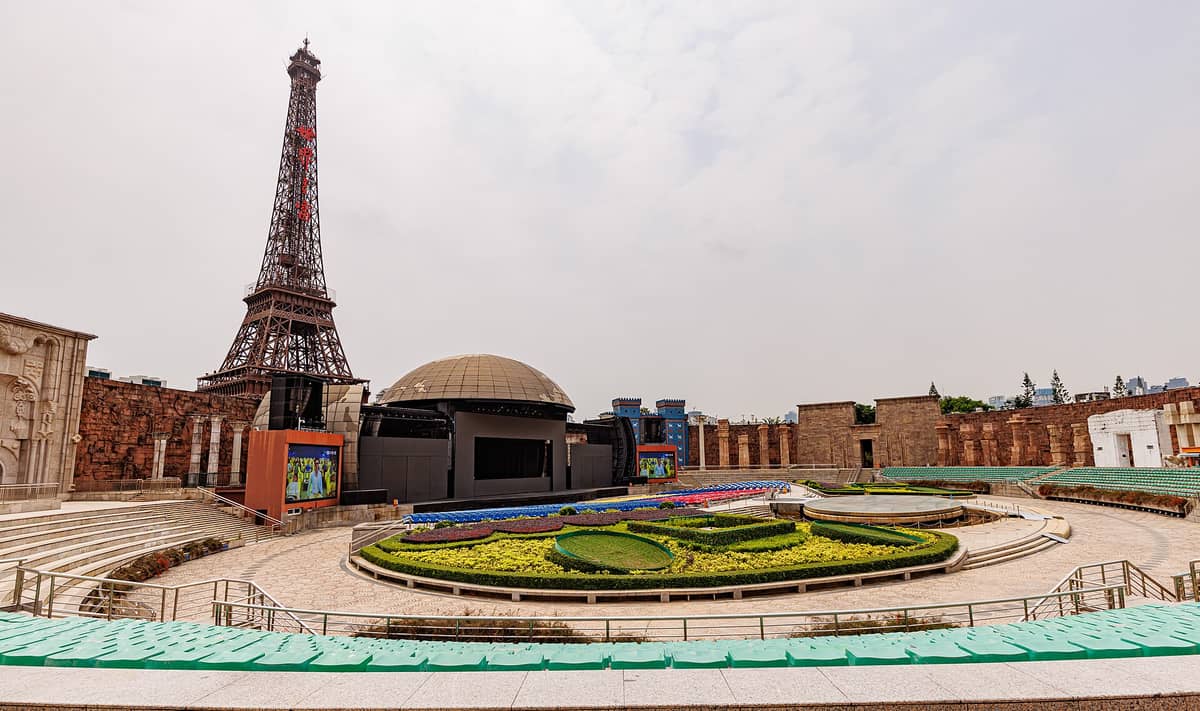
The park spans approximately 480,000 square meters and organizes its replicas into themed zones corresponding to different world regions: Europe, Asia, the Americas, Africa, Oceania, The park spans approximately 480,000 square meters and organizes its replicas into themed zones corresponding to different world regions, including Europe, Asia, the Americas, Africa, and Oceania. The structures range in scale from knee-high to several storeys tall, and the larger ones — particularly the Eiffel Tower replica, which is roughly one-third the height of the original — catch you off-guard when they appear above the treeline.
ℹ️ Good to know
Verify opening hours before you go. Official sources list hours as either 09:00–21:30 or 09:00–22:30 depending on the platform. The park's official website is the most reliable source for current times and pricing.
How the Experience Changes Through the Day
Arriving at opening — around 09:00 — gives you roughly two hours of relative calm. The light is soft and workable for photography, the main walkways are uncrowded, and the overall scale of the place becomes apparent when you're not navigating around tour groups. The Eiffel Tower zone and the European section tend to fill up first as the morning progresses, so starting there makes sense.
By mid-morning on weekends and public holidays, the crowd density shifts considerably. Chinese school groups arrive in organized columns, and the more photogenic spots develop informal queues. The atmosphere is loud and social rather than serene — vendors, recorded music from performance stages, children running between replica monuments. If you came expecting a quiet open-air museum experience, adjust your expectations accordingly.
The evening transformation is the genuine highlight that many daytime visitors miss entirely. After dark, the entire park switches to decorative lighting, and the Eiffel Tower replica in particular takes on a completely different character. Live performances, some involving large-scale projections or choreographed light shows, run on the main stage area. The evening ticket at approximately CNY 100 is a better choice than the full daytime ticket if your primary interest is spectacle rather than replica-viewing.
The Replicas Themselves: What to Expect
The quality varies noticeably by zone. The European section contains the most ambitious structures — the Eiffel Tower, the Arc de Triomphe, sections of the Acropolis, and a convincing rendering of Notre-Dame de Paris that predates the 2019 fire. These are built with enough detail to be interesting to observe up close, including stonework textures and decorative ironwork. The proportions hold up at normal viewing distances.
Other zones are less consistent. Some replicas feel like theme park props from a distance, and the landscaping around them occasionally looks worn. The park is old enough that maintenance quality matters, and it shows in patches. That said, the overall ambition of the project — a walk-through miniature atlas of human architecture — still delivers something that's hard to replicate elsewhere in Shenzhen.
Visitors who have actually been to the original landmarks will find the experience intellectually interesting in a different way: comparing memory to model, noticing what was simplified and what was prioritized. Visitors who haven't been to Paris or Cairo will find the scale references useful for building intuition about how these structures actually look.
💡 Local tip
Photography tip: The Eiffel Tower replica photographs best in early morning side-light or after dark when the park illuminations are active. At midday, the light flattens and the background crowds complicate framing. A wide-angle lens helps with the larger structures.
Getting There and Moving Around
Window of the World Station on Shenzhen Metro Lines 1 and 2 sits directly adjacent to the park entrance — Exit J deposits you essentially at the gate. This is one of the most straightforward transit connections of any major attraction in Shenzhen, and there's no meaningful reason to take a taxi or ride-hail unless you're arriving from an area with poor metro coverage.
The park is part of the broader OCT (Overseas Chinese Town) development zone in Nanshan District, which contains several other cultural and leisure attractions within walking distance.OCT-LOFTThe park is part of the broader OCT (Overseas Chinese Town) development zone in Nanshan District, which contains several other cultural and leisure attractions within walking distance. OCT-LOFT, Shenzhen's creative industry cluster, is located nearby and makes for a natural pairing if you're spending a full day in the area. The neighbourhood is well-covered by metro and generally easy to navigate on foot between sites.
If you're planning a broader itinerary in Shenzhen, theShenzhen metro and transit guidecovers fare structures, app-based ticketing, and cross-district travel times in detail.
Cultural Context: Why This Park Still Matters
When Window of the World opened in 1994, Shenzhen was about 14 years old as a Special Economic Zone. The city had been designated as China's first major experiment in market reform in 1980 and had grown at a pace with few historical precedents. A park that brought the Colosseum and the Grand Canyon to Guangdong wasn't just entertainment — it was a statement of aspiration, a deliberate gesture toward cosmopolitan identity during a period when Shenzhen was positioning itself as China's window to the world in the most literal sense.
That history gives the park a layer of meaning that pure entertainment venues lack. It's a physical artifact of a particular moment in Chinese urban development. Visitors interested in how Shenzhen became what it is today will find useful context in theShenzhen architecture guide, which covers how the city's built environment evolved from the 1980s onward.
Practical Details: What to Know Before You Arrive
The park covers a lot of ground, and comfortable shoes are non-negotiable. On warm days — which describes most of the year in Shenzhen, given the city's humid subtropical climate — sunscreen, a hat, and a water bottle matter. The park sells bottled water inside, but at theme-park pricing.
Shenzhen's rainy season runs roughly from late spring through summer, with heavy afternoon downpours common from May through September. The park's replicas and open pathways offer limited shelter, so visiting in October through December — during the drier, milder stretch — makes for a noticeably more comfortable experience. Weekdays are substantially quieter than weekends, particularly in the morning.
For families travelling with children, Window of the World pairs well with other family-oriented attractions in the city. TheShenzhen with kids guideoutlines how to structure a multi-day itinerary that balances cultural and entertainment options for different age groups.
⚠️ What to skip
Ticket prices and opening hours are subject to change. The figures cited here (approx. CNY 220 daytime, CNY 100 evening) should be confirmed at the official website or at the gate before purchasing.
Who Should Reconsider This Attraction
Window of the World is not for everyone, and it's worth being direct about that. Travellers who have already visited many of the original landmarks may find the replicas anticlimactic rather than evocative. Architecture enthusiasts looking for authentic historical structures will be better served elsewhere — Shenzhen has genuine historical fabric to explore, including the restored village at Nantou.
Solo travellers prioritising cultural depth over visual novelty may find the park feels thin after two or three hours. Shenzhen's contemporary art scene, concentrated in the OCT area and at dedicated institutions, offers more substantive engagement for that audience. TheShenzhen contemporary art guidecovers the city's gallery landscape in detail.
People with mobility limitations should note that the park covers a large area with varied terrain, and detailed information about step-free access routes or wheelchair availability is not published in accessible official sources. Contact the park directly before visiting if this is a concern.
Insider Tips
- Buy the evening ticket (approx. CNY 100) rather than the full-day ticket if you arrive after 16:00. The illuminated park after dark is a different experience entirely, and you pay substantially less for it.
- The Eiffel Tower replica is best photographed from the south-facing approach path in the morning, when the light catches the ironwork detail. By midday the structure sits in flat overhead light and the surrounding crowd becomes difficult to exclude from the frame.
- Weekday mornings between 09:00 and 11:00 are the calmest window in the park — tour buses and school groups typically arrive later. If you want the replicas with minimal crowds, this is your best option.
- The European zone and the Americas zone contain the largest and most detailed structures. If you're short on time, prioritise these two sections and treat the rest as supplementary.
- Food inside the park is standard theme-park fare at elevated prices. Eating before you arrive or heading back to the Sea World area nearby for lunch makes more financial sense.
Who Is Window of the World For?
- Families with children aged 5 and up who want an accessible, visually engaging day out
- First-time visitors to Shenzhen looking for a distinctive local attraction with clear entertainment value
- Photography enthusiasts interested in architectural miniature subjects, particularly at dawn or after dark
- Travellers curious about Shenzhen's history as a Special Economic Zone and what it aspired to become
- Groups wanting a flexible, self-paced attraction that accommodates different interests simultaneously
Nearby Attractions
Other things to see while in OCT (Overseas Chinese Town):
- Happy Valley Shenzhen
Happy Valley Shenzhen (深圳欢乐谷) is one of southern China's largest theme parks, open since 1998 in the OCT district of Nanshan. From high-speed roller coasters to evening light shows, here is what to expect, when to go, and how to make the most of a full day.
- OCT Loft Creative Culture Park
Occupying repurposed factory buildings from the late 1970s and 1980s, OCT Loft Creative Culture Park (华侨城创意文化园) is Shenzhen's most established creative district. Free to enter, it combines independent galleries, design studios, street art, and strong coffee in a compact, walkable setting in Nanshan.
- Splendid China & China Folk Culture Villages
Splendid China & China Folk Culture Villages packs the country's most iconic landmarks into miniature scale alongside full-size recreations of China's 56 ethnic minority villages. Located in OCT Shenzhen along Shennan Avenue, it is one of the city's oldest theme parks and remains an educational and visually striking experience for those willing to take it seriously.