Guachimontones Pyramids: The Circular Pyramids of Jalisco
The Zona Arqueológica de Los Guachimontones, located about 65 km northwest of Guadalajara near Teuchitlán, preserves the only known circular stepped pyramids in Mesoamerica. Built by the Teuchitlán culture between roughly 300 BCE and 450 CE, the site sits within the UNESCO-listed Agave Landscape and offers a rare archaeological encounter in a striking volcanic setting.
Quick Facts
- Location
- Hills above Teuchitlán, Jalisco — approx. 65 km northwest of Guadalajara (about 1 hour by car)
- Getting There
- Private car or organized tour from Guadalajara via Av. Vallarta and Highway 70 toward Ameca, then state road 4 to Teuchitlán. Bus service reaches Teuchitlán, but a taxi or uphill walk is still needed to reach the site.
- Time Needed
- 2.5 to 4 hours on-site, plus travel time. Plan a full half-day or full day from Guadalajara.
- Cost
- Approx. 30 MXN entrance (includes Phil Weigand Interpretive Center); children under 12 may enter free and Tuesdays have been reported as free admission. Optional guided tour approx. 200 MXN extra. Verify fees on arrival, as prices may change.
- Best for
- History and archaeology enthusiasts, architecture lovers, day-trippers from Guadalajara, families with older children
- Official website
- www.inah.gob.mx
Why Guachimontones Stands Apart
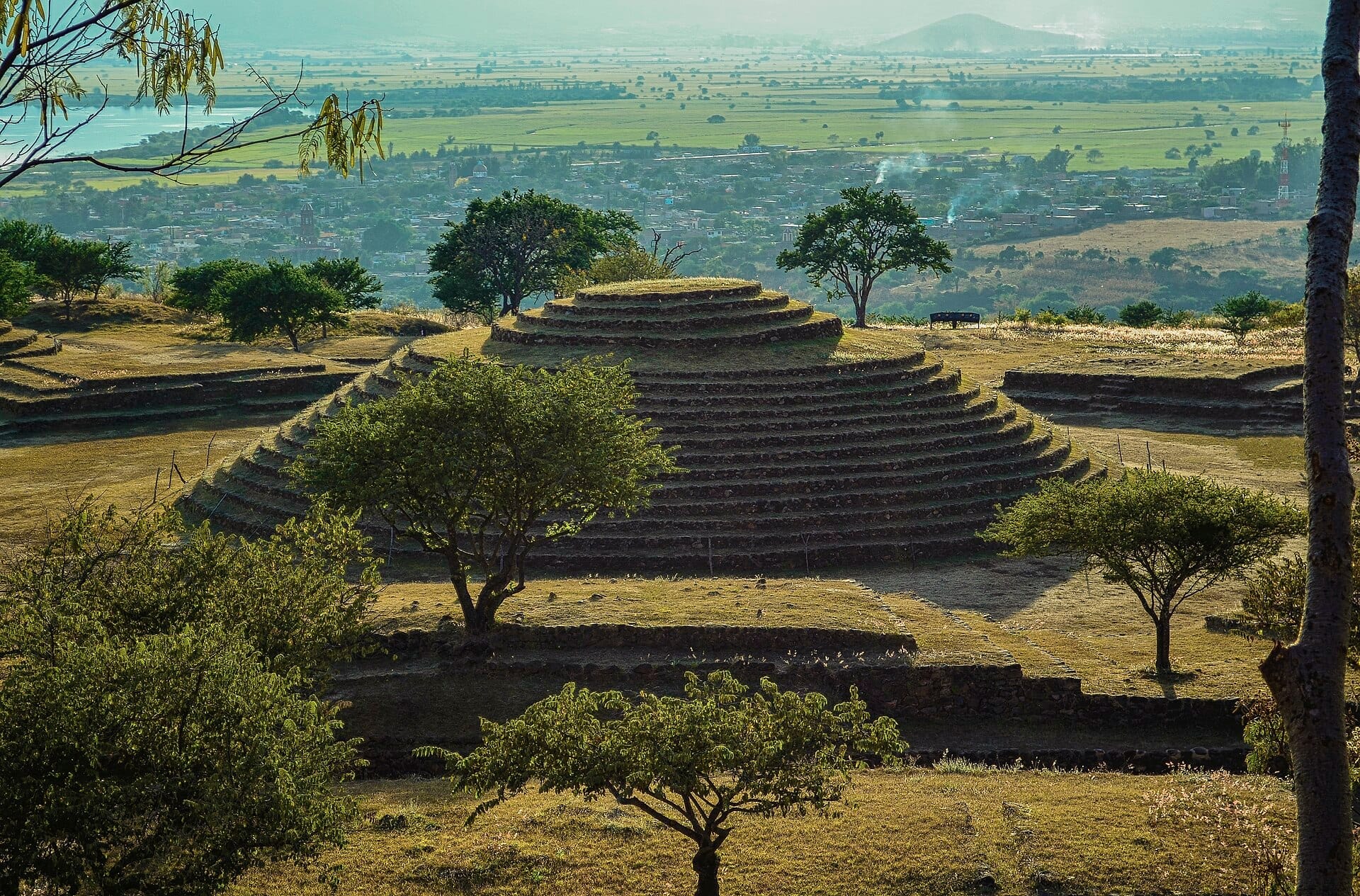
The Zona Arqueológica de Los Guachimontones is not a typical Mesoamerican ruin. While most pre-Columbian ceremonial centers built stepped pyramids with flat, rectangular bases, the Teuchitlán culture did something no other known civilization attempted at scale: they built their pyramids in concentric circles. Nine of these circular structures survive across the site, along with two ball courts, plazas, and house mounds. The largest circle measures roughly 18 meters high. Standing at its rim and looking inward at the tiered rings descending to a central platform, the geometry feels modern in a way that is almost disorienting.
This is genuine archaeological rarity, not a marketing claim. The Teuchitlán culture occupied and built here from approximately 300 BCE through 450 or 500 CE, spanning the Late Formative and Classic periods. The site was documented seriously in the 1970s and 1980s, largely through the work of American archaeologist Phil Weigand, whose interpretive center now greets visitors at the base of the hill. The name 'guachimontones' itself comes from local Nahuatl-influenced usage and refers broadly to the circular mound groupings.
ℹ️ Good to know
Guachimontones is part of the Agave Landscape and Ancient Industrial Facilities of Tequila UNESCO World Heritage Site (inscribed 2006), which covers a broader cultural landscape across Jalisco including agave fields and distilling history.
The Drive Out and Arriving at the Site
There is no practical public transit connection to Guachimontones, so most visitors either rent a car, book a guided tour from Guadalajara, or arrange private transport. The drive itself is a worthwhile part of the experience. From the city, you follow Avenida Vallarta west through Guadalajara's outer neighborhoods, past the edge of Bosque de la Primavera, then pick up Highway 70 (Carretera a Tepic Libre) toward Ameca before turning onto state road 4 toward Teuchitlán. The road winds through agave-covered highlands and small Jalisco towns, and by the time you reach Teuchitlán, the Tequila Volcano (Volcán de Tequila) is already visible to the northwest.
Tickets are purchased at a booth near the parking area at the base of the site, not online. The fee covers both the archaeological zone itself and the Phil Weigand Interpretive Center. Guided tours can be arranged on-site for an additional cost of approximately 200 MXN. If you have any depth of interest in the archaeology, a guide is worth the money: without context, the circular platforms can seem like underdressed stonework. With context, the spatial logic of the ceremonial layout becomes legible.
For those combining this with other Jalisco experiences, it pairs naturally with a visit to Pueblo Mágico TequilaTequila, which sits roughly 20 km further northwest. The two can be combined into a single full-day route from Guadalajara, though doing both well requires an early start.
Tickets & tours
Hand-picked options from our booking partner. Prices are indicative; availability and final rates are confirmed when you complete your booking.
Lake Chapala and Ajijic guided tour from Guadalajara
From 68 €Instant confirmationFree cancellationGuadalajara and Tlaquepaque guided tour
From 73 €Instant confirmationFree cancellation
The Phil Weigand Interpretive Center
Before climbing to the pyramids, most visitors pass through the interpretive center named for the archaeologist who brought international attention to the site. The museum is small but well-organized, with scale models of the circular structures, ceramic artifacts recovered from the site, and explanatory panels covering the Teuchitlán culture's social organization, agricultural practices, and trade networks. The ceramics are particularly striking: figurines depicting elaborately dressed figures on pole-ceremony platforms, which researchers believe were used in ritual dances atop the central pillars of the circular pyramids.
The center opens at 09:00, slightly before visitors typically start ascending the hill. Spending 20 to 30 minutes here before heading up pays dividends in terms of understanding what you are looking at. The signage is bilingual in many sections, though the quality of English translation varies. If you are visiting on a weekday morning, the museum is often quiet enough to read at your own pace without crowds.
💡 Local tip
The interpretive center closes at 17:00, while the archaeological site itself closes at 18:00. Visit the museum first before ascending, not after, so you are not caught racing back downhill to see it.
Walking the Site: What to Expect Underfoot
The path from the interpretive center up to the main pyramid groupings involves a sustained uphill walk on gravel and stone paths. The terrain is uneven, and some sections require stepping over rough volcanic rock. Wear proper footwear. Sandals or flat-soled shoes will make the climb uncomfortable and slippery, especially in wet conditions. Sturdy walking shoes or light hiking boots are the right call.
Once you reach the main ceremonial area, the scale of the largest circle registers in a way that the scale model in the museum does not fully prepare you for. The tiered rings, each about half a meter to a meter in height, step inward concentrically toward the central altar platform. Paths between the structures have been cleared and stabilized, but much of the site remains in a naturalistic state, with vegetation between the mounds and the occasional lizard crossing the path. The site is not manicured in the way major tourist-facing ruins like Teotihuacan or Chichen Itza are: the vegetation, the scale, and the relative quiet make it feel more like a discovery than a performance.
Two ball courts are visible from the main terrace area, though they are somewhat removed from the central circular structures. The courts follow the elongated I-shaped plan typical of Mesoamerican ball game architecture, though their exact function at this site relative to the ball courts found elsewhere in Mesoamerica is still discussed by researchers. From the higher points of the site, there are broad views over the surrounding valley and, on clear days, toward the Tequila Volcano.
Best Time to Visit
Guachimontones is an open-air site with minimal shade. Visiting during the dry season, roughly November through April, avoids the worst of the heat and eliminates the risk of rain turning the uneven paths into mud. The warmest months, May and June, push temperatures in this part of Jalisco into the low 30s Celsius (upper 80s Fahrenheit), and with the climb involved, the heat is genuinely tiring. July through September bring afternoon rains that can arrive quickly and with force.
Within the day, arriving at opening time (09:00) offers the best combination of cooler temperatures, softer morning light that gives the stone structures texture and depth, and smaller crowds. By midday on weekends, tour groups from Guadalajara begin arriving and the site becomes noticeably more crowded. Weekday mornings are consistently the quietest window. Bring water: there is no vendor presence inside the archaeological zone itself, though the parking area has some basic food and drink stalls.
⚠️ What to skip
There is no shade at the main circular pyramid area. Sun exposure is significant. Bring sunscreen, a hat, and at least one liter of water per person. In summer, the combination of heat and uphill walking can be exhausting by midday.
Photography and the Sensory Experience
The circular geometry of the pyramids photographs well from elevated positions, but getting true aerial perspective requires a drone, which is subject to INAH regulations and may require prior authorization. From ground level, the most effective compositions use the concentric rings as leading lines, shooting from the outer rim inward toward the central altar. Morning light from the east catches the stone terracing in a way that the flat midday light does not.
The sensory experience of the site goes beyond the visual. The hillside is quiet except for wind, birdsong from the surrounding oak and scrub vegetation, and the faint sounds of Teuchitlán below. The stone itself is rough volcanic basalt, warm to the touch by midmorning, with lichen patches in grey and orange. The smell of dry grass and occasional woodsmoke from the village below drifts across the site. It is a calm and somewhat austere environment, notably different from the commercial energy of Guadalajara's historic center.
If your interest in Jalisco's archaeological and cultural heritage runs deeper, the broader context of the UNESCO Agave Landscape connects this site to the living tequila-producing culture of the region. The José Cuervo Express train offers a different angle on the same landscape from Guadalajara, though it focuses on the agave and distilling heritage rather than the pre-Columbian period.
Honest Limitations and Who Might Skip It
Guachimontones is not for everyone. Visitors who prefer well-restored, richly labeled mega-sites with extensive facilities will find the experience bare-bones by comparison. The site has a modest interpretive center and a relatively small footprint of restored structures. If your primary interest is visual grandeur or dramatic architectural scale, Teotihuacan near Mexico City or Monte Albán in Oaxaca will deliver more in that register.
The 65-km drive from Guadalajara, while manageable, also makes this a significant time commitment. Visitors with only one or two days in the city and a long list of urban priorities may find the round trip, including site time, consumes most of a day. For those with limited mobility, the uphill terrain and uneven paths make reaching the main circular structures genuinely difficult; the museum alone is accessible but does not substitute for the site itself.
For travelers focused on Guadalajara's urban and cultural offerings, the city's core historic area offers a dense concentration of significant sites. The Hospicio Cabañas with its Orozco murals, and the Museo Regional de Guadalajara with its pre-Columbian collections, offer archaeological and cultural depth without leaving the city. The regional museum even holds artifacts that provide context for the Teuchitlán culture, making it a useful primer before or after a Guachimontones visit.
Practical Details at a Glance
- Opening hours: Tuesday–Sunday, 09:00–18:00. Closed Mondays. Phil Weigand Interpretive Center typically closes at 17:00. Hours may vary; verify before visiting.
- Admission: approximately 30 MXN, including the interpretive center. Optional guided tour approximately 200 MXN extra. Fees are paid at the parking entrance booth, cash preferred.
- Getting there: private car or organized tour, or bus to Teuchitlán plus taxi/walk. From Guadalajara, take Av. Vallarta west, connect to Highway 70 toward Ameca, then state road 4 to Teuchitlán. Follow signage for 'Guachimontones.' Drive time approximately 1 hour under normal conditions.
- What to wear: closed-toe shoes with grip, sun hat, light layers. Sunscreen is essential.
- What to bring: water (no vendors inside the site), snacks if desired, cash for entry.
- Photography: drone use subject to INAH regulations; check before bringing equipment.
- Accessibility: significant uphill walking on uneven volcanic terrain to reach the main pyramids. The interpretive center at the base is more accessible but specific wheelchair access details are not confirmed in available sources.
Insider Tips
- Arrive exactly at opening time (09:00) on a weekday. The first 90 minutes are markedly quieter than the midday period when tour buses from Guadalajara arrive, and the morning light on the stone terracing is substantially better for photography.
- Ask at the ticket booth whether an English-speaking guide is available that day. The guide roster changes, and it is worth requesting specifically rather than assuming one will be there. The Spanish-language guides are consistently present and highly informative even if your Spanish is intermediate.
- The hill continues above the main circular pyramid area. A short additional climb rewards you with a panoramic view of the Tequila Volcano and the surrounding valley that most visitors, who stop at the main structures, never see.
- Combine the visit with Teuchitlán town itself. The village below the site has a lake, a central plaza, and small restaurants serving local Jalisco food. Eating lunch in the village after the site visit makes the trip feel like a fuller regional excursion rather than just a ruin stop.
- If you visit during Mexico's rainy season (June–September), check the weather forecast specifically for Teuchitlán the morning of your trip. Afternoon downpours can make the uneven paths slippery and unpleasant, and visibility across the valley is often reduced. Morning-only visits with an early departure from Guadalajara are the safest strategy in those months.
Who Is Guachimontones Pyramids (Zona Arqueológica) For?
- Archaeology and pre-Columbian history enthusiasts looking for a site genuinely unlike anything else in Mesoamerica
- Architecture and design-minded travelers drawn to the unique circular geometry
- Day-trippers from Guadalajara combining the site with Tequila town or the surrounding Jalisco highlands
- Photographers seeking dramatic landscape and archaeological compositions outside the city
- Travelers with a full day to spare who want to understand the deep cultural roots of Jalisco beyond mariachi and tequila
Nearby Attractions
Combine your visit with:
- Ajijic (Lake Chapala Village)
Ajijic sits on the north shore of Lake Chapala, about an hour south of Guadalajara. With pre-conquest roots, cobblestone streets lined with art galleries, and one of Mexico's largest expat communities, it offers a completely different pace from the city. There is no admission fee to visit, and the town is accessible year-round.
- Bosque de La Primavera
Just 12 km west of Guadalajara, Bosque de La Primavera is a 30,500-hectare protected forest area offering hiking, birdwatching, hot springs, and rare ecological zones. It is one of the few places near a major Mexican city where you can genuinely disconnect from urban noise within 30 minutes.
- Bosque Los Colomos
Spanning roughly 92 hectares in northwestern Guadalajara, Bosque Los Colomos is a protected urban forest with ponds, pine-scented trails, and a Japanese garden donated by the city of Kyoto. Admission is free, and the park draws everyone from pre-dawn joggers to Sunday families.
- Japanese Garden — Bosque Los Colomos
Tucked inside the 93-hectare urban forest of Bosque Los Colomos, the Jardín Japonés is a formal Japanese-style garden donated by the people of Kyoto in 1994. It offers koi ponds, stone lanterns, arched bridges, and the kind of deliberate stillness that is genuinely hard to find in a city of over 1.5 million people.