Fort Tryon Park: Manhattan's Hilltop Escape with Hudson River Views
Fort Tryon Park is a 67-acre public park in Upper Manhattan, designed by the Olmsted Brothers and gifted to New York City by John D. Rockefeller Jr. in 1931. It sits on one of the borough's highest natural ridges, offering sweeping views of the Hudson River, eight miles of winding paths through wooded slopes, and the landmark Met Cloisters museum. Entry to the park is free.
Quick Facts
- Location
- Washington Heights and Inwood, Upper Manhattan (Henry Hudson Pkwy to Broadway/Bennett Ave, W 192nd St to Riverside Dr)
- Getting There
- Subway A train to Dyckman St or 191st St, both under a 10-minute walk to the park
- Time Needed
- 1.5 to 3 hours for the park; add 2+ hours if visiting The Met Cloisters
- Cost
- Free (park entry); The Met Cloisters has separate admission
- Best for
- Walkers, history enthusiasts, Hudson River views, quiet escapes from Midtown crowds
- Official website
- www.nycgovparks.org/parks/fort-tryon-park
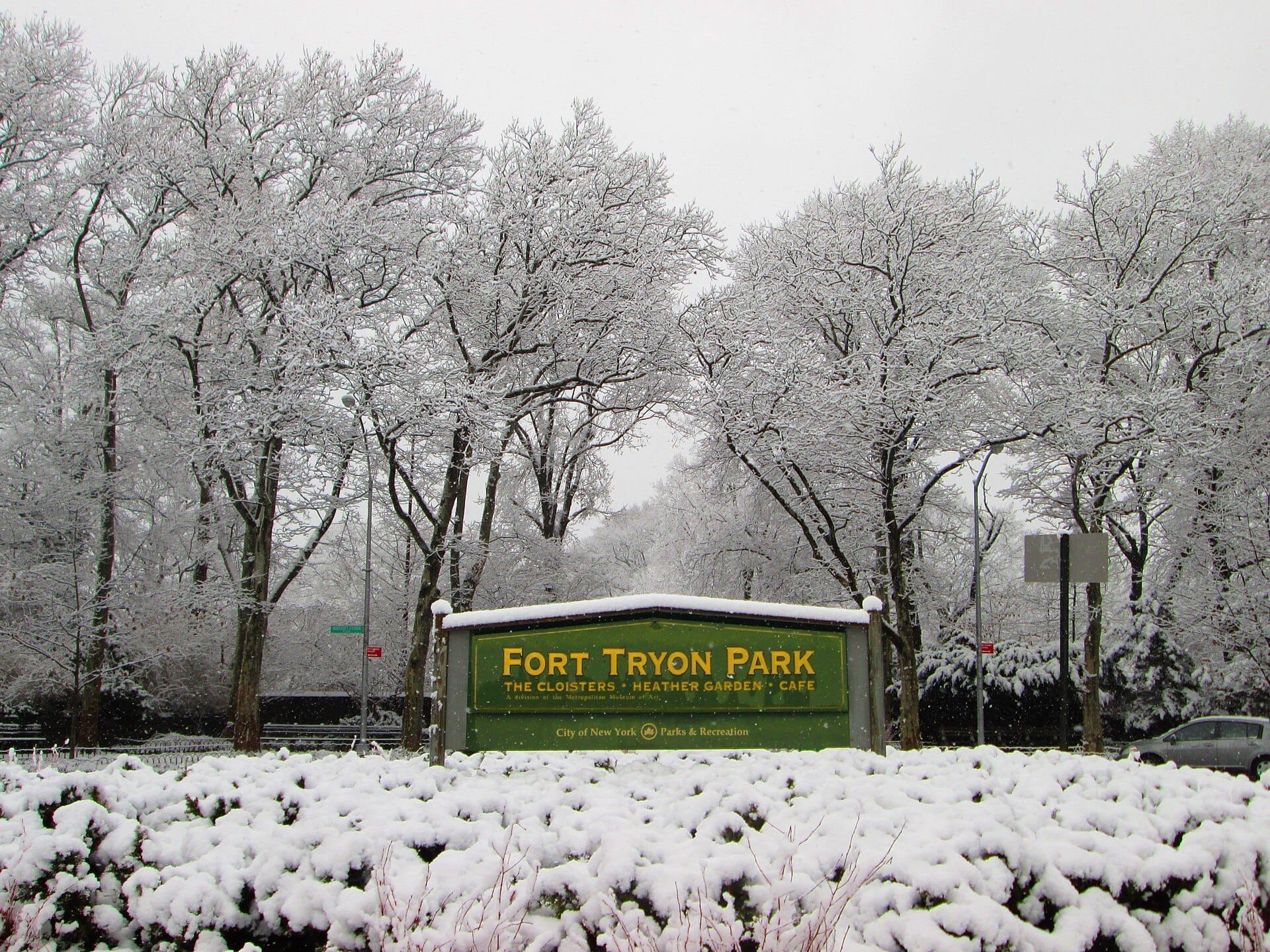
What Fort Tryon Park Actually Is
Fort Tryon Park occupies 67 acres on the northern tip of Manhattan, sprawling across a rugged ridgeline that sits among the highest points in the entire borough. This is not a manicured lawn with benches every fifty feet. The landscape is genuinely hilly, forested in stretches, and cut through by eight miles of paths that range from flat promenades to steep stone staircases flanked by native plantings.
The park takes its name from the last British fort to fall in Manhattan during the American Revolutionary War, captured by Hessian forces during the Battle of Fort Washington in November 1776. That history gives the place a quiet gravity that most city parks lack. The ridge you walk along was a genuine military fortification, and at points along the northern edge, the drop toward the Hudson is sharp enough to make the strategic logic feel obvious even today.
The park is also home to The Met Cloisters, a branch of the Metropolitan Museum of Art dedicated to medieval European art and architecture. The Cloisters has its own admission fee and its own experience entirely. This guide focuses on the park itself, though the two are impossible to fully separate: the Cloisters building is part of the visual drama of the hilltop.
💡 Local tip
The park is open daily from 6:00 a.m. to 1:00 a.m., year-round. Entry is always free. The Met Cloisters, located within the park, has separate hours and admission policies — check the Met's website before visiting.
The Design and the History Behind It
Fort Tryon Park would not exist in its current form without John D. Rockefeller Jr., who had begun acquiring the land by 1909. He commissioned the Olmsted Brothers, the firm founded by the sons of Frederick Law Olmsted (the landscape architect behind Central Park), to design the park in 1927. Rockefeller gifted the land to New York City in 1931, and the park was dedicated to the public in 1935 after construction was completed.
The Olmsted Brothers approach is visible throughout. Rather than imposing formal gardens on the hillside, they worked with the natural topography, layering paths at different elevations and using native and naturalistic plantings to soften the rocky terrain. The Heather Garden, located near the park's main entrance at Margaret Corbin Circle, is the largest public garden in the New York City parks system north of 59th Street. It covers roughly four acres and peaks in late summer and early fall when the heathers, coneflowers, and ornamental grasses reach full color.
Rockefeller also funded and arranged for the relocation of an entire collection of medieval European architectural elements from Europe to this site, which became The Met Cloisters. The combination of a medievally-styled museum building perched on a forested Manhattan ridge, designed to be seen from across the Hudson, was entirely intentional. Rockefeller even purchased land on the Palisades in New Jersey to ensure the view across the river remained unobstructed.
Tickets & tours
Hand-picked options from our booking partner. Prices are indicative; availability and final rates are confirmed when you complete your booking.
Statue of Liberty, Ellis Island, and Brooklyn Bridge Happy Hour Cruise
From 49 €Instant confirmationFree cancellationSpirit of New York Dinner Cruise
From 161 €Instant confirmationFree cancellationNew York City Highlights bike tour
From 70 €Instant confirmationFree cancellationNew York Statue of Liberty and Ellis Island tour by ferry
From 55 €Instant confirmation
What the Experience Feels Like: Morning, Afternoon, and Evening
On a weekday morning, Fort Tryon Park is almost meditative. The main paths fill with local residents from Washington Heights and Inwood: runners looping through the upper promenade, dog walkers navigating the wooded switchbacks, and older adults moving steadily along the paved sections near Heather Garden. The air at this elevation carries a noticeable breeze off the Hudson, cooler than street level, and the tree canopy filters enough light that the park feels genuinely shaded even in summer.
By midday on weekends, especially in spring and fall, the main overlook draws steady foot traffic. Families picnic on the grassy terraces. Groups gather at the stone-railed viewpoints facing the Hudson. The sounds shift: fewer joggers, more children, the occasional group playing music near the Heather Garden. The pace is leisurely but the park never feels overcrowded in the way that the Sheep Meadow in Central Park does on a warm Saturday.
Evenings before dusk are arguably the most atmospheric time to visit. The light over the Hudson turns amber and then deep orange, catching the Palisades cliffs in New Jersey and casting long shadows across the stone paths. The park empties out gradually, and by 7 or 8 p.m. on a summer evening, you can stand at the main overlook with almost no one around you and watch the light fade over the river. Bring a jacket: the ridge loses heat quickly after sunset.
ℹ️ Good to know
Weather significantly changes the experience. On overcast days, the Hudson views lose their drama and the wooded sections feel damp and grey. Clear days, especially in October and November when the foliage is at peak color, offer the park's most visually rewarding conditions.
Navigating the Park: A Practical Walkthrough
The main entrance at Margaret Corbin Circle, at the intersection of Fort Washington Avenue and Cabrini Boulevard, is the most logical starting point if you arrive by subway. From the Dyckman Street A train station, the walk uphill to Margaret Corbin Circle takes roughly 8 to 10 minutes. From 191st Street station (also A/1 lines), the approach is slightly different but comparable in time.
From the main entrance, most visitors follow the central promenade north toward the Heather Garden and then continue uphill toward the main ridge overlook. This route takes 20 to 30 minutes at a casual pace and is largely paved, though it does involve a steady incline. The overlook itself is a long stone-railed terrace with unobstructed views south toward the George Washington Bridge and across the Hudson to the Palisades. The Cloisters building is visible just north of this point, rising above the treeline.
The lower and upper wooded paths offer a more demanding alternative. Stone steps cut into the hillside connect different elevation levels, and some sections are unpaved and can be slick after rain. Wear shoes with grip if you plan to explore beyond the main promenades. The terrain is genuinely steep in places, and the paths are not always clearly signed. A trail map from the NYC Parks website is worth downloading before you arrive.
⚠️ What to skip
Wheelchair access is limited in much of the park due to steep terrain and stone staircases. The Heather Garden and sections of the main promenade near Margaret Corbin Circle are the most accessible areas. Check the NYC Parks accessibility page for current details before planning your visit.
Photography: Where to Stand and When
The main overlook on the ridge provides the signature shot: the Hudson River below, the Palisades stretching north, and the George Washington Bridge framing the southern edge of the view. For the best light, arrive in the late afternoon when the sun is in the west and illuminates the water directly. The bridge and the Cloisters tower both photograph well from here. If you are also interested in New York City's best viewpoints, this ridge offers a perspective on Upper Manhattan that almost no other public space in the city provides.
In October, the park's deciduous trees turn yellow and orange, and the combination of fall foliage, stone architecture, and river views is exceptional. This is also the busiest period for tourist visitors. Arrive before 9 a.m. on autumn weekends to have the overlook largely to yourself.
The Heather Garden photographs best in late summer (August through September) when the plantings are fully open. The formal stone walls and geometric planting beds work well in overcast light, which softens shadows and reveals color without harsh contrast.
The Surrounding Neighborhood
Fort Tryon Park sits in the Washington Heights and Inwood neighborhoods, which are among the most undervisited parts of Manhattan for tourists arriving for the first time. Upper Manhattan above 155th Street has a different pace and feel from Midtown: bakeries and small restaurants line the commercial streets around Dyckman, the Dominican community that anchors Washington Heights brings music and food culture to every block, and the scale of the neighborhood is genuinely human compared to the canyon streets of central Manhattan.
After visiting the park, the area around Dyckman Street has the highest concentration of cafes and restaurants. If you are spending a full day in the area, combining Fort Tryon Park with a visit to Inwood Hill Park, just to the north, makes geographic sense. Inwood Hill is larger, wilder, and less manicured, with ancient forest and Manhattan schist outcroppings that predate any human construction in the city.
Travelers who specifically want to understand how Manhattan's park system was developed might also want to read up on the architectural history of New York City before visiting, since Fort Tryon's design sits at an interesting intersection of landscape architecture, private philanthropy, and civic planning.
Who Might Be Disappointed Here
Fort Tryon Park is not for visitors looking for programmed entertainment. There are no rides, no food vendors beyond occasional pop-ups, no boat rentals, and no performance stages. The experience is entirely about landscape, walking, and views. If your primary interest is the Cloisters museum, budget your time accordingly: the park works best as a complement to that visit, not a substitute for it.
The steep terrain also makes it a challenging option for visitors with limited mobility, young children in strollers, or anyone who finds sustained uphill walking difficult. The main promenade near the Heather Garden is manageable, but accessing the best viewpoints requires climbing. If outdoor walking without significant elevation change is what you need, the flat stretches along the Hudson in Hudson River Park further south are a better fit.
Visitors who have already spent time at Central Park and found it too quiet or too removed from the city's energy will feel even more that way at Fort Tryon. This park sits further from the tourist center of Manhattan, draws a more local crowd, and offers fewer of the amenity conveniences that Central Park provides.
Insider Tips
- The park's least-visited section is the network of lower wooded paths along the western slope, just above the Henry Hudson Parkway. These paths offer partial river views through the trees and almost no foot traffic on weekdays, even in peak season.
- The Heather Garden is maintained by the Fort Tryon Park Conservancy and volunteers. Visiting during their organized planting days in spring gives you a chance to see the garden from the inside and speak with the staff who know every corner of the park.
- The Margaret Corbin monument near the main entrance honors a Revolutionary War soldier who took over her husband's cannon after he was killed in the 1776 battle. It is worth pausing at if you are interested in the park's military history — most visitors walk straight past it.
- If you plan to visit The Met Cloisters on the same day, do the park first while your legs are fresh. The Cloisters involves significant standing and walking through interior galleries, and the combination of both in one afternoon is tiring if done in the reverse order.
- On clear winter days, the ridge overlook offers the widest sightlines of the year — bare trees open up views through the canopy that summer foliage completely blocks. Cold weekday mornings in January or February are among the emptiest times you will ever experience a major Manhattan park.
Who Is Fort Tryon Park For?
- Walkers and hikers who want genuine terrain and elevation rather than a flat loop
- History enthusiasts interested in the Revolutionary War and early 20th-century landscape design
- Photographers seeking Hudson River views and fall foliage without Midtown crowds
- Travelers pairing a visit with The Met Cloisters for a full Upper Manhattan day
- Locals and repeat visitors looking for quiet green space far from tourist-heavy areas
Nearby Attractions
Other things to see while in Harlem:
- Apollo Theater
The Apollo Theater at 253 West 125th Street has shaped American music for over 90 years, launching careers from Ella Fitzgerald to James Brown. While the historic theater is undergoing a multi-year renovation, the free gallery and active programming make it worth the trip to Harlem.
- Cathedral Church of St. John the Divine
Rising above Morningside Heights at near Harlem, the Cathedral Church of Saint John the Divine is one of New York City's most extraordinary architectural spaces. Construction began in 1892 and continues to this day, making every visit a glimpse into a living, unfinished monument. At 601 feet long with a nave vaulting 124 feet overhead, the scale alone justifies the trip.
- El Museo del Barrio
Founded in East Harlem in 1969, El Museo del Barrio stands as the United States' leading museum dedicated to Latino, Caribbean, and Latin American art and culture. Positioned at the northern tip of Fifth Avenue's Museum Mile, it offers a distinct and often underappreciated counterpoint to the larger institutions that dominate the strip.
- High Bridge
High Bridge is New York City's oldest standing bridge, a 1,450-foot pedestrian and bicycle span connecting Washington Heights in Manhattan to the Highbridge neighborhood in The Bronx. Free to cross daily, it offers river views, genuine history, and a calm that most of the city simply does not offer.