Apollo Theater: The Heartbeat of Harlem's Music Legacy
The Apollo Theater at 253 West 125th Street has shaped American music for over 90 years, launching careers from Ella Fitzgerald to James Brown. While the historic theater is undergoing a multi-year renovation, the free gallery and active programming make it worth the trip to Harlem.
Quick Facts
- Location
- 253 West 125th Street, Harlem, New York, NY 10027
- Getting There
- A/B/C/D to 125th St (1.25 blocks west); 1/3 to 125th St (1.75 blocks east); Metro-North to Harlem–125th St
- Time Needed
- 45–90 minutes for the gallery; longer if attending a show
- Cost
- Free (Laura & Frank Baker Gallery); show tickets vary by event via Ticketmaster or box office
- Best for
- Music history lovers, Harlem culture seekers, architecture fans, first-time NYC visitors
- Official website
- www.apollotheater.org
What the Apollo Theater Is, and Why It Matters
The Apollo Theater is not simply a concert hall. It is one of the primary institutions through which African American musical culture was documented, tested, and exported to the rest of the world. Since its rechristening as the Apollo on January 26, 1934, the theater at 253 West 125th Street has been the proving ground for gospel, jazz, blues, R&B, soul, and hip-hop. Ella Fitzgerald won Amateur Night here in 1934. James Brown recorded his landmark 'Live at the Apollo' album here in 1962. Michael Jackson, Stevie Wonder, Aretha Franklin, and countless others performed on this stage before they became household names.
The building itself was constructed in 1913–1914 to a design by architect George Keister, who also designed Broadway's Belasco Theatre. It operated initially as Hurtig and Seamon's New Burlesque Theater, a whites-only venue serving a very different Harlem than the one that would emerge in subsequent decades. When Frank Schiffman and Leo Brecher took over in 1934 and opened it to Black audiences and performers, the Apollo became something far more culturally consequential than a vaudeville house. New York City designated it a landmark in 1983, and it was added to the National Register of Historic Places in 2016.
⚠️ What to skip
Important: The Apollo's historic theater is currently closed for renovation as part of a multi-year project, with reopening timing still to be announced. You can still visit the free Laura & Frank Baker Gallery, browse the gift shop, and attend certain Apollo-produced events at partner venues during this period. Always check apollotheater.org before visiting.
What You Can Actually See Right Now
With the main theater closed during its renovation, the visit centers on the Laura & Frank Baker Gallery, which is free to enter; current hours are subject to change, so check the official site before visiting. The current exhibition, 'Got to Be There: The Apollo, Its People and Its Stories,' presents artifacts, photographs, archival recordings, and oral histories that trace the theater's role in shaping American popular music. Expect to spend 45 minutes to an hour if you engage with the material seriously.
The gallery is compact but dense with content. Photographs from the 1940s and 1950s show packed audiences in formal dress. There are program notes from historic performances, costumes, and instruments. The smell of the space is that of a well-maintained archive: faint paper, wood, and the slight mustiness that comes with preserved fabric. It is quiet compared to the 125th Street sidewalk outside, which gives the exhibits room to register.
The Apollo Theater Gift Shop, located on the ground floor and typically aligned with gallery or event hours, carries branded merchandise alongside books on the theater's history and the broader Harlem music scene. It is one of the better-stocked venue gift shops in New York, with items that go beyond the generic.
Tickets & tours
Hand-picked options from our booking partner. Prices are indicative; availability and final rates are confirmed when you complete your booking.
Statue of Liberty, Ellis Island, and Brooklyn Bridge Happy Hour Cruise
From 49 €Instant confirmationFree cancellationSpirit of New York Dinner Cruise
From 161 €Instant confirmationFree cancellationNew York City Highlights bike tour
From 70 €Instant confirmationFree cancellationNew York Statue of Liberty and Ellis Island tour by ferry
From 55 €Instant confirmation
The Architecture and the Streetscape
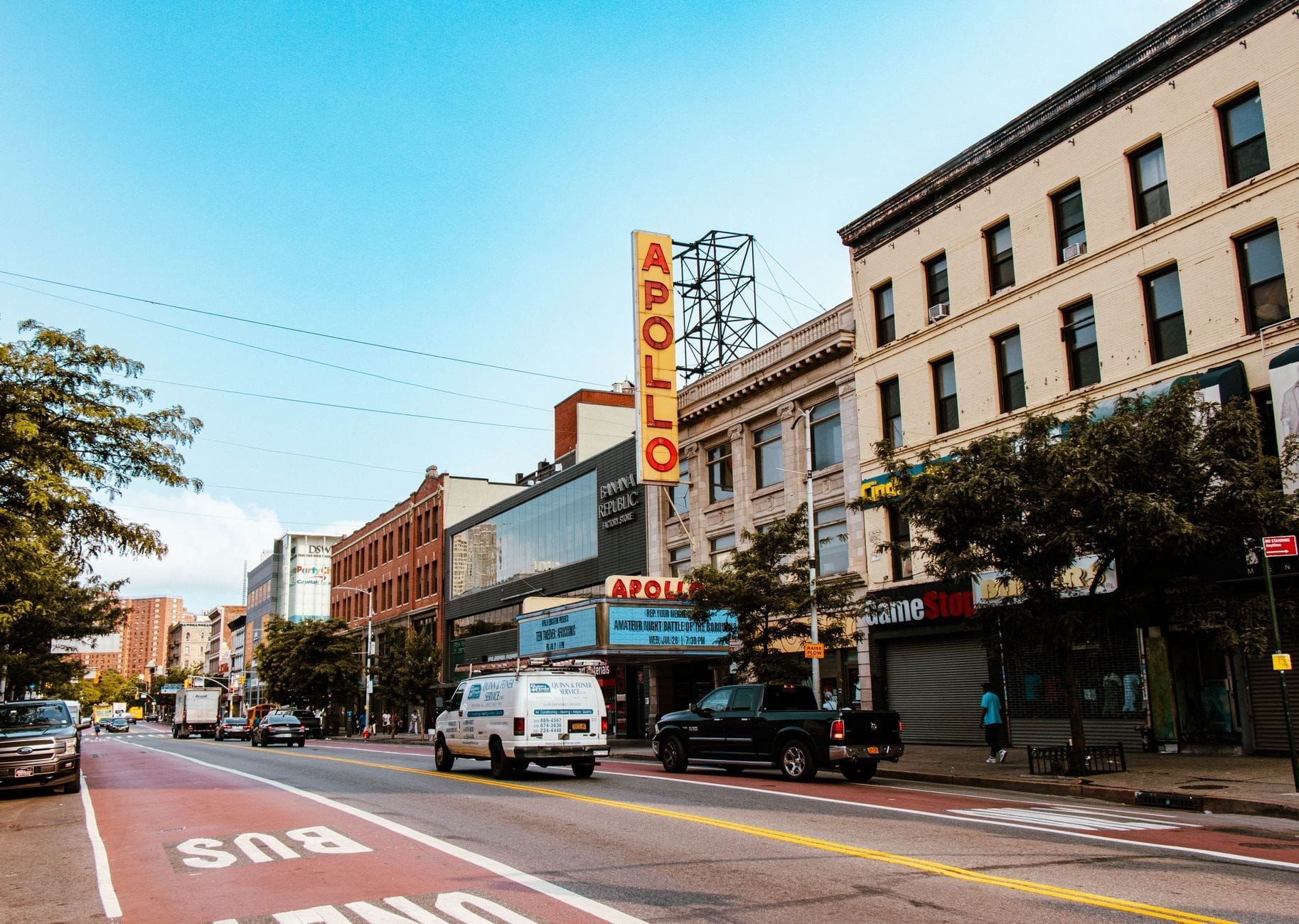
Even if you were not going inside, the Apollo's facade on West 125th Street would stop you. The marquee, with its bold red and white lettering, has appeared in thousands of photographs and is one of the most recognizable signs in New York. The building's terra cotta exterior and its proportions reflect early 20th-century commercial theater design, and it sits among a block of shops and restaurants that give it a working-neighborhood context very different from the sanitized plazas around many Manhattan cultural institutions.
West 125th Street in front of the Apollo is genuinely alive at most hours. Street vendors set up across the block, the M60 bus runs past regularly, and the foot traffic reflects the demographic diversity of modern Harlem. Visiting in the morning, before 11:00, the street is quieter and the facade easier to photograph without crowds. By early afternoon, particularly on weekends, it becomes considerably more congested. For context on the wider neighborhood and what else to explore nearby, the Harlem neighborhood guide covers the blocks around the Apollo in detail.
Amateur Night and the Apollo's Ongoing Programming
Amateur Night at the Apollo is the event that made the theater's reputation as a talent incubator, and it continues today, typically held on Wednesday evenings. Audience participation is not just encouraged, it is part of the format: performers who fail to connect with the crowd face ritualized elimination by audience noise, carried out by a figure known historically as the Executioner. The winners of Amateur Night have included Ella Fitzgerald, Sarah Vaughan, and Lauryn Hill.
During the renovation period, check the Apollo's official website for the current schedule and venue for Amateur Night and other productions. The organization continues to present programming, sometimes at partner venues in the area. Tickets for shows are sold through Ticketmaster or at the box office; check current box office hours on the official site, as they can vary.
💡 Local tip
Amateur Night tickets sell out well in advance, especially for themed editions. Book through the official website or Ticketmaster as soon as dates are announced. Do not buy from street resellers outside the theater.
Getting There and Moving Around the Neighborhood
The Apollo is well-served by public transit, which is the sensible way to arrive. The A, B, C, and D trains all stop at 125th Street, putting you about 1.25 blocks from the theater's entrance. The 1 and 3 trains also stop at 125th Street, requiring a slightly longer walk of about 1.75 blocks heading west. If you are coming from the east side of Manhattan, the 4, 5, or 6 to 125th Street leaves you further away; take a crosstown bus or a short cab ride to reach Frederick Douglass Boulevard, then walk a quarter block east.
Metro-North Railroad serves Harlem–125th Street station, a useful option if you are arriving from the northern suburbs or connecting from Grand Central. From the station, a taxi or the M60 or M100 bus will take you west along 125th Street. The MTA bus routes M7, M60, M100, M101, and the BX15 all run near the Apollo. Driving is not recommended: parking on or near 125th Street is limited and enforcement is active.
If you are combining the Apollo with a broader Harlem walk, the theater makes a natural anchor point. Soul food restaurants, music venues, the Studio Museum in Harlem, and Marcus Garvey Park are all within easy walking distance. A well-planned morning can take you from the Apollo's gallery to lunch at one of the neighborhood's long-standing restaurants. See the New York City food guide for specific Harlem dining recommendations worth building a day around.
Photography, Timing, and Practical Details
The Apollo marquee is one of the most photographed signs in New York, and for good reason: its proportions and coloring work well in most light conditions. Morning light, particularly in spring and autumn, hits the facade directly from the east before the building falls into shadow. By mid-afternoon in summer, haze and direct overhead light flatten the colors significantly. If you are shooting for quality rather than documentation, arrive before noon.
Inside the gallery, photography is generally permitted for personal use, though policies can change with exhibitions. The lighting in the gallery is deliberately subdued to protect archival materials, so phone cameras may struggle with some display cases. There is no dramatic interior architecture to photograph during the renovation period since the main auditorium is inaccessible.
The theater is accessible to visitors with mobility needs via the main entrance, and the Apollo's accessibility contact number is +1 (212) 531-5305 for specific assistance requirements. The surrounding sidewalk is flat and wide, which makes street-level access straightforward.
ℹ️ Good to know
The Apollo sits in Harlem, a neighborhood that has changed considerably in recent decades but retains a strong community character. Visiting respectfully means being aware that 125th Street is a working commercial corridor, not a tourist corridor built around sightseers.
Who Should Reconsider This Visit
Visitors whose primary goal is seeing the historic auditorium itself will be disappointed until the renovation is complete. The main theater is closed, and the current visitor experience is centered on the gallery exhibition. If your schedule is tight and you are weighing this against other major New York attractions, the experience right now is more akin to a small, free music museum than a grand theater visit. For a broader sense of where the Apollo fits in New York's cultural landscape, the New York City arts and culture guide can help you prioritize across the city's many institutions.
The neighborhood is not difficult to navigate, but visitors who prefer highly polished tourist infrastructure may find 125th Street more raw than they expect. That rawness is part of its authenticity, and most visitors find it preferable to the over-curated feel of some Manhattan tourist zones. But it is worth knowing in advance.
Insider Tips
- The 'Tree of Hope' stump inside the Apollo lobby is a piece of genuine folklore: performers rub it for luck before going onstage. It is a fragment of an actual elm tree that stood outside the theater on 7th Avenue, believed to bring good fortune to Harlem musicians. Ask about it when you visit the gallery.
- Amateur Night tickets for special editions, such as holiday shows or anniversary performances, go faster than regular Wednesday nights. Sign up for the Apollo's email list to get advance notice before tickets hit Ticketmaster.
- The box office may be closed on Sundays; if you need to handle any ticket issues or pick up will-call tickets, confirm current weekday and Saturday hours on the official site before you go.
- Combine a gallery visit with the Studio Museum in Harlem, a few blocks east on 125th Street. Both are free or low-cost, and together they make a coherent half-day focused on Black American artistic history.
- Check apollotheater.org for renovation updates and reopening announcements. When the main theater reopens, it is expected to be a significant cultural event. If you visit now, you will have a useful baseline for appreciating what changed.
Who Is Apollo Theater For?
- Music history enthusiasts who want to understand where American popular music was shaped
- First-time visitors to New York who want a culturally significant Harlem stop beyond sightseeing
- Travelers attending Amateur Night or a specific Apollo-produced show
- Architecture and landmark fans interested in early 20th-century commercial theater design
- Budget travelers: the gallery is free, and the surrounding neighborhood offers excellent, affordable food
Nearby Attractions
Other things to see while in Harlem:
- Cathedral Church of St. John the Divine
Rising above Morningside Heights at near Harlem, the Cathedral Church of Saint John the Divine is one of New York City's most extraordinary architectural spaces. Construction began in 1892 and continues to this day, making every visit a glimpse into a living, unfinished monument. At 601 feet long with a nave vaulting 124 feet overhead, the scale alone justifies the trip.
- El Museo del Barrio
Founded in East Harlem in 1969, El Museo del Barrio stands as the United States' leading museum dedicated to Latino, Caribbean, and Latin American art and culture. Positioned at the northern tip of Fifth Avenue's Museum Mile, it offers a distinct and often underappreciated counterpoint to the larger institutions that dominate the strip.
- Fort Tryon Park
Fort Tryon Park is a 67-acre public park in Upper Manhattan, designed by the Olmsted Brothers and gifted to New York City by John D. Rockefeller Jr. in 1931. It sits on one of the borough's highest natural ridges, offering sweeping views of the Hudson River, eight miles of winding paths through wooded slopes, and the landmark Met Cloisters museum. Entry to the park is free.
- High Bridge
High Bridge is New York City's oldest standing bridge, a 1,450-foot pedestrian and bicycle span connecting Washington Heights in Manhattan to the Highbridge neighborhood in The Bronx. Free to cross daily, it offers river views, genuine history, and a calm that most of the city simply does not offer.