Floralis Genérica: Buenos Aires' Giant Steel Flower in Recoleta
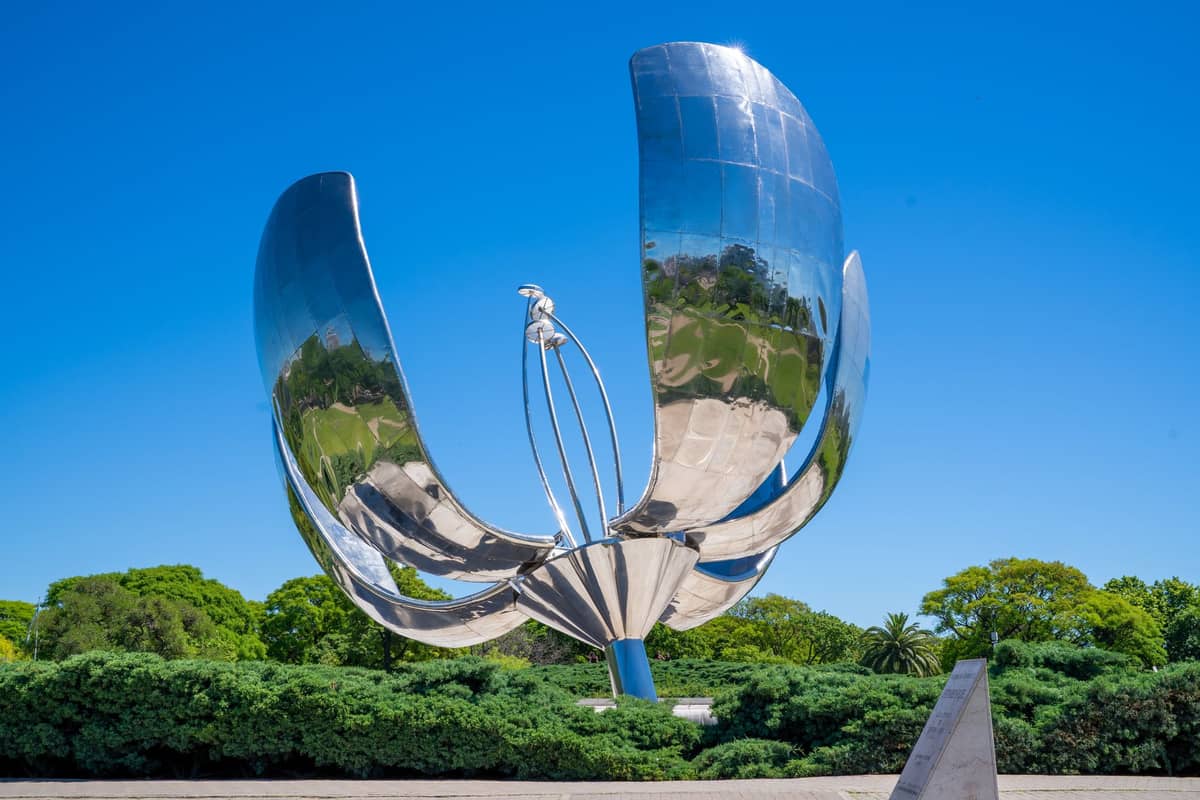
Standing roughly 23 metres tall in Plaza de las Naciones Unidas, Floralis Genérica is one of Buenos Aires' most distinctive public sculptures. Designed by Argentine architect Eduardo Catalano and inaugurated in 2002, this 18-tonne aluminium and stainless steel flower opens its petals each morning and closes at dusk. Entry is free, and the surrounding park makes it an easy, rewarding stop in Recoleta.
Quick Facts
- Location
- Plaza de las Naciones Unidas, Av. Presidente Figueroa Alcorta 2301, Recoleta, Buenos Aires
- Getting There
- Subte Line H, Facultad de Derecho or Las Heras stations; buses 41, 67, 124, 130 serve the area
- Time Needed
- 20–40 minutes at the sculpture; longer if combining with a Recoleta walk
- Cost
- Free — no ticket or entrance fee
- Best for
- Architecture enthusiasts, photographers, anyone exploring the Recoleta neighbourhood
What Floralis Genérica Actually Is
Floralis Genérica is a monumental public sculpture in the shape of an open flower, installed in 2002 in Plaza de las Naciones Unidas in Recoleta. It was designed by Argentine architect Eduardo Catalano, who funded the project himself and donated it to the city of Buenos Aires. The piece is built from aluminium and stainless steel, weighs approximately 18 tonnes, and rises roughly 20 to 23 metres from base to petal tip. When fully open, the flower spans around 32 metres in diameter.
The structure sits in a shallow reflective pool, which multiplies the visual scale of the sculpture and catches the sky around it. From certain angles, particularly when standing at pool level looking upward, the steel petals frame a circle of sky that changes colour dramatically depending on the light and time of day. The engineering behind the piece is as interesting as the aesthetic: the petals were originally designed to open and close mechanically, responding to daylight, with a hydraulic system opening them around 8:00 in the morning and closing them at sunset or midnight on special occasions.
⚠️ What to skip
The mechanical petal mechanism is not always operational. Do not plan your visit specifically around seeing the petals move — treat any movement as a bonus, not a guarantee.
The Experience at Different Times of Day
Morning is the most photogenic window. Between roughly 8:00 and 10:00, the low eastern sun hits the polished stainless steel surfaces at an angle that sends reflected light across the surrounding pool and nearby path. The metal literally shifts in tone from a cool silver-grey to a warmer, almost bronze hue as the sun climbs. At this hour the plaza is quiet, with the occasional jogger circling the perimeter of the park and a few dog walkers cutting through from the residential streets bordering Figueroa Alcorta avenue.
By midday the crowds thicken, particularly on weekends. The surrounding lawns fill up with students from the nearby Facultad de Derecho (Law School of the University of Buenos Aires), whose main building sits directly opposite on Avenida Figueroa Alcorta. The contrast between the modernist sculpture and the neoclassical university facade behind it is worth noticing — it captures something characteristic of Buenos Aires architecture as a whole.
At dusk, the light on the steel becomes more dramatic and the crowd thins again. If the illumination system is working, the sculpture glows after dark with internal and external lighting that makes it visible from some distance across the park. Night visits are quiet and the ambience shifts considerably; the surrounding avenue carries some traffic noise but the plaza itself feels calm.
💡 Local tip
For the best photography, come in the first two hours after sunrise. Overcast mornings also work well — diffused light eliminates harsh reflections from the steel and gives the sculpture a clean, graphic appearance.
Tickets & tours
Live prices and dates from our booking partner. If you book, we may earn a commission at no extra cost to you.
Madero Tango Show tickets with optional dinner
From 32 €Instant confirmationFree cancellationBuenos Aires small-group city tour with optional lunch and cruise
From 25 €Instant confirmationFree cancellationPiazzolla Tango Show VIP tickets with transfer and optional dinner
From 112 €Instant confirmationFree cancellationBuenos Aires shopping tour
From 15 €Instant confirmationFree cancellation
The Story Behind the Sculpture
Eduardo Catalano was born in Buenos Aires in 1917 and built his career largely in the United States, where he became a professor at MIT and North Carolina State University. He is known for pioneering work in structural geometry and shell roof design. Floralis Genérica, inaugurated in April 2002, was his gift to his home city — designed and paid for from his own resources. He described it as a synthesis of all flowers, a universal flower rather than any specific species.
The inauguration in 2002 carries its own significance. Argentina had just emerged from one of its worst economic crises, with the peso having collapsed and widespread social unrest in late 2001. The arrival of a large-scale, publicly funded artwork — in this case, one donated rather than commissioned — carried symbolic weight in a city that was visibly stressed. Whether that context shaped how the sculpture was received at the time is a matter of interpretation, but it is worth knowing.
The plaza itself, Plaza de las Naciones Unidas, is part of the broader green corridor running through Recoleta and connecting to the parks of Palermo. For a full orientation to this part of the city, the Recoleta neighbourhood guide covers the surrounding streets, institutions, and points of interest in more detail.
The Physical Setting and What to Look For
The sculpture stands in a wide, paved plaza with the shallow reflective pool as its immediate setting. The pool edge is raised and bordered by a low railing; there is a wide paved walkway around the perimeter that allows visitors to circle the sculpture fully and observe it from multiple angles. Each vantage point produces a noticeably different composition. From the northwest corner, the Law School facade becomes part of the background. From directly south, looking back toward Figueroa Alcorta, you get the flower against open sky.
The petals themselves have a textured surface that catches light differently depending on angle — up close, you can see the seams and structural joints in the aluminium, which gives the piece an honest industrial quality rather than a seamless, polished finish. The stem and base are functional engineering structures, not concealed. This directness in the construction is consistent with Catalano's architectural background; the structure does not disguise how it works.
The Facultad de Derecho building across the avenue is architecturally notable in its own right, and the area around it connects to the broader fabric of Buenos Aires' architectural heritage, which spans neoclassical, Art Deco, and modernist traditions in close proximity.
Getting There and Getting Around
The most straightforward Subte option is Line H to Facultad de Derecho station, from which the plaza is a short walk. Las Heras station on Line H is also used by some visitors, though it requires a slightly longer walk along Avenida del Libertador. Multiple bus lines pass along Figueroa Alcorta and the nearby avenues; lines 41, 67, 124, and 130 are among those commonly cited, but routes can change, so check current schedules via the official BA Como Llego trip planner or on-board the SUBE app.
Taxis and ride-hailing apps drop off directly on Figueroa Alcorta in front of the plaza. There is no dedicated parking lot for the sculpture, but the surrounding avenues have street parking. The plaza paths are flat and paved, making the site accessible for wheelchair users and strollers. There are no steps to reach the sculpture from street level. Accessible toilet facilities are not guaranteed on-site, so plan accordingly.
If you are combining this with a broader day in the area, the Recoleta Cemetery is roughly a 10-minute walk south and is worth pairing on the same outing. The Museo Nacional de Bellas Artes is also nearby, just a few blocks along Figueroa Alcorta, and admission is free.
Weather, Seasons, and When to Visit
Buenos Aires has a humid subtropical climate, which means summer (December to February) brings hot, humid conditions with temperatures frequently reaching 28 to 30°C. Visiting an outdoor sculpture at midday in summer can be uncomfortable; the plaza has limited shade. Spring (September to November) and autumn (March to May) offer milder temperatures generally in the 15 to 25°C range, which makes outdoor time in the plaza more comfortable.
Rain is possible year-round but heavier in summer and early autumn. After rain, the reflective pool and wet steel surfaces produce some striking visual effects, and the plaza is typically quiet in the aftermath of a shower. Winter visits (June to August) are perfectly viable — temperatures hover around 8 to 15°C, crowds thin considerably on weekday mornings, and the overcast light is often excellent for photography. Bring a light jacket.
For a full breakdown of when to visit Buenos Aires and how climate affects different types of attractions, see the best time to visit Buenos Aires guide.
Who Should Temper Their Expectations
Floralis Genérica is a worthwhile stop if you are already in the Recoleta area, but it does not justify a dedicated journey from the other side of the city on its own. The petal mechanism is unreliable enough that visitors who arrive expecting to watch the flower open or close may be disappointed. The sculpture is large and technically accomplished, but the experience of being there lasts 20 to 30 minutes for most people; it is not a prolonged attraction.
Travellers focused entirely on cultural history, interior spaces, or tango will find more to hold their attention elsewhere in Recoleta. This is an outdoor public sculpture in a city park — the value is in the scale, the light, and the engineering, not in any curated interior experience.
ℹ️ Good to know
Floralis Genérica is most rewarding when combined with other nearby attractions rather than treated as a stand-alone destination. A morning that starts here, moves to the Bellas Artes museum, and ends at the Recoleta Cemetery covers the neighbourhood efficiently and well.
Insider Tips
- Circle the sculpture fully before settling on a photo spot — the northwest angle, with the Law School colonnade in the background, gives the most layered composition and is used least often by visitors.
- If you visit in winter, the low sun angle in the late afternoon (around 16:00 to 17:00) rakes across the petals at an almost horizontal angle, creating strong shadow definition that is difficult to achieve in any other season.
- The reflective pool is shallow enough that on still, windless mornings the reflection is almost perfect — arrive before 9:00 on a calm day to catch this before foot traffic and breeze disturb the surface.
- On certain public holidays, the petals are programmed to stay open all night — check local Buenos Aires city news or the official tourism site close to your visit dates if this matters to your plans.
- Combine the visit with the Facultad de Derecho building across the avenue; the interior courtyard of the law school is sometimes accessible and architecturally interesting in its own right.
Who Is Floralis Genérica For?
- Architecture and design enthusiasts interested in structural engineering and public art
- Photographers seeking dramatic metallic reflections and large-scale sculptural subjects
- Travellers doing a full Recoleta walking loop covering the cemetery, Bellas Artes, and the park corridor
- Families with children who enjoy open outdoor spaces and impressive physical scale
- Visitors on a tight budget looking for a free, high-visual-impact stop
Nearby Attractions
Other things to see while in Recoleta:
- Basílica Nuestra Señora del Pilar
Standing directly beside the Recoleta Cemetery, the Basílica Nuestra Señora del Pilar is one of the oldest churches in Buenos Aires. Built in the 18th century as part of a Franciscan convent complex, it offers free entry, a small cloister museum, and a rare moment of quiet in one of the city's most visited corners.
- Biblioteca Nacional Mariano Moreno
The Biblioteca Nacional Mariano Moreno is Argentina's main national library, a striking Brutalist landmark in Recoleta that has safeguarded the country's literary and documentary heritage since its founding in 1810. Entry is free, the building is architecturally significant, and the reading rooms offer a rare window into Buenos Aires intellectual life.
- Cementerio de la Recoleta
The Cementerio de la Recoleta is a 13-hectare open-air monument to Argentina's political elite, military heroes, and cultural icons, mapped out in streets of carved marble, wrought iron, and crumbling Art Deco grandeur. It is where Eva Perón is buried, but the cemetery rewards those who wander beyond her tomb. Few attractions in Buenos Aires deliver this much history, beauty, and quiet drama in a single visit.
- Centro Cultural Recoleta
The Centro Cultural Recoleta is a large public cultural center in Recoleta, Buenos Aires, offering rotating contemporary art exhibitions, film screenings, and live performances across 27 rooms and additional dedicated spaces. Entry is free for Argentine residents and low-cost for international visitors, making it one of the most accessible cultural institutions in the city.
Planning a trip? Discover personalized activities with the Nomado app.