Dzintari Forest Park: Jūrmala's Pine-Scented Escape from the City
Dzintari Forest Park is a free-entry woodland park in the heart of Jūrmala, set among fragrant Scots pine trees just steps from the Gulf of Riga coast. Open daily from 09:00 to 22:00 all year round, it combines quiet forest paths, a famous open-air concert venue, and a rope adventure course — making it one of the most complete day-trip destinations within easy reach of Riga.
Quick Facts
- Location
- Jomas iela / Turaidas iela, Meža prospekts, Jūrmala, LV-2015
- Getting There
- Suburban train from Riga Central Station to Dzintari station; park is walkable from the platform
- Time Needed
- 1.5 to 3 hours, longer if combining with the beach or concert venue
- Cost
- Free entry; rope course and some activities charge separately
- Best for
- Families, nature walkers, day-trippers from Riga, summer concert-goers
What Is Dzintari Forest Park?
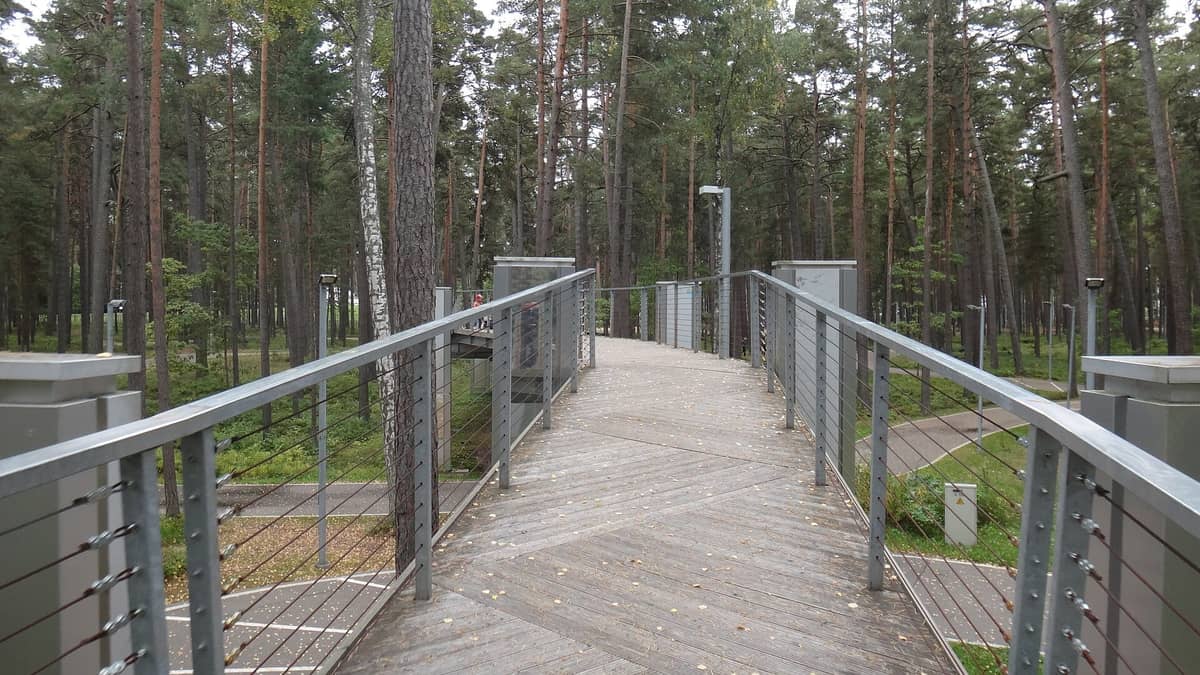
Dzintari Forest Park (Latvian: Dzintaru mežaparks) occupies the green spine of Jūrmala's central Dzintari district, where a broad belt of Scots pine stretches between the resort town's main pedestrian street and the Gulf of Riga shoreline. The air here carries a distinctive resinous sharpness from the pines, mixed on warm days with the faint salt of the nearby sea. It is the kind of place that feels larger than its boundaries suggest, partly because the tree canopy is so dense and the paths curve enough to lose sight of the street within a few minutes of entering.
The park is free to enter and open daily from 9:00 to 22:00, year-round. Unlike the more manicured city parks in Riga proper, such as Esplanade Park or Bastejkalns Park, Dzintari Forest Park retains a genuinely wild quality. The ground is soft with pine needles, the paths are sandy rather than paved in sections, and the overall atmosphere is closer to a managed forest than a formal garden.
💡 Local tip
The park is free to enter with no ticket barriers. Some activity operators inside, including rope course providers, charge their own fees. Check on arrival for current pricing.
A Bit of History: From Edinburg to Dzintari
The district has an unexpectedly cosmopolitan backstory. In 1877, the area was named Edinburg in honor of the marriage of Grand Duchess Maria Alexandrovna, daughter of Tsar Alexander II, to Prince Alfred, the Duke of Edinburgh. The name reflected the prestige that Baltic resort culture carried in the Russian imperial period, when Jūrmala's seaside served the aristocracy of St. Petersburg and Riga's merchant class alike.
When Latvia proclaimed independence in 1918 and the new republic consolidated in the early 1920s, the Latvian government renamed the district Dzintari, meaning "amber" in Latvian. The word is resonant: amber has washed up on the shores of the Gulf of Riga for centuries and remains one of the defining symbols of Latvia's Baltic identity. The park itself took shape over the following decades as a deliberately preserved green buffer within the expanding resort town.
Understanding this history matters for visitors because Jūrmala as a whole is more than a beach destination. The resort culture here evolved over roughly 150 years of layered history, from tsarist-era leisure estates through Soviet-era sanatoriums to today's mix of restored villas and modern tourism infrastructure. A walk through Dzintari Forest Park connects to that longer arc. For a fuller picture of the region, the Jūrmala travel guide covers the town's distinct neighborhoods and what each offers.
Tickets & tours
Hand-picked options from our booking partner. Prices are indicative; availability and final rates are confirmed when you complete your booking.
Canal boat sightseeing tour in Riga
From 13 €Instant confirmationArt and culture walking tour of Riga with a local
From 66 €Instant confirmationFree cancellationSelf-guided discovery walk in Riga - the essential old town and its secrets
From 30 €Instant confirmationFree cancellationExclusive private guided tour of Riga's architecture with a local
From 175 €Instant confirmationFree cancellation
What You Actually See and Hear in the Park
The park's defining sensory quality is its quiet. Even on summer weekends when Jūrmala is busy with visitors from Riga and beyond, the forest absorbs sound in a way that open beach spaces do not. You hear wind in the high pine canopy, the occasional creak of a trunk, birdsong from species like the common chaffinch and great tit, and the muffled laughter of children somewhere on the rope course. The ground underfoot alternates between packed sandy soil, wooden boardwalks in damper sections, and carpets of dry pine needles that are soft and slightly springy.
Visually, the park shifts with the light. Morning visits offer long, low shafts of sun cutting horizontally through the pines at angles that photographers specifically seek out. By midday in summer the canopy is thick enough that the interior stays relatively cool. Late afternoon brings a warmer, amber tone to the bark, which turns the pale Scots pine trunks into something almost photogenic by accident.
💡 Local tip
Photography tip: arrive between 08:30 and 10:00 on a clear morning. The low Baltic sun angles through the pine trunks at near-horizontal lines, creating strong contrast that is difficult to replicate at other times of day.
The park is also the home of the Dzintari Concert Hall (Dzintaru koncertzāle), an open-air wooden amphitheater that hosts one of Latvia's most beloved summer concert series. Performances range from classical orchestral programs to jazz and folk. On concert evenings, the atmosphere inside the park changes noticeably: visitors dress more formally than usual for a forest walk, and the paths fill with people navigating by phone flashlights after dark. Non-concert visitors should note that the surrounding park remains accessible during events, but foot traffic near the hall increases substantially.
How to Get There from Riga
The practical case for visiting Dzintari Forest Park is strong: it requires no car and no planning beyond showing up at Riga Central Station. Suburban trains (elektrikas) depart regularly for Jūrmala and stop at Dzintari station, making the journey straightforward. The ride takes approximately 20 to 30 minutes depending on the service. From Dzintari station, the park entrance area is within walking distance, following local signage along Meža prospekts.
Note that Jūrmala operates a vehicle entry fee for private cars during peak season, which does not apply to train passengers. Arriving by train is not only cheaper but avoids the summer traffic that can slow the coastal highway significantly. For broader guidance on navigating the region, the getting around Riga guide covers suburban rail and transit options in detail.
⚠️ What to skip
Jūrmala charges a vehicle entry fee for private cars during summer peak season. Train passengers are not affected. Check current fee dates before driving.
When to Visit: Seasons and Crowds
Summer, specifically June through August, is when the park is at its most alive. The concert hall is in full operation, families fill the rope course, and the nearby beach at Jūrmala is drawing large crowds. If you are planning a combined forest-and-beach day, this is the window to do it. That said, summer weekends between 11:00 and 16:00 are the busiest periods; weekday mornings are noticeably quieter. For context on what Jūrmala looks like at its peak, the Majori Beach guide gives a useful comparison for crowd levels and atmosphere.
Spring and autumn visits offer a completely different quality. In May, the forest floor shows patches of wood anemones and other ground-level plants that disappear under summer foot traffic. October brings real color to the few deciduous trees mixed among the pines, and the light turns low and golden earlier in the afternoon. The park is genuinely worth visiting in these shoulder months, when the resort infrastructure around it is quieter but the forest itself remains fully intact.
Winter is the overlooked option. The pines hold their needles and the forest stays green, while snow on the ground muffles sound even further and creates a stillness that is absent in summer. Jūrmala in winter is a very different place from its summer persona, explored in detail in the Riga in winter guide. The park closes at 22:00 all year round, but in December the sky darkens well before that, so morning visits are more practical in deep winter.
Activities Beyond Walking
The rope adventure course within the park is the main draw for families with children. It operates as a separately run facility and charges its own fees; current prices and age or height requirements are best confirmed directly with the operators on arrival. The course is designed for multiple age groups, with lower-level routes for younger children and higher challenge elements for older participants.
For adults, the primary activity is walking, and the park accommodates both purposeful exercise and aimless wandering equally well. Cyclists use some of the wider paths, though the sandy sections make road bikes impractical. The park's position between Jūrmala's central pedestrian street and the coast means it naturally anchors a longer route: arrive by train, walk through the forest, emerge at the beach, walk along the shoreline, and return through the park from the other direction. That loop takes between two and three hours at a relaxed pace.
The Dzintari Concert Hall schedule varies each summer and is published by the venue. If attending a concert is part of your plan, check the program in advance through the official Jūrmala tourism portal. For those planning a full day in the area, day trips from Riga covers how to combine Jūrmala visits with other nearby destinations.
Who Should Manage Expectations
Dzintari Forest Park is not a destination that rewards visitors who come expecting dramatic scenery or major monuments. The pines are tall but the terrain is flat, which is simply the nature of the Baltic coastal plain. There are no viewpoints, no cliff edges, no sweeping vistas. If that is what you are looking for, the forested valleys and castle ruins around Sigulda offer more topographic interest.
Visitors who need fully paved, step-free surfaces throughout should note that parts of the park use sandy or loose-surface paths. Specific accessibility infrastructure details are not centrally documented, and it is worth contacting the Jūrmala tourism office directly if mobility needs are a factor.
The park is also best understood as part of a Jūrmala day rather than as a standalone attraction requiring a dedicated trip from Riga. Travelers on a short visit to Latvia who can only make one day trip outside the capital may find that the Jūrmala combination of beach, forest park, and Art Nouveau resort architecture justifies the journey more convincingly than the park alone.
Insider Tips
- The pine resin smell is most intense on warm afternoons after rain. If the forecast shows a dry sunny day following overnight rain, the sensory experience in the forest is noticeably richer than on an ordinary summer morning.
- Dzintari station is one stop beyond Majori, Jūrmala's central and most-visited station. Getting off at Dzintari rather than Majori means you arrive directly near the park with fewer crowds to navigate on the platform and a shorter walk to the entrance.
- The open-air concert hall runs a summer season with classical, jazz, and folk programs. Tickets sell out for popular dates weeks in advance. Check the Jūrmala city portal early if a concert is part of your plan.
- The park's western edge connects directly to the beach via short pedestrian paths. Using the forest as a shaded approach to the beach rather than walking along the road is more pleasant and takes about the same time.
- Mosquitoes can be active near the damper interior sections of the park from late May through July, especially in the hour after sunset. Light repellent is worth packing for evening visits.
Who Is Dzintari Forest Park For?
- Day-trippers from Riga looking for a quick nature reset without renting a car
- Families with children who want to combine forest walks with the rope adventure course and beach in a single outing
- Concert-goers visiting the Dzintari Concert Hall during the summer program season
- Photographers seeking low morning light through pine forest on the Baltic coast
- Travelers exploring Jūrmala who want a shaded, quiet break from the open beach
Nearby Attractions
Other things to see while in Jūrmala:
- Kemeri National Park & Bog Boardwalk
Ķemeri National Park protects one of Latvia's largest raised peat bogs, formed over 10,000 years since the last Ice Age. A free wooden boardwalk loops through open bog pools, twisted pine islands, and vast silence just an hour from central Riga. Entry to the trails costs nothing and the park is open year-round, though seasonal parking fees apply at the main bog car park.
- Majori Beach
Majori Beach is the central beach of Jūrmala, a long-established Baltic resort town a short train ride from Riga. With fine white sand stretching roughly 25–50 metres wide, lifeguard supervision in summer, and a lively pedestrian street connecting the station to the shore, it offers a complete seaside escape without a car or complicated logistics.