Ķemeri National Park and the Great Bog Boardwalk: Latvia's Ancient Wilderness on Riga's Doorstep
Ķemeri National Park protects one of Latvia's largest raised peat bogs, formed over 10,000 years since the last Ice Age. A free wooden boardwalk loops through open bog pools, twisted pine islands, and vast silence just an hour from central Riga. Entry to the trails costs nothing and the park is open year-round, though seasonal parking fees apply at the main bog car park.
Quick Facts
- Location
- Ķemeri, Jūrmala municipality, Latvia
- Getting There
- Train from Riga to Ķemeri station (Rīga–Tukums line, operated by Pasažieru vilciens); ~50 min
- Time Needed
- 2–4 hours for the boardwalk loop; full day if combining trails
- Cost
- Free access to park and boardwalk; seasonal parking fee (around €2) at the main bog car park
- Best for
- Nature lovers, birdwatchers, photographers, quiet escapes from the city
- Official website
- http://www.daba.gov.lv/kemeri
What Ķemeri National Park Actually Is
Ķemeri National Park (Latvian: Ķemeru Nacionālais parks) was established in 1997 and covers roughly 38,165 hectares of western Latvia, making it one of the country's largest protected areas. The park sits within the administrative boundaries of Jūrmala and stretches across a landscape of raised peat bogs, old-growth forest, coastal meadows, and sulphurous mineral springs that once made the nearby Ķemeri spa town famous across the Russian Empire.
The centrepiece for most visitors is the Great Ķemeri Bog, a raised peat bog that began accumulating after the last Ice Age ended around 10,000 years ago. Peat bogs are among the slowest-forming ecosystems on the planet, with the surface rising only about one millimetre per year. What looks like an open, almost featureless plain of pale grasses and rust-coloured sedges is actually a living record of the post-glacial Baltic landscape. Beneath the walkway, the peat can be several metres deep.
ℹ️ Good to know
Entry to Ķemeri National Park and the Great Ķemeri Bog boardwalk is free of charge and there are no tickets, barriers, or booking required for independent visits, though a small seasonal parking fee applies at the main car park.
The Boardwalk Experience: What You Actually See
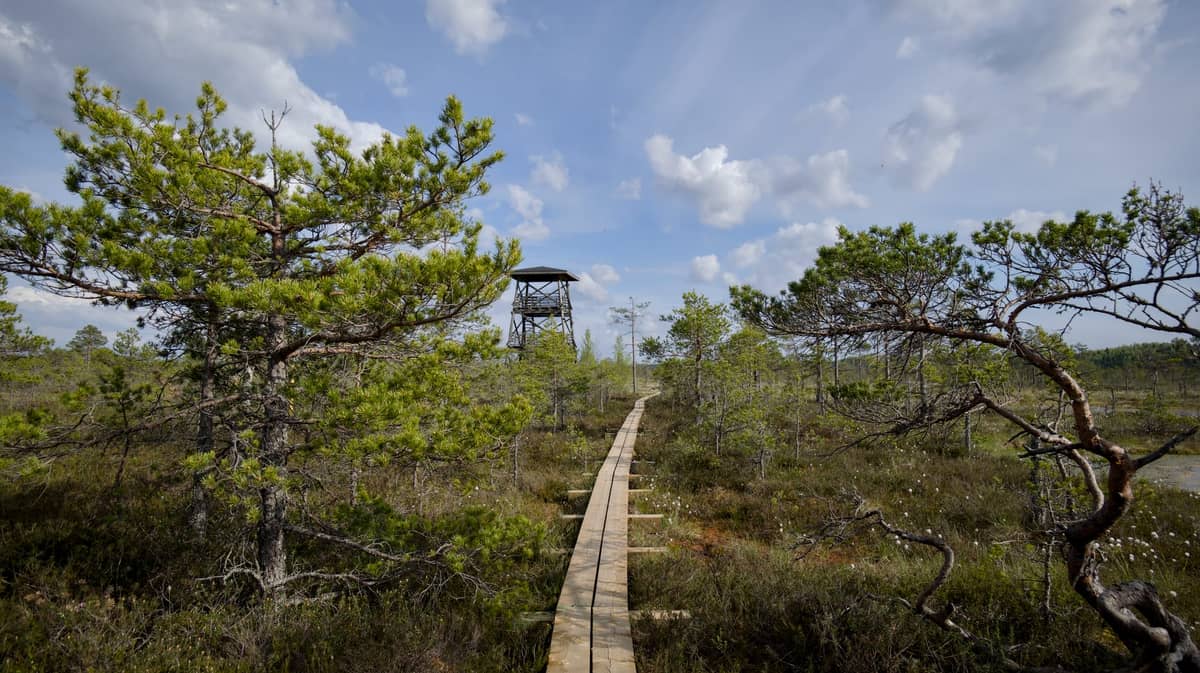
The wooden boardwalk that crosses the Great Ķemeri Bog is the main visitor route, and it delivers a landscape unlike anything most travellers have encountered. The bog surface is open and treeless except for isolated islands of stunted Scots pine, their trunks no thicker than a forearm despite being decades old. Bog conditions stress trees so severely that a pine growing for 80 years here might stand only two metres tall.
The colours shift dramatically with the seasons. In spring the bog pools reflect a pale sky between masses of white cotton-grass. Late summer turns the surface russet and amber as heather blooms across the open peat. In autumn, low-angled light makes the whole landscape glow. In winter, snow and ice compress the palette to near-monochrome, but the flat horizon and the silence are total. Each season offers a genuinely different walk.
Birdlife is a serious draw. The bog and surrounding wetlands are protected partly because of their value to waterfowl and wading birds. White storks, black storks, cranes, various duck species, and an array of warblers use the park during migration and breeding seasons. In early morning the birdsong from the forest edge mixes with frog calls from the pools, and the air smells of cold water, peat, and pine resin.
💡 Local tip
Bring binoculars. The bog's flat, open landscape means birds are visible at long range, and the park is one of the better places near Riga to spot black stork and crane during spring and autumn migration.
Tickets & tours
Hand-picked options from our booking partner. Prices are indicative; availability and final rates are confirmed when you complete your booking.
Canal boat sightseeing tour in Riga
From 13 €Instant confirmationArt and culture walking tour of Riga with a local
From 66 €Instant confirmationFree cancellationSelf-guided discovery walk in Riga - the essential old town and its secrets
From 30 €Instant confirmationFree cancellationExclusive private guided tour of Riga's architecture with a local
From 175 €Instant confirmationFree cancellation
How the Experience Changes by Time of Day
Early morning is the strongest time to visit. Before 9:00 the parking area is nearly empty, the light is low and golden, and the animal activity is highest. Mist sits in the bog pools for the first hour after sunrise in summer, giving the pine islands an almost Japanese quality. The silence is genuine: the park is far enough from roads and infrastructure that even ambient noise disappears.
Midday brings more visitors, particularly on summer weekends when families drive out from Riga and Jūrmala. The boardwalk is wide enough that it never feels truly crowded, but the meditative quality fades once groups with children are present. By mid-afternoon in high summer, mosquitoes become a significant issue near the bog edges and in the tree corridors.
Late afternoon and early evening recover some of the morning's atmosphere. The light re-enters that golden register, and most day-trippers have left by 17:00. Sunset over an open bog is worth timing a visit for, though arriving at dusk without a torch is not advisable on the forest trails beyond the main boardwalk loop.
Getting There: Train Versus Car
The most straightforward approach from Riga is the train. Pasažieru vilciens operates the Rīga–Ķemeri–Tukums line, and Ķemeri station is the stop to use. Journey time from Riga Central Station is roughly 50 minutes. The station sits within about a 3 km walk of the park; follow the signs or the road north from the station toward the A10 to reach the boardwalk trailhead. Check the Pasažieru vilciens timetable before departure as services can be less frequent at certain times of day.
If arriving by car, the route follows the Ventspils highway (A10) or the Talsi road (P128) toward Ķemeri. There is a car park at the main boardwalk entrance. Driving makes it easier to combine the bog with other stops around Jūrmala, including Majori Beach or Dzintari Forest Park on the same day.
The park is a textbook day trip from Riga, feasible without a car, and easily combined with a morning walk on the bog followed by an afternoon on the coast. The total journey from central Riga and back, with three hours in the park, fits comfortably inside a single day.
Practical Walkthrough: What to Prepare
The boardwalk itself is a loop trail on flat wooden planks. It requires no hiking fitness, and the surface is firm underfoot in dry conditions. However, the planks become genuinely slippery when wet, and in winter they ice over. Footwear with grip matters more here than on most nature walks: trainers with worn soles have caused problems for visitors on rainy days.
Mosquitoes and biting midges are active from May through August, concentrated near the bog edges and in shaded forest sections. Insect repellent is not optional in high summer; it is the single most important item to pack. Long sleeves and light trousers help significantly even in warm weather.
The Nature Education and Information Centre, known locally as the Forest House or Meža māja, is open June through August, Wednesday to Sunday from 11:00 to 17:00, and in May and September on weekends only during the same hours. Outside those windows, the park is unattended, but the bog boardwalk remains fully accessible. The Forest House provides maps, natural history exhibits, and background on the park's ecology. It is worth visiting if your timing aligns.
⚠️ What to skip
Secondary trails in the park can flood heavily in late winter and early spring due to snowmelt. The boardwalk remains passable, but off-boardwalk exploration during March and April may involve standing water and unstable ground.
Practical Assessment: Who Should Come and Who Might Want to Skip It
Ķemeri is a serious nature destination. The bog landscape is stark, quiet, and unusual, and that is precisely its appeal. Travellers who come expecting dramatic scenery in the alpine or coastal sense will find the flat, low-key environment underwhelming. There is an observation tower on the long loop, plus open bog vistas, no cafes, no visitor infrastructure beyond the seasonal Forest House. Bring your own food and water.
Travellers who want to understand the Baltic natural landscape more deeply, or who simply need a morning far away from city noise, will find Ķemeri remarkably rewarding. It works particularly well as a counterpoint to Riga's architectural density. After a day of Art Nouveau facades on Alberta iela or the medieval compression of Riga Old Town, stepping onto an open bog feels like a genuine reset.
Families with young children generally find the boardwalk a good outing provided the children are old enough to walk the full loop without needing to be carried. The flat terrain is manageable, but the bog pools beside the planks are unfenced, which demands constant attention with toddlers. Wheelchair users and visitors with significant mobility limitations should note that while the boardwalk is level, its wooden surface and the distance from parking to the trailhead may present challenges; no official wheelchair-certified status has been confirmed.
Insider Tips
- Arrive before 8:30 on a weekday to have the bog almost entirely to yourself. Weekend mornings after 10:00 see noticeably more visitors, especially in July and August.
- The best photography window is the hour after sunrise in summer, when mist sits in the pools and the cotton-grass catches backlit dew. A wide-angle lens and a low shooting angle from the boardwalk edge work better here than a telephoto.
- The Forest House (Meža māja) staff can point you to less-visited trail sections within the park that see almost no tourist traffic, particularly the forest and meadow routes away from the main bog loop.
- Pack more insect repellent than you think you need, and apply it before reaching the bog edge, not after the first bites. DEET-based repellent outperforms natural alternatives at the concentrations the midges here require.
- If you are combining Ķemeri with a beach day, do the bog walk first in the morning coolness and head to the coast in the afternoon. Reversing the order usually means arriving at the bog in the hottest, most insect-active part of the day.
Who Is Kemeri National Park & Bog Boardwalk For?
- Nature and wildlife photography, particularly birdwatching during spring and autumn migration
- Travellers wanting genuine solitude and open landscape within a day trip of Riga
- Anyone interested in peat bog ecology or the post-glacial Baltic natural environment
- Families with older children looking for an easy, free outdoor walk
- Visitors combining a coastal day in Jūrmala with a morning inland nature walk
Nearby Attractions
Other things to see while in Jūrmala:
- Dzintari Forest Park
Dzintari Forest Park is a free-entry woodland park in the heart of Jūrmala, set among fragrant Scots pine trees just steps from the Gulf of Riga coast. Open daily from 09:00 to 22:00 all year round, it combines quiet forest paths, a famous open-air concert venue, and a rope adventure course — making it one of the most complete day-trip destinations within easy reach of Riga.
- Majori Beach
Majori Beach is the central beach of Jūrmala, a long-established Baltic resort town a short train ride from Riga. With fine white sand stretching roughly 25–50 metres wide, lifeguard supervision in summer, and a lively pedestrian street connecting the station to the shore, it offers a complete seaside escape without a car or complicated logistics.