Mission Dolores Park: The Heart of the Mission District
Mission Dolores Park is the largest park in San Francisco's Mission District and a true crossroads of city life. Free to enter daily from 6 a.m. to 10 p.m., it draws everyone from weekend picnickers to dog walkers to families with strollers, all spread across a sun-drenched slope with views stretching toward downtown. If you want to understand how San Francisco actually spends its free time, spend an hour or two here.
Quick Facts
- Location
- 19th St & Dolores St, Mission District, San Francisco, CA 94114
- Getting There
- J Church Muni streetcar to Church St; BART to 16th St Mission, then walk west ~10 min
- Time Needed
- 1 to 3 hours depending on pace
- Cost
- Free (public park, no admission fee)
- Best for
- Picnickers, city view seekers, weekend loungers, local culture watchers
What Mission Dolores Park Actually Is
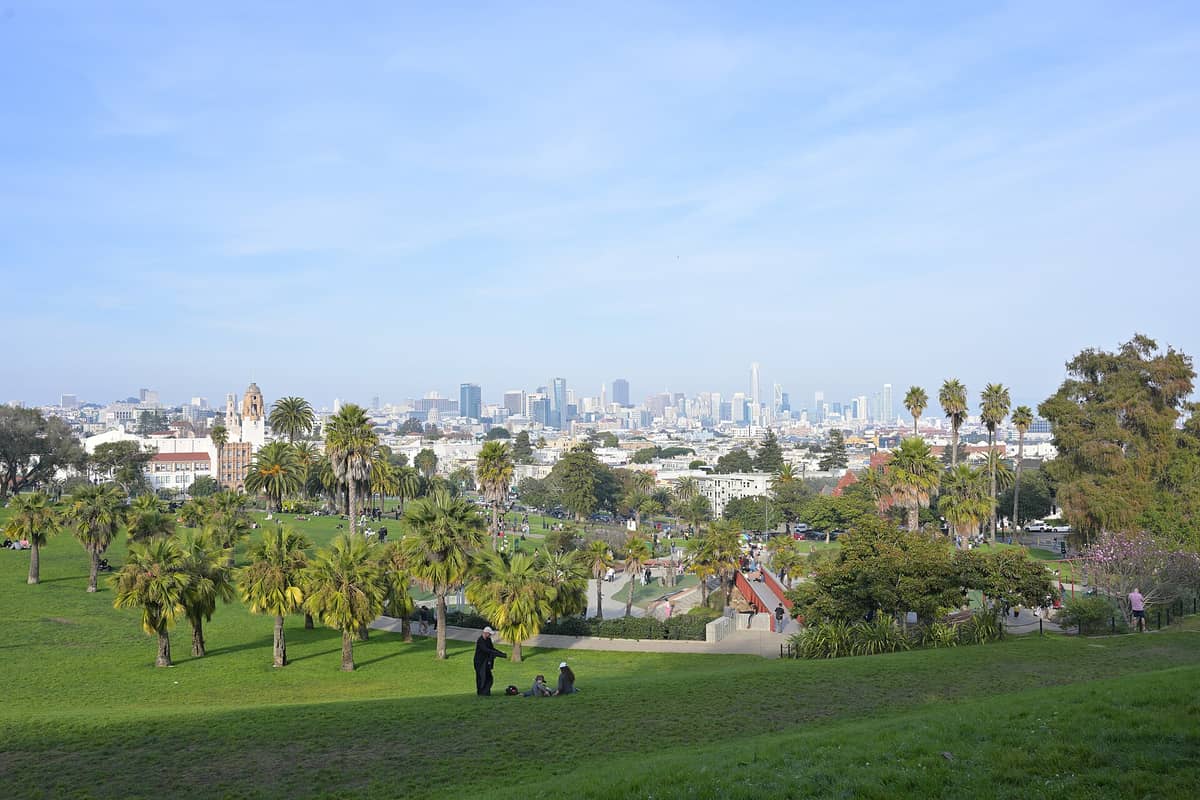
Mission Dolores Park is a roughly 15.5-acre public park sitting on a gentle hillside between Church Street to the east and Dolores Street to the west, anchored at its southern edge near 20th Street. It is the largest park in the Mission District and one of the most heavily used green spaces in San Francisco. On a clear Saturday afternoon the lawn fills shoulder-to-shoulder: people spread blankets in the sun, dogs cut between groups in pursuit of frisbees, and the sound of music from portable speakers layers over conversations in Spanish, English, and Mandarin. It is not a quiet retreat. It is the city at play.
The park is operated by the San Francisco Recreation and Parks Department and is open daily from 6:00 a.m. to 10:00 p.m. with no admission fee. Restrooms are located within the park, and a small concession kiosk near the main lawn area serves coffee and snacks on busy days, though hours are not fixed.
💡 Local tip
The park's upper northeast corner, near the 20th and Church intersection, offers one of the clearest unobstructed views of the downtown skyline. Arrive before noon on a clear day and the light falls directly on the Financial District towers.
How the Park Changes Hour by Hour
Early mornings, roughly 6:30 a.m. to 9:00 a.m., belong to dog walkers and joggers. The grass holds dew and the light comes in low from the east. The hill is nearly empty and the view of the city skyline from the upper slope is at its cleanest. Fog frequently sits over Twin Peaks and the western neighborhoods during this window, which creates a layered cityscape effect that photographers tend to appreciate. The air is cool, often in the low 50s Fahrenheit, and a jacket is advisable.
Midday on weekdays draws a younger crowd, often tech workers from nearby offices eating lunch on the grass, families with small children using the two playgrounds on the western and southern sides, and older residents on the paved paths. The pace is relaxed without being sleepy. Weekday afternoons are the best time to visit if you want the park at its most functional and least congested.
Weekend afternoons from roughly 1:00 p.m. to 6:00 p.m. are peak hours. The main lawn becomes extremely crowded in warm weather, especially between April and October. Finding a good stretch of open grass can take ten minutes of navigation. Noise levels are high, the smell of sunscreen and grass dominates, and the overall energy is festive but chaotic. This is the park's most photographed state, and if that communal scene is what you want to experience, this is the time to arrive. If you want space and quiet, it is the wrong window.
⚠️ What to skip
San Francisco summers (June through August) are frequently foggy and cool. Do not assume warm weather just because it is July. September and October offer statistically clearer skies and higher afternoon temperatures, making them the most reliable months for a sunny park visit.
Tickets & tours
Hand-picked options from our booking partner. Prices are indicative; availability and final rates are confirmed when you complete your booking.
Sonoma and Napa Valley wine tour from San Francisco
From 127 €Instant confirmationFree cancellationGo City | San Francisco Explorer Pass
From 76 €Instant confirmationFree cancellationMuir Woods and Sausalito guided tour with transportation
From 82 €Instant confirmationFree cancellationSan Francisco CityPASS
From 77 €Instant confirmationFree cancellation
The View and the Landscape
The park sits at an elevation that provides a clear sightline northeast toward downtown San Francisco. From the upper slope you can identify the Transamerica Pyramid, the Bay Bridge in the distance on clear days, and the dense grid of the Mission and Castro neighborhoods descending below. The view is not panoramic in the 360-degree sense, but the northeast-facing angle is genuinely good and completely unobstructed.
The terrain is sloped across most of the park, which means some sections are better suited to sitting and reading while others work well for active games. The southwest corner of the park is flatter and tends to draw volleyball and pickleball players. For those combining the park with a longer walk, the Mission Dolores basilica sits just two blocks north at 16th and Dolores, making a natural pairing for a morning itinerary.
The park's perimeter along Dolores Street is lined with tall palm trees that cast narrow shadows across the western grass sections in the afternoon. They are a visual landmark from several blocks away and give the park a slightly tropical quality that contrasts with the Victorian houses visible on the hillside streets above.
Historical and Cultural Context
The land was purchased by the City of San Francisco in 1905 as public parkland, and its development followed the period of reconstruction after the 1906 earthquake and fire, when demand for open green space in the city's densely built residential neighborhoods grew significantly.
The surrounding Mission District has been historically a predominantly Latino neighborhood and remains home to one of San Francisco's largest concentrations of Latino residents, restaurants, and murals. The park reflects that mix: weekend gatherings often include extended families with children, food from nearby taquerias carried in, and Spanish spoken as the dominant language in certain sections. Exploring the Mission District on foot before or after a park visit adds substantial context, especially Balmy Alley and Clarion Alley where the neighborhood's mural tradition is concentrated.
The park also has significance within San Francisco's LGBTQ+ history, being located at the edge of the Castro and the Mission, two neighborhoods central to that community's presence in the city. Weekend afternoons frequently include community events, informal gatherings, and occasional permitted festivals that reflect this layered social history. Check the SF Recreation and Parks calendar for scheduled events before visiting if you prefer to avoid large gatherings.
Getting There and Moving Around
The most straightforward transit option is the J Church Muni Metro streetcar, which runs along Church Street directly bordering the park's eastern edge. Board the J Church at any Market Street station heading outbound and exit at the 20th Street stop. The ride from the Civic Center area takes roughly ten minutes.
Alternatively, BART to 16th Street Mission Station puts you about a ten-minute walk west toward Dolores Street. That walk passes through the commercial heart of the Mission and gives you a ground-level introduction to the neighborhood before you reach the park. For more context on navigating Muni and BART within San Francisco, the getting around San Francisco guide covers fare details and route logic.
Street parking around the park on weekends is extremely competitive. If you are driving, plan to circle for fifteen to twenty minutes or park several blocks away on a quieter residential street. The perimeter of the park has multiple entrances with no gates, so entry from any side street is straightforward on foot.
ℹ️ Good to know
Cycling is a practical option here. Well-used bike routes in the area can bring you directly to the park's western edge, and bike racks are available at several park entrances.
Photography and Practical Logistics
The best photography window is early morning during late summer and fall. By 8:00 a.m. the light is warm and directional, the grass is mostly empty, and the skyline view from the upper northeast corner has no crowds to work around. Afternoon shots on clear days produce strong contrast between the green lawn and the white and pastel facades of the Victorian houses visible on the hillside. The palm-lined Dolores Street side makes for a strong compositional frame looking southeast.
There are no significant accessibility barriers for the paved perimeter paths and the park's main entrances. The interior lawn and upper slopes involve uneven grass terrain and gradients that may be challenging for wheelchair users or those with mobility limitations. Specific ADA amenities should be confirmed directly with the San Francisco Recreation and Parks Department before visiting.
If you are combining the park with a broader Mission itinerary, Balmy Alley is about a ten-minute walk south and east, and the park itself connects naturally to Clarion Alley further north. Together they form a compact walking route through the Mission's outdoor art and open space.
Who Should Skip This Park
Travelers looking for manicured, quiet green space with formal paths and cultivated gardens will find Mission Dolores Park underwhelming. It is an urban public lawn, not a botanical destination. The grass is well-used and shows wear in high-traffic sections. On popular weekend afternoons it is loud, crowded, and at times has the atmosphere of a low-key outdoor festival.
If what you want is a more curated park experience, the Japanese Tea Garden in Golden Gate Park or the Conservatory of Flowers offer a fundamentally different experience. And for pure San Francisco green-space scale and variety, the Golden Gate Park has no equal.
Insider Tips
- Weekday mornings between 7:00 and 9:00 a.m. offer the park at its best: clear views, dew-fresh grass, virtually no crowds, and the skyline lit by eastern light. It is a completely different experience from the weekend afternoon scene.
- The small coffee kiosk near the upper lawn area (often operating on weekend mornings) sells pour-over coffee. It is not always open, so bring your own if caffeine is critical to the plan.
- The northeast corner of the upper slope at approximately 20th and Church is the spot local photographers default to for downtown skyline shots. Stand there facing northeast and the Financial District frames cleanly above the rooflines.
- The park's southern end near 20th Street is noticeably quieter than the central lawn on busy days. If you want to sit in relative peace on a crowded afternoon, work your way to the southern perimeter.
- September and October are climatically the best months for a guaranteed sunny park visit. San Francisco's marine layer clears significantly in early fall, giving the park warm afternoons that the summer months rarely deliver.
Who Is Mission Dolores Park For?
- Locals and travelers who want to observe San Francisco social life at ground level
- Picnic lunches with a skyline backdrop in warm weather
- Dog owners looking for an off-leash-friendly open space
- Early morning joggers and walkers seeking a city viewpoint without climbing stairs
- Visitors combining a Mission District walking itinerary with outdoor time
Nearby Attractions
Other things to see while in Mission District:
- Balmy Alley
Balmy Alley is a one-block public alley in San Francisco's Mission District lined nearly wall to wall with murals dating back to 1972. Free to visit at any hour, it functions as an open-air gallery where the art changes over time, reflecting the neighborhood's Latino heritage, political history, and ongoing community activism.
- Clarion Alley
A one-block alley between Mission and Valencia Streets, Clarion Alley has been San Francisco's most concentrated outdoor mural corridor since 1992. The art is raw, politically engaged, and changes regularly — making it one of the few attractions in the city that rewards repeat visits.
- Mission San Francisco de Asís (Mission Dolores)
Founded in 1776 and still standing at the corner of 16th and Dolores Streets, Mission San Francisco de Asís is the oldest surviving structure in San Francisco. Equal parts active parish, colonial history museum, and quiet cemetery, it rewards visitors who take the time to look closely.