Clarion Alley: The Mission District's Living Canvas of Political Street Art
A one-block alley between Mission and Valencia Streets, Clarion Alley has been San Francisco's most concentrated outdoor mural corridor since 1992. The art is raw, politically engaged, and changes regularly — making it one of the few attractions in the city that rewards repeat visits.
Quick Facts
- Location
- Between Mission & Valencia Streets, 17th–18th Streets, Mission District, San Francisco, CA 94110
- Getting There
- 16th St Mission BART (~2–3 blocks); walk west on 16th St, left on Valencia, then right into the alley between 17th and 18th
- Time Needed
- 20–45 minutes for the alley itself; 1–2 hours if combined with surrounding Mission murals
- Cost
- Free — public alley, open 24 hours daily
- Best for
- Street art enthusiasts, photographers, travelers interested in social justice history and Latin American cultural heritage
- Official website
- clarionalleymuralproject.org
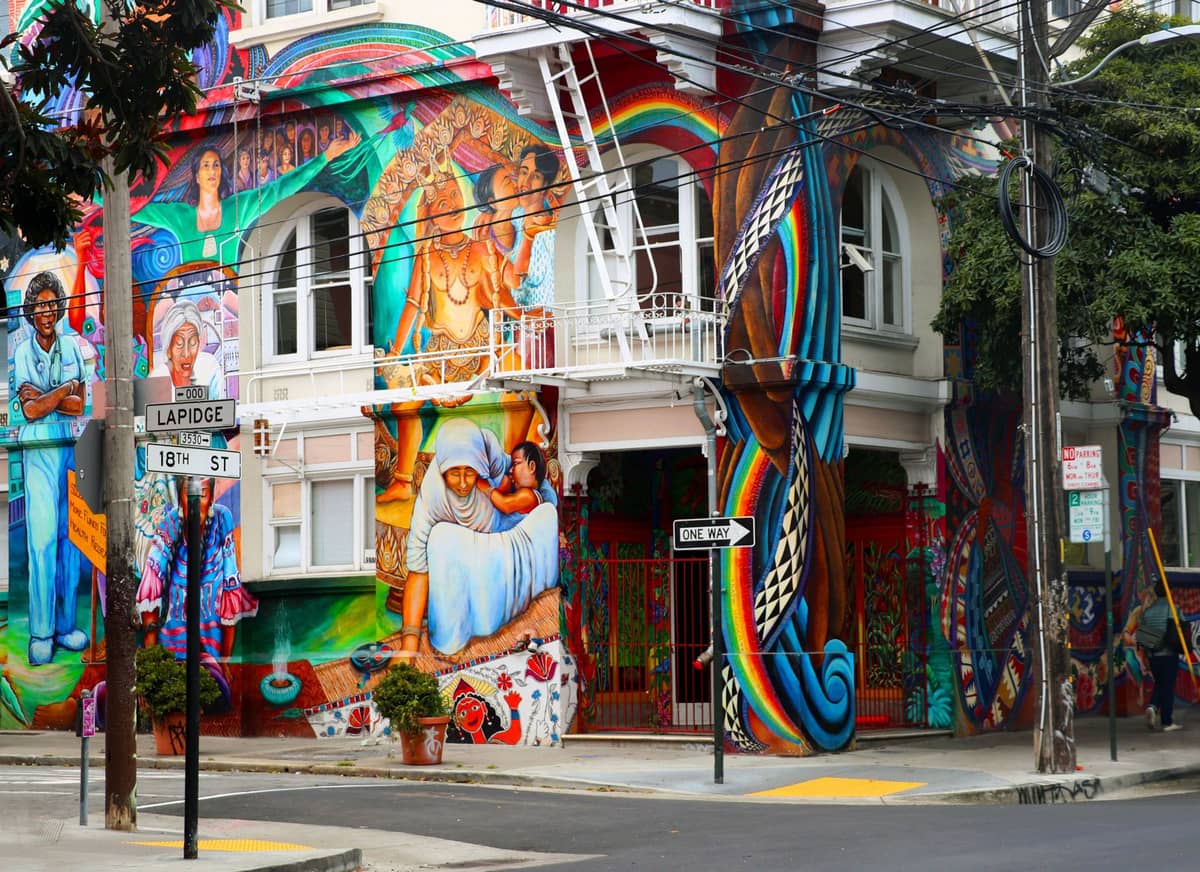
What Clarion Alley Actually Is
Clarion Alley is a 560-foot-long, 15-foot-wide public alleyway running one block between Mission Street and Valencia Street, tucked between 17th and 18th Streets in the heart of San Francisco's Mission District. Every inch of its walls is covered in murals, most of them large-scale, most of them political, and many of them recent. This is not a curated gallery with plaques and lighting. It's a working alley with bins, bikes, and the persistent smell of coffee from nearby cafes drifting in from Valencia Street. The art feels urgent because it is.
The Clarion Alley Mural Project, known as CAMP, was founded in 1992 by a collective of local artists who wanted to reclaim the space from neglect and vandalism. That founding year matters: 1992 was the year of the Rodney King verdict and the Los Angeles uprising, and the Mission District was itself in the middle of a housing crisis that would only deepen over the following decades. The murals have reflected that tension ever since, addressing gentrification, police violence, immigration, queer rights, Indigenous sovereignty, and global solidarity in terms that are rarely diplomatic.
ℹ️ Good to know
Clarion Alley is a public right-of-way and admission is free at all hours. The alley is also genuinely an active residential and commercial lane — residents live and work here, so keep noise down during early morning and evening hours.
The Art: What You'll See and How to Read It
Entering from the Mission Street end, you're immediately confronted with full-wall compositions that dwarf you. The scale is part of the point. Unlike many street art destinations where murals are decorative or brand-adjacent, the work in Clarion Alley tends toward the confrontational. Figures are depicted in grief, in defiance, or in solidarity. Text appears frequently, in English and Spanish, sometimes in both simultaneously. The typography is often as carefully crafted as the imagery.
Individual panels are maintained and replaced by CAMP, which coordinates with both established Mission artists and emerging voices. Because pieces are regularly repainted, the alley looks meaningfully different from one year to the next. A mural memorializing a shooting victim from 2019 may be replaced by work responding to a more recent event. This cycle of creation and erasure is intentional: the alley is meant to function as a living document, not a permanent archive. If you've visited before and want to see what's new, it's worth checking the CAMP website before your trip.
Stylistically, the work ranges from photorealist portraiture to flat graphic illustration to abstract composition. What unifies it is a clear connection to the Mission's predominantly Latin American cultural identity and its long history of activist art, a tradition that stretches back through the neighborhood's Balmy Alley murals just a few blocks away. Balmy Alley, whose murals began in the early 1970s, tends to focus more on Central American political themes; Clarion casts a wider net.
Tickets & tours
Hand-picked options from our booking partner. Prices are indicative; availability and final rates are confirmed when you complete your booking.
Sonoma and Napa Valley wine tour from San Francisco
From 127 €Instant confirmationFree cancellationSilicon Valley Tech day tour
From 124 €Instant confirmationFree cancellationMuir Woods with Napa and Sonoma Wine Country tour
From 144 €Instant confirmationFree cancellationSonoma and Napa Valley full-day wine tour from San Francisco
From 141 €Instant confirmationFree cancellation
Morning, Afternoon, or Night: When to Visit
The alley is open at all hours, but the experience shifts considerably depending on when you arrive. Early mornings, before 9am, the alley is quiet enough that you can stand in front of a single mural for several minutes without anyone else in frame. The light is soft and indirect, which actually suits photography well — the walls face north and south, meaning harsh direct sun isn't usually a factor, but golden-hour light from the east catches the Mission Street entrance cleanly.
By midday on weekends, particularly in the warmer months of September and October when San Francisco sheds its marine layer, the alley draws consistent foot traffic. Locals cut through it as a shortcut between Valencia and Mission Streets; tourists arrive in clusters, often with phones raised. The alley is only 15 feet wide, so ten people can make it feel genuinely crowded. If you want space to photograph without strangers in every shot, weekday mornings are your best window.
After dark, the alley is lit unevenly by spillover light from building windows and a few wall-mounted fixtures. Some murals photograph remarkably well with long-exposure techniques at night, and the alley has a different atmosphere entirely, quieter and more intimate. However, the Mission District's 16th Street corridor, especially near BART, sees some of San Francisco's higher pedestrian activity at night. Exercise the same awareness you would in any dense urban neighborhood.
💡 Local tip
For photography: enter from the Valencia Street end in the morning when the light is better for the longer wall runs. A wide-angle lens or the ultrawide setting on a smartphone helps capture full compositions in the narrow space.
Getting There and Moving Through the Neighborhood
The 16th St Mission BART Station is the single most convenient transit access point, a few minutes' walk northeast of the alley's Valencia Street entrance. From the station, walk west on 16th Street, turn left (south) onto Valencia Street, and the alley entrance appears on your left between 17th and 18th Streets. The walk takes under five minutes.
The alley's flat, paved surface makes it accessible for wheelchair users and strollers along its full length. There are no steps or significant grade changes. The Mission District itself is one of San Francisco's flattest neighborhoods, making it unusually walkable compared to hillier parts of the city. You can comfortably pair Clarion Alley with Balmy Alley, Dolores Park, and Mission Dolores within a single afternoon on foot.
Cultural Context: Why This Alley Matters
The Mission District has been San Francisco's Latino cultural center since at least the mid-20th century, shaped by waves of immigration from Mexico, El Salvador, Guatemala, Nicaragua, and other Latin American countries. The neighborhood's identity has also been defined by displacement: two tech booms, in the late 1990s and again after 2010, brought intense gentrification pressure that dramatically altered the neighborhood's demographics and rent levels.
Clarion Alley sits at the intersection of those pressures. The murals have documented and responded to evictions, police shootings, ICE raids, and the COVID-19 pandemic's disproportionate impact on low-income communities of color. For a traveler accustomed to street art that functions primarily as aesthetic backdrop, the directness of some pieces can be disorienting. That disorientation is part of what makes the alley worth your time. This is not public art that decorates power. It's public art that challenges it.
If you want to understand the broader context of mural art in San Francisco's Mission District, the San Francisco walking tour options include several Mission-focused routes that connect Clarion Alley, Balmy Alley, and other mural sites with narration from guides who know the neighborhood's history.
What Clarion Alley Is Not
Clarion Alley is a short, narrow alley. The full experience of walking its length takes under ten minutes at a leisurely pace. If you've traveled specifically for it as your main Mission District activity, you may feel the detour was brief. It works best as one stop in a longer walk through the neighborhood, not as a standalone destination for a half-day.
The art is also explicitly political and, in places, graphic. Several murals depict police violence, border deaths, and other traumatic subject matter with unflinching imagery. Visitors who prefer decorative or apolitical street art, or who are traveling with young children, should know what to expect. The alley does not curate for comfort.
If your goal is a broader overview of San Francisco's public art landscape, pair this with the 16th Avenue Tiled Steps in the Inner Sunset for a contrast in tone and style, or head to Coit Tower in North Beach, whose 1930s WPA frescoes represent an earlier chapter in San Francisco's tradition of socially engaged public art.
⚠️ What to skip
Some murals in Clarion Alley contain imagery of violence, death, and explicit political messaging. This is intentional on the part of the artists and the project. It is not appropriate as the primary destination for very young children.
Combining Clarion Alley with the Rest of the Mission
The Mission District rewards spending a few hours, not just a few minutes. From Clarion Alley, it's a short walk south to Dolores Park, which offers one of the better views of the downtown skyline and fills with a cross-section of San Francisco residents on sunny afternoons. Mission Dolores, the city's oldest building, is nearby on Dolores Street and provides historical grounding for the neighborhood's deeper past.
Valencia Street, which forms one boundary of the alley, is one of the city's better corridors for independent bookshops, cafes, and restaurants. If you're building a longer Mission itinerary, the San Francisco 3-day itinerary groups the Mission efficiently with other nearby neighborhoods to minimize transit time.
Insider Tips
- Enter from the Valencia Street end rather than Mission Street for better initial light and a longer uninterrupted wall run as you walk toward Mission Street.
- Check the Clarion Alley Mural Project website (clarionalleymuralproject.org) before visiting — they occasionally post notices about new murals being painted or community events happening in the alley, which are worth timing your visit around.
- The alley is at its most photogenic under overcast skies, which San Francisco produces frequently. Flat diffuse light eliminates harsh shadows in the narrow space and makes colors appear more saturated.
- If you want to understand the individual works, photograph the murals and look up the artists afterward. Many CAMP artists are active on social media and provide context for specific pieces that you won't find on any sign in the alley itself.
- Combine Clarion Alley with Balmy Alley (three blocks southeast, between 24th and 25th Streets on Treat Avenue) to get a fuller picture of the Mission's mural tradition — the two alleys have distinct histories, aesthetics, and political emphases.
Who Is Clarion Alley For?
- Street art and urban culture enthusiasts who want context beyond aesthetics
- Photographers seeking bold graphic compositions without crowds (on weekday mornings)
- Travelers interested in social justice history, Latin American culture, and community-based art
- Mission District visitors building a full neighborhood afternoon that includes food, parks, and history
- Return visitors to San Francisco who have already seen the standard tourist circuit and want something with more local specificity
Nearby Attractions
Other things to see while in Mission District:
- Balmy Alley
Balmy Alley is a one-block public alley in San Francisco's Mission District lined nearly wall to wall with murals dating back to 1972. Free to visit at any hour, it functions as an open-air gallery where the art changes over time, reflecting the neighborhood's Latino heritage, political history, and ongoing community activism.
- Mission Dolores Park
Mission Dolores Park is the largest park in San Francisco's Mission District and a true crossroads of city life. Free to enter daily from 6 a.m. to 10 p.m., it draws everyone from weekend picnickers to dog walkers to families with strollers, all spread across a sun-drenched slope with views stretching toward downtown. If you want to understand how San Francisco actually spends its free time, spend an hour or two here.
- Mission San Francisco de Asís (Mission Dolores)
Founded in 1776 and still standing at the corner of 16th and Dolores Streets, Mission San Francisco de Asís is the oldest surviving structure in San Francisco. Equal parts active parish, colonial history museum, and quiet cemetery, it rewards visitors who take the time to look closely.