Balmy Alley: San Francisco's Living Canvas of Political Art
Balmy Alley is a one-block public alley in San Francisco's Mission District lined nearly wall to wall with murals dating back to 1972. Free to visit at any hour, it functions as an open-air gallery where the art changes over time, reflecting the neighborhood's Latino heritage, political history, and ongoing community activism.
Quick Facts
- Location
- Between 24th and 25th Streets, between Treat Avenue and Harrison Street, Mission District, San Francisco, CA 94110
- Getting There
- 24th Street Mission BART station, then a short walk east
- Time Needed
- 20 to 45 minutes for the alley itself; 1 to 2 hours if exploring the wider mural corridor on 24th Street
- Cost
- Free. No tickets, no entry requirements.
- Best for
- Street art lovers, photographers, anyone interested in Chicano and Latin American political history
- Official website
- balmyalley.org
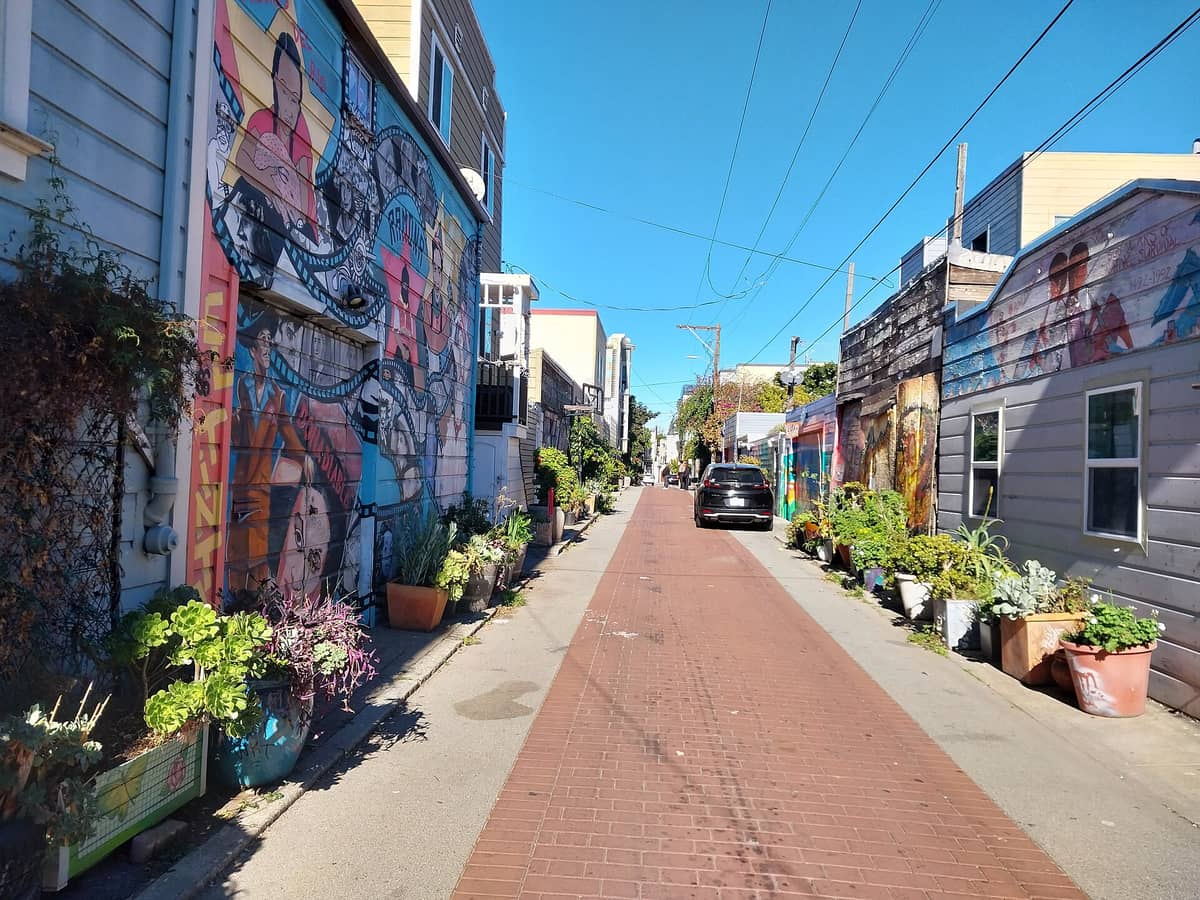
What Balmy Alley Actually Is
Balmy Alley, formally named Balmy Street, is a single block running between 24th and 25th Streets in San Francisco's Mission District. In practical terms, it is a narrow residential alley whose garage doors, fence panels, wooden walls, and exterior building surfaces have been painted with murals more or less continuously since 1972. What began as a neighborhood beautification effort evolved into one of the most politically charged outdoor art spaces in the United States.
Unlike a curated gallery, the murals here are the work of dozens of artists across five decades. Some pieces survive for years; others are painted over when residents or artists decide the wall needs something new. There is no map you can download that will perfectly match what you find on the day you visit. That impermanence is part of the point.
ℹ️ Good to know
Balmy Alley is a public street and is accessible at all times with no admission fee. It is approximately one block long and takes under five minutes to walk end to end, though most visitors move slowly and spend 20 to 40 minutes reading, photographing, and absorbing the work.
The History Behind the Paint
The Mission District has been a center of Latino life in San Francisco since at least the mid-twentieth century, drawing immigrants from Mexico, Central America, and South America. The mural tradition here draws directly from the Mexican muralist movement, particularly the work of Diego Rivera, David Alfaro Siqueiros, and José Clemente Orozco, who believed that public art was a form of political speech accessible to everyone regardless of literacy or income.
Balmy Alley's murals became especially significant during the mid-1980s, when artists began responding to the civil wars in El Salvador, Guatemala, and Nicaragua. Many Mission residents had direct family ties to those conflicts, and the alley became a place to document suffering, demand accountability, and assert cultural survival. Those themes have never fully left, even as newer murals address housing displacement, immigration enforcement, and environmental justice.
The alley does not exist in isolation. It sits within one of the densest mural corridors in North America. Walking a few blocks along 24th Street and into the surrounding neighborhood reveals dozens more works, many by artists associated with Precita Eyes Muralists, a community arts organization based nearby in the Mission. Precita Eyes has led guided mural tours of the area for decades and offers one of the most informed ways to understand what you are looking at. For a broader picture of the neighborhood's cultural landscape, the Mission District has its own distinct rhythm and story beyond the paint.
Tickets & tours
Hand-picked options from our booking partner. Prices are indicative; availability and final rates are confirmed when you complete your booking.
Sonoma and Napa Valley wine tour from San Francisco
From 127 €Instant confirmationFree cancellationSilicon Valley Tech day tour
From 124 €Instant confirmationFree cancellationMuir Woods with Napa and Sonoma Wine Country tour
From 144 €Instant confirmationFree cancellationSonoma and Napa Valley full-day wine tour from San Francisco
From 141 €Instant confirmationFree cancellation
What You See Walking Through
Entering from 24th Street, the shift is immediate. The alley is perhaps fifteen feet wide, and on both sides the surfaces are almost entirely covered. There are no bare walls to give your eye a rest. The scale varies dramatically: a garage door might carry a single bold image, while the side of a building carries a multi-panel narrative that requires you to step back and piece it together.
Subject matter ranges from pre-Columbian imagery and indigenous spiritual symbols to portraits of political figures, scenes of displacement and migration, and flat-out abstract color fields. Some murals are meticulously detailed; others are rougher, quicker, more urgent in their execution. The cumulative effect is less like a gallery visit and more like reading a community's collective memory, one wall at a time.
Notice the texture underfoot: the alley's pavement is uneven in places, and the surface is a mix of asphalt patches and older concrete. It is a working residential lane, not a pedestrianized zone, so occasional vehicles do pass through. Residents live here. Keep voices low and avoid blocking driveways for extended periods.
💡 Local tip
For photography, overcast mornings produce the most even light across the murals without the harsh shadows that midday sun creates. The alley runs roughly north to south, so the eastern wall gets direct morning light and the western wall benefits from softer afternoon light.
How the Experience Changes by Time of Day
Early mornings, particularly on weekdays before 9 am, Balmy Alley is quiet to the point of stillness. You may be the only non-resident there. The sounds are neighborhood sounds: someone taking out recycling, a dog, a bus making a turn on 24th. This is the best time to spend with the work slowly without feeling any pressure to move along.
By mid-morning on weekends, small tour groups begin arriving. Guided walks led by Precita Eyes typically pass through, and a guide's commentary adds real depth to works whose context you might otherwise miss entirely. If you are here without a guide, take your phone but also take time to simply look before you search for explanations.
Afternoon visits are perfectly workable but more crowded, and the alley can feel narrow when multiple groups overlap. By late afternoon, the light on the western wall turns warmer and more photogenic. Evening visits are possible since the alley is technically public and accessible around the clock, but the murals lose much of their visual detail after dark, and the alley is unlit.
Getting There and Getting Around
The most straightforward approach is BART to 24th Street Mission station, then walking east on 24th Street for about three blocks. The alley runs between 24th and 25th Streets, opening off the south side of 24th between Treat Avenue and Harrison Street. Street parking exists in the surrounding blocks but the Mission is dense and parking can be unreliable on weekends. Most visitors find transit or cycling easier.
Several Muni bus lines also serve the 24th and Mission corridor. For general guidance on navigating San Francisco by transit, the getting around San Francisco guide covers Muni, BART, and other options in practical detail.
The alley itself is a flat, paved surface with no steps, though the pavement is not uniformly smooth. A wheelchair can navigate it, but the surface quality varies and there is no formal accessible amenity. Restrooms are not available at Balmy Alley; the nearest options are in the cafes and restaurants on 24th Street.
Extending Your Visit: The Wider Mission Mural Walk
Balmy Alley is the most concentrated point in a much larger mural landscape. A ten-minute walk gets you to Clarion Alley near 17th and Valencia, another major mural corridor with a distinctly different visual and political tone. The two alleys together give you a fuller picture of how public art functions differently in different parts of the same neighborhood.
The area around 24th Street is also one of the better places in San Francisco to eat well without spending much. Taquerias, panaderías, and Mission-style burrito spots line the corridor. The Mission burrito guide is a useful companion if you are building a half-day itinerary around the neighborhood.
Two blocks from Balmy Alley, Mission Dolores is the oldest intact building in San Francisco, founded in 1776. Pairing the alley with the mission gives a visit a wider historical arc, from Spanish colonization to contemporary immigrant art made in response to that same history.
Practical Limitations
Balmy Alley is one block long. If you are visiting San Francisco for two or three days and have not arranged a guided tour, thirty minutes here is probably the right allocation. It rewards slow, attentive looking, but it does not expand the way a larger park or museum does.
The condition of individual murals varies. Some are freshly restored; others are weathered, tagged with graffiti, or partially obscured. This is not a perfectly maintained installation. If you are expecting the pristine reproduction quality you might see in a print, the reality of paint fading in Bay Area weather and being layered over by decades of subsequent work may surprise you.
⚠️ What to skip
Balmy Alley is a residential lane with people living and working there. Do not touch the murals, block driveways, or play music loudly. Treat it as someone's home street, because that is exactly what it is.
Insider Tips
- Precita Eyes Muralists leads guided walking tours of the Mission mural district that include Balmy Alley. Their guides are often artists who have worked in the neighborhood for decades. This is not a generic tourist tour; the depth of knowledge on offer is exceptional and worth checking their current schedule before you visit.
- If you want to photograph the full length of an individual wall panel without distortion, bring a wide-angle lens or use your phone's panorama mode from as far back as the narrow alley allows. Standing in the center of the lane and shooting straight at the wall gives the flattest, most accurate representation of the work.
- The western-facing walls catch warm afternoon light from roughly 3 pm onward in summer. If golden-hour photography matters to you, the later afternoon slot is notably better than midday for those specific panels.
- Some of the most powerful works are on the garage doors, which can be partially obscured if a door is open. Weekday mornings when residents have left for work often yield clearer views than weekend afternoons when people are home and doors are in various states.
- Check balmyalley.org before your visit. The site documents the alley's history and individual murals in more detail than any on-site signage provides, and it can help you identify and understand specific works you encounter.
Who Is Balmy Alley For?
- Travelers interested in Chicano art, Latin American political history, or the community roots of the mural tradition
- Photographers looking for bold, graphic subjects in natural outdoor light
- First-time visitors to San Francisco who want to understand a neighborhood beyond its surface tourism layer
- Anyone building a half-day Mission District itinerary that includes food, history, and street culture
- Visitors who have already seen the main landmarks and want something more local in character
Nearby Attractions
Other things to see while in Mission District:
- Clarion Alley
A one-block alley between Mission and Valencia Streets, Clarion Alley has been San Francisco's most concentrated outdoor mural corridor since 1992. The art is raw, politically engaged, and changes regularly — making it one of the few attractions in the city that rewards repeat visits.
- Mission Dolores Park
Mission Dolores Park is the largest park in San Francisco's Mission District and a true crossroads of city life. Free to enter daily from 6 a.m. to 10 p.m., it draws everyone from weekend picnickers to dog walkers to families with strollers, all spread across a sun-drenched slope with views stretching toward downtown. If you want to understand how San Francisco actually spends its free time, spend an hour or two here.
- Mission San Francisco de Asís (Mission Dolores)
Founded in 1776 and still standing at the corner of 16th and Dolores Streets, Mission San Francisco de Asís is the oldest surviving structure in San Francisco. Equal parts active parish, colonial history museum, and quiet cemetery, it rewards visitors who take the time to look closely.