Mission Dolores: Inside San Francisco's Oldest Building
Founded in 1776 and still standing at the corner of 16th and Dolores Streets, Mission San Francisco de Asís is the oldest surviving structure in San Francisco. Equal parts active parish, colonial history museum, and quiet cemetery, it rewards visitors who take the time to look closely.
Quick Facts
- Location
- 3321 16th Street, corner of 16th & Dolores Streets, Mission District, San Francisco, CA 94114
- Getting There
- BART to 16th St. Mission, then 3 blocks east; or Muni 22 Fillmore bus stops nearby along 16th Street
- Time Needed
- 45 minutes to 1.5 hours
- Cost
- Suggested donation about USD $10 adults / $5 students; confirm current amount with the mission directly
- Best for
- History, architecture, photography, and anyone curious about pre-Gold Rush San Francisco
- Official website
- www.missiondolores.org
What Mission Dolores Actually Is
Mission San Francisco de Asís, known almost universally as Mission Dolores, is the sixth of California's 21 Spanish Franciscan missions and the oldest intact structure in the city. It was founded on October 9, 1776, about three months after the Declaration of Independence was signed on the opposite side of the continent. The adobe church that visitors walk through today was completed in 1791 and has outlasted earthquakes, fires, and two and a half centuries of urban transformation around it.
The name 'Dolores' itself does not refer to the mission's patron saint. It comes from the Arroyo de los Dolores, a creek that once ran nearby and was named by Spanish explorers who camped there on the Friday of Sorrows in 1776. The informal name stuck, and today it designates not just the mission but the surrounding neighborhood, the park across the street, and one of the city's most recognizable streets.
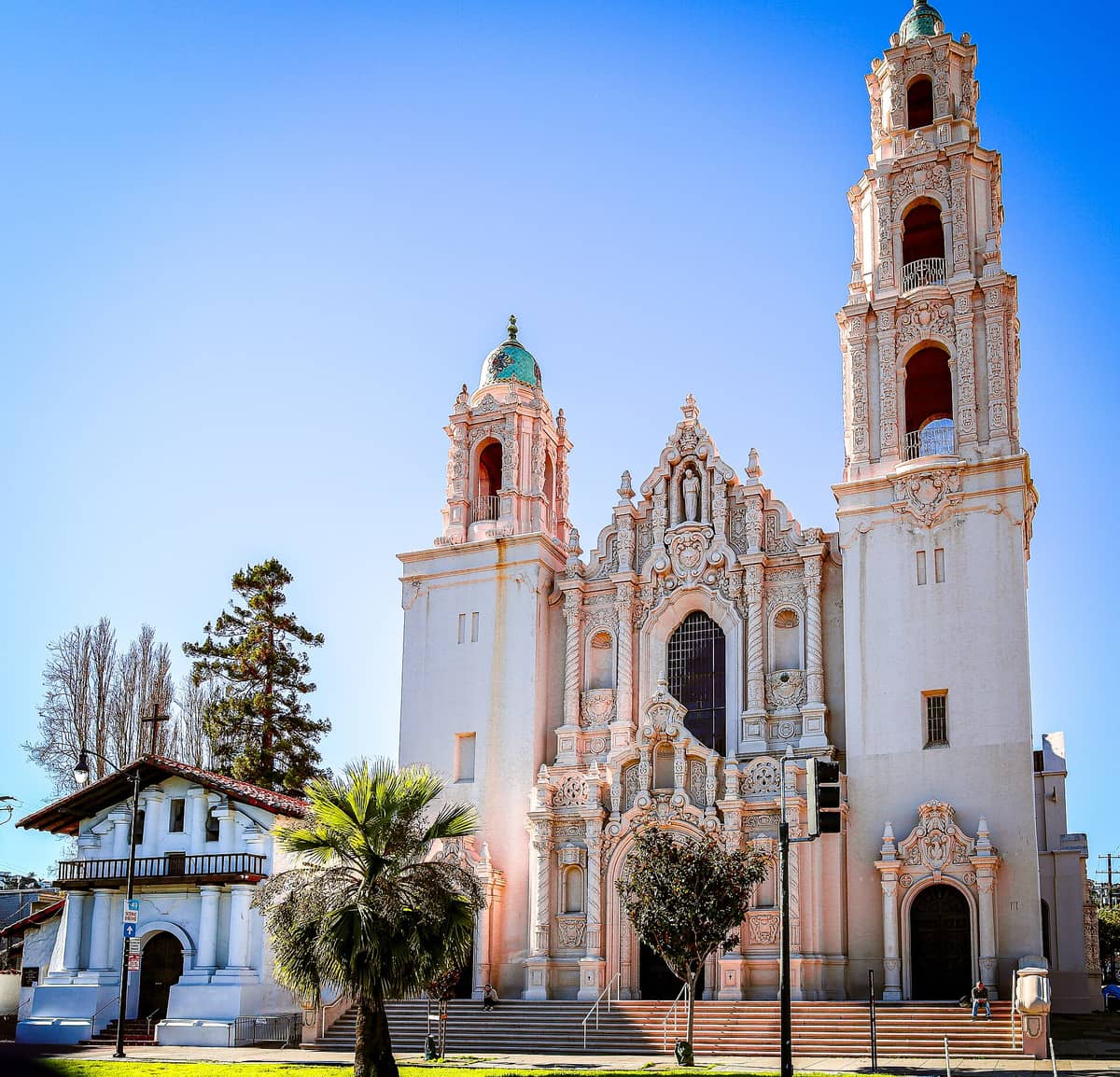
The complex today consists of two adjacent churches: the original 1791 adobe chapel and the larger Basilica next door, completed in 1918 in a Spanish Colonial Revival style with Churrigueresque detailing. Most visitors are primarily interested in the old chapel, the small museum inside, and the cemetery behind it. The Basilica is an active parish and can usually be viewed from the entrance for free.
ℹ️ Good to know
Hours: Monday through Friday 10:00 a.m. to 4:00 p.m.; Saturday & Sunday 10:00 a.m. to 5:00 p.m. Closed Thanksgiving, Christmas, and New Year's Day. Limited hours on Good Friday and Easter Sunday. Call ahead to confirm, as hours can change without notice.
The Adobe Chapel: What You See Inside
Stepping into the original chapel is a genuine architectural shift. The walls are adobe, roughly four feet thick, which gives the interior a cool, slightly earthy smell regardless of the season outside. The ceiling is painted in geometric patterns said to reflect Ohlone and Coast Miwok design traditions, the Indigenous peoples of the San Francisco peninsula with whom the Franciscan missionaries had direct, and often devastating, contact. Look up before you do anything else: the original ceiling timbers are hand-hewn redwood and have never been replaced.
The altar at the far end was brought from Mexico in the late 18th century, and several of the statues date to the mission's founding era. The chapel is small enough that even a modest crowd makes it feel full. On weekday mornings before 11:00 a.m., you can often have much of it to yourself, which makes a considerable difference to the quality of the visit.
A small museum adjoins the chapel. It holds documents, vestments, and artifacts from the colonial period, along with interpretive panels that cover both the Franciscan perspective and the impact of the mission system on the Ohlone population. The panels do not shy away from the darker record: thousands of Indigenous people are buried in the adjacent cemetery, and the exhibit acknowledges the complex and often coercive relationship between the missions and the people they sought to convert.
Tickets & tours
Hand-picked options from our booking partner. Prices are indicative; availability and final rates are confirmed when you complete your booking.
Mission District Food Tour
From 76 €Instant confirmationThe Walt Disney Family Museum general admission tickets
From 21 €Instant confirmationSonoma and Napa Valley wine tour from San Francisco
From 127 €Instant confirmationFree cancellationGo City | San Francisco Explorer Pass
From 76 €Instant confirmationFree cancellation
The Cemetery: San Francisco's Oldest Graveyard
The cemetery behind the chapel is the emotional and historical center of the site. It contains the graves of prominent figures from early California history, including Luis Antonio Arguello, the first governor of California under Mexican rule, and several early San Francisco mayors. The grave markers range from ornate Victorian monuments to simple wooden crosses, and many show the wear of two centuries of Bay Area fog and rain.
Walk slowly here. The garden is compact but dense with detail. Native plantings and carefully maintained hedges give it a quiet, enclosed feel that contrasts sharply with the noise of the Mission District just outside the walls. The cemetery is also a place of active pilgrimage for those researching early California genealogy, and on some mornings you may encounter people photographing specific stones with careful attention.
A monument near the entrance honors the Ohlone people, acknowledging that the unmarked graves of thousands of Indigenous individuals lie within the grounds. This is not a footnote: it is one of the most significant facts about the site, and it shapes how the space feels to many visitors who know the history.
How the Experience Changes by Time of Day
Right after opening, around 10:00 to 10:30 a.m., is when the light inside the chapel is at its best. The sun comes through the windows on the east side at a low angle, catching the texture of the adobe walls and the gilded detail on the altar. Tour groups typically arrive midmorning and peak between 11:00 a.m. and 2:00 p.m., when the space can feel crowded for its size.
Afternoon visits, particularly on weekdays, often feel more contemplative. The Basilica across the small courtyard draws some visitors away, and the museum section empties out after about 1:30 p.m. If you are visiting primarily for photography, the late afternoon light (around 3:00 to 4:00 p.m.) can be excellent in the cemetery, where the low angle of the sun picks out the relief carving on the older headstones.
Weekends bring families with children exploring the Mission District's broader attractions. The mission handles this well: the space is small enough to feel significant even when shared, and the staff are generally patient with curious kids. That said, the meditative quality of a quiet morning visit is harder to find on a Saturday.
💡 Local tip
Photography tip: A wide-angle lens or a phone on portrait mode in natural light works well inside the chapel. Flash photography is typically discouraged. For the cemetery, overcast days actually produce better results than bright sunshine, as the even light reveals the texture of the aging stone without harsh shadows.
Getting There and Practical Details
The most straightforward approach is BART to the 16th St. Mission station, followed by a three-block walk east along 16th Street toward Dolores Street. The walk passes through a stretch of the Mission District that is lively and worth the few minutes on foot. Muni's 22 Fillmore bus also stops directly at the mission, which is useful if you are coming from Pacific Heights, the Fillmore corridor, or the Haight.
The mission sits directly across Dolores Street from Dolores Park, one of the city's most active neighborhood parks. Combining both in a single outing is natural: the park offers a very different angle on the Mission District's contemporary character, and the contrast with the 18th-century adobe across the street is worth reflecting on.
The suggested donation is about USD $10 for adults and $5 for students; confirm the current amount directly with the mission before visiting. There is no large gift shop, but a modest selection of books and souvenirs is available near the exit. The surrounding neighborhood has no shortage of cafes and restaurants along Valencia Street and 18th Street if you want to extend the visit.
Accessibility information is not comprehensively detailed on secondary sources. The building sits at street level on a city corner, but the adobe structure's age and interior layout mean some areas may have limitations. Visitors with specific accessibility needs are advised to contact the mission directly before visiting.
Historical Context: Why This Building Survived
San Francisco's built environment is not known for its antiquity. The Gold Rush of 1849, the 1906 earthquake and fire, and decades of aggressive redevelopment erased most of what came before. Mission Dolores survived the 1906 earthquake largely intact because of its adobe construction: the thick, earthen walls flexed rather than shattered. The Basilica next door, a later structure, was damaged and rebuilt, but the original chapel stood much as it had since its completion in 1791.
This makes Mission Dolores a singular site. To stand inside it is to be in a room that predates the city itself by more than seven decades. The Franciscan mission system of which it was a part stretched from San Diego to Sonoma, and understanding one mission helps contextualize the others. For broader context on the city's architectural history, the San Francisco architecture guide covers how the colonial period fits into the city's longer built history.
The mission also carries a complicated legacy in California's relationship with its Indigenous past. Scholars and California Native communities have increasingly called attention to the mission system's role in the displacement and deaths of Indigenous peoples. The interpretive exhibits inside the museum engage with this history, though opinions differ on how fully any single site can reckon with it.
Who Will Get the Most From This Visit
Visitors with an interest in California's pre-statehood history will find Mission Dolores rewarding in ways that few other city sites can match. Architecture enthusiasts will want to spend time with the ceiling, the altar, and the relationship between the adobe chapel and the Churrigueresque Basilica beside it. Those researching early California families or the history of the Ohlone people will find the cemetery and museum useful starting points. And anyone building a first-time visit to San Francisco who wants to move beyond the waterfront and into the neighborhoods should consider pairing the mission with the nearby Balmy Alley murals and a walk along Valencia Street for a fuller picture of the Mission District's layered character.
If you are looking for a comprehensive introduction to the neighborhood before your visit, the Mission District neighborhood guide covers what else to see, eat, and do within walking distance of the mission.
Visitors who are primarily looking for a high-energy tourist experience, or who have little interest in colonial or religious history, may find the 45-minute visit underwhelming relative to other city attractions. The space is intimate and quiet by design. That is its strength for the right visitor, and a limitation for others.
⚠️ What to skip
The mission is an active place of worship, not only a museum. Dress and behavior accordingly: keep voices low inside the chapel, and be respectful in the cemetery. Some visitors are there to pray, not sightsee.
Insider Tips
- Arrive at opening time on a weekday if you want the chapel largely to yourself. The difference between a 10:15 a.m. visit and an 11:30 a.m. visit in terms of crowd density is significant.
- The painted ceiling is the single most remarkable feature inside, and it is easy to miss if you walk straight to the altar. Stop just inside the entrance door and look up first.
- The Basilica entrance to the right of the chapel is usually open and free to look into from the threshold. The interior is lavishly decorated in the Spanish Colonial Revival style and makes a sharp visual contrast to the plainness of the adobe chapel.
- The cemetery gate is included with admission. Walk the full perimeter rather than just the central path: several of the most historically significant markers are along the side walls and easy to overlook.
- The neighborhood around the mission changes character quickly depending on which direction you walk. Dolores Street heading south is residential and calm. Valencia Street one block east is dense with cafes, bookshops, and bars. Both are worth exploring after your visit.
Who Is Mission San Francisco de Asís (Mission Dolores) For?
- History and architecture enthusiasts interested in California's Spanish colonial period
- Photographers looking for interior light, textured surfaces, and cemetery compositions
- First-time visitors who want to understand the city's origins beyond the waterfront
- Genealogy researchers with ties to early California families
- Travelers combining a Mission District afternoon with Dolores Park and local dining
Nearby Attractions
Other things to see while in Mission District:
- Balmy Alley
Balmy Alley is a one-block public alley in San Francisco's Mission District lined nearly wall to wall with murals dating back to 1972. Free to visit at any hour, it functions as an open-air gallery where the art changes over time, reflecting the neighborhood's Latino heritage, political history, and ongoing community activism.
- Clarion Alley
A one-block alley between Mission and Valencia Streets, Clarion Alley has been San Francisco's most concentrated outdoor mural corridor since 1992. The art is raw, politically engaged, and changes regularly — making it one of the few attractions in the city that rewards repeat visits.
- Mission Dolores Park
Mission Dolores Park is the largest park in San Francisco's Mission District and a true crossroads of city life. Free to enter daily from 6 a.m. to 10 p.m., it draws everyone from weekend picnickers to dog walkers to families with strollers, all spread across a sun-drenched slope with views stretching toward downtown. If you want to understand how San Francisco actually spends its free time, spend an hour or two here.