Cuicuilco Archaeological Zone: The Ancient City Swallowed by a Volcano
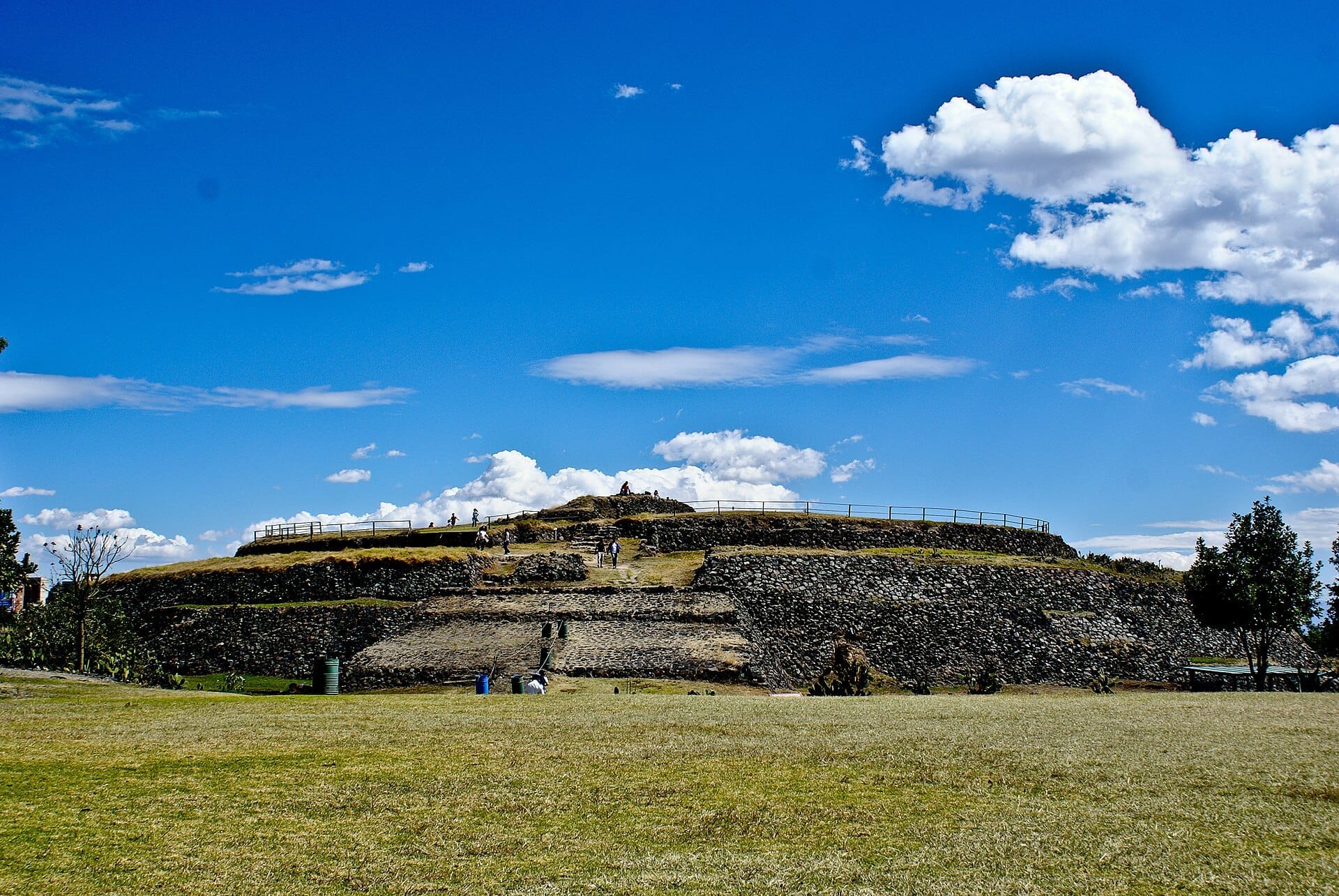
Cuicuilco is one of the oldest excavated urban centers in the Valley of Mexico, dating to around 700 BCE. A five-tiered circular pyramid rises from a lava field in the south of Mexico City, accompanied by a site museum and walking trails through volcanic rock. It receives far fewer visitors than Teotihuacan, making it one of the most peaceful pre-Hispanic sites in the entire metropolitan area.
Quick Facts
- Location
- Espacio Ecológico Cuicuilco, Tlalpan, 14060, CDMX — near the intersection of Avenida Insurgentes and Anillo Periférico, opposite the Perisur shopping mall
- Getting There
- Metro Line 3 to Ciudad Universitaria, then a short bus or taxi south along Insurgentes; the site is approximately 15–19 km south of the historic center
- Time Needed
- 1.5 to 2.5 hours for pyramid, trails, and site museum
- Cost
- Admission fee applies; exact current pricing not published on official INAH pages — confirm via zacuicuilco_inah@inah.gob.mx or +52 (55) 5606 9758 before visiting
- Best for
- Pre-Hispanic history, low-crowd archaeology, photography, and combining with a UNAM campus visit
- Official website
- www.inah.gob.mx/zonas/119-zona-arqueologica-cuicuilco
What Cuicuilco Is — And Why It Matters
The Cuicuilco Archaeological Zone sits quietly in the southern reaches of Mexico City, tucked between a commercial shopping mall and the vast lava fields of the Pedregal de San Ángel. The site preserves one of the earliest complex urban settlements ever excavated in the Valley of Mexico, with evidence of occupation stretching from around 700 BCE until the Xitle volcano eruption buried much of the settlement between roughly 245 and 315 CE. At its height, scholars estimate the city supported a population of around 20,000 people — a significant urban center for its era in Mesoamerica.
The defining structure is a five-tiered circular pyramid approximately 18 meters (59 feet) high and roughly 135 meters in diameter at its base. Circular pyramids are unusual in Mesoamerican architecture; most pre-Hispanic monumental structures follow a stepped rectangular or square plan. Cuicuilco's form has no close parallel in the region, which makes it architecturally singular even before you consider its age.
The city's end came violently. The Xitle volcano, whose lava field now forms the Pedregal de San Ángel ecological reserve adjacent to the UNAM campus, erupted between roughly 245 and 315 CE. Lava flows buried much of Cuicuilco under meters of basalt. What visitors see today is only a fraction of what survives underground; excavations have revealed the main pyramid and some surrounding structures, but large portions of the settlement remain under the lava field.
ℹ️ Good to know
Opening hours: Monday to Sunday, 09:00–17:00, including free admission on Sundays for Mexican nationals and residents. The site is managed by the Instituto Nacional de Antropología e Historia (INAH). Confirm current admission prices directly with the site before visiting, as they are not reliably published online.
The Experience: Walking Through 2,700 Years of History
The entrance area feels unexpectedly calm for a site this significant. There is a small parking area, restrooms, and a modest reception building. Signage is primarily in Spanish, so travelers with limited Spanish may want to read up beforehand or download a translation app. The site museum near the entrance holds ceramic pieces, figurines, and explanatory panels that provide essential context before you approach the pyramid itself.
The path from the museum to the main pyramid takes you through a scrubby landscape of wild grass, agave, and the knotted forms of tejocote and other native plants. The volcanic rock underfoot is rough and dark. On a clear morning, before the haze settles over the valley, you can see the snowcapped cone of Popocatépetl to the southeast — a striking visual reminder that you are standing in a geologically active highland basin where volcanoes have shaped human history directly.
The pyramid itself is usually climbable via a ramp on its western side, although access to the summit can occasionally be restricted for conservation or safety reasons. The climb is short but steep in places, and the ramp surface is uneven. At the summit, the views across the lava field to the south and toward the UNAM campus to the north are worth the effort. The platform is wide enough to walk around comfortably, and the proportions of the structure become legible only once you are standing on top of it.
Tickets & tours
Live prices and dates from our booking partner. If you book, we may earn a commission at no extra cost to you.
Puebla and Cholula guided tour from Mexico City with optional lunch
From 43 €Instant confirmationFree cancellationXochimilco, Coyoacan and Frida Kahlo Museum with skip-the-line tickets
From 63 €Instant confirmationFree cancellationMexico City exploration game and tour in Chimalistac
From 10 €Instant confirmationFree cancellationCuernavaca and Taxco Guided Tour with Optional Lunch
From 40 €Instant confirmationFree cancellation
Time of Day and Crowd Patterns
Cuicuilco receives a fraction of the visitors that Teotihuacan draws on any given day. On weekday mornings, the site can feel almost deserted. You may share the grounds with a handful of history students, local joggers using the outer trails, or the occasional tour group from a nearby school. This is a place where you can stand at the summit of a pre-Hispanic pyramid without another person in your sightline.
Weekends bring more visitors, particularly on Sunday mornings when families from the surrounding neighborhoods use the trails and open space. Even then, the atmosphere is relaxed rather than crowded. The site never approaches the congestion levels of the more prominent archaeological zones in Mexico City.
Mid-morning arrivals, around 10:00 to 11:00, offer good light for photography and reasonable temperatures. By early afternoon in the dry season (November to April), the sun is intense at altitude and there is limited shade on the pyramid ramp and summit. Bring water. In the rainy season (May to October), afternoon thunderstorms can arrive quickly; morning visits are strongly recommended during those months.
💡 Local tip
Visit on a weekday morning in the dry season for the best combination of light, temperature, and solitude. Bring at least one liter of water — there are no refreshment vendors inside the site.
The Site Museum: Small but Substantive
The on-site museum (Museo de Sitio de Cuicuilco) is included with general admission and should not be skipped. The collection is focused and manageable, covering the chronology of the settlement, the social organization of its inhabitants, and the volcanic event that ended it. Ceramic figurines from the formative period, stone tools, and burial offerings are displayed with explanatory panels.
The museum also addresses the archaeological history of the site itself, which is especially interesting. Excavations began in the early 20th century, and the site's interpretation has shifted considerably as more evidence emerged. The displays reflect current scholarly consensus without oversimplifying the unresolved questions about Cuicuilco's relationship to other early Mesoamerican centers. If you engage seriously with the museum before walking the grounds, the pyramid reads very differently.
Getting There: Practical Logistics
The site is located in the Tlalpan borough, near the intersection of Avenida Insurgentes Sur and Anillo Periférico. Arriving by taxi or ride-hailing app (Uber, Didi, and Cabify all operate in Mexico City) is the most straightforward option from most parts of the city. Ask your driver for 'Zona Arqueológica de Cuicuilco, frente al Perisur' — the Perisur shopping mall is a well-known landmark that most drivers will recognize immediately.
By public transit, take Metro Line 3 south to the Ciudad Universitaria station, then board a southbound bus or take a short taxi along Insurgentes toward the Perisur intersection, or use Metrobús Line 1 and get off at Villa Olímpica or Cuicuilco stations, both a short walk from the site. If you are combining the visit with a walk through the UNAM campus, the two sites are close enough to manage in a single morning, though the campus itself is very large and warrants dedicated time.
⚠️ What to skip
The site is approximately 19 km south of the historic center. Factor in Mexico City traffic if traveling by road during peak hours (roughly 07:30–09:30 and 17:30–19:30 on weekdays). Allow extra time or travel outside those windows.
Photography, Accessibility, and What to Bring
The volcanic landscape surrounding the pyramid is visually distinctive — dark basalt contrasts sharply with the pale stonework of the pyramid's visible tiers, and the scrub vegetation adds texture to wide shots. The best light on the pyramid's main facade falls in the morning, when the sun comes from the east. The summit platform allows clean 360-degree views, though the urban sprawl to the north and the Perisur mall to the south do intrude on the landscape.
The main pyramid ramp has an incline that requires some physical effort, and the volcanic rock paths around the site are uneven. Wear closed-toe shoes with grip — sandals or smooth-soled shoes are not suitable. The site has no verified step-free access route to the pyramid summit; travelers with mobility concerns should contact INAH directly at zacuicuilco_inah@inah.gob.mx or +52 (55) 5606 9758 to confirm what is accessible before visiting. The museum building and ground-level trail areas are more manageable.
Mexico City sits at approximately 2,240 meters above sea level, which means sun exposure is more intense than at sea level and physical exertion can feel harder than expected. If you are recently arrived and still adjusting to the altitude, keep the visit light and pace yourself. For more on managing the elevation, see the Mexico City altitude guide.
Context: How Cuicuilco Fits Into Mexico City's Pre-Hispanic Story
Most visitors to Mexico City's pre-Hispanic past focus on the Aztec (Mexica) layers: the Templo Mayor in the historic center, or the great pyramids at Teotihuacan an hour north of the city. Cuicuilco sits at the other end of that timeline. It predates Teotihuacan by centuries and represents an entirely different cultural tradition, one whose full character remains incompletely understood precisely because so much of the site lies under lava.
What is striking about standing at Cuicuilco is the awareness that this was a functioning city — with craft production, trade networks, ceremonial architecture, and a substantial population — at a time when Rome was still a small settlement on the Tiber. The Valley of Mexico was already a center of civilizational development well before the cultures most people associate with ancient Mexico emerged. Cuicuilco is the evidence for that earlier chapter, and it sits inside a modern city that has largely grown up around and over it.
If pre-Hispanic archaeology is a particular interest, Cuicuilco pairs well with a visit to the Museo Nacional de Antropología, which contextualizes the full sweep of Mesoamerican civilizations and includes artifacts from both the formative period (Cuicuilco's era) and later cultures. The museum's collection provides the broader framework that the Cuicuilco site museum, despite its quality, cannot match in scope.
Who Might Want to Skip This
Cuicuilco is not an attraction that rewards visitors primarily seeking visual spectacle. The visible pyramid, while ancient and architecturally unusual, is a single structure rather than a sprawling complex. The grounds are modest in scale. Travelers on a tight schedule who want maximum density of sights per hour may find the 19 km journey from the center disproportionate to what they see, especially if they are planning a separate day trip to Teotihuacan, which offers far more surface area and multiple pyramids.
Visitors who struggle with uneven terrain or heat exposure should note the limitations around accessibility and sun exposure mentioned above. And anyone hoping for comprehensive English-language interpretation will need to supplement with prior reading, as most on-site signage is in Spanish.
Insider Tips
- The outer perimeter of the site includes walking paths through the volcanic rock landscape that most casual visitors skip. These trails give you a much better sense of the scale of the Xitle lava field and how completely it buried the ancient city. Allow an extra 30 minutes if you want to explore beyond the pyramid.
- Combine Cuicuilco with a visit to the UNAM campus on the same morning. The university's Espacio Escultórico — a dramatic open-air installation of volcanic rock and concrete monoliths on the edge of the Pedregal — is a short distance away and shares the same geological landscape as the archaeological zone.
- The site museum occasionally hosts temporary exhibitions and academic lectures that are open to the public. Check the INAH website or contact the site directly if you are interested in programming beyond the permanent collection.
- If you arrive by taxi, confirm the driver knows the entrance on Calle Zapote inside the Espacio Ecológico Cuicuilco, not just the general Perisur intersection. The entrance road is easy to miss from the main avenue.
- Mornings in the dry season (November to April) offer the clearest views of Popocatépetl from the pyramid summit. Cloud cover and haze typically increase through the afternoon, and the volcano is frequently obscured by midday in the rainy season.
Who Is Cuicuilco Archaeological Zone For?
- Travelers with a serious interest in pre-Hispanic Mesoamerican history who want to go beyond the Aztec period
- Photographers looking for an atmospheric, low-crowd archaeological site with striking volcanic landscape
- Visitors combining a morning at UNAM's campus and ecological reserve with a history stop
- Those who want to understand the deep chronological layers beneath modern Mexico City
- Travelers who appreciate archaeological sites that are still actively under study, where the full story has not yet been told
Nearby Attractions
Other things to see while in UNAM & Pedregal:
- Museo Universitario Arte Contemporáneo (MUAC)
Housed inside a striking concrete building designed by Teodoro González de León, MUAC is the National Autonomous University of Mexico's dedicated contemporary art museum. With thought-provoking rotating exhibitions, a serious permanent collection, and one of the most architecturally compelling interiors in the city, it rewards visitors who want more than a casual cultural stop.
- UNAM University City Campus
Built between 1949 and 1952 by over 60 architects and artists, UNAM's Central University City Campus is a UNESCO World Heritage Site where modernist architecture, pre-Hispanic references, and monumental public art coexist across roughly 7.2 square kilometers. Outdoor access is free, making it one of the most rewarding cultural detours in southern Mexico City.
Planning a trip? Discover personalized activities with the Nomado app.