Museo Universitario Arte Contemporáneo (MUAC): Contemporary Art on the UNAM Campus
Housed inside a striking concrete building designed by Teodoro González de León, MUAC is the National Autonomous University of Mexico's dedicated contemporary art museum. With thought-provoking rotating exhibitions, a serious permanent collection, and one of the most architecturally compelling interiors in the city, it rewards visitors who want more than a casual cultural stop.
Quick Facts
- Location
- Centro Cultural Universitario, Insurgentes Sur 3000, Ciudad Universitaria, Coyoacán, Mexico City
- Getting There
- Take Metro Line 3 to Universidad station, then Pumabús Route 3 (Zona Cultural) to Centro Cultural Universitario
- Time Needed
- 1.5 to 3 hours depending on current exhibitions
- Cost
- General admission $60 MXN; free for UNAM students; some free-access and discount programs available
- Best for
- Contemporary art enthusiasts, architecture lovers, students, and anyone curious about Mexico's cultural production
- Official website
- muac.unam.mx
What MUAC Is
The Museo Universitario Arte Contemporáneo, known universally as MUAC, is the contemporary art museum of the Universidad Nacional Autónoma de México (UNAM), one of Latin America's most important public universities. Opened in 2008 after roughly two years of construction, it sits within the Centro Cultural Universitario complex on UNAM's Ciudad Universitaria campus in the south of Mexico City. The museum occupies approximately 13,947 square metres of space, making it a significant institution by any international measure, not just a regional one.
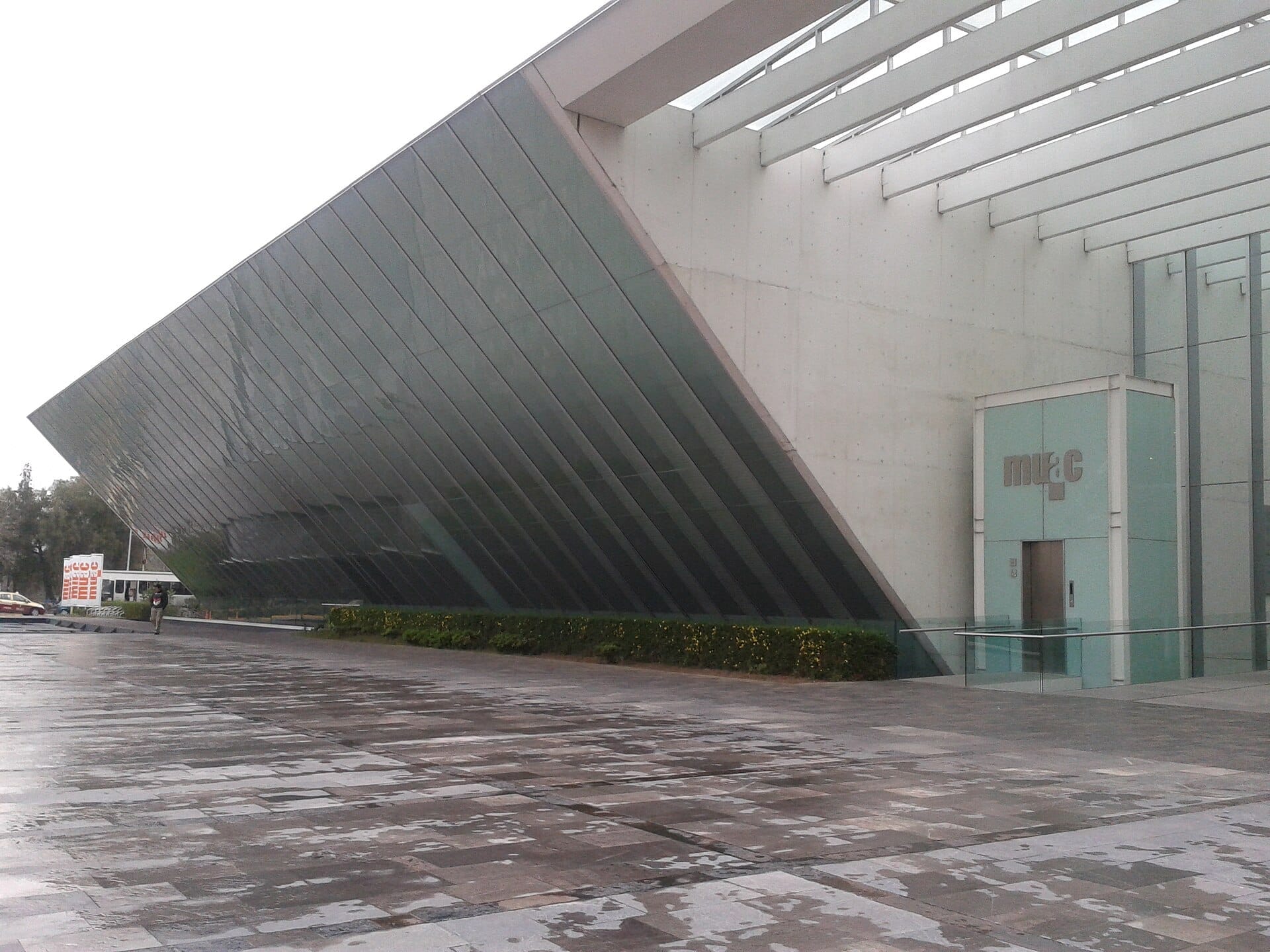
The building itself, designed by Pritzker Prize-shortlisted Mexican architect Teodoro González de León, is reason enough for architecture-minded visitors to make the trip south. González de León worked with exposed aggregate concrete throughout his career, and MUAC is a late-career statement: angular, monumental, and calibrated to handle the strong southern-city light. The facade has a textured, almost geological quality that softens through the day as shadows shift across its surface.
ℹ️ Good to know
Opening hours: Tuesday and Wednesday 10:00–18:00; Thursday 10:00–20:00; Friday 10:00–18:00; Saturday 11:00–20:00; Sunday 11:00–18:00. MUAC is closed on Monday. Verify current hours at muac.unam.mx before visiting, as hours may be extended for special programs.
The Architecture: A Building Worth Your Attention Before You Go Inside
Most visitors walk straight from the entrance toward the galleries, but it is worth pausing in the lobby and circulation areas. González de León used a system of interlocking levels and ramps that make the vertical movement through the building feel sculptural. The main exhibition spaces receive controlled natural light through skylights and louvers, giving certain works a quality of illumination you rarely see in artificially lit gallery spaces. Late morning, roughly between 11:00 and 13:00, is when this effect is most pronounced.
The exterior plaza connects MUAC to the rest of the Centro Cultural Universitario, which includes the Sala Nezahualcoyotl concert hall and the Centro Cultural Universitario theatre complex. If you arrive before the museum opens, the plaza itself is a good place to observe the spatial planning of the broader campus. The integration of modern architecture with the volcanic rock landscape of the Pedregal de San Ángel ecological reserve, which surrounds much of the campus, gives the entire area a character unlike any other part of Mexico City.
UNAM's Ciudad Universitaria campus is a UNESCO World Heritage Site, recognized in 2007 for the integration of modernist architecture, landscape design, and public art. MUAC was built after this designation but shares its philosophical lineage with the campus's original 1950s buildings. If you want to understand the full scope of the campus, the UNAM campus guide covers the wider grounds in detail.
Tickets & tours
Live prices and dates from our booking partner. If you book, we may earn a commission at no extra cost to you.
Xochimilco, Coyoacan and Frida Kahlo Museum with skip-the-line tickets
From 63 €Instant confirmationFree cancellationFrida Kahlo and Diego Rivera legacy visit to three museums with skip-the-line tickets
From 67 €Instant confirmationFree cancellationSix Flags Amusement Park tickets and transportation
From 87 €Instant confirmationFree cancellationMexico City National Museum of Anthropology guided tour
From 57 €Instant confirmationFree cancellation
The Exhibitions: What to Expect Inside
MUAC operates a mixed model of rotating temporary exhibitions and a permanent collection drawn primarily from UNAM's holdings of contemporary Mexican and international art. The temporary exhibitions tend to be ambitious in scale and curatorial reach, often focusing on artists who are critically significant but not necessarily commercial names. Past programming has included solo retrospectives, group shows organized around theoretical frameworks, and multimedia installations that make full use of the building's large-format spaces.
The permanent collection, which includes works from the 1950s onward with a concentration on late 20th and early 21st century production, is displayed selectively rather than exhaustively. You will not find every work on the walls at once. This means the experience changes meaningfully between visits, which is useful to know if you are spending more than a few days in the city. The curation generally favors conceptual depth over populist accessibility, so visitors expecting a survey of famous names may be surprised by how rigorous, and occasionally demanding, the experience is.
💡 Local tip
Check the current exhibition program at muac.unam.mx before you visit. MUAC's programming rotates regularly, and the difference between a visit during a major retrospective and a transitional period between shows can be significant.
Getting There: The Journey Is Part of the Experience
MUAC is located in the far south of Mexico City, which means reaching it requires deliberate effort from most tourist-centric neighborhoods. From the city center or Roma-Condesa, allow at least 45 minutes to an hour each way. The most reliable public transport route is Metro Line 3 (the olive-green line) south to Universidad station, then the Pumabús Route 3 Zona Cultural campus bus to the Centro Cultural Universitario stop. The Pumabús is a free internal shuttle system operated by UNAM, which is worth knowing: once on campus, you can move between major points without additional cost.
Ride-hailing apps including Uber and DiDi serve the area without difficulty, and the journey from Condesa or Roma takes roughly 30 to 40 minutes outside peak hours. Traffic on Insurgentes Sur, the main artery running to the campus, can be heavy during morning and evening rush periods (approximately 7:30–9:30 and 17:30–20:00 on weekdays). If you are combining MUAC with a visit to nearby Coyoacán, note that the two are separated by a meaningful distance and are not easily walkable from each other.
For a broader strategy on moving around the south of the city, the getting around Mexico City guide outlines the full public transport network in practical terms.
Timing Your Visit: Morning Calm vs. Afternoon Energy
Wednesday and Thursday mornings are consistently the quietest times. The museum opens at 11:00 and for the first 90 minutes or so, the galleries are often nearly empty. This matters because MUAC's larger installation works, particularly pieces that use sound or video components, are best experienced without a crowd refracting the attention in the space. The light through the upper galleries is also at its most interesting in the late morning before the sun moves past the skylights.
Weekends, especially Saturday afternoons, attract a younger local audience including UNAM students and Mexico City's art-engaged community. The atmosphere shifts to something more social and animated. This can be enjoyable if you want to observe how a well-educated local public engages with contemporary work, but it does mean more competition for the more intimate exhibition spaces. Sunday tends to be slightly quieter than Saturday.
⚠️ What to skip
MUAC is closed on Mondays. If your Mexico City schedule is tight, do not assume it follows a standard seven-day pattern. Build your visit for Wednesday through Sunday only.
Practical Notes: Admission, Photography, and Nearby Stops
General admission is $60 MXN, which is among the most affordable entry prices for a serious contemporary art institution anywhere in the world. UNAM students enter free. The museum periodically offers free public access days or reduced-price programs, so check the official site if cost is a concern. At $60 MXN, MUAC represents exceptional value even for visitors on a careful budget.
Photography policies vary by exhibition. In many spaces, photography without flash is permitted for personal, non-commercial use, but individual works by artists with specific copyright arrangements may be restricted. Gallery attendants are present in each room and will let you know if a particular work cannot be photographed. Video work on screens is almost always off-limits for filming. The architecture itself, including the lobby, atrium, and exterior, is fair game and especially rewarding to photograph. The concrete textures and geometric shadows offer strong compositional material.
The broader UNAM-Pedregal neighborhood offers several reasons to extend your visit beyond MUAC itself. The UNESCO-listed UNAM campus rewards a longer exploration on foot, and the Jardín Botánico and Espacio Escultórico are within walking distance of the museum.
If you plan to continue south to Coyoacán afterward, note that the Museo Frida Kahlo and Museo Anahuacalli both require advance ticket reservations and represent a very different type of cultural experience. Planning both MUAC and Coyoacán into a single day is feasible but requires an early start.
Who Might Not Enjoy This Visit
MUAC is not an encyclopedic museum. Visitors expecting to see pre-Columbian artifacts, colonial painting, or a survey of Mexican art history will find none of that here. The programming is firmly rooted in contemporary and conceptual work, and some exhibitions make substantial demands on the viewer's patience and prior engagement with art theory. If you are looking for a quick, accessible cultural highlight, the Museo Nacional de Antropología or the Palacio de Bellas Artes may be more immediately rewarding choices for a single museum visit.
The location also counts against MUAC for visitors with limited time. Getting to Ciudad Universitaria from the historic center takes the better part of an hour by public transport. If you only have two or three days in the city, weigh the journey time against your other priorities. The 3-day Mexico City itinerary can help you think through how to sequence the south of the city against the central neighborhoods.
Insider Tips
- The museum's bookshop carries critical publications, exhibition catalogues, and art theory titles that are difficult to find elsewhere in Mexico City. Even if you skip the exhibitions, it is worth a browse.
- Arrive at 11:00 on a Wednesday for the quietest possible experience. Gallery attendants are often willing to talk about current works when the rooms are empty, which can dramatically improve your understanding of what you are looking at.
- The Pumabús is free and connects MUAC to the rest of the UNAM campus, including the Espacio Escultórico, a circular land-art installation embedded in the volcanic rock that is easy to miss and entirely free to visit.
- MUAC occasionally hosts evening events, lectures, and film screenings that are either free or very low cost. Check the programs section of muac.unam.mx for dates, as these events rarely appear in third-party travel listings.
- The cafe adjacent to the museum is a decent spot for coffee and a break. The outdoor seating area faces a quiet courtyard and is rarely crowded even on weekends.
Who Is Museo Universitario Arte Contemporáneo (MUAC) For?
- Contemporary art enthusiasts who want rigorous, non-commercial programming rather than crowd-pleasing blockbusters
- Architecture lovers interested in the work of Teodoro González de León and late 20th-century Mexican modernism
- Students and academics with an interest in Latin American cultural production and critical theory
- Travelers visiting the UNAM campus who want to combine art with the broader UNESCO World Heritage site
- Budget-conscious visitors who want a high-quality museum experience: at $60 MXN, the value is difficult to match
Nearby Attractions
Other things to see while in UNAM & Pedregal:
- Cuicuilco Archaeological Zone
Cuicuilco is one of the oldest excavated urban centers in the Valley of Mexico, dating to around 700 BCE. A five-tiered circular pyramid rises from a lava field in the south of Mexico City, accompanied by a site museum and walking trails through volcanic rock. It receives far fewer visitors than Teotihuacan, making it one of the most peaceful pre-Hispanic sites in the entire metropolitan area.
- UNAM University City Campus
Built between 1949 and 1952 by over 60 architects and artists, UNAM's Central University City Campus is a UNESCO World Heritage Site where modernist architecture, pre-Hispanic references, and monumental public art coexist across roughly 7.2 square kilometers. Outdoor access is free, making it one of the most rewarding cultural detours in southern Mexico City.
Planning a trip? Discover personalized activities with the Nomado app.