UNAM Ciudad Universitaria: Mexico's Most Ambitious Campus
Built between 1949 and 1952 by over 60 architects and artists, UNAM's Central University City Campus is a UNESCO World Heritage Site where modernist architecture, pre-Hispanic references, and monumental public art coexist across roughly 7.2 square kilometers. Outdoor access is free, making it one of the most rewarding cultural detours in southern Mexico City.
Quick Facts
- Location
- Av. Universidad 3000, Ciudad Universitaria, Coyoacán, Mexico City (C.P. 04510)
- Getting There
- Metro Line 3 (olive green), station 'Universidad' — campus shuttles and walking paths lead into the central zone
- Time Needed
- 2–4 hours for outdoor highlights; half a day if visiting MUAC or other campus venues
- Cost
- Free to access outdoor areas, plazas, and murals; individual museums charge their own entrance fees (verify on-site)
- Best for
- Architecture enthusiasts, art lovers, students of 20th-century Latin American history, and anyone who enjoys walking a city on a human scale
- Official website
- http://www.unam.mx
What Ciudad Universitaria Is
The Central University City Campus of the National Autonomous University of Mexico, known universally as Ciudad Universitaria or simply CU, is not a compact attraction you can absorb in an hour. It is a fully functioning university campus of roughly 7.2 square kilometers, inscribed as a UNESCO World Heritage Site in 2007, and widely regarded as one of the most coherent expressions of 20th-century modernism anywhere in the world. More than 60 architects, engineers, and artists collaborated on its construction beginning in 1949, with the main campus inaugurated in 1954, creating an ensemble where urban planning, architecture, landscape, and monumental art were conceived together rather than layered on top of each other.
For visitors, this means arriving somewhere that functions simultaneously as a living university, an open-air art museum, and a piece of architectural history. Students walk past Diego Rivera mosaics on their way to class. Families picnic on volcanic rock formations that double as landscape design. The scale is generous and the atmosphere is unhurried, which sets CU apart from most formal cultural institutions in Mexico City.
💡 Local tip
Outdoor access to the campus plazas, murals, and grounds is free of charge. There is no entrance gate or ticketing point for the open areas. Individual museums and cultural venues on campus set their own hours and admission fees — check each venue's website before you go.
The Architecture and the Murals: What You Will Actually See
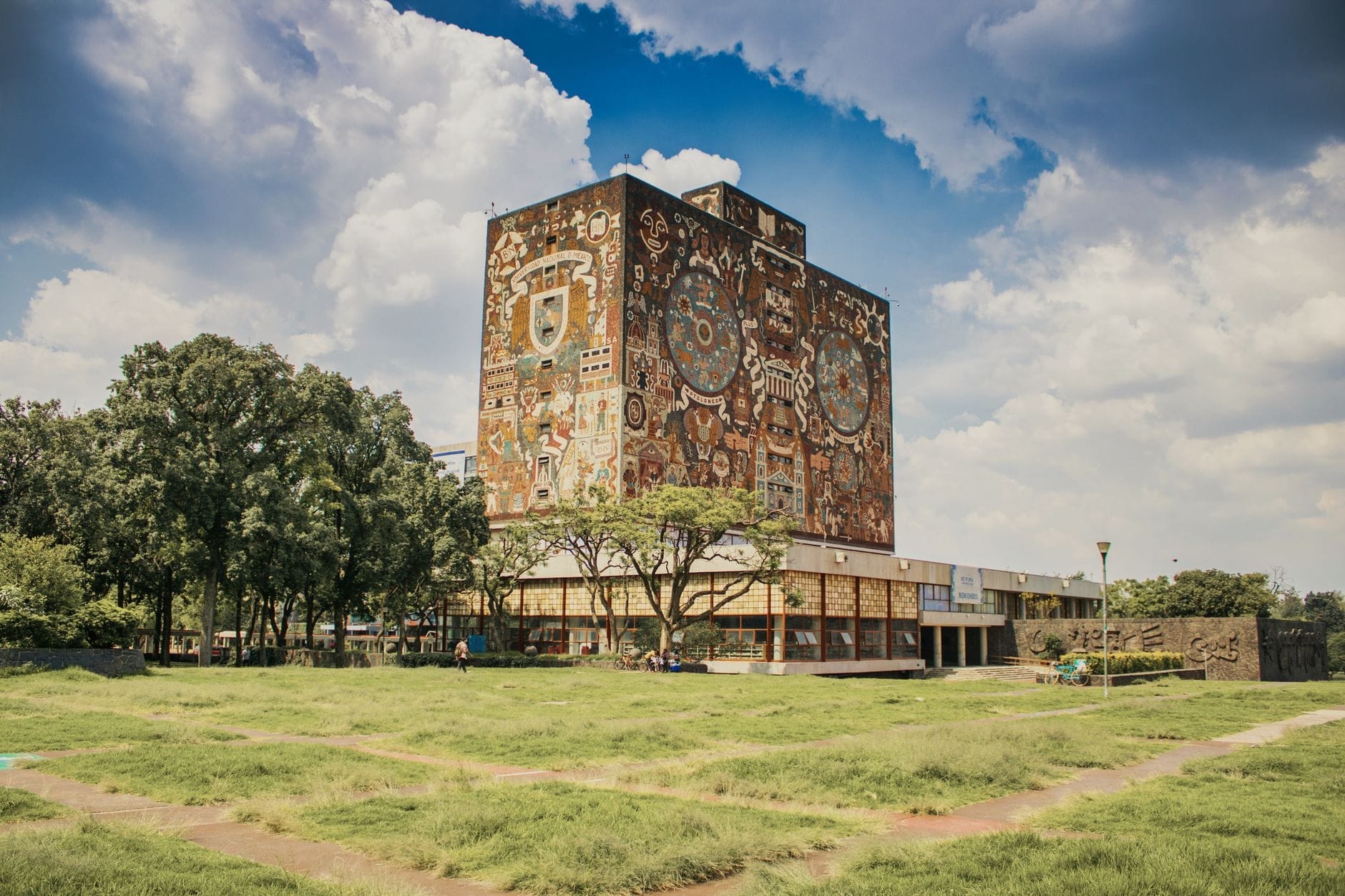
The visual centerpiece of any visit is the Central Library, designed by Juan O'Gorman and completed in 1952. The ten-story windowless tower is wrapped on all four facades with a mosaic made from millions of pieces of natural stone in multiple colors, depicting Mexican history from pre-Hispanic cosmology to the colonial period and into the modern era. Standing at ground level and looking up at the full south facade is one of those architectural experiences that resists description — the scale is too large for a single photograph, and the detail demands you get close enough to identify individual tesserae.
Around the central academic zone, a series of major buildings carry exterior murals by some of the most significant Mexican artists of the 20th century. The Rectory Tower features a relief mosaic by David Alfaro Siqueiros on its south face, along with glass mosaic work by José Chávez Morado. The Faculty of Medicine building includes mural work with pre-Hispanic and modern medical imagery. None of this is in a gallery. It is all outside, part of the daily flow of the campus, visible from walkways and plazas without any admission requirement.
The Olympic Stadium, inaugurated in 1954 and designed by Augusto Pérez Palacios among others, sits at the western edge of the central zone. Its exterior carries a Diego Rivera mural rendered in relief mosaic, depicting the origins of Mexican sport and the fusion of pre-Hispanic and modern culture. The stadium itself is embedded into the natural volcanic landscape, sinking below grade so that its form feels like an extension of the land rather than an object placed upon it.
Tickets & tours
Live prices and dates from our booking partner. If you book, we may earn a commission at no extra cost to you.
Shared Tour to Xochimilco, Coyoacan and UNAM Murals
From 32 €Instant confirmationFree cancellationPuebla and Cholula guided tour from Mexico City with optional lunch
From 43 €Instant confirmationFree cancellationXochimilco, Coyoacan and Frida Kahlo Museum with skip-the-line tickets
From 63 €Instant confirmationFree cancellationMexico City exploration game and tour in Chimalistac
From 10 €Instant confirmationFree cancellation
The Volcanic Landscape and the Pedregal
What makes Ciudad Universitaria unlike any other modernist campus is the ground it sits on. The site occupies part of the Pedregal de San Ángel, a lava field produced by the eruption of the Xitle volcano roughly 2,000 years ago. The central campus was built on and around this volcanic rock, and large sections of it have been preserved as the Reserva Ecológica del Pedregal de San Ángel, a protected ecological reserve covering about 237 hectares within the campus boundary.
In the zones adjacent to the main academic buildings, the volcanic rock breaks through the surface in dramatic formations, creating a textured, dark gray landscape of sharp edges and organic shapes that contrasts directly with the clean lines of the modernist architecture above it. This was an intentional design choice: the architects and planners wanted the new campus to acknowledge the ancient geological and cultural history of the Valley of Mexico, not erase it.
If you have an interest in ecology as well as architecture, the Pedregal reserve supports a notable range of endemic species in an urban context. For a deeper look at Mexico City's relationship with its natural landscape, the nearby Cuicuilco Archaeological Zone — also associated with the Xitle eruption — makes a logical pairing.
How the Campus Changes Through the Day
Early morning on weekdays, between roughly 7 and 9 AM, Ciudad Universitaria is primarily a commuter environment. Students arrive by Metro, campus bus, and bicycle. The plazas around the Rectory and the Central Library are quiet, the light is cool and low, and the mosaic surfaces catch the morning sun at angles that make the colors especially vivid. This is the best time for photography of the library tower's facade, before the southern sun climbs high enough to flatten the contrast.
Midday brings a noticeable shift. The main pedestrian arteries fill with students moving between faculties, vendors appear near the main plaza, and the food options at campus comedores (canteens) become available. The atmosphere is active but not overwhelming. Visitors who are used to crowded tourist sites will find the scale of CU diffuses foot traffic in a way that never feels congested.
Weekend mornings are the recommended window for leisure visitors. The academic rush is gone, families and joggers use the open spaces, and the cultural venues are open without the pressure of student traffic. Sunlight on the O'Gorman mosaics in the late morning hours is particularly rewarding. Bring water — the campus is large and open, shade is intermittent between buildings, and at 2,240 meters of altitude, sun exposure is more intense than it feels.
ℹ️ Good to know
Mexico City sits at approximately 2,250 meters above sea level. Physical exertion at this altitude — including extended walking on a large campus — can tire visitors more quickly than expected, particularly in the first day or two after arrival. Carry water and take the altitude seriously.
MUAC and the Cultural Venues Worth Planning Around
The Museo Universitario Arte Contemporáneo, known as MUAC, is the most significant indoor cultural venue on campus. Designed by Teodoro González de León and opened in 2008 to the public, it is one of the largest contemporary art museums in Latin America, with a permanent collection of Mexican and international work from the second half of the 20th century onward. The building itself, with its deeply textured concrete facades and angular forms, is worth seeing architecturally even before you step inside.
MUAC operates on its own schedule and admission structure, separate from the campus as a whole. Check the MUAC attraction page for current hours and ticket prices before planning your visit, as these change with exhibitions.
Beyond MUAC, the campus hosts the Sala Nezahualcóyotl concert hall (one of Mexico's premier classical music venues), the Espacio Escultórico (an open-air sculpture ring built on the volcanic landscape in 1979, with works by six major Mexican sculptors), and the UNAM Cultural Center. The Espacio Escultórico is free to enter and is particularly atmospheric at dusk, when the light falls across the lava field between the large geometric sculptures.
Getting There and Getting Around
The most practical transit route is Metro Line 3 (olive green) southbound to the Universidad station. From there, UNAM's internal bus network (Pumabús) connects the station to different zones of the campus for free. The main cultural and architectural highlights cluster around the central academic zone, which is walkable from the main Pumabús stops.
Ride-hailing apps including Uber, DiDi, and Cabify all serve this area of the city and can drop you directly at specific campus entrances, which is convenient if you are combining the visit with nearby attractions. For full context on moving around the city, the guide to getting around Mexico City covers all public transit options in detail.
The campus covers a large area and the main cultural sites are spread out. Comfortable, closed-toe walking shoes are advisable, especially if you plan to explore near the volcanic rock zones where surfaces are uneven. Wheelchair access varies considerably across the campus: the main paved plazas and newer buildings are generally accessible, but the volcanic landscape sections and older structures can be difficult. Visitors with specific mobility requirements should check individual venue accessibility information on the UNAM website before arriving.
Worth Your Time?: Who This Is For and Who Might Pass
Ciudad Universitaria rewards visitors who come with curiosity about architecture, Mexican cultural history, and 20th-century art. If those subjects engage you, the campus offers a density of significant work that rivals any formal museum in the city, and the experience of seeing it in a living, functioning university context adds a dimension no gallery can replicate.
Visitors who are primarily interested in colonial history, the Aztec past, or street food scenes may find the campus peripheral to their itinerary. Mexico City's centro histórico offers a more concentrated encounter with those threads — the Templo Mayor and National Palace are better starting points for that kind of visit. UNAM is also not particularly suited to young children unless there is a specific event or exhibition aimed at families, given the lack of interactive programming in the outdoor areas.
Rainy season afternoons (roughly May through October) can make outdoor exploration uncomfortable. The afternoon thunderstorms that typify Mexico City's summer months arrive quickly and the open plazas offer limited shelter. Morning visits are more reliable year-round, and the dry season window from approximately November through April gives the most consistent conditions for extended outdoor time on campus.
Insider Tips
- The south facade of the Central Library receives direct morning sunlight from roughly 9 to 11 AM on clear days — the color saturation in the natural stone mosaic at that hour is noticeably richer than in flat midday light. Bring a wide-angle lens or step back as far as the plaza allows to frame the full facade.
- The Espacio Escultórico is often overlooked in favor of the library and Rectory, but the ring of six large-scale sculptures on the open lava field is one of the most unusual outdoor art environments in Latin America. It is free to enter and typically quiet on weekday mornings.
- UNAM campus comedores (university canteens) serve subsidized meals and are open to the public during academic term. A full lunch costs a fraction of what you would pay in Coyoacán or Roma. Ask students to point you toward the nearest comedor — they vary by faculty zone.
- If you arrive by Metro to the Universidad station, take a few minutes to examine the station's own murals before boarding the Pumabús. Station art is part of Mexico City Metro's design philosophy and the Universidad stop has work worth noticing.
- The campus is bordered to the south by the Coyoacán and San Ángel neighborhoods, both of which reward an afternoon extension. Combining a morning at UNAM with lunch in San Ángel and the Saturday Bazaar del Sábado makes for an efficient use of a full day in the south of the city.
Who Is UNAM University City Campus For?
- Architecture and design travelers who want to understand 20th-century Latin American modernism in context
- Art enthusiasts interested in Diego Rivera, David Alfaro Siqueiros, and the Mexican muralist movement beyond gallery walls
- Budget travelers: one of the most architecturally significant sites in Mexico City with no admission charge for the main outdoor areas
- Visitors combining a southern Mexico City day with Coyoacán or San Ángel who want a substantive cultural stop en route
- Photographers seeking non-touristic urban subjects — the interplay of modernist concrete, volcanic rock, and public art is visually distinctive
Nearby Attractions
Other things to see while in UNAM & Pedregal:
- Cuicuilco Archaeological Zone
Cuicuilco is one of the oldest excavated urban centers in the Valley of Mexico, dating to around 700 BCE. A five-tiered circular pyramid rises from a lava field in the south of Mexico City, accompanied by a site museum and walking trails through volcanic rock. It receives far fewer visitors than Teotihuacan, making it one of the most peaceful pre-Hispanic sites in the entire metropolitan area.
- Museo Universitario Arte Contemporáneo (MUAC)
Housed inside a striking concrete building designed by Teodoro González de León, MUAC is the National Autonomous University of Mexico's dedicated contemporary art museum. With thought-provoking rotating exhibitions, a serious permanent collection, and one of the most architecturally compelling interiors in the city, it rewards visitors who want more than a casual cultural stop.
Planning a trip? Discover personalized activities with the Nomado app.