Crescent Park: New Orleans' Best Riverfront Walk
Crescent Park stretches 1.4 miles along the Mississippi River in the Bywater neighborhood, offering free access to sweeping river views, award-winning landscape design, and a rare sense of open space just outside the French Quarter's orbit. It is one of the most thoughtfully designed public spaces in the city.
Quick Facts
- Location
- Bywater neighborhood, along the Mississippi Riverfront, New Orleans, LA
- Getting There
- Walkable from the French Quarter via the riverfront path; Uber/Lyft recommended from other neighborhoods
- Time Needed
- 45 minutes to 2 hours depending on pace
- Cost
- Free
- Best for
- Morning walkers, cyclists, photographers, and anyone wanting river views without crowds
- Official website
- www.neworleans.com/listing/crescent-park/32174
What Crescent Park Actually Is
Crescent Park is a 20-acre, 1.4-mile linear public park running along the Mississippi River in New Orleans' Bywater neighborhood. It sits on land that was once an active industrial waterfront, and the design by landscape architecture firm Hargreaves Associates, with local architects EskewDumezRipple, preserves that gritty industrial character while opening the riverfront to the public for the first time in generations.
The park is free, open daily, and doesn't ask anything of you. No ticket booth, no entry queue, no gift shop. You walk in, and the Mississippi River is right there in front of you, wide and brown and moving faster than most people expect. The river bend that gives New Orleans its nickname, the Crescent City, is especially legible from this stretch of bank.
ℹ️ Good to know
Crescent Park connects to Woldenberg Park and the French Quarter riverfront via a short walk across N. Peters Street at Esplanade, creating roughly 2.25 miles of continuous riverside path from Spanish Plaza. If you are already at the Moon Walk, you can walk here without backtracking.
The Design: Post-Katrina Vision Made Concrete
The park was not a spontaneous improvement. It emerged from a 2006 planning initiative called Reinventing the Crescent, conceived as the city rebuilt itself after Hurricane Katrina. The broader master plan envisions six miles of reconnected riverfront across multiple phases. Crescent Park was Phase 1, completed in 2014, and it earned the 2015 American Architecture Award, among other honors.
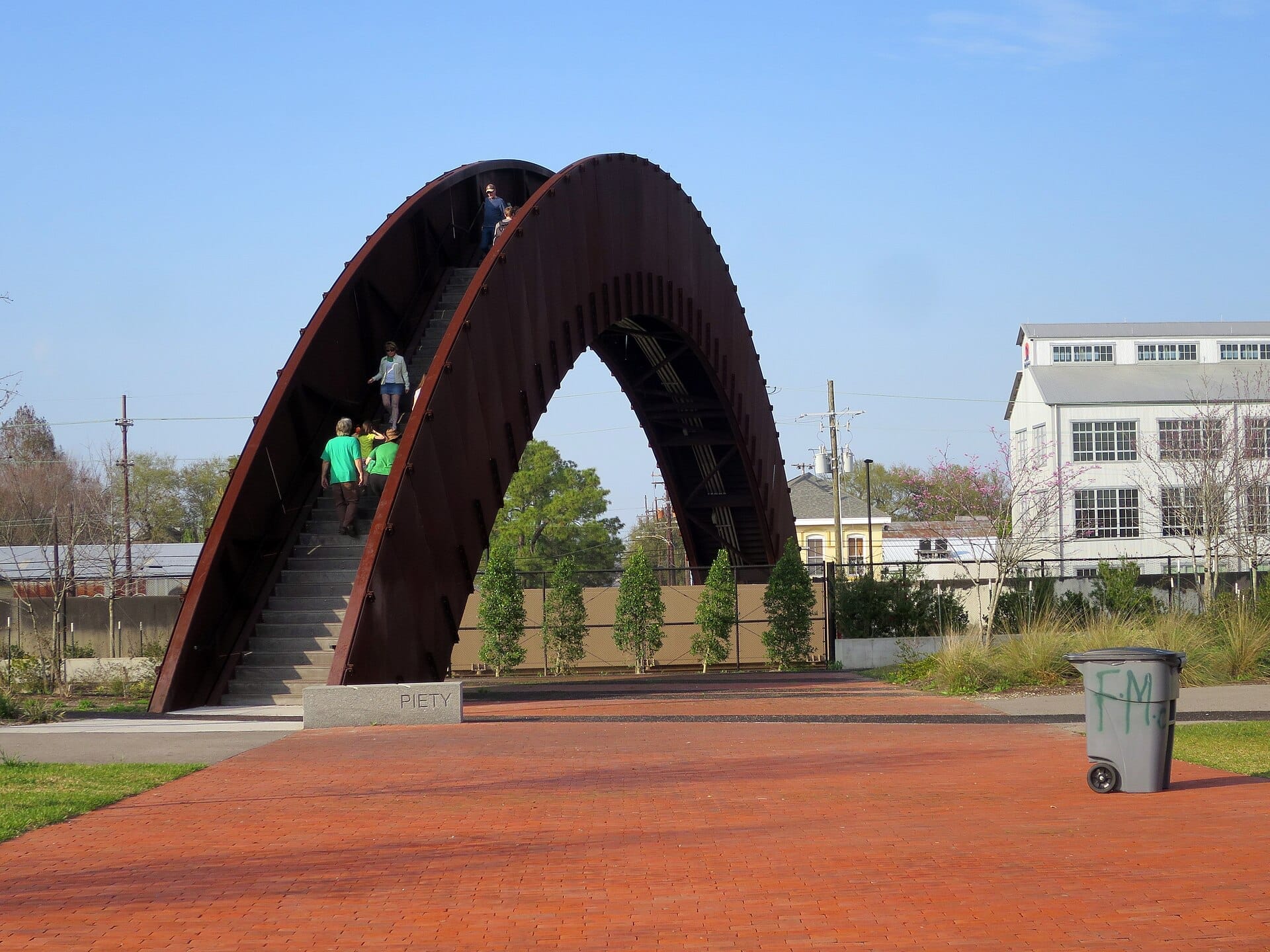
What makes the design distinctive is how little it tries to disguise its industrial past. The Piety Street Wharf entry involves a sculptural rusted-steel bridge that arcs over the floodwall and old rail lines, landing you directly on the batture, the narrow strip of land between the levee and the water. The bridge is not subtle. It is angular, deliberately rough-looking, and it announces that this is not a manicured garden. It is reclaimed infrastructure.
A second access point, the Mandeville Crossing, provides a more gradual entry at the Marigny end of the park. Both crossings have to clear the flood protection infrastructure that separates the city from the river, which explains why simply walking down to the water requires a bridge at all in New Orleans.
Tickets & tours
Hand-picked options from our booking partner. Prices are indicative; availability and final rates are confirmed when you complete your booking.
Spooky kid-friendly family ghost tour
From 32 €Instant confirmationFree cancellationWalking the Devil's Empire tour with HELLVISION™ in New Orleans
From 32 €Instant confirmationFree cancellationThe New Orleans haunted cemetery city bus tour
From 43 €Instant confirmationFree cancellationWhitney Plantation Tour
From 72 €Instant confirmationFree cancellation
What the Visit Feels Like, Hour by Hour
Early morning is the best time to visit without qualification. Between 7 and 9 AM, the light hits the river at a low angle, the air is cooler than it will be for the rest of the day, and the park is mostly occupied by dog walkers, joggers, and a handful of people sitting on the grassy slopes watching barges push upstream. The smell at this hour is river mud and dew on grass. It is not unpleasant. It smells like somewhere real.
By late morning, the park fills with a different crowd: families with strollers, cyclists, and tourists who have walked over from the Marigny. The riverfront path is wide enough that it never feels genuinely crowded, but the solitary quality of the early morning is gone. Midday in summer can be brutal. New Orleans summers bring temperatures into the low 90s Fahrenheit with high humidity, and there is limited shade on the riverfront side of the park. Bring water and do not underestimate how exposed the batture section is.
Late afternoon, especially in the fall and spring months from October through May, is the second-best window. The light softens, the heat drops slightly, and you get good westward views of the river surface. Sunsets here, with the river bending away and the Crescent City Connection bridge visible in the distance, are genuinely striking and entirely free to experience.
⚠️ What to skip
Summer visits (June through August) require real planning. The park offers almost no shade on the riverbank itself. Bring sun protection, carry more water than you think you need, and consider visiting before 9 AM or after 5 PM.
Practical Walkthrough: Getting In and Moving Through
The park runs roughly from the Piety Street Wharf at its upriver end to the Marigny end near Mazant Street. Most visitors enter via the Piety Street bridge, which is the more dramatic entry and the one closest to Bywater's main commercial stretch on Magazine Street and Chartres Street.
If you are coming from the French Quarter, the riverfront path from Woldenberg Park connects via a short walk across N. Peters Street at Esplanade, so you can reach the entire distance with minimal street crossing. From Jackson Square, plan on about 20 to 30 minutes on foot at a comfortable pace.
The path surface is paved and flat throughout, making it accessible for wheelchair users and suitable for road bikes and strollers. There are no significant elevation changes aside from the bridge ascents at each entry point. Dogs are welcome on leash, and you will see many of them.
There are no food vendors inside the park and no permanent restroom facilities that can be counted on at all hours. Plan accordingly before you enter. The nearest cafes and restaurants are on Chartres Street in Bywater, a short walk from the Piety Street entrance.
Photography: What Works and What Doesn't
The Piety Street bridge is the most photographed element of the park, and for good reason. The angular Cor-Ten steel structure against a clear sky photographs well at any time of day, but golden hour light brings out the rust tones dramatically. Shoot from the base of the bridge looking up, or from the riverbank side looking back toward the city, and you get a composition that reads as architectural without feeling like a postcard.
The river itself is more challenging to photograph than it looks. It is extremely wide at this bend, which flattens telephoto shots. Wide-angle lenses work better here. Barges and tugboats pass with some regularity and add scale and movement to river compositions. The Crescent City Connection bridge appears in the background of upriver shots and gives a sense of the river's full breadth.
If you are looking for the most photographed spots in the city more broadly, the most Instagrammable spots in New Orleans guide covers Crescent Park alongside other locations worth comparing.
Neighborhood Context: Bywater and Marigny
Crescent Park sits in the overlap zone between the Bywater and Marigny neighborhoods, two of the most interesting residential areas in the city. These are not tourist districts in the conventional sense. They have working artists' studios, Creole cottages with deep porches, corner bars that open early and close late, and a street art scene that changes block by block.
After your walk through the park, the most logical extension is a stroll through Bywater's main streets or a short ride to Frenchmen Street, about 10 minutes away by foot, where live music starts in the early evening and continues late into the night. This combination, park in the afternoon followed by Frenchmen Street at night, makes for one of the more complete and genuinely local half-days in New Orleans.
If you want to understand the cultural and historical layers of this part of the city before you visit, the New Orleans history guide provides useful context on how the riverfront developed and why the Reinventing the Crescent project was considered so significant post-Katrina.
Who Will Love It and Who Should Skip It
Crescent Park rewards people who want open space, river air, and a moment away from the density of the French Quarter. Runners, cyclists, and dog owners use it as a genuine daily amenity. Photographers get architecture, landscape, and water in one place. Families with young children have flat, safe paths and open grass. Couples looking for a low-key, non-touristy afternoon will find it suits them well.
Travelers who only have a single day in New Orleans and need to prioritize high-density cultural content might find Crescent Park harder to justify against museums like the National WWII Museum or iconic sites like Jackson Square. The park is scenic but not historically dense. If you want to understand the city's history, culture, and food in a single day, other priorities will likely come first.
Visitors who are sensitive to heat and have limited mobility should note that the bridge entries, while manageable for most, do involve an elevated arc with some incline. The batture section in summer is exposed to direct sun with no relief. These are real considerations, not minor caveats.
Insider Tips
- The Piety Street bridge entry is the more dramatic of the two access points. If you are only doing one end of the park, start here rather than at Mandeville Crossing.
- Bring your own water regardless of season. There are no fountains or vendors inside the park, and the river exposure means you will feel the heat or wind more than on city streets.
- Barges pass the park's riverfront edge with some regularity, often close enough to feel the displaced water and hear the diesel engines. For a useful sense of the Mississippi's scale and working character, simply wait a few minutes on the batture.
- The park is quietest on weekday mornings before 9 AM. Weekends, especially in spring and fall, draw considerably more people from around 10 AM onward.
- If you are combining the park with a Frenchmen Street evening, bring a light jacket in fall and winter. Temperatures in New Orleans drop faster after sunset than many visitors expect, especially near the river where wind picks up.
Who Is Crescent Park For?
- Morning joggers and cyclists who want a flat, scenic route along the water
- Photographers seeking architectural and landscape subjects outside the French Quarter
- Couples looking for a quiet, non-commercial afternoon with river views
- Families with strollers or young children who need open, flat space
- Travelers who want to experience Bywater and the Marigny on foot before an evening on Frenchmen Street
Nearby Attractions
Other things to see while in Marigny & Bywater:
- Frenchmen Street
Frenchmen Street in the Faubourg Marigny is where New Orleans plays music for itself. A three-block stretch of jazz clubs, brass bands, and an open-air art market draws locals and savvy visitors every night of the week. Free to walk, affordable to explore, and genuinely alive after dark.
- St. Roch Market
Housed in a landmark building dating to 1875, St. Roch Market is a neighborhood food hall on St. Claude Avenue where local vendors serve everything from raw oysters to sushi alongside craft cocktails. Free to enter, genuinely local in character, and a solid reason to spend an afternoon in the Marigny-Bywater corridor.