Castillo de la Luz: Gran Canaria's Oldest Fortress and Its Surprising Second Life
Built in 1494 to defend Las Palmas from pirate raids, Castillo de la Luz now houses a permanent collection of sculptor Martín Chirino's work inside one of the Canary Islands' most significant late-medieval fortifications. It sits at the northern edge of La Isleta, a short walk from Las Canteras beach, and costs just 4 euros to enter.
Quick Facts
- Location
- Calle Juan Rejón s/n, La Isleta, Las Palmas de Gran Canaria
- Getting There
- Multiple city bus lines stop nearby (1, 2, 12, 21, 33, 47); walkable from Las Canteras beach
- Time Needed
- 1 to 2 hours
- Cost
- 4 € general / 2 € reduced / Free on Wednesdays 16:00–19:00
- Best for
- History lovers, contemporary art, architecture, budget visitors, families
- Official website
- castillodelaluz.sacatuentrada.es
What Is Castillo de la Luz?
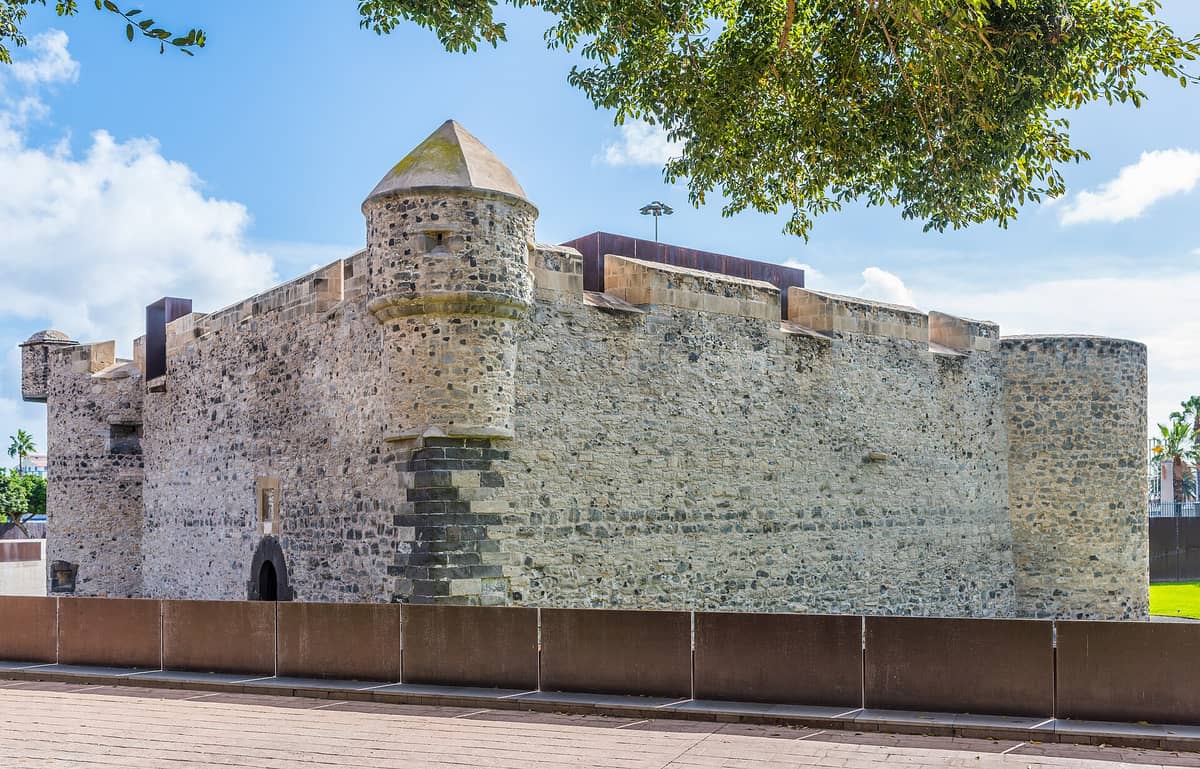
Castillo de la Luz is a 15th-century military fortress and, since 2015, a functioning museum dedicated to the work of Canarian sculptor Martín Chirino. It stands in the La Isleta district of Las Palmas de Gran Canaria, close to Puerto de La Luz, and is considered one of the oldest fortifications in the entire Canary Islands. The combination of medieval stone walls, a moat-like surrounding park, and contemporary iron sculptures makes for an unusual pairing that works better than it sounds.
The castle was originally known as Fortaleza de las Isletas, and its construction began in 1494, the same decade Columbus stopped at Gran Canaria on his way to the Americas. Its purpose was straightforward: protect the fledgling settlement and its harbor from pirate attacks, which were frequent and devastating along the Atlantic trade routes. The fortification changed hands, was expanded, fell into disrepair, and underwent restoration over five centuries before being repurposed as a cultural institution.
💡 Local tip
Visit on Wednesday afternoon for free entry between 16:00 and 19:00. A free guided tour runs at 17:00 on Wednesdays and covers both the architecture and the Chirino collection. Worth planning your week around if you're on a tight budget.
The Architecture: Reading the Walls
From the outside, the castle looks deliberately severe. The walls are thick volcanic stone, the corners are squared and unornamented, and the overall silhouette is low and horizontal rather than the towering fantasy-castle shape most visitors expect. This is a working fortification, built to absorb cannon fire rather than impress courtiers. The surrounding park, planted with palms and pines, softens the approach considerably.
Up close, the stonework tells a more complex story. Different phases of construction are visible in the varying textures and bonding techniques across the walls. Archaeological excavations carried out during restoration uncovered layers of structural history that confirmed the castle was modified repeatedly in response to evolving military threats and changing Spanish colonial strategy. The restorations were careful to preserve this legibility rather than smooth everything over into a false uniformity.
The interior spaces are cool and dim, as thick stone walls tend to be. In summer, when the rest of Las Palmas is warm and bright, this makes the castle a genuinely pleasant place to spend an hour. The contrast between the shadowed stone interiors and the sharp Atlantic light outside is striking, particularly in the late morning when sun hits the courtyard at an angle.
The Martín Chirino Collection: Why a Sculptor Suits This Space
The Fundación de Arte y Pensamiento Martín Chirino has occupied the castle since 28 March 2015, and the fit between artist and building is not accidental. Chirino, born in Las Palmas in 1925 and one of Spain's most internationally recognized sculptors, worked primarily in iron, producing spiral and wind-inspired forms that feel elemental rather than decorative. His most famous series, the "Aeróvoros" and the spiraling wind forms, look like they belong in spaces defined by raw material and geological time.
The permanent exhibition distributes sculptures across the castle's rooms and outdoor spaces. Some pieces sit in the courtyard where natural light catches the oxidized iron surfaces differently across the day. Morning light tends to pick out the texture and patina; afternoon light flattens the forms into silhouette. If you care about how you experience sculpture, aim for a morning visit.
The collection is not enormous, and visitors who have spent time with major retrospective exhibitions of Chirino's work elsewhere may find the scope modest. But for most visitors, the permanent collection provides a coherent and well-curated introduction to an artist who is genuinely important in 20th-century Spanish sculpture and not yet as well known internationally as he deserves to be.
The Surrounding Park and How to Approach the Visit
The castle sits at the center of a small park, Parque Castillo de Luz, which serves as both its protective buffer and a neighborhood green space. Local residents use it on weekend mornings for walking and sitting in the shade. The park is free to enter and pleasant to walk through even if you don't go into the museum itself, though skipping the interior entirely would be a mistake.
Most visitors arrive from Las Canteras beach, which is about 15 to 20 minutes on foot heading north along the seafront. This is the best approach: walk the full length of the beach promenade, turn into La Isleta, and let the shift in atmosphere from tourist beach to working port neighborhood register before you reach the castle. The area around La Isleta is one of the more authentic corners of Las Palmas, with corner bars, fishing nets, and apartment blocks that have nothing to do with tourism.
If you're coming by bus, lines 1, 2, 12, 21, 33, and 47 all stop near the castle. The urban bus network in Las Palmas is reliable and reasonably frequent during daytime hours. Single fares are low, and a rechargeable TransGC card reduces the per-trip cost further. Verify current fares before travel, as they are subject to change.
ℹ️ Good to know
Opening hours: Tuesday to Saturday 10:00–19:00, Sunday 10:00–14:00. Closed Monday. Check ahead for any temporary closures around public holidays.
Historical Significance: Pirates, Trade Routes, and Atlantic Power
The castle's location makes its history legible. Standing near Puerto de La Luz, which remains one of the busiest ports in Spain and one of the largest in the Atlantic, you can see why this stretch of coastline needed defending in 1494. The Canary Islands sat at the intersection of European expansion into Africa and the Americas. Ships stopping here to resupply were carrying everything that made 15th and 16th-century empires function: gold, spices, enslaved people, food, weapons. That made them targets.
The castle repelled multiple pirate attacks over its active military life, and the story of its sieges and defenses gives some texture to what can otherwise feel like an abstract historical site. If you plan to combine this visit with the broader historic district of Las Palmas, the Cathedral of Santa Ana and the Casa de Colón in Vegueta were being built and developed during the same period as the castle's construction. Together, they form a coherent picture of early colonial Las Palmas.
Practical Walkthrough: What to Expect Inside
Entry is through the park gate, then across to the castle entrance. Buy tickets at the door or through the online ticketing portal. The museum spaces are compact and organized across the ground floor and some upper areas. English-language information is available but less comprehensive than the Spanish materials, so non-Spanish speakers may want to look up Martín Chirino's work in advance to get more from the visit.
The free guided tour on Wednesday at 17:00 is conducted in Spanish. If you don't speak Spanish, you can still follow the guide around the spaces and use the architectural context, even if the commentary is inaccessible. The spaces are small enough that audio guides or interpretation materials can be read alongside the tour without feeling lost.
Accessibility provisions are in place: people with reduced mobility and their companions benefit from specific concessions, and the museum layout accommodates visits without stairs in the main exhibition areas. Confirm current accessibility details directly with the museum before planning a visit with specific requirements.
⚠️ What to skip
The castle is closed on Mondays. Several online listings show outdated or incomplete hours. The official booking site (castillodelaluz.sacatuentrada.es) has the most reliable current information.
Photography and Timing Notes
The castle exterior photographs well in the morning when the light comes from the east and picks out the texture of the volcanic stone. The park around it has enough shade and visual framing from the trees that midday shots are still workable, which is not always the case for white-walled buildings in the Canary Islands. The interior spaces are dark and require either patience with low-light settings or acceptance that atmosphere rather than technical precision is the goal.
The surrounding La Isleta neighborhood offers good street photography if you extend your visit before or after the museum. The walk back south along the seafront past Santa Catalina gives you views of the harbor, the beach, and the city skyline that are worth having on camera.
Insider Tips
- The free Wednesday visit (16:00–19:00) includes the guided tour at 17:00, making it the best value way to see the castle. It's a genuinely useful tour, not just a checkbox experience.
- Combine your visit with a walk through La Isleta before arriving at the castle. The neighborhood between Las Canteras and the fortress is one of the least touristy corners of Las Palmas, with old fishing-community character still intact.
- The park around the castle is the best spot in the immediate area for a quiet sit-down with no traffic noise. Bring water if you're visiting in summer, as there are no cafes or kiosks immediately at the castle entrance.
- Martín Chirino's spiral iron forms look different in different light. If you want to see the courtyard sculptures at their most textured and complex, arrive between 10:00 and 11:30 when the low eastern sun catches the oxidized surfaces.
- The castle's ticket price is low enough that it requires almost no justification even if you have only a passing interest in either history or sculpture. At 4 euros, it costs less than a coffee and pastry at most Las Palmas cafes.
Who Is Castillo de la Luz For?
- History and architecture enthusiasts interested in early Spanish colonial fortifications
- Contemporary art visitors wanting to understand Canarian artistic identity through Martín Chirino's work
- Budget travelers: free on Wednesday afternoons, and genuinely cheap on all other days
- Families with children who need a break from the beach and benefit from open outdoor park space around the castle
- Anyone combining Las Canteras with a longer walk north into the La Isleta neighborhood
Nearby Attractions
Other things to see while in Santa Catalina & La Isleta:
- Elder Museum of Science and Technology
Housed in a converted industrial building inside Parque Santa Catalina, the Elder Museum of Science and Technology is Las Palmas' interactive science museum. It mixes interactive exhibits with real spacecraft hardware, making it a solid choice for curious adults and families with children.
- Parque de Santa Catalina
Parque de Santa Catalina is the cosmopolitan centerpiece of Las Palmas de Gran Canaria, sitting between the cruise port and the city's commercial district. Free to enter, open around the clock, and packed with local life at almost any hour, it is the best single spot to take the pulse of the Canarian capital.
- Poema del Mar Aquarium
Acuario Poema del Mar is one of Europe's most ambitious indoor aquariums, set in the harbour district of Las Palmas de Gran Canaria. Across three zones and 35 recreated marine ecosystems, it takes visitors from Atlantic tide pools to deep tropical reefs. Here's what the experience actually delivers.