Carlton Gardens: Melbourne's World Heritage Parkland
Carlton Gardens is a 26-hectare Victorian-era park in inner-north Melbourne, inscribed on the UNESCO World Heritage List alongside the Royal Exhibition Building. It blends formal garden design, towering elms, and one of Australia's most architecturally significant public spaces into a single walkable precinct.
Quick Facts
- Location
- Carlton, Melbourne VIC (inner north, about 1.5 km from the CBD)
- Getting There
- Parliament Station (10 min walk); trams 86 and 96 stop nearby
- Time Needed
- 45 minutes to 2 hours depending on pace and museum visits
- Cost
- Free to enter the gardens; Melbourne Museum (adjacent) charges admission
- Best for
- Architecture lovers, families, picnickers, history enthusiasts
- Official website
- www.melbourne.vic.gov.au/carlton-gardens
What Carlton Gardens Actually Is
Carlton Gardens is not a casual afterthought tucked behind a museum. It is a formal Victorian-era public park covering approximately 26 hectares in Carlton, Melbourne's inner-north suburb, and it carries UNESCO World Heritage status jointly with the Royal Exhibition Building at its centre. That inscription, awarded in 2004, makes this the only place in mainland Australia where you can stand inside a World Heritage-listed cultural landscape and look directly at the building that earned it. That context matters when you're deciding whether to walk through quickly or spend real time here.
The gardens were designed and laid out to host the 1880 Melbourne International Exhibition, a Victorian-era trade fair that signalled Melbourne's ambitions as a major world city. The Royal Exhibition Building, designed by architect Joseph Reed, was constructed for that event and later served as the venue for the opening of Australia's first federal parliament in 1901. The grounds surrounding it were planned with the same deliberate formality: geometric pathways, ornamental fountains, and tree-lined axes that frame the building from multiple angles.
ℹ️ Good to know
Entry to Carlton Gardens is free and open year-round. There are no gates or ticketed entry points for the parkland itself. The Royal Exhibition Building and adjacent Melbourne Museum are separate ticketed attractions.
The Layout and What You'll See
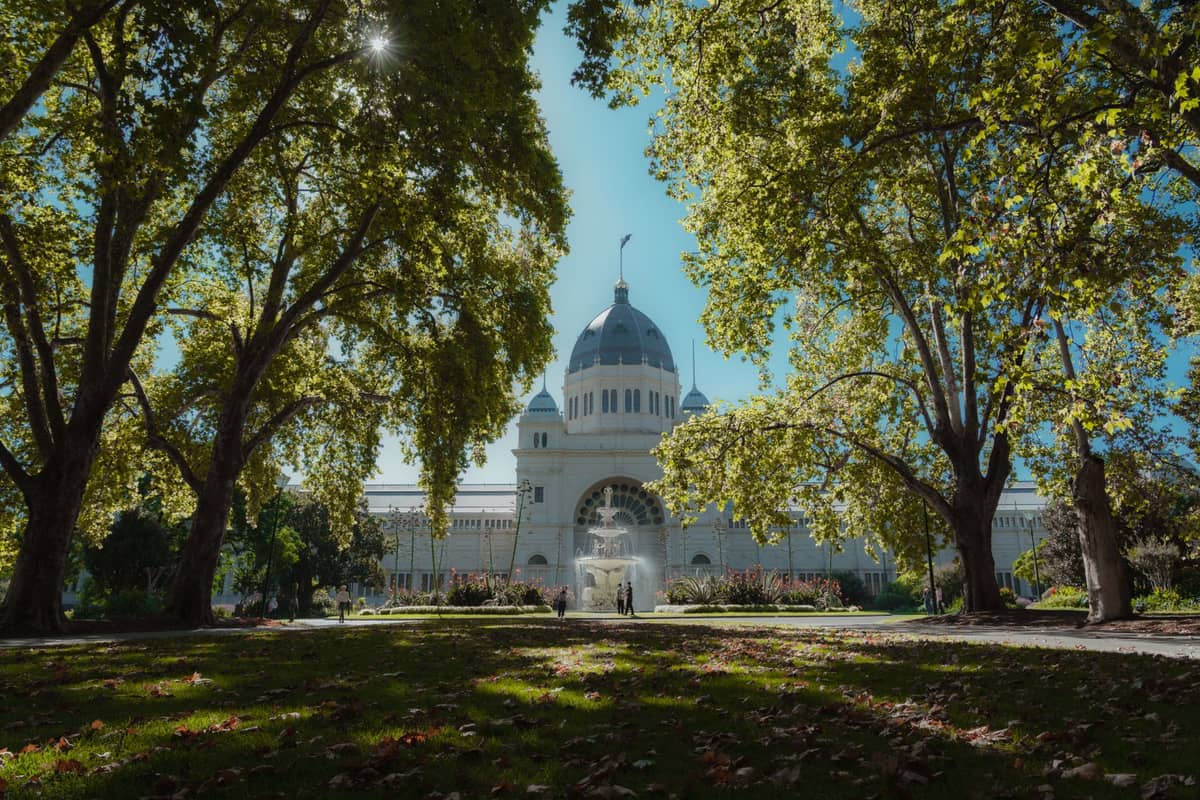
The gardens are bisected by Rathdowne Street, which creates a northern half and a southern half with distinct characters. The southern section, nearest the Royal Exhibition Building, is the more formally designed area: clipped hedges, a large central fountain, and radiating gravel paths that echo the building's grand main axis. This is where most visitors spend their time, and where the photographic relationship between the fountain, the lawns, and the building's Romanesque facade is most obvious.
The northern half is quieter and less visited. The tree canopy here is denser, with rows of mature elms that create tunnel-like corridors during summer when the leaves are fully out. In autumn, roughly April to May, the same elms turn amber and drop leaves across the paths in a way that feels genuinely seasonal, which is rare in Melbourne's more temperate landscape. This section suits people looking for a slower, shadier walk away from the tourist cluster around the building.
Throughout the gardens you'll find the Carlton Gardens Recital Hall, ornamental lakes with ducks, heritage-listed specimen trees, and plaques marking points of historical significance. The grounds also contain a children's playground in the northern section, which is consistently well-used on weekday mornings by local families.
Tickets & tours
Live prices and dates from our booking partner. If you book, we may earn a commission at no extra cost to you.
Sovereign Hill, Botanical Gardens and Melbourne Skydeck Bus Tour
From 116 €Instant confirmationFree cancellationGreat Ocean Road reverse itinerary tour from Melbourne
From 77 €Instant confirmationFree cancellationGreat Ocean Road bus tour with a forest walk
From 90 €Instant confirmationFree cancellationYarra Valley Bus Wine Tour including lunch with a glass of wine and chocolate
From 107 €Instant confirmationFree cancellation
How the Gardens Change Through the Day
Early mornings, before 8 a.m. the gardens belong almost entirely to locals: joggers on the gravel paths, dog walkers in the northern section, and the occasional office worker cutting through from Carlton to the CBD. The light at this hour falls low and long across the lawns, and the Royal Exhibition Building's ochre stone catches it well. If you want a photograph of the building without other tourists in frame, this is your window.
By mid-morning, school groups begin arriving. Melbourne Museum, which sits at the northern edge of the gardens, draws regular school excursions, and groups often spill into the parkland before and after their museum session. Between roughly 10 a.m. and 2 p.m. on weekdays during the school term, expect children around the northern play area and fountain. This doesn't diminish the experience significantly, but it changes the atmosphere.
Late afternoon, around 4 to 6 p.m. brings another shift. Office workers from Carlton and the nearby university precinct use the gardens as a shortcut or a place to decompress. The light again becomes interesting as it hits the Exhibition Building from the west. Weekend afternoons in good weather see picnic groups on the lawns, particularly in the southern section close to the fountain.
💡 Local tip
For the best combination of good light, low crowds, and a quiet atmosphere, visit on a weekday morning between 7 and 9 a.m., particularly in autumn when the elm canopy is at its most photogenic.
The Royal Exhibition Building: Why It Matters
You cannot fully understand Carlton Gardens without engaging with the Royal Exhibition Building at its heart. Designed by Joseph Reed and completed in 1880, it is one of the finest surviving examples of Victorian-era exhibition hall architecture in the world. Its central dome, inspired loosely by the Duomo in Florence, reaches 61 metres at its highest point and remains a landmark visible from several approaches into Carlton.
The building opened Australia's first federal parliament in 1901, before a permanent parliament house was established in Canberra. That historical weight is not always obvious when you're looking at it from the gardens, but it gives the structure a significance that goes well beyond its architectural interest. Tours of the interior are operated by the Melbourne Museum, which adjoins the building on the northern side. Booking a guided tour is the only way to enter the building itself, since the interior is not generally open for independent exploration.
From the gardens, the building rewards slow observation. Walk the full perimeter rather than just viewing it from the main southern approach. The eastern and western facades each have their own decorative details, and the relationship between the building and the surrounding tree canopy shifts significantly depending on which side you're standing on.
Getting There and Getting Around
Carlton Gardens sits in the suburb of Carlton, which connects directly to the CBD. From Parliament Station, the walk is approximately 10 minutes north along Spring Street and then Nicholson Street. Tram routes 86 and 96, running up Nicholson Street, both stop close to the gardens' eastern boundary. If you're already using Melbourne's City Circle Tram for sightseeing, it does not serve Carlton directly, so you'll need to change to one of the Nicholson Street trams or walk from Spring Street.
The gardens themselves are flat and easy to navigate on foot. Gravel and paved paths run throughout. There is no official map of the gardens posted at the entrance, so it's worth having a rough sense of the layout before arriving. The Melbourne Museum entrance on Swanston Street marks the northern boundary; the ornamental fountain and Exhibition Building entrance mark the south.
💡 Local tip
The City of Melbourne's website lists Carlton Gardens as accessible, but the gravel paths in parts of the garden may be difficult for mobility aids after rain. The main paved paths around the Royal Exhibition Building and fountain are smoother and better suited for wheelchairs and prams.
Carlton Gardens in Context: The Neighbourhood Around It
Carlton Gardens sits at the southern edge of Carlton, a suburb defined largely by the University of Melbourne to its west and Lygon Street's Italian restaurant strip a few blocks further in. After visiting the gardens, walking north along Rathdowne Street or Drummond Street takes you into residential Carlton: Victorian terrace houses, corner cafes, and the quieter pace of an established inner suburb. This is a better introduction to Carlton's character than Lygon Street's busier main strip, which skews heavily tourist. For broader context on the suburb and what surrounds it, the Carlton neighbourhood guide covers the area in more detail.
The gardens also sit within easy walking distance of the CBD's northern edge. From the Exhibition Building, it's roughly a 15-minute walk down Spring Street to Federation Square and the cultural precinct along the Yarra. This makes Carlton Gardens a natural first or last stop on a broader city walking loop rather than a standalone destination requiring a dedicated trip.
What the Gardens Don't Offer (And Who Should Manage Expectations)
Carlton Gardens is a formal, heritage-protected park, not a sprawling natural landscape. If you're expecting native bush, informal walking trails, or the kind of ecological variety you'd find at a larger parkland, you'll be disappointed. The planting here is predominantly European in character: elms, oaks, and ornamental deciduous trees chosen to fit the Victorian-era aesthetic of the original design.
People who find formal garden design uninteresting may get limited return from more than 30 minutes here, unless they're also visiting Melbourne Museum or taking a guided tour of the Royal Exhibition Building. The gardens work best as part of a broader Carlton or inner-city itinerary. They're less rewarding as a primary destination if your interest is in Melbourne's natural environment or contemporary culture. For something greener and more ecologically varied, the Royal Botanic Gardens Victoria in South Yarra offer a substantially different experience.
Weather affects the experience more than most visitors anticipate. On grey winter days, the formal layout and bare deciduous trees can feel sparse. Melbourne's climate is temperate but changeable, with average winter maximums around 14°C and regular overcast periods from June to August. Autumn and spring are the more visually rewarding seasons, though spring (September to November) weather is notoriously variable.
Insider Tips
- The fountain at the southern end of the gardens runs continuously and has good drinking water access nearby. It's a useful reference point for meeting people and for orienting yourself in the gardens.
- Guided tours of the Royal Exhibition Building interior run on select days and must be booked through Melbourne Museum. The interior is rarely seen by casual visitors and includes the original 1880 timber floors and decorative ceiling details that the exterior doesn't hint at.
- The northern elm avenue is one of the few places in central Melbourne where you get genuine seasonal autumn colour. Plan a visit in late April or early May if you're in the city at that time, even if only for 20 minutes.
- Carlton Gardens hosts occasional outdoor events, markets, and temporary installations. Check the City of Melbourne events page before visiting if you want to either attend one of these or specifically avoid the crowds they bring.
- From the main southern lawn, the Royal Exhibition Building aligns almost perfectly with the fountain in the foreground. This is the most reproduced angle of the building, but it's a genuinely good composition, especially in morning light when the stone is warmly lit and the crowd is minimal.
Who Is Carlton Gardens For?
- Architecture and history enthusiasts who want to see the only World Heritage-listed cultural landscape on mainland Australia
- Families with children, particularly those visiting Melbourne Museum and looking for an outdoor space to decompress before or after
- Photographers working in morning or late afternoon light, when the Exhibition Building is at its most photogenic
- Walkers building a broader inner-city itinerary that connects Carlton to the CBD
- Autumn visitors who want accessible seasonal foliage close to the city centre
Nearby Attractions
Other things to see while in Carlton & Parkville:
- Melbourne Museum
Melbourne Museum is one of Australia's largest museums, in Carlton Gardens, opposite the World Heritage-listed Royal Exhibition Building in Carlton. With permanent galleries spanning natural history, First Peoples culture, science, and Australian social history, it rewards careful exploration far more than a rushed walk-through.
- Melbourne Zoo
The Royal Melbourne Zoological Gardens has been open since 1862, making it Australia's oldest zoo. Spread across Royal Park in Parkville, it combines heritage gardens with modern animal habitats and conservation exhibits. Here is what a visit actually looks like, and how to make the most of it.
- Royal Exhibition Building
Built in 1879–1880 and inscribed on the World Heritage List in 2004, the Royal Exhibition Building is one of Australia's most significant Victorian-era structures. Standing beside the Carlton Gardens with its 60-metre dome visible from across the neighbourhood, it rewards visitors who arrive with context and realistic expectations about access.
Planning a trip? Discover personalized activities with the Nomado app.