Bugis Street Market: Singapore's Largest Open-Air Shopping Maze
Bugis Street Market packs over 800 stalls into a covered labyrinth near Bugis MRT, selling everything from budget fashion and phone cases to local snacks and tourist keepsakes. It's loud, crowded at peak hours, and unapologetically commercial — but for price-conscious shoppers and souvenir hunters, few places in Singapore deliver more variety for less money.
Quick Facts
- Location
- 3 New Bugis Street, Singapore 188867 (Kampong Glam area)
- Getting There
- Bugis MRT (Downtown Line / East-West Line), 3-minute walk
- Time Needed
- 45 minutes to 2 hours depending on how seriously you shop
- Cost
- Free entry; budget S$10–S$30 for shopping or snacks
- Best for
- Budget shoppers, souvenir hunters, casual street food grazing
What Bugis Street Market Actually Is
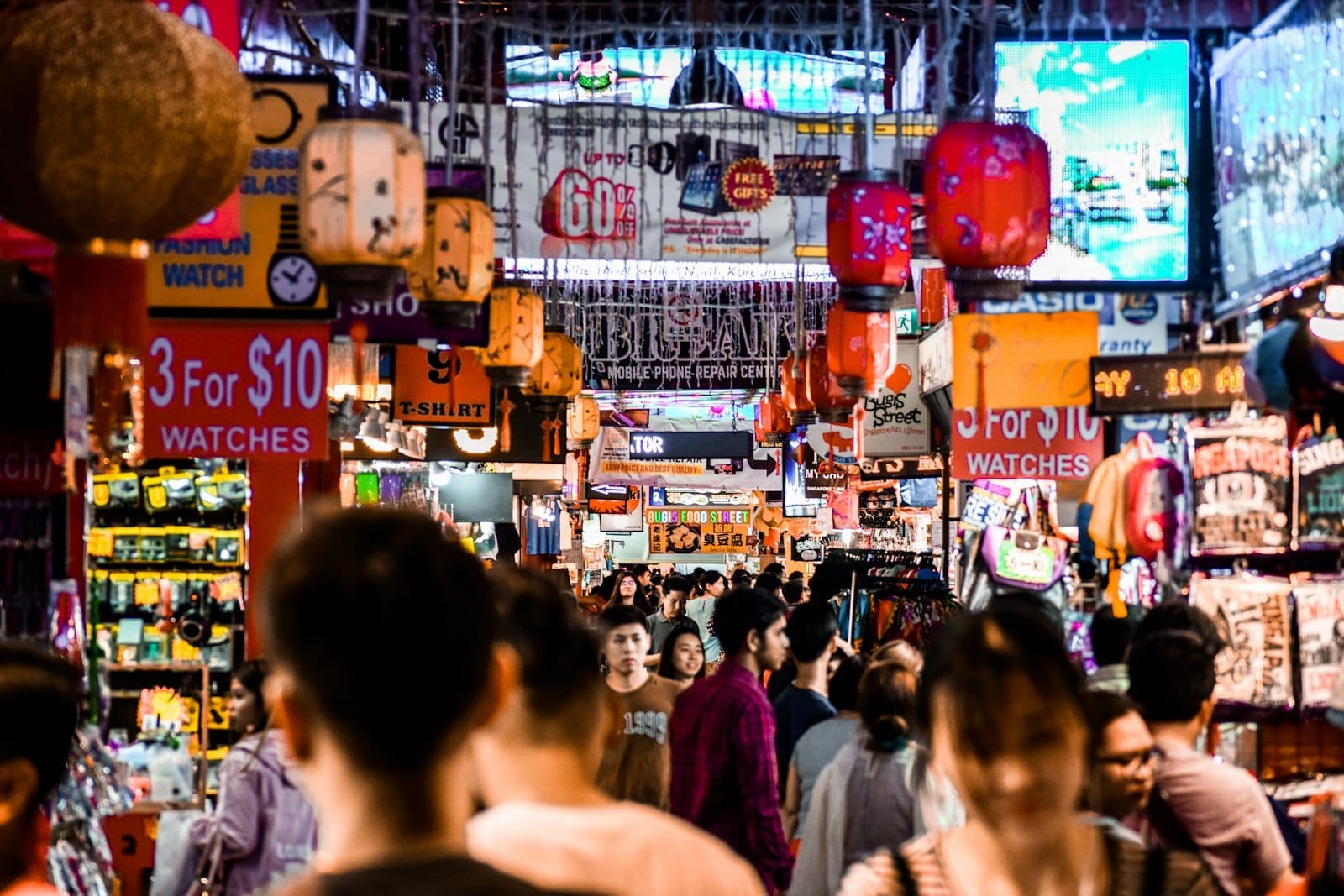
Bugis Street Market is widely cited as Singapore's largest street market, with more than 600 shops spread across a covered, multi-lane complex at 3 New Bugis Street. The market operates daily from approximately 11:00 AM to 10:00 PM, with some stalls opening at 10:00 AM and staying open until 11:00 PM on weekends. Entry is free at all times.
What you find inside is a dense, maze-like grid of narrow lanes lined with vendors selling fast fashion, streetwear, accessories, phone cases, cosmetics, cheap luggage, novelty souvenirs, and local snacks. The atmosphere is closer to a covered bazaar than an outdoor night market — most of the complex is shaded or fully roofed, which means it remains passable in Singapore's frequent afternoon rain showers.
💡 Local tip
Come on a weekday morning between 11:00 AM and 1:00 PM for the most relaxed browsing. By late afternoon and on weekends, the lanes fill quickly and navigation becomes genuinely difficult.
The History Behind the Name
The original Bugis Street, which occupied a different site from the 1950s through the early 1980s, was one of Singapore's most notorious nightlife addresses — a place of open-air seafood restaurants, hawker stalls, and a transgender street scene that drew both locals and sailors from the nearby port. It was colourful, chaotic, and by multiple accounts genuinely dangerous after dark. The government cleared it in 1985 to make way for the Bugis MRT station.
The current market is a recreation, not a continuation. It opened in the late 1980s on what was formerly known as New Bugis Street (Albert Street), and has been expanded and modernised several times since. The wild character of the original is entirely absent. What remains is a sanitised, commercially organised market that trades on the name recognition while offering something quite different in practice.
Understanding this distinction matters for managing expectations. Travellers who arrive hoping for an atmospheric historic street market will find something far more functional. Those who come looking for an efficient, covered, price-competitive shopping environment will generally leave satisfied.
Tickets & tours
Hand-picked options from our booking partner. Prices are indicative; availability and final rates are confirmed when you complete your booking.
Adventure Cove Waterpark™ e-ticket
From 27 €Instant confirmationWild Wild Wet Waterpark Entrance Ticket
From 15 €Instant confirmationLion City bike tour in Singapore
From 55 €Instant confirmationFree cancellationLuggage Storage in Singapore
From 7 €Instant confirmationFree cancellation
What You'll Find in the Stalls
The merchandise skews heavily towards fashion and accessories aimed at teenagers and young adults: cropped tops, graphic tees, printed shorts, costume jewellery, caps, sunglasses, and canvas sneakers. Prices are generally low by Singapore standards, though comparable goods can be found online for less. Bargaining is not the norm here the way it is in some regional markets — most stalls have fixed displayed prices, though polite negotiation on multiple purchases occasionally works.
A significant portion of the stalls sell tourist-facing items: Singapore-branded magnets, keychains, Merlion figurines, postcards, and novelty snack boxes (salted egg chips, pandan cookies, and similar). These make functional gifts and the selection is wide, though the same items appear across dozens of adjacent stalls at nearly identical prices.
Scattered throughout the market are food and drink vendors selling bubble tea, fresh fruit juice, fried snacks, ice cream, and small cooked dishes. The quality is inconsistent but prices are reasonable, and eating while walking is very much part of how visitors experience the place.
ℹ️ Good to know
For a more substantial meal nearby, the Kampong Glam area has significantly better food options. The market's food stalls work best for a quick snack between shopping, not as a dining destination.
How the Experience Changes Through the Day
Mid-morning on weekdays is when the market is most navigable. Stall holders are setting up or finishing displays, the lanes have room to breathe, and vendors are often willing to spend more time talking through options. The light, filtered through the semi-open roof sections, is relatively pleasant at this hour.
From around 3:00 PM onward, and especially on Saturdays, the energy shifts noticeably. School groups, families, and tourists converge simultaneously. The ambient noise level rises sharply — a combination of competing music from adjacent stalls, vendor calls, and the general density of bodies in narrow corridors. Navigating with a stroller or large bag becomes genuinely awkward. Photography in these conditions produces crowded, cluttered shots.
Weekend evenings have the most atmosphere in terms of energy and light, but also the least practical shopping experience. If your goal is browsing without frustration, avoid Saturday afternoons in particular.
Getting There and Getting Around
Bugis MRT station (served by both the East-West Line and the Downtown Line) sits almost directly adjacent to the market. The walk from the station exit to the main market entrance takes about three minutes. The red-roofed entrance is visible from the street and serves as the primary orientation point. For more on navigating Singapore's public transport, see the getting around Singapore guide.
The market connects seamlessly to two air-conditioned shopping malls: Bugis Junction is directly adjacent, and Bugis+ is a short walk across Victoria Street. This is worth knowing for more than convenience — when the outdoor lanes feel overwhelming or the heat becomes uncomfortable, stepping into either mall provides an immediate reset. Both malls also have food courts with more substantial dining options than the market stalls.
The entire market complex is covered and accessible without significant steps, making it manageable for visitors with mobility considerations. Wheelchairs and prams can navigate most main lanes, though the narrower side corridors become difficult when busy.
Placing Bugis Street in Context: The Kampong Glam Neighbourhood
Bugis Street Market sits at the edge of Kampong Glam, one of Singapore's most historically layered neighbourhoods. A short walk from the market entrance brings you into a different character entirely: the narrow shophouse streets of Arab Street and Haji Lane, the gold-domed Sultan Mosque, and the Malay Heritage Centre.
This combination is one of the strongest arguments for visiting Bugis Street Market at all. If you treat the market as one stop on a longer walk through the neighbourhood rather than a destination in itself, the overall experience is considerably richer. Browse the market, then walk ten minutes to Haji Lane for independent boutiques and cafes that feel genuinely distinct, or continue to Sultan Mosque for one of Singapore's most architecturally impressive religious buildings.
💡 Local tip
If you're spending a full afternoon in this part of the city, start at Bugis Street Market when it opens, then work your way deeper into Kampong Glam as the day progresses. The neighbourhood's cafes and restaurants are considerably better for an evening meal than the market's food stalls.
Who Should Skip It (And Why)
Travellers with limited time in Singapore and a strong preference for curated, quality-focused shopping should probably use their time elsewhere. The market offers volume and low prices, not curation or quality. Most of the fashion is fast and disposable; most of the souvenirs are mass-produced and identical to what you'll find in multiple other locations.
Visitors specifically interested in Singapore's food culture will find more rewarding options within walking distance, including Tekka Centre in nearby Little India, or the range of hawker options covered in the Singapore hawker centres guide.
Noise-sensitive visitors or anyone who finds dense, high-stimulus environments tiring should be aware that peak-hour Bugis Street is loud in a sustained, unavoidable way. The covered layout concentrates sound rather than dispersing it.
Insider Tips
- The red-roofed main entrance faces New Bugis Street and is the most obvious entry point, but the market has multiple access corridors. Entering from the Bugis Junction side deposits you closer to the food stalls and tends to be slightly less crowded at the start.
- Souvenir prices at Bugis Street are competitive but not uniquely low. If you're buying in quantity (gifts for multiple people), vendors at several stalls will apply an informal bulk discount if you ask straightforwardly and buy at least five or six of the same item.
- The covered walkway between Bugis Street and Bugis Junction is a useful shortcut during heavy rain and also hosts smaller pop-up vendors that rotate regularly — occasionally you'll find more interesting stock here than in the main market.
- Weekday mornings are also when restocking happens, so shelves and racks tend to be fuller and better organised than at the end of a busy weekend. If a particular stall looks sparse on Saturday evening, the same stock in better condition is available Tuesday morning.
- The market's own website (bugistreet.com) lists periodic promotional events and seasonal sales. Checking it before a visit during public holiday periods can flag unusual hours or special stall configurations.
Who Is Bugis Street Market For?
- Budget-conscious shoppers looking for affordable fashion and accessories without mall prices
- Travellers hunting for a wide selection of Singapore souvenirs in one concentrated location
- First-time visitors who want a quick, accessible introduction to Singapore's market culture before exploring more neighbourhood-specific markets
- Families with teenagers who want to browse independently while parents explore the surrounding Kampong Glam neighbourhood
- Visitors who want to combine practical souvenir shopping with a longer walk through one of Singapore's most characterful historic districts
Nearby Attractions
Other things to see while in Kampong Glam:
- Arab Street
Arab Street is the spine of Kampong Glam, Singapore's Malay-Arab heritage quarter. Lined with restored shophouses selling batik, rattan, and perfume oils, it connects centuries of mercantile history to a neighbourhood that now hums with cafés, street art, and one of the city's most photogenic mosques.
- Haji Lane
Haji Lane is a narrow alley in Kampong Glam where pastel-painted 19th-century shophouses line up beside hand-painted murals, independent boutiques, and rooftop cafes. It is free to walk, open around the clock, and most rewarding in the late afternoon when the light softens and the street starts to breathe.
- Malay Heritage Centre
Housed in the 19th-century Istana Kampong Gelam, the Malay Heritage Centre is Singapore's dedicated museum for Malay history, culture, and identity. Entry is free, the building is a gazetted National Monument, and the surrounding Kampong Glam neighbourhood adds layers of living context that make the visit feel genuinely rewarding.
- Sultan Mosque
Rising above the rooftops of Kampong Glam on North Bridge Road, Sultan Mosque is Singapore's most significant Islamic landmark and a gazetted national monument. Its golden domes and Indo-Saracenic facade draw visitors from every corner of the city, while the interior remains an active place of worship for up to 5,000 congregants.