Sultan Mosque (Masjid Sultan): The Heart of Kampong Glam
Rising above the rooftops of Kampong Glam on North Bridge Road, Sultan Mosque is Singapore's most significant Islamic landmark and a gazetted national monument. Its golden domes and Indo-Saracenic facade draw visitors from every corner of the city, while the interior remains an active place of worship for up to 5,000 congregants.
Quick Facts
- Location
- 3 Muscat Street, Kampong Glam, Singapore 198833
- Getting There
- Bugis MRT (EW12/DT14) or Lavender MRT (EW11), both a short walk away
- Time Needed
- 30–60 minutes for the mosque; pair with 2–3 hours exploring Kampong Glam
- Cost
- Free entry for visitors (non-Muslims welcome outside prayer times)
- Best for
- Architecture enthusiasts, cultural explorers, photography, first-time visitors to Singapore
- Official website
- http://sultanmosque.sg
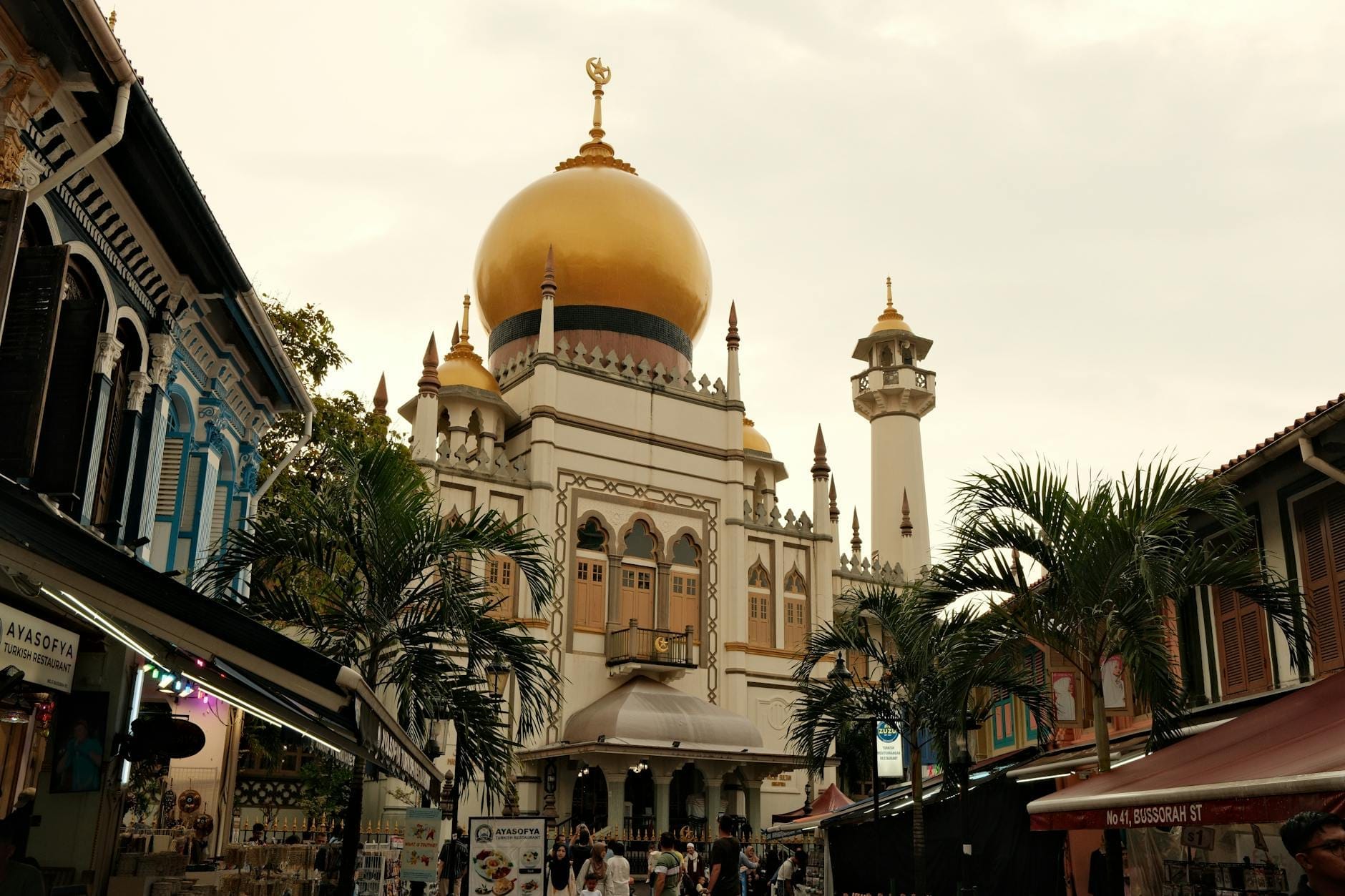
What Makes Sultan Mosque Worth Your Time
Masjid Sultan, known in English as Sultan Mosque, is not merely a photo stop on a Kampong Glam walking route. It is a working mosque that has anchored Singapore's Malay-Muslim community since 1824, and its current structure, completed in 1932, represents one of the most ambitious pieces of religious architecture the British colonial era produced in this part of Southeast Asia. The golden domes are visible from several streets away, and up close, the building rewards slow looking: the brickwork, the arched colonnades, and the unusual decorative band of glass bottle bases embedded in the base of the domes.
Visitors who treat this purely as a backdrop for photographs miss what makes the mosque genuinely interesting. Step inside during non-prayer hours, observe the scale of the main prayer hall, and you begin to understand why this site was gazetted as a national monument in 1975 and why it remains the focal point of Hari Raya Puasa celebrations that draw tens of thousands of people to the surrounding streets each year.
💡 Local tip
Check the official prayer schedule at sultanmosque.sg before visiting. The mosque is closed to non-Muslim visitors during the five daily prayer times, which shift slightly each day. Arriving just after a prayer period ends typically means a quieter, more relaxed visit.
Architecture and History: More Than a Pretty Dome
The original Sultan Mosque was built in 1826 on land granted by Stamford Raffles to Sultan Hussein Shah of Johor as part of the 1819 treaty that ceded Singapore to the British East India Company. That first structure was modest. A century later, the Alsagoff Arab family and the wider Muslim community funded a complete rebuild, commissioning Irish architectural firm Swan and Maclaren to design a new mosque. The result, completed in 1932, is a confident example of Indo-Saracenic architecture: a style that blends Mughal, Islamic, and European classical elements, which British architects used widely across India and, to a lesser extent, the Straits Settlements.
The two main domes are the defining visual feature. Beneath each dome, look closely at the decorative band that runs around the base. It is made from the bottoms of glass bottles, a practical and symbolic flourish: the story goes that poorer members of the congregation donated bottles so they could say a part of them went into building the mosque. Whether apocryphal or not, the detail speaks to the communal effort behind the building. The mosque was reconstructed and expanded to accommodate up to 5,000 worshippers, and the mosque can now accommodate up to 5,000 worshippers.
The interior of the main prayer hall is austere by the standards of some grand mosques elsewhere in the world, with large carpeted floors, high ceilings, and an emphasis on spatial generosity over ornamental density. The mihrab (the niche indicating the direction of Mecca) and the minbar (the raised pulpit) are worth examining up close.
Tickets & tours
Hand-picked options from our booking partner. Prices are indicative; availability and final rates are confirmed when you complete your booking.
Adventure Cove Waterpark™ e-ticket
From 27 €Instant confirmationWild Wild Wet Waterpark Entrance Ticket
From 15 €Instant confirmationLion City bike tour in Singapore
From 55 €Instant confirmationFree cancellationLuggage Storage in Singapore
From 7 €Instant confirmationFree cancellation
How the Mosque Changes Through the Day
Early morning, around the Fajr (dawn) prayer, the surrounding streets are quiet and the mosque's exterior is lit by the pale light of a Singapore morning. The calls to prayer, broadcast from the minarets, carry clearly across Kampong Glam and set the neighborhood's rhythm. This is not a practical visiting time for most tourists, but if you happen to be up early and walking through, the atmosphere is worth noting.
Mid-morning, roughly 9am to noon, is consistently the best window for visitors. The crowds are manageable, the light falls well on the southern facade from North Bridge Road, and the mosque staff who assist visitors at the entrance are present and unhurried. By midday, tour groups begin to arrive in larger numbers, and the narrow entrance corridor can feel congested.
Late afternoon, in the hour before Asr (afternoon) prayer, catches the golden light on the domes in a way that photographers specifically seek out. The surrounding streets of Kampong Glam fill with foot traffic from Arab Street and Haji Lane at this time, so the whole neighborhood takes on a livelier character. After Maghrib (sunset) prayer on Fridays, the area around the mosque is particularly animated, with food stalls and traders extending their hours.
⚠️ What to skip
On Fridays, the main Friday prayer (Jumah) draws a significantly larger crowd than weekday prayers. The surrounding streets may be partially closed or crowded. Plan your visit either in the morning before noon or in the late afternoon on Fridays.
Visiting Practicalities: What to Know Before You Arrive
Entry is free for all visitors, Muslim and non-Muslim alike, outside of prayer times. Modest dress is required: shoulders and knees must be covered. Robes are available to borrow at the entrance for visitors who need them, so you will not be turned away for wearing shorts or a sleeveless top, but carrying a light layer to drape over yourself is a more comfortable and respectful option in Singapore's heat.
Shoes are removed before entering the main prayer hall. There are designated racks at the entrance. The marble and tile floors inside are cool underfoot, which is a genuine relief after walking Kampong Glam's streets in the midday heat.
The mosque is barrier-free and accessible for wheelchair users. The nearest MRT stations are Bugis (East-West and Downtown Lines) and Lavender (East-West Line), each roughly a 10-minute walk away. From Bugis, walk north along Victoria Street and turn right onto Ophir Road, then right again onto North Bridge Road. The domes become visible well before you arrive. Taxis and ride-hailing apps drop off easily on North Bridge Road.
Photography inside the prayer hall requires discretion and quiet. Photography of worshippers in prayer is not appropriate. Outside, the best unobstructed view of the facade is from across North Bridge Road. For a wider shot that includes the surrounding shophouses, step back toward the junction with Ophir Road. The Haji Lane side streets also offer framing opportunities through gaps in the shophouse rows.
Kampong Glam: The Neighborhood Around the Mosque
Sultan Mosque sits at the geographic and cultural core of Kampong Glam, Singapore's historic Malay-Arab quarter. The neighborhood was formally designated as the Malay settlement area under Raffles' 1822 town plan, and it has retained a distinct Muslim character that sets it apart from the rest of the city. The streets immediately surrounding the mosque, particularly Muscat Street, Arab Street, and Baghdad Street, are lined with carpet merchants, textile sellers, perfume shops stocking Middle Eastern oud and attar, and restaurants serving Malay, Turkish, and Arab cuisines.
For cultural context before or after your visit, the Malay Heritage Centre is located just 200 metres away in the former Istana Kampong Glam (the Malay royal palace), and provides a well-curated history of the community and the neighborhood. Haji Lane, the narrow street running parallel to Arab Street, has evolved into a destination for independent fashion boutiques and cafes, offering a sharper contrast to the mosque's solemnity than some visitors expect.
ℹ️ Good to know
During Ramadan, the area around Sultan Mosque transforms in the evenings. Geylang Serai is the main Ramadan bazaar, but the Kampong Glam streets also host food stalls and extended trading hours. The pre-dawn and post-Iftar periods around the mosque are culturally rich moments to observe, though visitors should remain respectful and unobtrusive.
Who Should Skip This Attraction
Sultan Mosque is not a museum or a heritage park. It is an active house of worship that happens to be open to the public. Visitors expecting an immersive guided experience with interpretation panels, air-conditioned exhibit halls, or curated storytelling will be disappointed. The visit is primarily visual and atmospheric, and the interior viewing time is genuinely short unless you choose to sit quietly and observe.
Travelers on very tight schedules who have already visited significant religious sites in Singapore, or those with no particular interest in Islamic architecture or Malay cultural history, may find the 30-minute detour into Kampong Glam is better spent elsewhere. That said, the surrounding neighborhood makes the trip worthwhile independent of the mosque itself, so the question is really whether Kampong Glam fits your itinerary rather than whether the mosque alone justifies a visit.
Insider Tips
- The glass bottle band at the base of the domes is easy to miss from street level. Step closer than feels natural and look at the decorative trim: the circular bottle bases are embedded in rows and catch the light in a way that photographs rarely capture well.
- Visiting just after the Zuhr (midday) prayer ends, typically early afternoon, often yields a brief window when the prayer hall is accessible and attendance has thinned out. Check the day's exact prayer times on the mosque's official website before planning your arrival.
- The shophouse facades on Muscat Street or Arab Street, which runs perpendicular to the mosque's main entrance, were repainted as part of a conservation effort and create a postcard-perfect foreground with the domes behind them. This street is consistently used for professional shoots and is worth finding.
- If you are visiting during Hari Raya Puasa (Eid al-Fitr), the entire Kampong Glam precinct is transformed with lights, decorations, and extended market stalls. The mosque itself will be extremely crowded for prayers, so non-Muslim visitors are better served arriving in the days leading up to Eid rather than on the day itself.
- Robes at the entrance are shared and not individually washed between each use. If you are particular about hygiene or comfort, wearing long trousers and a shirt with sleeves avoids the need to borrow one.
Who Is Sultan Mosque For?
- First-time visitors to Singapore who want to understand the city's ethnic and religious diversity beyond the obvious tourist circuit
- Architecture enthusiasts interested in Indo-Saracenic and colonial-era religious buildings
- Photographers seeking the contrast between golden Islamic domes and Singapore's shophouse streetscapes
- Travelers combining a Kampong Glam walking route through Arab Street, Haji Lane, and the Malay Heritage Centre
- Visitors during Ramadan or the Hari Raya period who want to experience the neighborhood at its most culturally distinctive
Nearby Attractions
Other things to see while in Kampong Glam:
- Arab Street
Arab Street is the spine of Kampong Glam, Singapore's Malay-Arab heritage quarter. Lined with restored shophouses selling batik, rattan, and perfume oils, it connects centuries of mercantile history to a neighbourhood that now hums with cafés, street art, and one of the city's most photogenic mosques.
- Bugis Street Market
Bugis Street Market packs over 800 stalls into a covered labyrinth near Bugis MRT, selling everything from budget fashion and phone cases to local snacks and tourist keepsakes. It's loud, crowded at peak hours, and unapologetically commercial — but for price-conscious shoppers and souvenir hunters, few places in Singapore deliver more variety for less money.
- Haji Lane
Haji Lane is a narrow alley in Kampong Glam where pastel-painted 19th-century shophouses line up beside hand-painted murals, independent boutiques, and rooftop cafes. It is free to walk, open around the clock, and most rewarding in the late afternoon when the light softens and the street starts to breathe.
- Malay Heritage Centre
Housed in the 19th-century Istana Kampong Gelam, the Malay Heritage Centre is Singapore's dedicated museum for Malay history, culture, and identity. Entry is free, the building is a gazetted National Monument, and the surrounding Kampong Glam neighbourhood adds layers of living context that make the visit feel genuinely rewarding.