Haji Lane: Singapore's Skinniest Street with the Most Personality
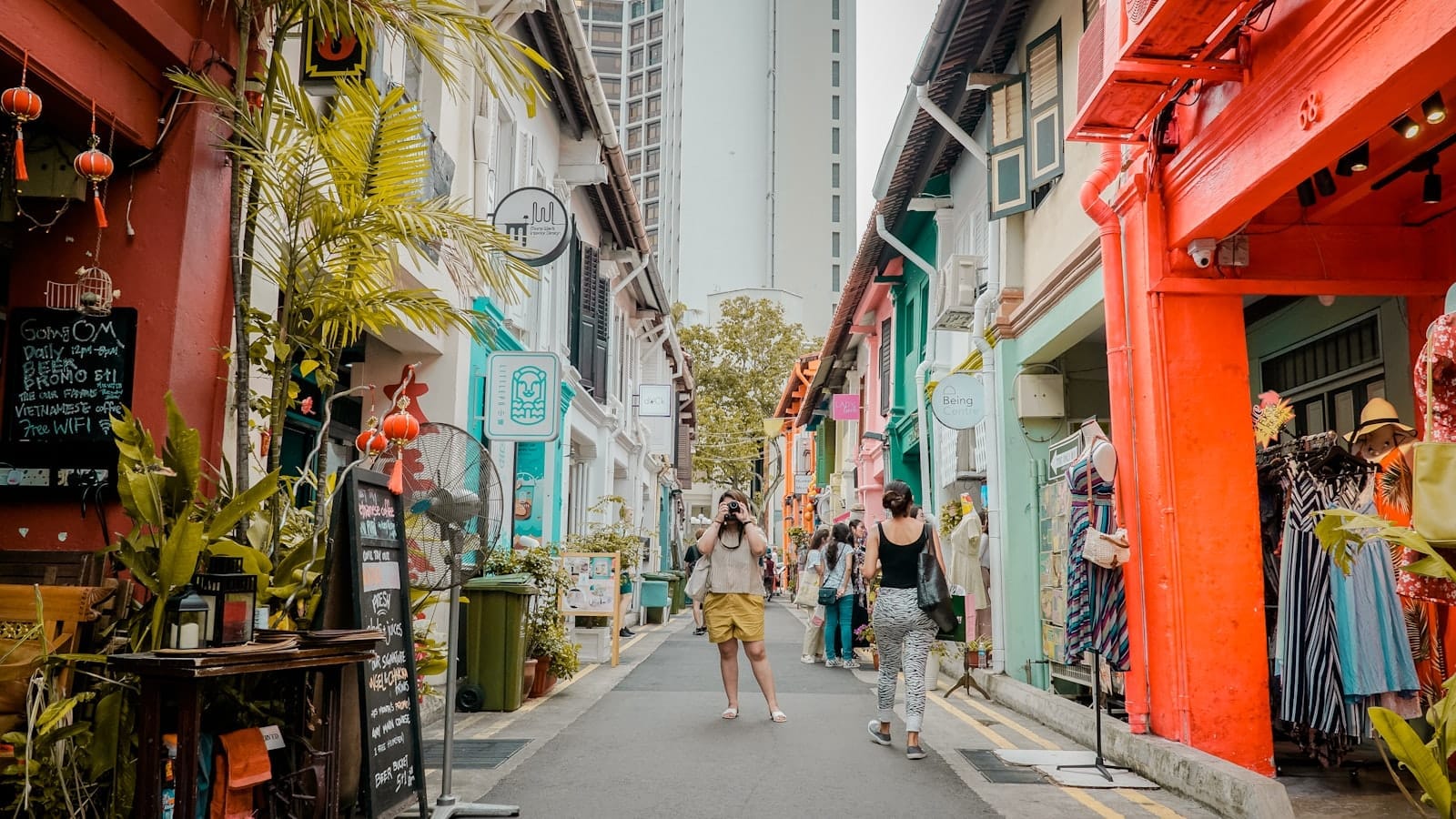
Haji Lane is a narrow alley in Kampong Glam where pastel-painted 19th-century shophouses line up beside hand-painted murals, independent boutiques, and rooftop cafes. It is free to walk, open around the clock, and most rewarding in the late afternoon when the light softens and the street starts to breathe.
Quick Facts
- Location
- Kampong Gelam, Singapore (between Arab Street and Baghdad Street)
- Getting There
- Bugis MRT (EW12/DT14), approximately 5-minute walk
- Time Needed
- 1 to 2 hours for a relaxed walk; longer if dining or shopping
- Cost
- Free entry as a public street; shops and cafes vary
- Best for
- Street art, indie shopping, cafe hopping, evening atmosphere
What Haji Lane Actually Is
Haji Lane is one of the shortest and narrowest streets in Singapore, stretching just a few hundred metres through the Kampong Glam district. At its tightest points, the lane measures little more than four metres across. What it lacks in width it compensates for in density: nearly every shophouse facade has been painted, tiled, stencilled, or transformed into a full-scale mural. The street is a public thoroughfare, free to walk day or night, and it functions simultaneously as a gallery, a retail strip, a dining destination, and one of the more photographed corners of the city.
The shophouses themselves date to the period between roughly 1840 and 1900, built in the simple Early style typical of Singapore's colonial-era urban fabric: low ceilings, thick masonry walls, and five-foot covered walkways called 'five-footways' that run along the frontage. Originally, this lane served a very specific purpose. Kampong Glam was designated the Malay and Arab quarter under Raffles' 1822 town plan, and the shophouses here lodged Muslim pilgrims gathering for the Hajj, the annual pilgrimage to Mecca. The name Haji Lane is a direct reference to that history.
ℹ️ Good to know
Haji Lane is a public street open 24 hours. Most shops open between 12:00 and 14:00 and close around 22:00. Cafes tend to open earlier; bars and some boutiques stay open past midnight on weekends.
How the Street Changes Through the Day
Visit before noon and Haji Lane belongs almost entirely to photographers. The morning light hits the west-facing facades cleanly, the five-footways are empty, and the painted walls read with full clarity against quiet surroundings. It is genuinely the best time to photograph the murals without negotiating around other visitors, delivery cyclists, or open cafe umbrellas. The trade-off is that most shops are shuttered, so there is little to browse.
By mid-afternoon, the lane finds its rhythm. Boutiques pull back their grilles, cafes fill their window seats, and the smell of coffee and incense from nearby shops drifts down the alley. Weekend afternoons bring the densest crowds, and on a Saturday between 15:00 and 18:00 the lane can feel genuinely compressed. Weekday afternoons are considerably calmer.
After dark, Haji Lane shifts register again. String lights run between shophouse rooftops, bars project coloured light onto the lane, and the atmosphere tilts decisively toward nightlife. Several rooftop bars in the immediate neighbourhood draw groups who begin their evening here before moving toward the wider Kampong Glam drinking circuit. The energy is lively but not rowdy, and the lane remains safe and well-lit throughout.
💡 Local tip
For the best balance of atmosphere and manageability, arrive around 16:00 on a weekday. Shops are open, the afternoon heat is fading, and the lane is photogenic without being congested.
Tickets & tours
Hand-picked options from our booking partner. Prices are indicative; availability and final rates are confirmed when you complete your booking.
Adventure Cove Waterpark™ e-ticket
From 27 €Instant confirmationWild Wild Wet Waterpark Entrance Ticket
From 15 €Instant confirmationLion City bike tour in Singapore
From 55 €Instant confirmationFree cancellationLuggage Storage in Singapore
From 7 €Instant confirmationFree cancellation
The Street Art and Architecture
The murals on Haji Lane are not a single commissioned project. They have accumulated over two decades of gradual transformation, contributed by local artists, international visitors, and commercial collaborations. Styles range from precise geometric patterns echoing Islamic tile work to loose, expressive figurative pieces and typography-based work in Arabic and English. Because the art is not curated as a permanent collection, it changes. Pieces are painted over, updated, or replaced when shophouses change tenants or when facades are repainted. Return visitors often find the lane looks different from a previous trip.
The architectural bones of the shophouses are worth paying attention to independently of the paint. Look up at the roof ridges, ornamental plasterwork, and timber shutters that survive on several units. The contrast between the 19th-century construction and the contemporary graphic interventions is part of what makes the street visually interesting rather than merely colourful.
Shopping and Eating: What to Expect
The retail offer on Haji Lane leans independent and design-conscious. You will find locally designed clothing labels, vintage-influenced accessories, concept stores for homewares and stationery, and a small number of gallery spaces. This is not a souvenir strip. Prices reflect the boutique nature of most shops, and browsing without buying is entirely normal. The atmosphere is relaxed rather than sales-driven.
For food and drink, the lane itself has a concentration of cafes and cocktail bars, and the surrounding streets extend the options considerably. Arab Street runs parallel and carries more traditional textile merchants alongside newer cafes and the widely photographed exterior of the Sultan Mosque. The area rewards slow exploration rather than a quick pass-through.
If you are planning a broader day in the neighbourhood, Kampong Glam connects naturally to the Sultan Mosque and the Malay Heritage Centre, both within a few minutes on foot. Together, these three points form a coherent half-day itinerary.
Getting There and Getting Around
The most straightforward approach is from Bugis MRT station, served by both the East-West Line (EW12) and the Downtown Line (DT14). From the station exit nearest to North Bridge Road, the walk to Haji Lane takes around five minutes, passing through the transition from the commercial density of Bugis Street toward the lower-rise character of Kampong Glam. The contrast is notable: within a few blocks, the scale drops, the street noise changes, and the visual environment becomes considerably more interesting.
If you are arriving from the direction of Marina Bay or the river, the walk along Beach Road also works well and provides a different approach angle to the neighbourhood.
⚠️ What to skip
Haji Lane is a narrow working street, not a pedestrian mall. Motorcycles and bicycles pass through regularly. Stay aware of traffic, particularly near the Baghdad Street end.
Accessibility and Honest Limitations
Wheelchair users and visitors with mobility aids will find Haji Lane challenging. The five-foot walkways are narrow, often partially occupied by cafe furniture, and the lane itself has uneven paving in sections. When the street is crowded on weekend afternoons, even pedestrian navigation becomes effortful. The surrounding streets in Kampong Glam are generally more navigable.
The lane is sometimes described as a counterpoint to Singapore's polished commercial face, which is partly fair. It is genuinely independent in character. But it is also well known, frequently included in tourism itineraries, and on peak weekend afternoons it carries a crowd that reduces the sense of discovery. Visitors who come hoping for an untracked neighbourhood experience may need to recalibrate expectations. Come for the architecture, the art, and specific shops you have researched rather than the atmosphere of a secret find.
Travellers primarily interested in large-scale retail, air-conditioned comfort, or fast-moving itineraries are unlikely to get much from Haji Lane. It rewards slow, curious visitors more than goal-oriented ones.
Fitting Haji Lane Into a Wider Singapore Day
Kampong Glam as a whole deserves more time than most itineraries allocate. A useful half-day structure: arrive around 14:00, walk Haji Lane and Arab Street, visit the Sultan Mosque before afternoon prayers end, stop into the Malay Heritage Centre for context, then have dinner at one of the neighbourhood's Malay or Middle Eastern restaurants. If you want to read ahead on how Kampong Glam fits into the broader city, the Kampong Glam neighbourhood guide covers the area in fuller detail.
For visitors building a first-time trip, a structured Singapore itinerary can help sequence Haji Lane alongside other key points without doubling back unnecessarily across the city.
Insider Tips
- The most interesting murals are often on the side walls and rear facades of shophouses rather than the main street-facing surfaces. Walk slowly and look left toward the internal gaps between buildings.
- Several boutiques keep irregular hours and may open late or close early without notice. If there is a specific shop you have researched, check their social media on the day before visiting.
- The rooftop bars along and immediately adjacent to Haji Lane are popular for sunset drinks, but the views themselves are not panoramic. They are better understood as an atmospheric setting than a viewpoint.
- If you visit on a Friday, be aware that the Sultan Mosque draws large crowds for Friday prayers, which affects pedestrian flow on Arab Street and the surrounding lanes between approximately 12:00 and 14:00.
- Haji Lane and Arab Street form a natural loop that takes under twenty minutes to complete at a walking pace. A second pass in the opposite direction often surfaces details missed on the first.
Who Is Haji Lane For?
- Independent travellers who enjoy street-level urban design and architecture
- Photographers looking for graphic, mural-heavy backgrounds with minimal staging required
- Shoppers interested in locally designed goods and one-off boutique finds
- Visitors who want to combine a walkable neighbourhood with cultural context at the Malay Heritage Centre and Sultan Mosque
- Evening explorers looking for a compact, walkable bar and cafe circuit
Nearby Attractions
Other things to see while in Kampong Glam:
- Arab Street
Arab Street is the spine of Kampong Glam, Singapore's Malay-Arab heritage quarter. Lined with restored shophouses selling batik, rattan, and perfume oils, it connects centuries of mercantile history to a neighbourhood that now hums with cafés, street art, and one of the city's most photogenic mosques.
- Bugis Street Market
Bugis Street Market packs over 800 stalls into a covered labyrinth near Bugis MRT, selling everything from budget fashion and phone cases to local snacks and tourist keepsakes. It's loud, crowded at peak hours, and unapologetically commercial — but for price-conscious shoppers and souvenir hunters, few places in Singapore deliver more variety for less money.
- Malay Heritage Centre
Housed in the 19th-century Istana Kampong Gelam, the Malay Heritage Centre is Singapore's dedicated museum for Malay history, culture, and identity. Entry is free, the building is a gazetted National Monument, and the surrounding Kampong Glam neighbourhood adds layers of living context that make the visit feel genuinely rewarding.
- Sultan Mosque
Rising above the rooftops of Kampong Glam on North Bridge Road, Sultan Mosque is Singapore's most significant Islamic landmark and a gazetted national monument. Its golden domes and Indo-Saracenic facade draw visitors from every corner of the city, while the interior remains an active place of worship for up to 5,000 congregants.