The Bell Tower (Swan Bells): Perth's Waterfront Icon Worth the Climb
The Bell Tower on Barrack Square houses one of the world's largest musical instruments: a set of 18 bells including 12 historic bells from St Martin-in-the-Fields in London. With river panoramas, hands-on exhibits, and live ringing sessions, it earns its place on the Perth CBD waterfront.
Quick Facts
- Location
- Barrack Square, Riverside Drive, Perth CBD, Western Australia
- Getting There
- Elizabeth Quay Train Station & Busport (~400 m, 10-min walk); free Blue CAT bus stops at Barrack Square
- Time Needed
- 1 to 1.5 hours is comfortable; allow more if you stay for a live ringing session
- Cost
- Paid admission; check thebelltower.com.au for current ticket prices
- Best for
- History lovers, architecture fans, families, and anyone wanting Swan River views without a full hike
- Official website
- www.thebelltower.com.au
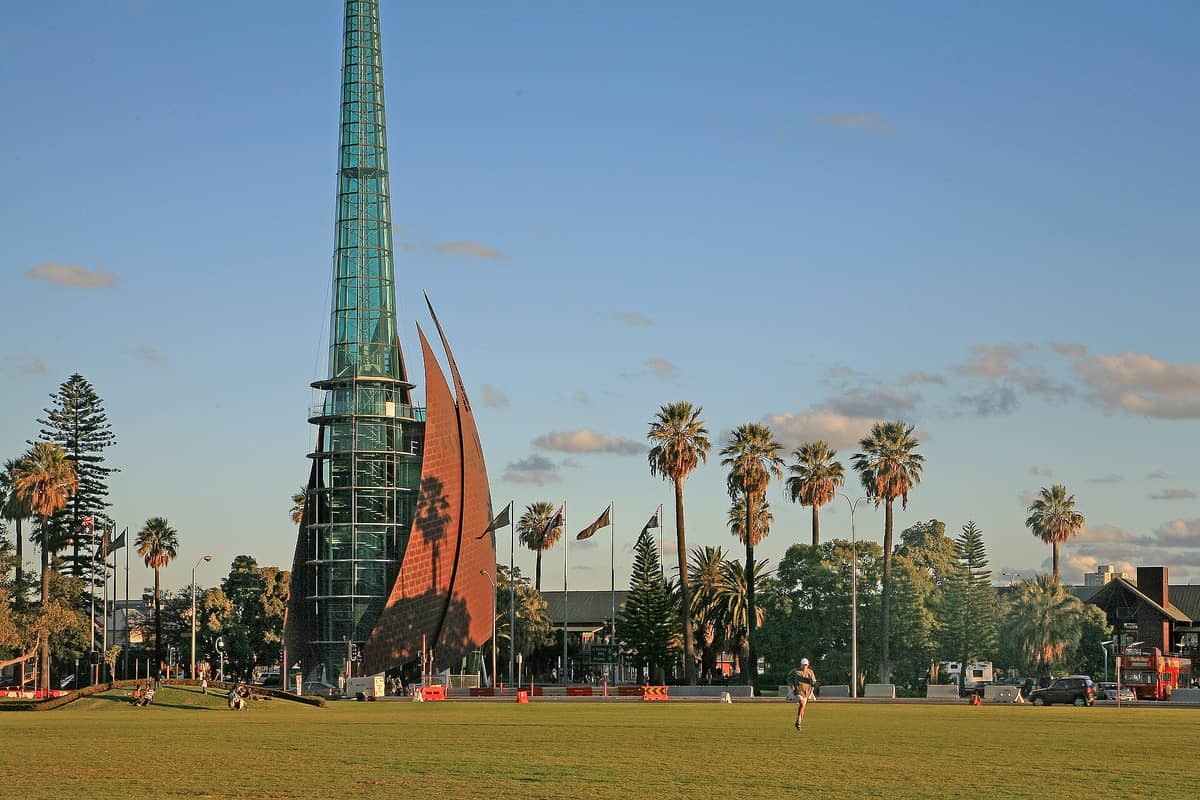
What Is The Bell Tower?
The Bell Tower, also marketed as the Swan Bells, is a purpose-built bell tower on the Swan River foreshore in Perth, Western Australia. Completed in 2000 to mark the new millennium, it was designed to house a remarkable gift: twelve bells from the London church of St Martin-in-the-Fields, eight of which date to the 17th century and are believed to have rung to mark the departure of the First Fleet to Australia in 1788. Combined with six locally cast bells, the tower now holds 18 bells in total, forming one of the largest sets of change-ringing bells in the world.
The structure itself is hard to miss. Rising 82.5 metres above the waterfront, its copper-and-glass spire tapers to a point against the Perth sky. At ground level, the base fans out in a triangular form clad in copper that weathers to a greenish patina. It is undeniably a statement building, and opinions on its aesthetics vary among Perth residents, but from the river or from the opposite bank at South Perth, it reads as a clear landmark.
💡 Local tip
The bells are rung by hand on Thursdays and Sundays. If hearing live change ringing is a priority, check the current ringing schedule on the official website before you visit, as times can shift.
The Bells Themselves: Why They Matter
Change ringing is a distinctly English tradition with roots going back to the early 17th century. Unlike carillon playing, where a single musician presses keys to play melodies, change ringing involves a team of ringers each controlling one bell, working through mathematical sequences called 'changes.' The discipline requires coordination, timing, and considerable physical effort. The bells at The Bell Tower weigh between 50 kg and 6.5 tonnes, and the largest takes real skill to control.
The provenance of the St Martin-in-the-Fields bells gives the collection genuine historical weight. St Martin-in-the-Fields, on Trafalgar Square in London, is one of England's most famous churches. When those twelve bells were gifted to Australia in 1988 as part of the Bicentenary celebrations, Western Australia eventually secured them for permanent display and active ringing. Bringing them to Perth took years of negotiation and planning before the tower opened in 2000.
Inside the tower, interpretive displays explain the history of the bells and the craft of change ringing clearly enough that visitors with no background in bell ringing leave with a genuine understanding. The exhibits include tactile elements and hands-on demonstrations, which makes this section particularly good for children and anyone who prefers learning by doing rather than reading panels.
Tickets & tours
Live prices and dates from our booking partner. If you book, we may earn a commission at no extra cost to you.
Visiting the Tower: Floor by Floor
Entry is through the ground floor, where you buy tickets and pick up any audio guide materials. The lift serves all publicly accessible floors and has automatic accessible doors, making the tower usable for visitors who cannot manage stairs. The lower levels focus on the historical and musical story of the bells, with display cases, timelines, and audio elements.
The ringing chamber is the visual centrepiece of any visit. When ringers are present, you can watch them work from a viewing position. Even on days without live ringing, the bells hang visibly within the chamber, and the sheer scale of the largest bell makes an impression. The acoustics in the chamber mean that during a ringing session, the sound is powerful. Hearing protection is available at the attraction, and it is worth taking up that offer if you are sensitive to loud sound or bringing children.
Upper floors offer progressively better views over the Swan River, Elizabeth Quay, and the CBD skyline. On a clear morning, the light on the water is particularly strong. The view north toward the city and south toward the Narrows Bridge and Kings Park gives useful spatial orientation to visitors still finding their feet in Perth. Photography through the glass requires care with reflections, but the upper outdoor or semi-open positions give cleaner shots.
The tower sits at the eastern end of Elizabeth Quay, a foreshore precinct redeveloped in the mid-2010s. After your visit, the waterfront path connects you directly toElizabeth Quay, where cafes, restaurants, and ferry connections to South Perth are a short walk away.
How the Experience Changes by Time of Day
The tower opens at 10:00 am daily, and the first hour after opening tends to be the quietest. Morning light from the east illuminates the copper exterior warmly, and the river is usually calm at that time, which makes for cleaner reflections if you are photographing the exterior. Arriving close to opening time on a weekday generally means small crowds and relaxed pacing through the exhibits.
Midday and early afternoon bring the peak visitor numbers, particularly during school holidays. If you are visiting with young children who need structured activity, this is fine. If you prefer a quieter experience, earlier is better. Late afternoon, approaching the 3:45 pm last entry, is typically quiet again, and the light on the river at that time of day has a warmer, lower angle, but you should not count on having time to linger if you arrive near the cutoff.
⚠️ What to skip
The Bell Tower is closed on Good Friday and Christmas Day, and opens at noon on ANZAC Day. Hours may also be reduced for private events. Confirm on the official website before making this the centrepiece of a day out.
Summer temperatures in Perth regularly exceed 35°C, and the glass-and-copper structure can become warm inside during the hottest part of the day. The building is air-conditioned, but arriving in the morning is more comfortable than visiting in the early afternoon heat of January or February.
Getting There and Getting Around Nearby
The Bell Tower sits on Barrack Square, Riverside Drive, on the Perth CBD waterfront. Elizabeth Quay Train Station and Busport is approximately 400 metres away, roughly a ten-minute walk along the foreshore path. This station is served by multiple Transperth rail lines connecting to the wider metropolitan network. The free Blue CAT bus, part of Perth's free inner-city bus network, stops at Barrack Square and is a convenient option if you are arriving from elsewhere in the CBD.
Limited paid parking is available in the surrounding area, but driving into this part of the CBD on a busy day is rarely the most efficient choice. For detailed route planning, use the Transperth journey planner. For broader orientation around the central city, thegetting around Perth guide covers transit options across the network.
The tower's waterfront location makes it a natural pairing with other nearby attractions.Elizabeth Quay is immediately adjacent. The Perth CBD extends north from Barrack Square, with the cultural precinct and Northbridge a short walk further.
Accessibility
The Bell Tower has a lift serving every floor, wheelchair-accessible automatic doors, and an accessible toilet on site. Tactile exhibits are incorporated into the displays. Guide dogs are welcome throughout the attraction. Hearing protection is provided for visitors who need it during ringing sessions. For visitors with sensory sensitivities, it is worth noting that live bell ringing is genuinely loud at close range, even with hearing protection.
Is The Bell Tower Worth Your Time?
For a general visitor on a tight two or three day itinerary, The Bell Tower is a reasonable hour's stop that combines waterfront scenery, architectural interest, and a slice of Anglo-Australian history that is genuinely not replicated anywhere else in the country. The combination of legitimate historical artefacts and a working bell ringing tradition lifts it above a purely decorative landmark.
It is not, however, a half-day attraction. Visitors who expect an exhaustive museum experience comparable to the WA Museum or an immersive cultural institution may find the content light. The appeal is strongest when a live ringing session is scheduled, and considerably thinner without one. If you are time-poor and have to choose between this and a longer experience like a visit to Kings Park or a ferry across to the South Perth foreshore, weigh your priorities accordingly.
Travellers planning a first trip to Perth can find The Bell Tower folded into broader itinerary suggestions in the 3 days in Perth itinerary. For visitors with more time, the one-week Perth itinerary places it in context alongside the city's other waterfront and cultural sites.
Who should skip it: travellers who have no particular interest in architecture, bells, or Anglo-Australian history and are prioritising beaches or natural landscapes will find their time better spent elsewhere. The Bell Tower is not the right first stop for families whose primary goal is outdoor or wildlife-based activity.
Insider Tips
- Check the ringing schedule on the official website before you visit. Without a live ringing session, the experience is shorter and notably quieter. Sunday mornings are a regular time to catch ringers in action.
- The Blue CAT bus is free and stops directly at Barrack Square. If you are already in the CBD and walking feels too hot, this is the easiest way to arrive without dealing with parking.
- For the cleanest exterior photographs, position yourself along the Elizabeth Quay boardwalk to the east in the morning when the sun is behind you and the copper spire is fully lit.
- Bring or buy hearing protection if you are visiting with young children or have sound sensitivity. The bells are significantly louder in person than any recording suggests, and the protection offered at the venue is basic foam.
- The tower's top floors give a useful bird's-eye read of the CBD street grid, the Swan River bends, and the position of Kings Park on the ridge to the southwest. Use it as an orientation tool at the start of a Perth visit rather than at the end.
Who Is Bell Tower (The Swan Bells) For?
- History and heritage travellers interested in the Anglo-Australian story
- Architecture enthusiasts curious about the millennium-era copper spire design
- Families with older children who engage with interactive and tactile exhibits
- First-time Perth visitors wanting a quick waterfront orientation with a view
- Anyone who wants to witness live English-style change ringing outside the UK
Nearby Attractions
Other things to see while in Perth CBD:
- Art Gallery of Western Australia
The Art Gallery of Western Australia (AGWA) is the state's premier public art institution, housed in a geometrically distinctive 1979 building at the Perth Cultural Centre. General admission is free, the permanent collection spans centuries of Australian and international art, and the gallery sits a short walk from Perth Train Station.
- Elizabeth Quay
Elizabeth Quay is a free public precinct on the Swan River foreshore in central Perth, opened in January 2016. It combines waterfront dining, public art, an inlet boardwalk, and ferry and train connections in a compact space that functions as both a local gathering point and a gateway into the CBD.
- His Majesty's Theatre
His Majesty's Theatre on Hay Street has anchored Perth's cultural life since opening on Christmas Eve 1904. Equal parts ornate Edwardian architecture and world-class performance venue, it rewards both theatre-goers and anyone curious about Western Australia's built heritage.
- London Court
Opened in 1937, London Court is a two-storey Tudor-revival arcade running through the heart of Perth's CBD, linking the pedestrian Hay Street Mall to St Georges Terrace. Free to enter and wheelchair accessible, it offers a striking architectural detour from the surrounding glass towers.
Planning a trip? Discover personalized activities with the Nomado app.