Art Gallery of Western Australia: Perth's Free Cultural Anchor
The Art Gallery of Western Australia (AGWA) is the state's premier public art institution, housed in a geometrically distinctive 1979 building at the Perth Cultural Centre. General admission is free, the permanent collection spans centuries of Australian and international art, and the gallery sits a short walk from Perth Train Station.
Quick Facts
- Location
- Perth Cultural Centre, Perth WA 6000 (Perth CBD)
- Getting There
- Walk from Perth Train Station via the pedestrian overpass; Blue CAT bus stops at the Museum on Beaufort Street
- Time Needed
- 1.5 to 3 hours (more if a ticketed special exhibition is on)
- Cost
- Free for general collection; special exhibitions may charge admission
- Best for
- Art lovers, rainy-day seekers, solo travellers, families with older children
- Official website
- artgallery.wa.gov.au
What the Art Gallery of Western Australia Actually Is
The Art Gallery of Western Australia, widely abbreviated to AGWA, is the state's oldest and largest public art institution. Founded in 1895, it moved into its current home on 2 October 1979, a building that still feels deliberate rather than dated. The collection covers Australian art from the colonial era to the present, a significant body of work by First Nations artists, and a selection of international pieces. For visitors passing through Perth, this is the single cultural institution most likely to reward a few unplanned hours.
The gallery sits inside the Perth Cultural Centre, a pedestrianised precinct that groups the state library, the WA Museum Boola Bardip, and several smaller arts organisations within a few minutes' walk of each other. This concentration makes it easy to combine visits without covering much ground.
⚠️ What to skip
Opening hours appear differently on different pages of the official website: the Plan Your Visit page states 10am–5pm daily, while the FAQ page indicates Wednesday–Monday with Tuesdays closed. Verify your intended visit day directly at artgallery.wa.gov.au before you go. The gallery is also closed Good Friday and Christmas Day.
The Building: Geometry as Architecture
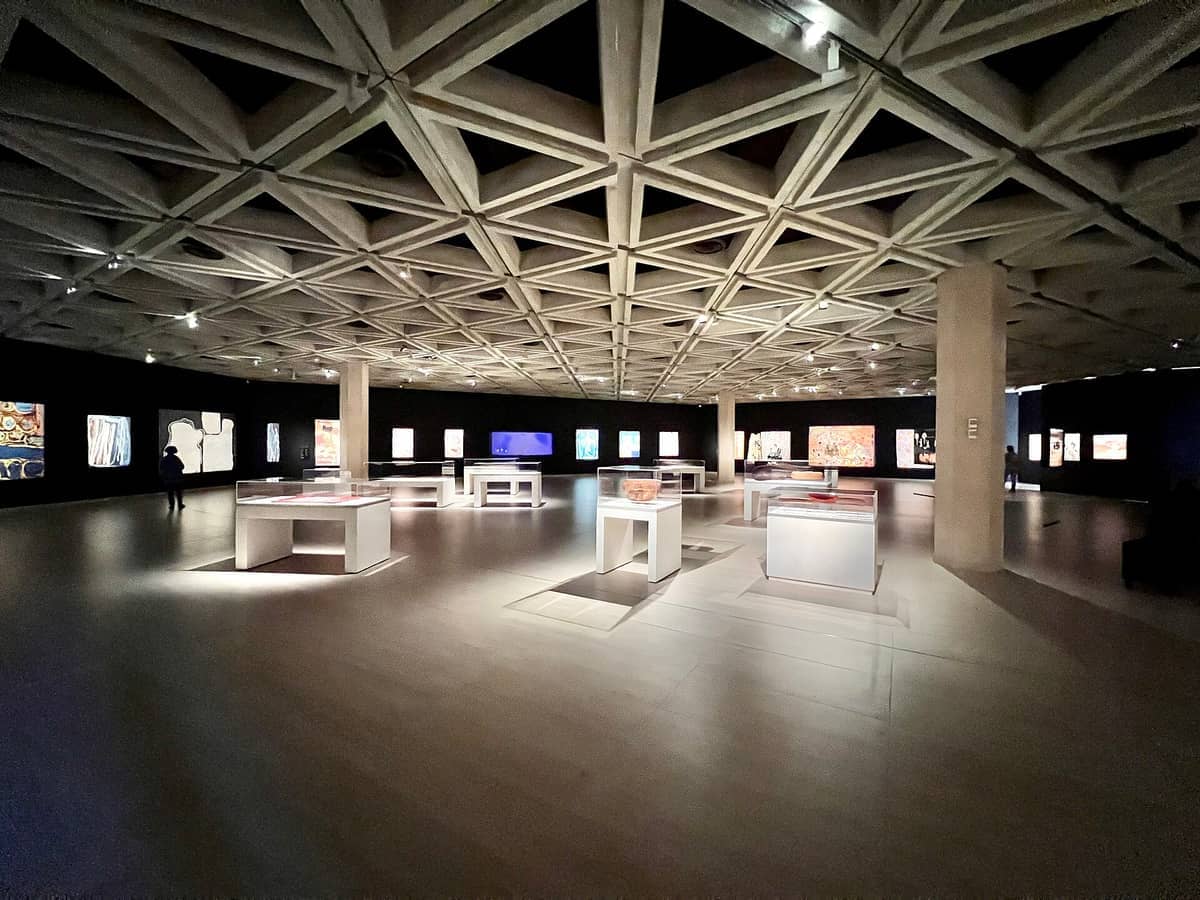
Most galleries are afterthoughts of their buildings. AGWA is not. The 1979 structure uses 120-degree angles throughout, and its modular wall lengths of 7, 14, and 21 metres create an interlocking rhythm that feels consistent from room to room. Natural light enters from above in several of the permanent galleries, which changes how paintings read at different times of day. Morning light in the main collection rooms is cooler and more even; by mid-afternoon, warmer tones filter in from the western aspects.
From the outside, the building reads as solid and restrained against the more ornate State Library behind it. The roofline is low enough that the space feels approachable rather than monumental. Inside, the gallery unfolds across multiple levels connected by three public lifts and staircases that open onto different parts of the collection without a single forced route through.
Tickets & tours
Live prices and dates from our booking partner. If you book, we may earn a commission at no extra cost to you.
The Bell Tower chiming experience
From 11 €Instant confirmationFree cancellationPinnacles and Swan Valley Full-day Guided Tour
From 201 €Instant confirmationFree cancellationPerth and Fremantle Guided Tour and Swan River Cruise
From 110 €Instant confirmationFree cancellationPerth and Fremantle Tour in German with Hotel Pickup
From 84 €Instant confirmationFree cancellation
The Permanent Collection: What to Prioritise
The permanent collection holds works spanning several centuries, but its greatest strength is Australian art from the late 19th century onward. Paintings by figures from the Heidelberg School appear alongside mid-20th century modernists and contemporary practitioners, making it possible to trace how Australian artists negotiated landscape, identity, and international influence over a long arc. The labelling is clear and contextual rather than academic.
The First Nations holdings deserve specific attention. AGWA has one of the more substantial collections of Aboriginal and Torres Strait Islander art in any Australian state gallery, and the works are displayed and contextualised with care. Visitors unfamiliar with the cultural traditions represented will find the interpretive text genuinely useful rather than tokenistic.
Decorative arts, jewellery, and craft objects occupy dedicated rooms that often get skipped by visitors focused on painting and sculpture. These are worth slowing down for: several pieces in the decorative collection are among the most technically precise objects in the building.
If your time is limited, check the current exhibition schedule on the official website before arriving. Special exhibitions rotate several times a year and occasionally draw works from international collections that would otherwise require travel to see. Ticketed exhibitions are typically priced separately from the free permanent collection. For a broader picture of Perth's cultural institutions, thePerth museums guide covers what each major venue does best.
How the Experience Changes by Time of Day
Arriving at opening, around 10am, gives you the gallery at its quietest. School groups typically arrive mid-morning and can fill certain rooms between roughly 10:30am and noon. If you are visiting during the school term and want contemplative space around the permanent collection, arriving right at 10am or after 2pm is the more reliable strategy.
Midday is the gallery's peak period for casual visitors moving through the Cultural Centre precinct. The café area near the entrance becomes occupied, and the ground-floor spaces feel livelier. This is not a problem if you are visiting with children or prefer some ambient energy around you.
Late afternoon, in the final hour before closing, the light in the upper galleries takes on a warmer quality and visitor numbers thin noticeably. If you are particularly interested in how natural light affects painting, this is the time to revisit any rooms you covered earlier. The gallery does not rush visitors out abruptly at 5pm, but staff begin moving through the galleries shortly before closing.
💡 Local tip
On days above 38°C in Perth's summer, the gallery becomes a genuinely useful retreat with consistent air conditioning throughout. Plan outdoor sightseeing in the morning and save AGWA for the hottest part of the afternoon.
Getting There and Getting Around Inside
The most straightforward approach is via Perth Train Station. A pedestrian overpass connects the station directly to the Cultural Centre precinct, which puts you about a two-minute walk from the gallery entrance. The Blue CAT bus service, which is free to ride, stops at the Museum on Beaufort Street, placing you at the north end of the Cultural Centre. Paid parking is available in Cultural Centre car parks and near the State Library, though on weekday mornings these fill quickly.
For visitors combining the gallery with other nearby cultural stops, the Perth Cultural Centreis the natural hub. The WA Museum Boola Bardip is the most substantial pairing: AGWA is free for the permanent collection and Boola Bardip charges A$15 for adult general admission; together they cover a full day without backtracking.
Inside the gallery, three public lifts serve all floors. Free manual wheelchairs, walking frames, and an electric buggy are available from reception; the electric buggy requires 24 hours' advance notice. Accessible toilets are on multiple levels. ACROD parking is available in the Cultural Centre car parks.
Photography and Practical Notes
Photography of the permanent collection is generally permitted for personal, non-commercial use, though individual works may be restricted due to copyright. Look for posted notices at room entrances, and when in doubt, ask at the information desk rather than assume. Flash is not permitted anywhere in the gallery. The natural-lit rooms on the upper levels photograph well in morning light; avoid photographing through glass cases without adjusting your angle to reduce reflection.
The gallery has a shop near the entrance that stocks catalogues, art books, and a curated selection of prints and objects. It is worth a look even if you are not buying: the stock tends to reflect the current exhibition program and gives a useful preview of what is on before you enter the galleries.
Perth's summer heat (mean maximums of 31.4°C in January and 31.7°C in February, per Bureau of Meteorology long-term averages) makes indoor attractions more attractive than in other cities. If you are structuring a day that starts with outdoor time, theElizabeth Quaywaterfront is a 15-minute walk south and worth doing before the heat peaks. Return to AGWA for the afternoon.
Who This Attraction Suits and Who It Might Not
AGWA works well for travellers who want substantive cultural content without paying entry fees, visitors sheltering from extreme heat or rain, and anyone curious about how Australian artistic identity developed from the colonial period onward. The First Nations collection is genuinely worth time even for visitors with little prior exposure to the subject.
Travellers looking primarily for interactive, hands-on experiences or those travelling with young children who need movement may find the gallery's pace frustrating. ThePerth with kids guidehas alternatives better suited to younger visitors. Equally, if your time in Perth is short and you are weighing one cultural stop against another, check what special exhibition is currently on: a strong ticketed show can tip the balance significantly.
The gallery is not particularly photogenic from the outside, and visitors primarily motivated by social-media-friendly architecture may prefer the visual drama of Matagarup Bridge or the Kings Park DNA Tower. AGWA rewards attention paid to what is inside rather than what surrounds it.
Insider Tips
- Check the special exhibitions calendar before visiting rather than after: some ticketed shows run for only a few weeks, and discovering one has just closed is genuinely disappointing. The website updates the calendar in advance.
- The upper-level galleries get significantly quieter by 3pm on weekdays. If you want the permanent collection largely to yourself, skip the lunchtime peak and return mid-afternoon.
- The free Blue CAT bus loops through Northbridge and the Cultural Centre precinct, which means you can connect to dining and café options in Northbridge without walking far after a long gallery visit.
- If you need the electric accessibility buggy, book it at least 24 hours ahead through the gallery's reception. Turning up without a booking means it may not be available.
- The gallery's shop stocks exhibition catalogues from past shows at reduced prices. If you missed a previous exhibition that interests you, the catalogue often remains available long after the show has closed.
Who Is Art Gallery of Western Australia For?
- Art and culture travellers wanting serious collection depth at no entry cost
- Visitors seeking relief from Perth's summer heat in a cool, spacious indoor environment
- Travellers interested in First Nations Australian art and cultural context
- Solo travellers who prefer to move at their own pace through a well-labelled collection
- Anyone building a full cultural day alongside the WA Museum Boola Bardip next door
Nearby Attractions
Other things to see while in Perth CBD:
- Bell Tower (The Swan Bells)
The Bell Tower on Barrack Square houses one of the world's largest musical instruments: a set of 18 bells including 12 historic bells from St Martin-in-the-Fields in London. With river panoramas, hands-on exhibits, and live ringing sessions, it earns its place on the Perth CBD waterfront.
- Elizabeth Quay
Elizabeth Quay is a free public precinct on the Swan River foreshore in central Perth, opened in January 2016. It combines waterfront dining, public art, an inlet boardwalk, and ferry and train connections in a compact space that functions as both a local gathering point and a gateway into the CBD.
- His Majesty's Theatre
His Majesty's Theatre on Hay Street has anchored Perth's cultural life since opening on Christmas Eve 1904. Equal parts ornate Edwardian architecture and world-class performance venue, it rewards both theatre-goers and anyone curious about Western Australia's built heritage.
- London Court
Opened in 1937, London Court is a two-storey Tudor-revival arcade running through the heart of Perth's CBD, linking the pedestrian Hay Street Mall to St Georges Terrace. Free to enter and wheelchair accessible, it offers a striking architectural detour from the surrounding glass towers.
Planning a trip? Discover personalized activities with the Nomado app.