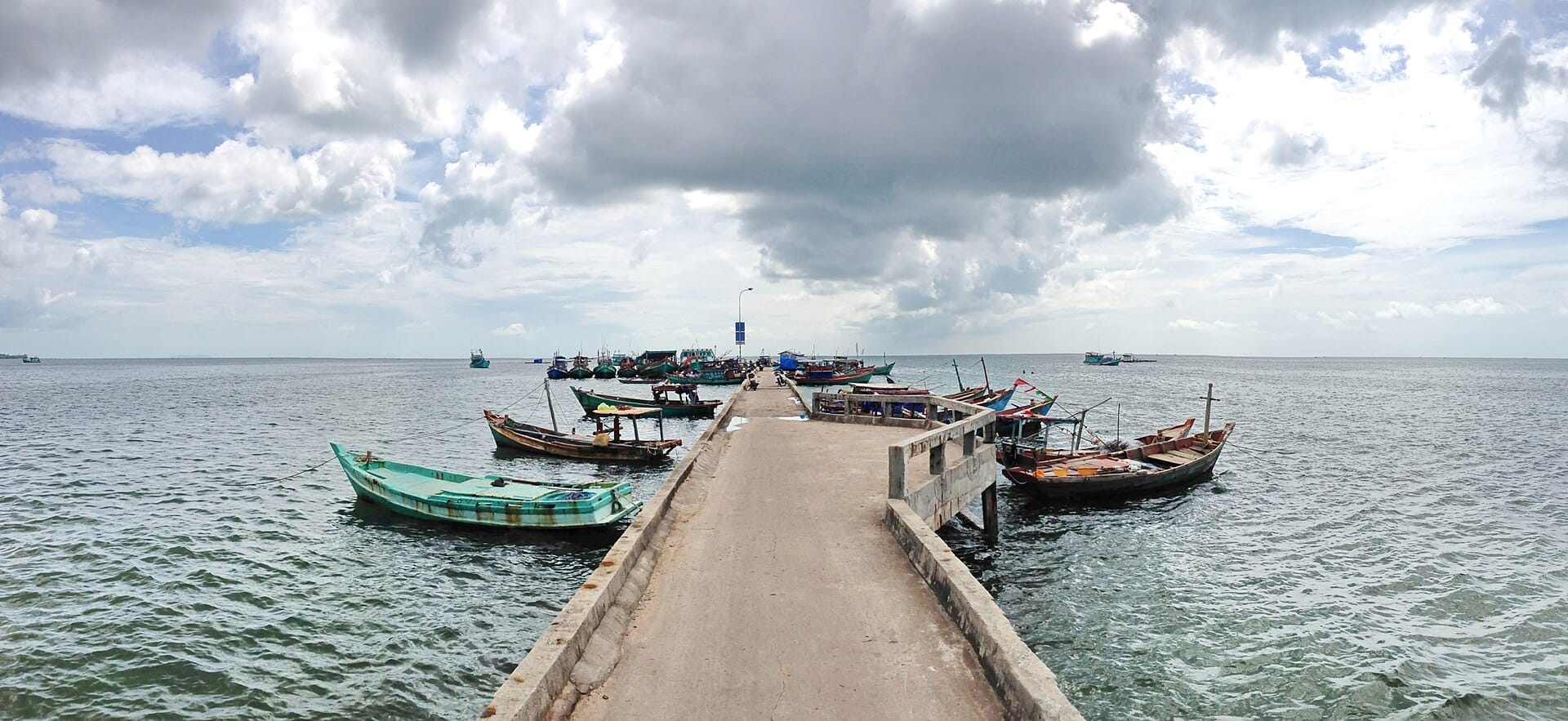
Ham Ninh sits on Phu Quoc's central-east coast, a working fishing village that predates the island's tourism boom by centuries. It offers a quieter, more grounded side of the island: fresh crab pulled straight from the sea, weathered wooden jetties, and a pace of life that hasn't changed much in decades.
Ham Ninh is where Phu Quoc shows its older face. Stretched along a shallow bay on the island's east coast, this fishing village of stilt houses and seafood shacks operates on tidal rhythms rather than tourist schedules, making it one of the few places on the island where local life genuinely outweighs the spectacle put on for visitors.
Orientation
Ham Ninh occupies a curved bay on the central-east coast of Phu Quoc, roughly 15 kilometers from Duong Dong town and about 25 kilometers from the international airport. The village faces east toward the sea, and on clear days you can see the silhouettes of the Cambodian coastline across the water. The bay is shallow and calm, protected from the open Gulf of Thailand swells that shape the beaches on the west side of the island.
The main road running north-south along Phu Quoc's spine connects Ham Ninh to both Duong Dong in the north and An Thoi in the south. A single turn-off leads east down to the waterfront, where the village proper sits on a narrow strip between the road and the sea. The jetty area is the social and commercial heart: wooden platforms extend over the water, boats dock and depart throughout the day, and the seafood restaurants that made Ham Ninh famous line the waterfront end to end.
Travelers using Ham Ninh as a base for island exploration will find it reasonably well-positioned. An Thoi port is about 20 kilometers south, which is the departure point for the Hon Thom cable car and island-hopping tours. Duong Dong, the island's main commercial center, is reachable in around 25 minutes by scooter heading north on the central highway.
Character and Atmosphere
Ham Ninh doesn't perform for visitors. That's the first thing you notice when you arrive. The village wakes early, around 5am, when the fishing boats return from overnight trips and the docks fill with the noise of engines, ice, and the thud of fish being transferred into crates. By 7am the catch is sorted, sold, and moving inland. The waterfront smells like salt and diesel and something vaguely marine, and the light at that hour comes in low and gold off the flat water.
By mid-morning the village quiets significantly. The boats are gone or moored, the fishermen are resting, and the restaurant owners are prepping for the lunch crowd. This is a good time to walk the wooden jetties without competition, or to sit at one of the low plastic tables near the water with a glass of iced coffee and watch the mangrove-fringed shore to the north. The heat by midday is serious in the dry season, and the east-facing orientation means the village gets afternoon shade earlier than the west-coast beaches.
Afternoons bring a different crowd. Day-trippers from the resort strip on Long Beach arrive by taxi or rented scooter, mostly for lunch or an early dinner, and the waterfront restaurants fill up. The atmosphere shifts slightly toward tourism in these hours, but it never becomes overwhelming the way the Duong Dong night market can. By early evening the day-trippers leave, and Ham Ninh settles back into its own company. The sunsets here face east over the water toward the mainland, which means the colors are subtler than the dramatic western skies, but the quietude compensates.
ℹ️ Good to know
Ham Ninh is one of the oldest settlements on Phu Quoc, with records of habitation and fishing activity dating back several centuries. Its position on the calmer east coast made it a natural harbor for traditional wooden fishing boats that couldn't handle the open-sea conditions on the island's west side.
What to See and Do
The village itself is the main attraction at Ham Ninh fishing village. Walking the length of the waterfront jetty takes about 15 minutes at a slow pace and gives you the clearest picture of how the village functions: boats in various states of repair, nets spread out for mending, and the small shrines that fishermen maintain for safe passage. The stilt houses extend out over the water on the northern end of the jetty, some of them serving as family homes and others converted into simple seafood restaurants.
Beyond the waterfront, the village has a small temple and several back lanes worth wandering if you have time. The lanes are narrow, shaded by older trees, and noticeably cooler than the open waterfront. You'll pass modest homes with vegetable gardens, tethered dogs, and the occasional motorbike repair operation. This is ordinary Vietnamese island life, and the contrast with the manicured resort zones elsewhere on the island is instructive.
Ham Ninh is also a practical launchpad for the rest of the island's east coast. The Phu Quoc National Park begins just a few kilometers north, and the hiking and trekking trails accessible from that direction offer a very different Phu Quoc experience from the beach resorts. The park covers roughly 70% of the island's land area and provides the forested backdrop visible from the Ham Ninh waterfront.
Walk the full length of the waterfront jetty, best done before 9am or after 4pm
Watch the morning fish unloading from the dock area near the main restaurant strip
Explore the back lanes of the village away from the waterfront for a less photographed perspective
Use Ham Ninh as a base for scooter excursions north into the national park
Time a visit to coincide with low tide, when the bay floor exposes mudflats and wading birds
💡 Local tip
Arrive before 8am if you want to see the working fishing village in action. After 10am, most of the catch has been processed and the docks are quiet until the afternoon restaurant rush begins.
Eating and Drinking
Ham Ninh's food scene is genuinely one of its strongest draws, and the reason most day-trippers make the trip across the island. The specialty is freshly caught seafood, particularly crab, prepared simply: steamed, grilled, or stir-fried with minimal additions that let the quality of the product speak. The crabs from the shallow east-coast waters are widely considered among the best on the island, and the local claim that they taste different from anywhere else on Phu Quoc is not entirely without basis given the different coastal ecology.
The waterfront restaurants are all broadly similar in style: open-air wooden structures over or beside the water, plastic furniture, laminated photo menus, and tanks of live seafood near the entrance where you can point at what you want. Pricing is generally calculated by weight for the main seafood items. While costs have crept up with tourism demand, Ham Ninh still undercuts the resort-adjacent seafood restaurants significantly. A full meal of crab, grilled fish, vegetables, and rice for two people typically runs well below what the same meal would cost in Duong Dong or near Long Beach.
Beyond the seafood, there are a handful of small local eateries in the back lanes of the village serving rice and noodle dishes for residents rather than tourists. These are worth finding if you want something cheaper and more representative of everyday cooking. The village also has a few small convenience stores and a couple of spots where you can get Vietnamese iced coffee in the morning.
Steamed mud crab with salt, chili, and lime: the signature dish of Ham Ninh
Grilled squid served with local dipping sauce
Steamed clams and cockles, sold by the bowl at the simpler stalls
Fresh spring rolls and local vermicelli soups in the back-lane eateries
Phu Quoc fish sauce, available to buy from several small vendors near the waterfront
⚠️ What to skip
Seafood is priced by weight and menus don't always make this transparent. Before ordering crab or large fish, confirm the price per kilogram and the estimated weight of what you're selecting. This avoids bill surprises that are a common complaint from visitors to waterfront restaurants throughout Vietnam.
Getting There and Around
The most practical way to reach Ham Ninh from anywhere on Phu Quoc is by rented scooter. The road from Duong Dong town takes roughly 25 to 30 minutes heading south and then east along the central highway, with a clearly marked turn-off toward the coast. The road into the village is straightforward and well-maintained as far as the waterfront parking area.
Taxis and app-based ride services operate on Phu Quoc, and most will make the trip to Ham Ninh without issue. The fare from Long Beach or Duong Dong is moderate, and for a day trip involving a meal, splitting a taxi round-trip is a reasonable option. There is no public bus service that runs directly to Ham Ninh's waterfront, so independent arrival either requires a motorbike or a hired vehicle.
For visitors interested in combining Ham Ninh with other east-coast or southern experiences, a scooter loop makes good sense. You could ride south from Ham Ninh toward An Thoi, then catch the Hon Thom cable car and return north via the west coast to see Long Beach in the late afternoon. This loop covers the geographic variety of the island without excessive backtracking and takes a full day at a comfortable pace.
For general guidance on getting around the island, the getting around Phu Quoc guide covers scooter rental, taxi apps, and road conditions in detail.
Where to Stay
Ham Ninh is not a primary accommodation hub in the way that Long Beach or Ong Lang are. There are no large resorts here, and the accommodation options are modest by any measure: a handful of guesthouses and homestays that serve travelers who specifically want to wake up in a fishing village rather than a resort compound. For those visitors, the trade-off is worth it. The mornings in Ham Ninh are genuinely different from anything on the west coast.
Most visitors to Phu Quoc use Ham Ninh as a half-day or full-day excursion from a base elsewhere. If you're deciding where to stay on the island overall, the Phu Quoc accommodation guide maps out the differences between the main zones, including the quieter beach areas at Ong Lang, both of which make convenient bases for a Ham Ninh day trip.
Travelers who do choose to stay in Ham Ninh should be aware that the village has limited evening entertainment and the road connections at night are dark and relatively quiet. The reward is access to the early morning fishing activity that day-trippers miss entirely, and a quality of quiet that is increasingly rare on an island that has been developed at pace over the past decade.
TL;DR
Ham Ninh is Phu Quoc's most authentic surviving fishing village, best experienced in the early morning before the day-trip crowd arrives from the west-coast resorts.
The seafood, particularly steamed mud crab, is genuinely excellent and noticeably cheaper than equivalent restaurants near Long Beach or Duong Dong.
Getting there requires a scooter or taxi, and there is no direct public transport from the main resort zones.
Accommodation options are limited and modest, making Ham Ninh better suited as a half-day or full-day excursion than a base.
Best for: travelers who want to see how Phu Quoc looked before the resort boom, food-focused visitors, and anyone willing to get up early for the morning fishing dock activity.
Phu Quoc has two distinct seasons: a dry season from November to April, which offers the most reliable conditions for beaches and water activities, and a rainy season from May to October, which brings fewer crowds and lower prices but less predictable weather and sometimes rough seas.
Phu Quoc has no island-wide public bus network. Getting around means choosing between motorbike rental, Grab, metered taxis, VinBus on specific routes, or hiring a private driver. This guide explains each option with honest advice on what works where.
Phu Quoc has beaches spread around the island with very different characters. Sao Beach delivers the most photogenic white sand. Long Beach is the most convenient. Ong Lang offers rocky coves and a quieter atmosphere. This guide compares each main beach to help you choose based on your priorities.
The An Thoi archipelago sits south of Phu Quoc and contains around 20 small islands in the Gulf of Thailand. Day tours depart from An Thoi pier and visit several islands for snorkeling, swimming, and lunch. This guide covers what to expect, how to choose a tour, and the best conditions for going.
Phu Quoc's main draws span beaches, a large national park, island hopping, a wartime prison museum, a night market, and an entertainment cluster in the north. This guide covers the island's key attractions across all categories, with honest notes on what each involves and who it suits.
Phu Quoc has no island-wide public transport, so where you stay determines your daily logistics. Duong Dong is the most central base. Long Beach covers the widest range of accommodation. Ong Lang suits eco-resort travelers. The Ganh Dau north and An Thoi south are best if you're visiting the Vinpearl complex or Sunset Town specifically.