Zhujiajiao Ancient Water Town: Shanghai's Canal Town Worth the Journey
Zhujiajiao Ancient Water Town sits in Qingpu District, about 45 to 50 kilometers west of central Shanghai, preserving a network of Ming and Qing dynasty canals, stone bridges, and whitewashed lane houses that the urban core long ago erased. Entry to the town streets is free, the boat rides are short and memorable, and the crowds are manageable if you time your visit right.
Quick Facts
- Location
- No. 555 Kezhiyuan Road, Zhujiajiao Town, Qingpu District, Shanghai
- Getting There
- Shanghai Metro Line 17 to Zhujiajiao Station, then walk or short local ride to the town entrance
- Time Needed
- 3 to 5 hours for a thorough visit; half a day recommended from central Shanghai including transit
- Cost
- Town streets free; individual attractions CNY 10–20 each; combined ticket around CNY 60; boat rides extra
- Best for
- History lovers, photographers, day-trippers wanting a break from Shanghai's urban pace, families with older children
- Official website
- www.zhujiajiao.com/en
What Zhujiajiao Actually Is
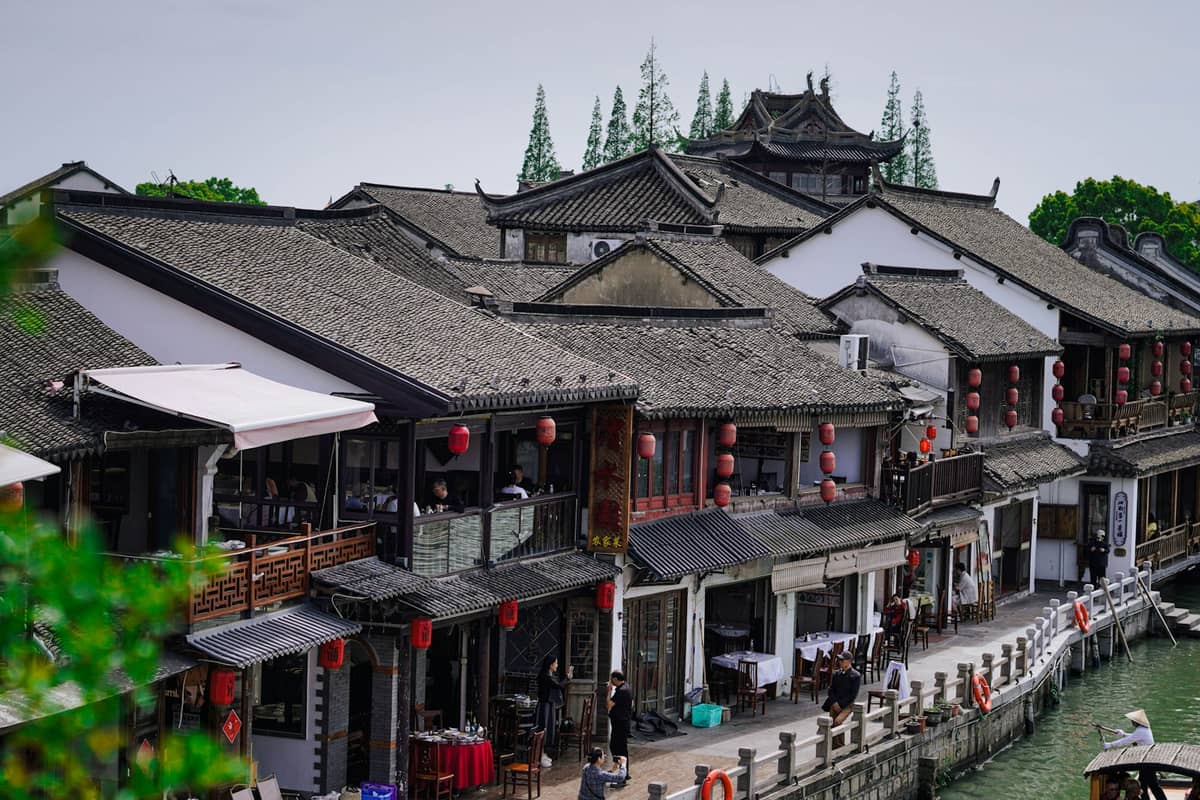
Zhujiajiao Ancient Water Town is a nationally designated historical and cultural town in Qingpu District, roughly 45 to 50 kilometers west of central Shanghai. It sits at the edge of Dianshan Lake, threaded by canals that were once the commercial arteries of a prosperous river trading community. The town was first listed as a Shanghai Historical and Cultural Town in 1991, earned National AAAA-Level Tourist Attraction status in 2004, and was included in the third batch of National Historical and Cultural Towns in 2007. That layered designation matters: unlike fully reconstructed 'ancient towns' elsewhere in China, significant portions of Zhujiajiao's street fabric, bridges, and lane houses are genuinely old, dating to the Ming and Qing dynasties.
The nickname 'Venice of Shanghai' gets applied to it frequently, and like most such nicknames it sets expectations that reality can only partially meet. There are no grand palazzos here. What you do get is something quieter and more authentic: a working town that has layered tourism over a lived-in historic core, where residents still hang laundry from windows above the waterways and fishing boats occasionally share canal space with tourist punts.
ℹ️ Good to know
The town streets and canals are free to enter at any hour, though the main tourist services follow daytime schedules. The paid attractions inside — Kezhi Garden, Yuanjin Zen Temple, the Qing Dynasty Post Office, and others — operate roughly 08:30 to 17:00. If you arrive after 16:00, you can still walk the streets and bridges but will miss most ticketed sites. Verify hours on the official site before visiting, as holiday schedules vary.
The Bridges: Zhujiajiao's Defining Feature
The town's most immediately striking feature is its stone arch bridges. Zhujiajiao has 36 of them in various styles, spanning canals of different widths. The largest and most photographed is Fangsheng Bridge, a five-arch granite structure completed in 1571 during the Wanli period of the Ming dynasty. It is wide enough for a small market to operate across it, which in warmer months it sometimes does. Standing on its highest arch at mid-morning, you look north and south along the main canal with whitewashed walls, black roof tiles, and wooden shopfronts reflected in the water below.
Smaller bridges — single-arch, mossy, barely wide enough for two people to pass — connect the narrower back lanes and are far less visited. If the main canal near Fangsheng Bridge feels crowded, following the waterway west on foot for ten minutes brings you to stretches where the foot traffic drops sharply and the architecture feels less curated.
Tickets & tours
Hand-picked options from our booking partner. Prices are indicative; availability and final rates are confirmed when you complete your booking.
Shanghai city and Zhujiajiao water town private tour with lunch
From 371 €Instant confirmationFree cancellationShanghai private tour with iconic landmarks of the old and new city
From 284 €Instant confirmationFree cancellationShangai Yuyuan Garden entrance tickets
From 9 €Instant confirmationFree cancellation
How the Town Feels at Different Hours
Early morning, around 08:00 to 09:00, is when Zhujiajiao is at its most honest. Shop owners are setting up stalls of rice cakes, dried meats, and local snacks. The smell of sesame oil from a brazier on Caizhi Street cuts through the cool air. The canal light at this hour is flat and grey, which is actually ideal for photography because it eliminates the harsh reflections and shadow contrast that make midday shots harder to work with.
By 10:30 on a weekend, the dynamic shifts considerably. Tour groups arrive from Shanghai in waves, and the main streets near Fangsheng Bridge become genuinely congested. The souvenir stalls amplify their audio loops, and queues form for the most popular snack vendors. This is not a crowd-free experience at peak times, and anyone expecting the quiet of a Tuesday morning on a Saturday afternoon will be disappointed.
Weekday visits between September and November offer the most comfortable balance. The weather is mild, the humidity drops from summer highs, and school groups are in session. If a weekend is your only option, arriving before 09:00 and heading to the back lanes west of the main commercial strip buys you at least an hour of relative calm before the main wave arrives.
💡 Local tip
Avoid visiting on national public holidays, particularly Golden Week in early October. The town receives visitor numbers that make comfortable exploration nearly impossible. If you visit in summer (June to August), expect high humidity, temperatures above 32°C, and afternoon thunderstorms. Bring water, a fan, and light clothing.
Paid Attractions Inside the Town
The paid sites inside Zhujiajiao each require a separate ticket unless you buy the combined pass, which covers several attractions for around CNY 60. The combined ticket generally represents better value if you plan to see more than two sites.
Kezhi Garden (currently around CNY 20) is a classical Jiangnan scholar's garden from the Qing dynasty, compact but carefully proportioned, with rockeries, pavilions, and a koi pond. It provides a rare moment of quiet even when the surrounding streets are crowded. Yuanjin Zen Temple (around CNY 10) is an active Buddhist temple dating to 1341, during the Yuan dynasty — one of the oldest structures in the region. The incense smoke that drifts through the main hall is thick enough to notice from the entrance gate. The Qing Dynasty Post Office (around CNY 10 to 15) is one of the oldest remaining post offices in China and is worth the small entrance fee as a genuinely unusual historical artifact.
Boat rides on the canals are available separately from the main ticket, typically in traditional wooden punts poled by local boatmen. The standard route runs roughly 20 minutes through the main canal. The experience is pleasant, the perspective from water level is different from anything you get on foot, and the price is not steep, though you should confirm current rates at the dock. Skip it only if crowds have made the canal itself busy with boats, at which point the romantic aspect diminishes.
Getting There from Central Shanghai
The most straightforward route is Shanghai Metro Line 17 to Zhujiajiao Station. Line 17 runs from Hongqiao Railway Station in western Shanghai out to Qingpu District, and the journey takes roughly 40 to 50 minutes from Hongqiao. From central locations like People's Square, factor in a transfer and allow about 60 to 75 minutes total travel time each way. From Zhujiajiao Station, the ancient town entrance is accessible by foot (around 20 minutes) or a short local bus or taxi ride.
An alternative is the tourist bus (Zhuhu Special Line) that departs from near People's Square in the Pu'an Road and Jinling Road area. It takes longer than the metro but drops visitors closer to the town entrance. If you are combining Zhujiajiao with other suburban or water town destinations, check the Shanghai water towns guide for route combinations that make sense geographically.
Driving or taking a Didi ride-hailing car is convenient if you are in a group, since the parking situation near the town entrance is manageable outside of peak holiday periods. Solo travelers will find the metro the simplest option. Taxis from central Shanghai to Zhujiajiao run considerably more expensive than the metro and are subject to expressway toll charges.
⚠️ What to skip
Metro Line 17 timetables and first/last train times should be confirmed before your visit, particularly if you plan to stay into the evening. Missing the last train leaves you with a taxi fare back to central Shanghai that will be significantly higher than expected.
Food, Shopping, and What to Buy
The main commercial street sells the same category of items you find in most historic towns across China: dried meats, local rice wine, sesame cakes, and handicrafts. Zhujiajiao does have some locally specific items worth looking for. Zongzi (sticky rice wrapped in bamboo leaves) made fresh on the street are worth trying hot. The town also has a small reputation for its river shrimp, served simply fried at the canal-side restaurants.
Restaurants along the canal cater broadly to tourists, with menus in Chinese and sometimes English. Prices are higher than equivalent food in Shanghai's outer neighborhoods but not unreasonable. If you are visiting in autumn, the hairy crab season overlaps with Zhujiajiao's most comfortable weather — the Shanghai hairy crab guide gives context on what to look for and where quality matters.
Photography and Practical Details
The best photography light in Zhujiajiao falls in the first two hours after sunrise and the hour before sunset. The main canal near Fangsheng Bridge reflects the bridge arches cleanly in calm water in the early morning, before boat traffic stirs the surface. The back lanes, with their whitewashed walls, wooden doors, and occasional potted plants, work well in overcast light, which Zhujiajiao's climate provides frequently from November through March.
For a broader understanding of how Zhujiajiao fits into Shanghai's photographic geography, the best photo spots in Shanghai guide covers perspectives across the city and its day-trip range.
On accessibility: the town's stone bridges have steps, and the canal-side paths are uneven in places. Cobbled lanes are common throughout. Wheelchair users will face significant challenges, and pushchairs with young children require extra care on the bridge stairs. There is no detailed accessibility map published by the official site; visitors with mobility requirements should contact local tourism services in advance. The core plaza areas near the main entrance are flat and manageable, but the most visually rewarding parts of town involve uneven ground.
Wear comfortable, flat-soled shoes with grip. In wet weather the stone surfaces become slippery quickly, and the most atmospheric lanes are also the ones most prone to puddles after rain. A compact umbrella is useful year-round.
Who Should Skip Zhujiajiao
Travelers with very limited time in Shanghai and a preference for concentrated urban experiences may find the 60 to 90 minutes of transit each way hard to justify. The town is genuinely interesting, but it is not a substitute for the depth of Shanghai's urban core. If your visit to Shanghai is two days or fewer, the time may be better spent in the city itself.
Visitors who have already explored multiple Jiangnan water towns — Tongli, Wuzhen, Xitang — will find Zhujiajiao covers familiar ground. It is smaller and more accessible than some of its rivals, which makes it ideal as a first water town experience, but it offers less variety than a multi-town itinerary. The day trips from Shanghai guide lays out how to compare options based on distance, character, and available time.
On crowded weekend days, visitors who are sensitive to noise and density will find the main commercial strip stressful rather than enjoyable. The back lanes offer relief, but reaching them requires deliberately navigating away from the signposted tourist circuit.
Insider Tips
- Walk west along the north canal bank past the main tourist cluster and you reach residential streets where the foot traffic drops by two-thirds within ten minutes. The architecture here is as old, the canal views are comparable, and the souvenir sellers disappear entirely.
- The combined ticket covering multiple internal attractions is sold at booths near the main entrance plaza, but you can also buy individual tickets at each site. If you are unsure how many you want to visit, buy individually rather than committing to the bundle upfront.
- Yuanjin Zen Temple sees fewer visitors than Kezhi Garden despite being historically older. Arriving there before 10:00 on a weekday often means you have the main courtyard essentially to yourself during morning prayer time, which is the most atmospheric hour to visit.
- Fangsheng Bridge is best photographed from canal level, not from the bridge itself. Walk down the stone steps to the waterfront on either bank and frame the arches from a low angle. Most visitors photograph from the top and get the same shot.
- Metro Line 17 is the locals' route; the tourist bus from People's Square deposits large tour groups directly at the entrance simultaneously. If crowd minimization matters to you, the metro is the better choice even if it requires a short onward transfer.
Who Is Zhujiajiao Ancient Water Town For?
- First-time visitors to a Chinese water town who want accessible history without a long journey from Shanghai
- Photographers looking for canal reflections, stone bridges, and Jiangnan architectural detail in diffuse morning light
- Travelers pairing a half-day in Zhujiajiao with an afternoon back in Shanghai on a single itinerary day
- Families with older children who can navigate uneven stone paths and will enjoy the boat ride on the canals
- Autumn visitors timing the trip to overlap with mild weather and, if interested, the hairy crab season in Qingpu
Nearby Attractions
Combine your visit with:
- Chongming Island
Chongming Island sits at the mouth of the Yangtze River, a vast alluvial island that functions as Shanghai's rural counterweight. Wetland reserves, a national forest park, cycling paths through farmland, and virtually no high-rises make it a genuinely different Shanghai experience.
- ERA Acrobatics Show
Running nightly at Shanghai Circus World in Jing'an District, ERA2 – Spirit of Shanghai is the city's flagship acrobatics production. Expect gravity-defying stunts, dramatic lighting, and a 60-to-100-minute show that needs no translation. Here is everything you need to know before buying a ticket.
- Jade Buddha Temple
The Jade Buddha Temple (玉佛禅寺, Yùfó Chán Sì) is one of Shanghai's most significant active Buddhist monasteries, housing two exceptional jade Buddha statues brought from Burma in the late 19th century. Unlike many temples that have become purely ceremonial attractions, this one functions as a working monastery, with monks in residence and daily rituals that visitors can witness firsthand.
- Jinshan City Beach
Jinshan City Beach (金山城市沙滩景区) is a man-made coastal resort on Hangzhou Bay, about 60 km south of central Shanghai. It is the closest thing to a genuine beach day the city offers, with designated swimming zones, a long promenade, and seasonal facilities. This guide covers what to realistically expect, when to go, and how to get there.