Yongsan Electronics Market: Seoul's Tech Bazaar Worth Exploring
Yongsan Electronics Market is Seoul's sprawling hub for consumer electronics, computer components, cameras, and second-hand tech. Spread across several interconnected buildings in Yongsan-gu, it rewards patient shoppers who know how to navigate it, but can feel overwhelming and dated to those expecting a polished retail experience.
Quick Facts
- Location
- 134 Cheongpa-ro, Yongsan-gu, Seoul (우편번호 04372)
- Getting There
- Yongsan Station (Line 1 / Gyeongui-Jungang Line), Exit 3 — approx. 375 m walk
- Time Needed
- 1–3 hours depending on shopping goals
- Cost
- Free entry; individual purchases vary widely
- Best for
- Electronics shoppers, component hunters, tech enthusiasts, budget gadget seekers
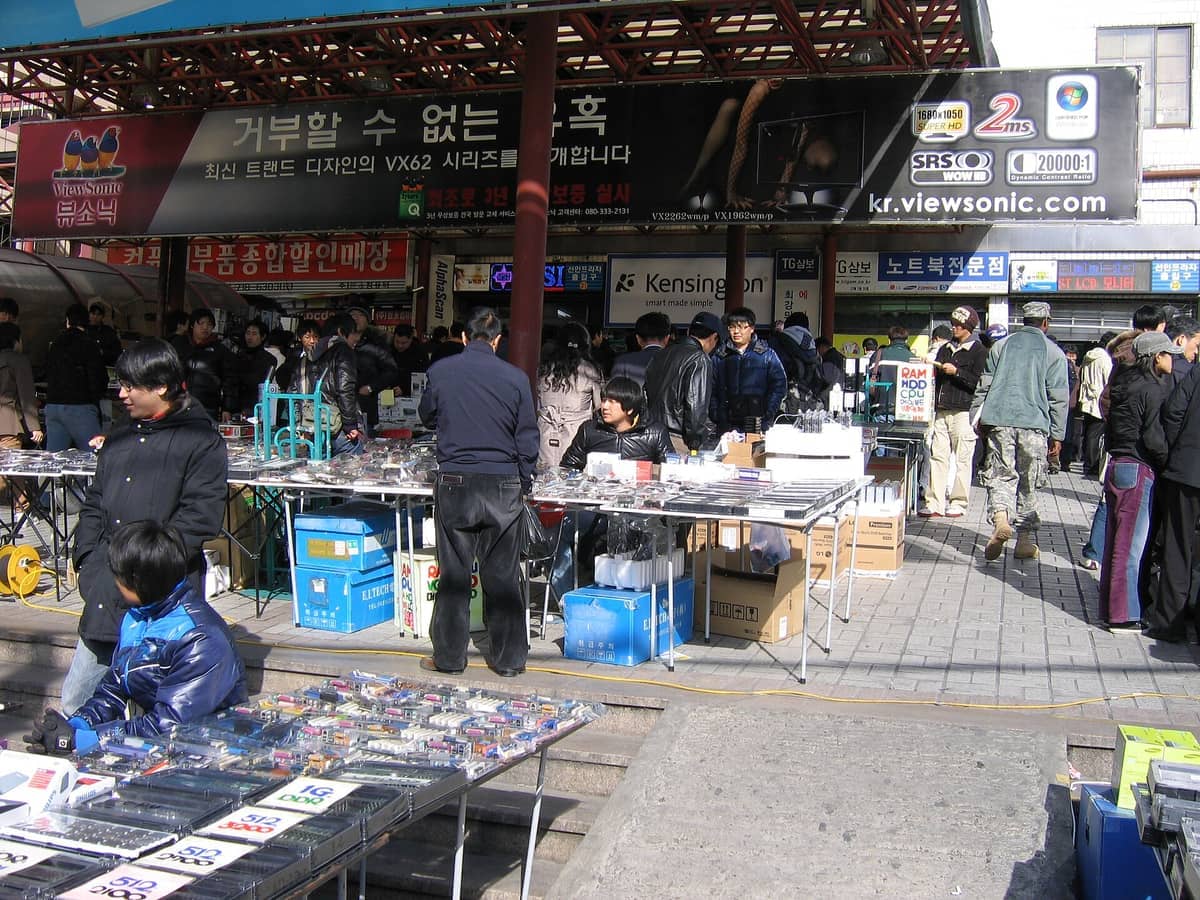
What Is Yongsan Electronics Market?
Yongsan Electronics Market (용산전자상가) is the collective name for a cluster of large retail buildings in Yongsan-gu that together form Seoul's most concentrated hub for electronics, computer hardware, peripherals, cameras, cables, and second-hand tech. It is not a single shop or a curated department store. It is closer in structure to a wholesale bazaar: thousands of individually operated stalls and small shops stacked across multiple floors, each specializing in something different, from graphics cards and gaming peripherals to vintage audio equipment and phone repair parts.
The scale can be disorienting at first. The market is spread across several distinct buildings including Jeonja Land, Najin, Seonin, and Wonhyo, connected by covered walkways and ground-level plazas., connected by covered walkways and ground-level plazas. Walking from one end to the other without stopping takes around fifteen to twenty minutes. With stops, the space expands considerably.
ℹ️ Good to know
Official hours: Weekdays 09:00–20:00, Weekends 09:00–18:00. Hours vary by individual store. The market is closed on the 2nd and 4th Sunday of every month. Confirm before visiting on a weekend.
The Atmosphere at Different Times of Day
Arriving just after opening, around 9:00–10:00 on a weekday, gives a particular window into how the market actually operates. Shop owners are arranging displays, delivery workers are moving stock on hand trolleys, and the fluorescent lighting of the upper floors hums to life gradually. At this hour, you can browse without pressure and have more focused conversations with vendors.
By midday on weekdays, foot traffic picks up noticeably with a mix of small business owners sourcing components, students looking for affordable laptops, and tourists doing reconnaissance. The ground-floor areas near the main entrances get congested with people stopping to compare prices on phones and accessories. The upper floors, particularly those dedicated to computer components and used equipment, stay comparatively quieter throughout the day.
Weekends see a different crowd: more casual shoppers, families, and younger visitors who have come specifically to browse gaming gear or find a deal on a used camera. The earlier closing time on weekends (18:00) means the last hour can feel rushed. If you are planning a serious purchasing trip, a weekday morning is the better window.
Tickets & tours
Hand-picked options from our booking partner. Prices are indicative; availability and final rates are confirmed when you complete your booking.
DMZ and Lake Majang Suspension Bridge Tour from Seoul
From 57 €Instant confirmationFree cancellationHalf Day DMZ Tour from Seoul, 3rd Tunnel, Observatory and More
From 47 €Instant confirmationFree cancellationSeoul zombie city exploration game and private tour
From 10 €Instant confirmationFree cancellationLuggage Storage in Seoul
From 7 €Instant confirmationFree cancellation
What You Can Actually Buy Here
The market's real strength is in specificity. For consumer electronics like smartphones, the prices are not always dramatically lower than elsewhere, and it is worth comparing against large chain electronics stores in the city before assuming Yongsan is cheapest. Where Yongsan genuinely stands out is in components, parts, and specialized equipment that simply are not stocked in mainstream retail.
Computer builders will find vendors selling individual RAM sticks, SSDs, cooling systems, and niche peripherals that require hunting elsewhere in most cities. Photographers can find used camera bodies and lenses at prices that vary significantly by stall, so comparison shopping across three or four vendors for the same model is standard practice. The cable and adapter section of the market is almost legendary among expats: if you need an obscure connector, a legacy port adapter, or a specific power converter, there is almost certainly a stall somewhere in Yongsan that has it.
Second-hand electronics occupy a significant portion of the market. Quality and condition vary. Some vendors deal exclusively in refurbished stock with basic warranties; others sell as-is. Ask directly about the return policy before paying, and if possible, test the item in the shop.
💡 Local tip
Bring a translation app. Most vendors in the component-heavy floors speak limited English, but many are accustomed to showing prices on a calculator and communicating through screens. Google Translate's camera mode works reasonably well for reading Korean product specifications.
Historical and Cultural Context
Yongsan's identity as an electronics district took shape during South Korea's rapid economic development in the 1980s and 1990s, when the country's electronics manufacturing sector was expanding and consumer demand for technology products was accelerating. The market became the physical address where that demand met supply, drawing vendors, importers, and hobbyists into a single concentrated zone.
By the 2010s, the rise of online retail and large electronics chains like Hi-Mart began changing the market's role. Foot traffic declined from its peak. Several buildings have undergone partial conversion or sit at reduced capacity compared to earlier decades. This context matters for visitors: Yongsan today is a working, living market, but it operates in the shadow of its own past scale. Some floors feel sparse, and a handful of buildings have noticeably more vacant stalls than others. That is not a reason to skip it; it is simply an honest picture of what to expect.
The neighborhood itself sits within the broader Yongsan-gu district, which also includes Itaewon, the area's internationally known dining and nightlife zone, and the War Memorial of Korea, one of the most significant historical museums in the city. Electronics Market visitors who build in extra time can combine both in a single half-day.
Getting There and Getting Around
The most straightforward approach is Yongsan Station on Seoul Metro Line 1 and the Gyeongui-Jungang Line. Exit 3 places you about 375 meters from the market entrance, a flat walk along a wide commercial street. The route is well-signed. Yongsan Station is also a major intercity rail hub, so visitors arriving from other Korean cities by KTX or ITX can walk directly to the market from the station without changing transport.
If you are coming from Itaewon, the walk takes roughly ten to fifteen minutes downhill. From the National Museum of Korea, which is a short distance south, the walk is under twenty minutes or a quick taxi ride. Bus routes also serve the area, though the station is generally the easiest orientation point for first-time visitors.
⚠️ What to skip
The market is closed on the 2nd and 4th Sunday of every month. This is easy to miss when planning, and arriving on a closure day means most stalls will be shut. Double-check the calendar before making a special trip.
Photography, Accessibility, and Practical Notes
Photography inside individual shops is generally tolerated in the browsing areas, but ask before pointing a camera directly at a vendor's pricing boards or inventory. The market itself, particularly the exterior plaza areas and signage-heavy corridors, makes for visually interesting documentary photography. The density of signs, cables, and display units creates an authentically chaotic visual texture that contrasts sharply with Seoul's newer, more designed retail spaces.
Accessibility information for Yongsan Station and the market buildings is not comprehensively documented in available official sources. Yongsan Station itself is a large station with elevator access on certain lines, but the internal layout of the older market buildings includes stairs and narrow corridors that may present challenges for visitors using wheelchairs or mobility aids. If accessibility is a concern, it is worth contacting the station or building management directly before your visit.
Yongsan is covered under the standard T-money card system. If you are still planning how to get around the city, the guide to getting around Seoul covers transit cards, subway lines, and bus routes in practical detail.
Is It Worth Your Time?
The honest answer depends entirely on what you are looking for. For tech enthusiasts, component hunters, camera buyers, and people who enjoy the experience of a market-style electronics bazaar, Yongsan offers something genuinely hard to replicate in a standard retail environment. The density of specialized knowledge concentrated in the vendors, the ability to physically handle and test equipment before buying, and the possibility of finding parts that do not exist in mainstream stores all give the market real value.
For general tourists with limited time and no specific purchasing goal, Yongsan is a lower priority. It is not a spectacle in the way that a traditional market like Gwangjang is, and it lacks the visual cohesion of newer commercial districts. Shoppers expecting deeply discounted prices on current-model flagship smartphones or tablets may find the market does not deliver that particular promise consistently.
If your Seoul itinerary is focused on culture, food, and city walks rather than electronics specifically, the time might be better spent at other destinations in the area. But if you are building a longer trip and want to see a different side of Seoul's commercial identity, there are ways to fold it into a broader Yongsan day that also takes in the neighborhood's other draws.
Insider Tips
- Prices on used electronics are rarely fixed. A polite, unhurried negotiation is accepted practice, especially if you are buying more than one item from the same vendor. Starting 10–15% below the listed price is reasonable.
- The upper floors of the older buildings tend to have more specialized and niche stock than the ground-level commercial floors, which skew toward accessories and consumer goods. If you are looking for components or professional equipment, go up first.
- Bring cash in Korean won. While many vendors accept card payments, some smaller stalls are cash-only, and having physical currency gives you more flexibility when negotiating.
- The market closes on the 2nd and 4th Sunday of every month. If your visit falls on a Sunday, verify which Sunday it is before making the trip a priority.
- A short taxi or subway ride from the market puts you at Itaewon for lunch or dinner. Planning an electronics morning followed by a meal in Itaewon is an efficient way to use the Yongsan area without backtracking.
Who Is Yongsan Electronics Market For?
- Computer builders and hardware enthusiasts looking for components and peripherals
- Photographers hunting for used camera bodies and lenses at negotiable prices
- Expats or long-term visitors needing specific adapters, cables, or tech accessories
- Budget-conscious travelers looking for second-hand devices with room to negotiate
- Curious travelers who want to see a working market-style electronics district rather than a polished retail experience
Nearby Attractions
Other things to see while in Itaewon & Yongsan:
- Seoul Central Mosque & Itaewon Mosque Area
Built in 1976, Seoul Central Mosque (서울중앙성원) is Korea's first and largest mosque, perched on a quiet hillside above Itaewon. Free to visit and architecturally striking against Seoul's skyline, it offers a genuinely contemplative experience alongside a neighborhood packed with halal restaurants and international culture.
- Leeum Museum of Art
Leeum Museum of Art in Hannam-dong brings together over 15,000 works spanning ancient Korean ceramics to contemporary global art, housed in three architecturally distinct buildings designed by some of the world's most recognized architects. It is a rare institution that rewards both first-time visitors and those who return with purpose.
- National Museum of Korea
The National Museum of Korea in Yongsan is South Korea's premier public museum and one of Asia's largest museums by floor area. Housing hundreds of thousands of artifacts across three floors of permanent galleries, it traces Korean civilization from the prehistoric era through the Joseon dynasty — and admission to the permanent collection is completely free.
- War Memorial of Korea
The War Memorial of Korea in Yongsan is one of Seoul's largest and most serious museums, covering the full arc of Korean military history from ancient conflicts through the Korean War and beyond. Admission is free, the outdoor displays alone take an hour, and the indoor galleries reward visitors who give it a full half-day.