War Memorial of Korea: Seoul's Most Sobering and Impressive Free Attraction
The War Memorial of Korea in Yongsan is one of Seoul's largest and most serious museums, covering the full arc of Korean military history from ancient conflicts through the Korean War and beyond. Admission is free, the outdoor displays alone take an hour, and the indoor galleries reward visitors who give it a full half-day.
Quick Facts
- Location
- 04353 29 Itaewon-ro, Yongsan-gu, Seoul
- Getting There
- Samgakji Station, Line 4, Exit 11 — 227 m walk
- Time Needed
- 2–4 hours; outdoor grounds alone take 60–90 minutes
- Cost
- Free admission
- Best for
- History enthusiasts, families, those interested in Korean identity and the Korean War
- Official website
- www.warmemo.or.kr
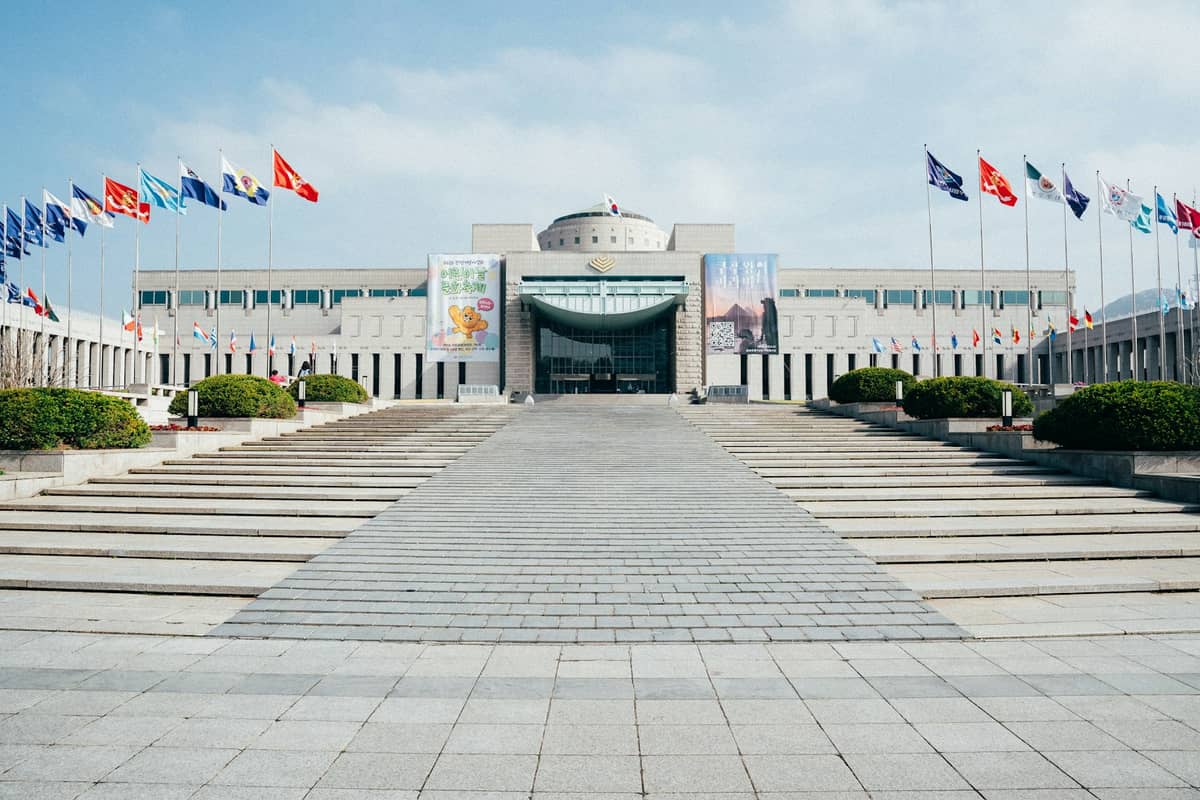
What Is the War Memorial of Korea?
The War Memorial of Korea (전쟁기념관) opened on June 10, 1994, and is located in Yongsan-gu — a location that carries its own historical weight. The building is massive by any standard, flanked by outdoor exhibition areas filled with tanks, aircraft, artillery, and naval vessels. For a free attraction, the scale and scope are genuinely surprising to first-time visitors., flanked by outdoor exhibition areas filled with tanks, aircraft, artillery, and naval vessels. For a free attraction, the scale and scope are genuinely surprising to first-time visitors.
The memorial covers Korean military history from ancient periods through to modern peacekeeping operations, but its emotional core is the Korean War (1950–1953). It is not a triumphalist space. The tone inside is measured and often somber, particularly in the rooms dedicated to casualties and the division of the peninsula. That said, the outdoor areas, with their rows of decommissioned military hardware, feel more like an open-air collection than a place of grief — children run between fighter jets while parents read informational placards., but its emotional core is the Korean War (1950–1953). It is not a triumphalist space. The tone inside is measured and often somber, particularly in the rooms dedicated to casualties and the division of the peninsula. That said, the outdoor areas, with their rows of decommissioned military hardware, feel more like an open-air collection than a place of grief — children run between fighter jets while parents read informational placards.
ℹ️ Good to know
Opening hours: Tuesday to Sunday, 09:30–18:00. Closed on Mondays and the day following national holidays. Admission is free. Admission is free.
The Outdoor Grounds: Tanks, Jets, and a Brothers Statue
Before you enter the building, set aside at least an hour for the grounds. The outdoor exhibition areas ring the main structure and display a large collection of military equipment, including fighter aircraft, tanks, self-propelled howitzers, naval guns, and a turtle ship replica. The equipment is arranged along paved walkways and is accessible up close, which makes this section particularly engaging for children and anyone with an interest in military technology.
The most visited piece is not hardware but sculpture. The Brothers Statue at the main entrance is a prominent landmark, and worth pausing at rather than passing by for a quick photograph., and worth pausing at rather than passing by for a quick photograph.
On weekday mornings the grounds are relatively quiet, with older Korean visitors reading placard text carefully and school groups moving in clusters. Weekend afternoons bring larger crowds, more families, and occasional military ceremonies on the plaza. The grounds are partially shaded by mature trees, but exposed stretches can be harsh in summer. Bring water if you are visiting between June and August.
💡 Local tip
Visit the outdoor areas first, when your energy is fresh. The interior galleries require sustained concentration, and most visitors underestimate how much time the grounds consume.
Tickets & tours
Hand-picked options from our booking partner. Prices are indicative; availability and final rates are confirmed when you complete your booking.
DMZ and Lake Majang Suspension Bridge Tour from Seoul
From 57 €Instant confirmationFree cancellationHalf Day DMZ Tour from Seoul, 3rd Tunnel, Observatory and More
From 47 €Instant confirmationFree cancellationSeoul zombie city exploration game and private tour
From 10 €Instant confirmationFree cancellationLuggage Storage in Seoul
From 7 €Instant confirmationFree cancellation
Inside the Museum: Six Permanent Halls
The interior is organized into six permanent exhibition halls. The Memorial Hall covers the pre-modern period, tracing Korean military culture through ancient kingdoms, the Joseon dynasty, and the Japanese colonial era. The displays mix artifacts, reconstructed uniforms, dioramas, and illustrated timelines. The content is dense, and English translations are provided throughout, though some panels in the older sections use somewhat dated phrasing.
The Korean War Hall is the centerpiece and occupies the most space. It traces the conflict chronologically from the North Korean invasion on June 25, 1950, through the UN intervention, the Incheon Landing, the push to the Yalu River, the Chinese entry, and the eventual armistice in 1953. Maps, film footage, personal testimonies, and interactive touchscreens make this section genuinely informative even for visitors who arrive knowing little about the conflict. The casualty figures are presented without euphemism.
The Vietnam-related hall and the Overseas Dispatch Hall cover South Korea's military involvement in international conflicts, including its deployment to Vietnam in the 1960s and 1970s. These sections receive less attention in most travel guides but offer useful context for understanding how the Republic of Korea's military has operated beyond its borders. The final halls cover the ROK Armed Forces today: equipment, structure, and current deployments including UN peacekeeping missions.
💡 Local tip
Free guided tours are available in English at set times, and they are worth picking up for the Korean War Hall specifically, where the narration adds context that placards alone cannot provide. They are worth picking up for the Korean War Hall specifically, where the audio narration adds context that placards alone cannot provide.
How the Experience Changes by Time of Day
Arriving at opening time (09:30) on a weekday gives you the quietest conditions, particularly inside. The marble halls amplify sound, so by mid-morning on weekends, school group visits create significant noise levels that disrupt the contemplative mood the design intends. If you are visiting for the emotional weight of the Korean War exhibits, a Tuesday or Wednesday morning is noticeably more affecting than a Saturday afternoon.
Late afternoon light in the outdoor areas, roughly between 15:00 and 17:00, is better for photography of the large sculptures and aircraft. The grounds close at 18:00, and the area empties relatively quickly after that.
In autumn, In autumn, the trees surrounding the outdoor areas add unexpected visual texture to the rows of military hardware. Spring brings more comfortable conditions for outdoor exploration than summer, when temperatures regularly exceed 30°C and humidity is high.
Historical and Cultural Context
The War Memorial sits in Yongsan-gu, a district with layered military significance. The area long had major military installations, and parts of the former U.S. garrison area are being transformed into a public park. Understanding Yongsan's history as a military district makes the memorial's placement feel less arbitrary and more intentional. For broader context on the neighborhood, the covers the area's evolution from garrison town to one of Seoul's most internationally diverse neighborhoods. Understanding Yongsan's history as a military district makes the memorial's placement feel less arbitrary and more intentional. For broader context on the neighborhood, the Itaewon-Yongsan district guide covers the area's evolution from garrison town to one of Seoul's most internationally diverse neighborhoods.
The Korean War remains a defining event in South Korean national identity. It is not a distant history here. Many older Korean visitors to the memorial are veterans or the children of veterans, and their presence lends the space a gravity that guidebooks rarely capture. The conflict is sometimes called the "Forgotten War" in Western contexts, but it is anything but forgotten in Korea. If you are also interested in the ongoing implications of the peninsula's division, a DMZ tour from Seoul makes a natural complement to a visit here, providing current-day perspective on the armistice line that has existed since 1953.
Getting There and Practical Notes
The most straightforward route is Samgakji Station on Seoul Metro Line 4, Exit 11. The walk to the main entrance is approximately 227 meters along a clearly marked path and takes about three minutes. The station makes it easy to combine with visits elsewhere in the city. making it easy to combine with visits elsewhere in the city.
The museum is free to enter, which makes it an easy addition to any itinerary without cost calculation. However, the food options inside the grounds are limited and basic. The surrounding area near Samgakji has a handful of cafes and casual restaurants, and the Itaewon strip is about a 15-minute walk north, offering considerably more dining variety. If you are planning a full morning here, eat before you arrive or budget time for a post-visit meal nearby.
Photography is permitted throughout the outdoor areas and in most indoor galleries; flash and tripod restrictions apply in some sections. The memorial is large enough that wearing comfortable shoes is a practical necessity rather than a suggestion. If you are building a longer day around the Yongsan area, the National Museum of Korea is a short taxi or bus ride away and covers Korean cultural history in comparable depth.
⚠️ What to skip
The museum is closed every Monday. If you are visiting Seoul for only a few days and Monday is your only available day, this attraction is not accessible. Plan accordingly.
Who Should Skip This
The War Memorial is not universally enjoyable. Visitors looking for light, casual sightseeing will find the indoor galleries demanding — the subject matter is heavy, the exhibits are text-dense, and the building itself is austere. If your Seoul itinerary is already full and you have limited time in Yongsan, the museum's outdoor areas can be seen in under an hour without going inside, but skipping the interior means missing the historical substance that justifies the visit.
Very young children (under five or six) will find little to engage with beyond the outdoor vehicles and aircraft, though the playground near the rear of the grounds provides some relief. Travelers focused primarily on food, design, or nightlife will find the time better spent elsewhere. For a lighter but still culturally significant experience in the same general area, Leeum Museum of Art is a short distance away and offers world-class Korean and international art in a striking building.
Insider Tips
- The indoor map provided at the entrance understates the size of the outdoor areas. Pick one up anyway, but add 20–30 minutes to whatever time estimate you make for the grounds.
- The rear garden area is less visited than the main plaza and contains some of the more unusual equipment displays, including naval vessels and landing craft. Most visitors turn around before reaching it.
- Korean school groups typically arrive between 10:00 and 11:30. If you want quieter indoor galleries, aim to start your interior visit before 10:00 or after 13:00.
- There is a small café inside the museum building, but vending machines near the outdoor areas provide cheaper water and drinks — useful information on hot summer days when outdoor exploration is physically demanding.
- The memorial occasionally hosts temporary exhibitions on specific conflicts or periods. Check the official website at warmemo.or.kr before visiting, as these can add significant interest to an already full visit.
Who Is War Memorial of Korea For?
- History and military history enthusiasts wanting serious, well-documented coverage of the Korean War and Korean military heritage
- Families with school-age children, who will engage with the outdoor aircraft and tank displays
- First-time visitors to Seoul wanting cultural context for understanding modern Korean identity
- Budget travelers: the combination of free admission and a full half-day of content makes this exceptional value
- Travelers pairing it with a DMZ tour, for whom the memorial provides essential historical grounding
Nearby Attractions
Other things to see while in Itaewon & Yongsan:
- Seoul Central Mosque & Itaewon Mosque Area
Built in 1976, Seoul Central Mosque (서울중앙성원) is Korea's first and largest mosque, perched on a quiet hillside above Itaewon. Free to visit and architecturally striking against Seoul's skyline, it offers a genuinely contemplative experience alongside a neighborhood packed with halal restaurants and international culture.
- Leeum Museum of Art
Leeum Museum of Art in Hannam-dong brings together over 15,000 works spanning ancient Korean ceramics to contemporary global art, housed in three architecturally distinct buildings designed by some of the world's most recognized architects. It is a rare institution that rewards both first-time visitors and those who return with purpose.
- National Museum of Korea
The National Museum of Korea in Yongsan is South Korea's premier public museum and one of Asia's largest museums by floor area. Housing hundreds of thousands of artifacts across three floors of permanent galleries, it traces Korean civilization from the prehistoric era through the Joseon dynasty — and admission to the permanent collection is completely free.
- Yongsan Electronics Market
Yongsan Electronics Market is Seoul's sprawling hub for consumer electronics, computer components, cameras, and second-hand tech. Spread across several interconnected buildings in Yongsan-gu, it rewards patient shoppers who know how to navigate it, but can feel overwhelming and dated to those expecting a polished retail experience.