Seoul Central Mosque: Korea's First Mosque in the Heart of Itaewon
Built in 1976, Seoul Central Mosque (서울중앙성원) is Korea's first and largest mosque, perched on a quiet hillside above Itaewon. Free to visit and architecturally striking against Seoul's skyline, it offers a genuinely contemplative experience alongside a neighborhood packed with halal restaurants and international culture.
Quick Facts
- Location
- 39, Usadan-ro 10-gil, Yongsan-gu, Seoul (Hannam-dong)
- Getting There
- Seoul Subway Line 6, Itaewon Station Exit 3 — approx. 477 m uphill on foot
- Time Needed
- 30–60 minutes for the mosque; add 1–2 hours to explore the surrounding Itaewon halal strip
- Cost
- Free admission
- Best for
- Architecture lovers, Muslim travelers, cross-cultural curiosity, quiet escapes from Itaewon's main street
- Official website
- http://www.koreaislam.org/en/mainpage
What Seoul Central Mosque Actually Is
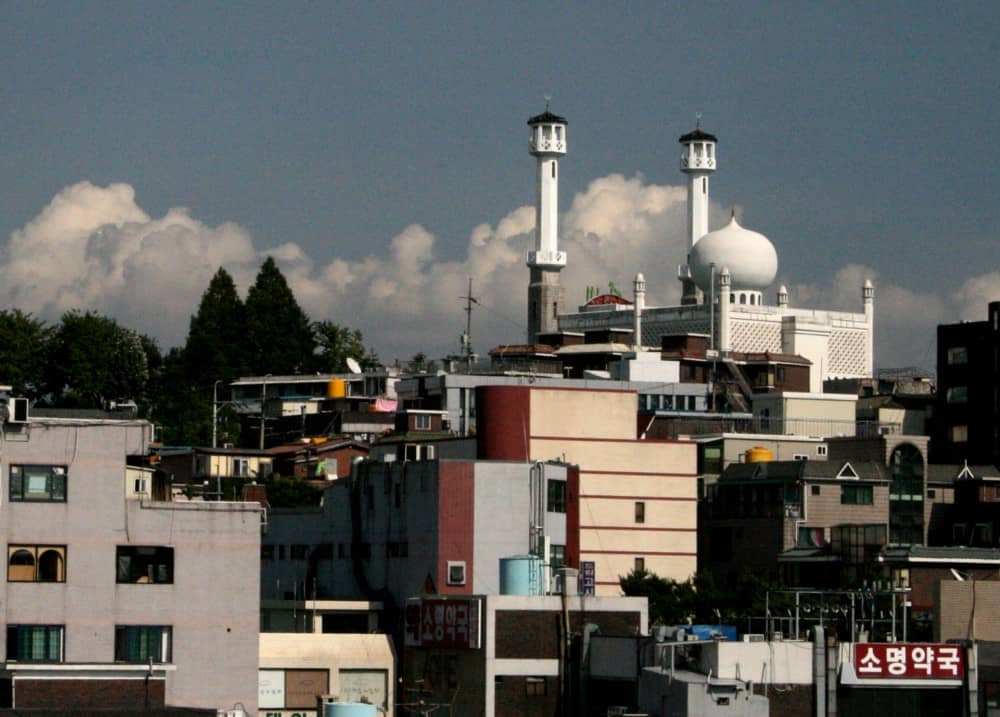
Seoul Central Mosque (서울중앙성원) is the first mosque ever built in South Korea, completed in 1976 on a hillside in Hannam-dong, Yongsan-gu. It remains the country's largest Islamic sanctuary Seoul Central Mosque (서울중앙성원) is the first mosque ever built in South Korea, completed in 1976 on a hillside in Hannam-dong, Yongsan-gu. It remains an important Islamic center and serves as the headquarters of the Korea Muslim Federation. For everyone else, it is one of Seoul's most architecturally unexpected landmarks: a white domed structure with twin minarets, rising behind a gate at the top of a steep residential lane a few hundred meters from Itaewon Station.
This is an active place of worship first. Non-Muslim visitors are welcome outside of prayer times, but the space deserves the same quiet respect you would bring to any religious site. That said, the Korea Muslim Federation has historically been open to curious visitors, and the mosque's presence has shaped the surrounding streets into one of Seoul's most genuinely international pockets.
ℹ️ Good to know
Visiting hours are listed as 09:00–19:00, but prayer times shift with sunrise throughout the year. Non-Muslim visitors should avoid entering the main prayer hall during the five daily prayer times. Check the Korea Muslim Federation website for current prayer schedules before you go.
The Approach: A Climb Worth Making
The walk from Itaewon Station Exit 3 is short in distance but steep in character. You leave the burger joints and neon of Itaewon's main drag, pass halal butchers and Arabic-script restaurant signs, and begin a lane that tilts noticeably upward. The neighborhood here is quiet by Seoul standards: no street-food carts, no K-pop playing from speakers. By the time you reach the mosque's outer gate, you can already hear the difference. On a clear morning, the view back across the rooftops toward Namsan is worth stopping for.
The approach itself is a form of orientation. This part of Itaewon developed as a hub for Seoul's Muslim community, Arab expats, and workers from across Southeast Asia and the Middle East. The street up to the mosque is sometimes called Seoul's halal food strip, and it functions as a genuine community zone rather than a themed tourist district. You will find Uzbek pilaf, halal Korean fried chicken, Turkish kebabs, and Indonesian rendang within a three-minute walk of the mosque gate. Late Friday morning, the lane fills with worshippers arriving for Jumu'ah (Friday prayer), and the energy shifts noticeably.
The area sits within the broader Itaewon and Yongsan district, which has long been Seoul's most internationally diverse neighborhood, shaped in part by the proximity of the former US military base at Yongsan.
Tickets & tours
Hand-picked options from our booking partner. Prices are indicative; availability and final rates are confirmed when you complete your booking.
DMZ and Lake Majang Suspension Bridge Tour from Seoul
From 57 €Instant confirmationFree cancellationHalf Day DMZ Tour from Seoul, 3rd Tunnel, Observatory and More
From 47 €Instant confirmationFree cancellationSeoul zombie city exploration game and private tour
From 10 €Instant confirmationFree cancellationLuggage Storage in Seoul
From 7 €Instant confirmationFree cancellation
The Architecture: Why It Stands Out in Seoul
The mosque was designed in a traditional Islamic style, which makes it genuinely arresting against the backdrop of Seoul's apartment towers and steel-and-glass commercial blocks. The white exterior, the central dome, and the twin minarets are not common shapes in this city. Construction was supported by Saudi Arabia and several other Muslim-majority countries as part of a broader effort by the Korean government and the Muslim community to establish a permanent Islamic center in Seoul. The project took roughly two years, beginning in October 1974.
Up close, the craftsmanship in the tilework and the geometric patterns around the entrance is worth slowing down for. The interior of the main prayer hall features a high vaulted ceiling, patterned carpets, and natural light from arched windows. Non-Muslim visitors who are admitted outside prayer times will notice the absence of figurative imagery, in keeping with Islamic tradition, and the precise orientation of the space toward Mecca (the qibla direction is marked clearly).
Photography of the exterior is generally acceptable; photography inside the prayer hall requires discretion and should not interrupt worshippers. If you are unsure, err on the side of putting the camera away.
Visiting as a Non-Muslim Traveler
The mosque is open for general visits, and admission is free. Visitors should dress modestly: shoulders and knees covered for both men and women. Women are expected to cover their hair inside the prayer hall; scarves may be available at the entrance, but bringing your own is safer. Remove shoes before entering the prayer space.
The experience inside is contemplative rather than spectacular. There is no audio guide, no exhibition, and no gift shop. What you get is the architecture, the quiet, and a sense of a community that exists largely outside the typical tourist circuit of Seoul. If you approach it with that expectation, it is quietly impressive. If you come hoping for elaborate displays or interactive exhibits, this is not that kind of visit.
⚠️ What to skip
Friday midday is the busiest time of the week. Jumu'ah (Friday prayer) draws a significant crowd. If you want to observe the exterior atmosphere of a busy Friday, arriving just before midday and staying outside is fine. If you want a quieter interior visit, go on a weekday morning.
Facilities at the mosque include Quran copies, prayer mats, qibla direction markers, and wudu (ritual washing) areas. These are provided for Muslim worshippers. The Korea Muslim Federation maintains the site and its offices are located on the premises.
How the Surrounding Area Changes the Visit
Separating the mosque from its neighborhood misses the point. The halal restaurant strip below the gate is one of the few places in Seoul where you can find a wide range of halal dining options within a short stretch of pavement. For Muslim travelers navigating Seoul's predominantly pork-heavy food culture, this is a practical anchor point for the whole trip. For non-Muslim visitors with a genuine interest in food diversity, it is simply one of the more interesting streets in the city.
The broader Itaewon area rewards extended exploration. If the mosque visit opens up your appetite for the neighborhood's international layers, the Leeum Museum of Art is a short walk away in Hannam-dong, offering some of the strongest contemporary Korean art holdings in the country. The contrast between the two places, one a religious sanctuary, one a world-class contemporary art institution, is part of what makes this corner of Seoul distinctive.
Itaewon's main street has changed significantly over recent years. It is worth reading about the wider range of things to do in Seoul to put Itaewon in context if this is your first time in the city.
Practical Details for Your Visit
Getting There
Take Seoul Subway Line 6 to Itaewon Station and use Exit 3. The mosque is approximately 477 meters from the exit, almost entirely uphill. The walk takes you through the halal food street, which itself is worth a slow pass. Taxis can drop you closer to the gate but the lane is narrow. Kakao T is the most reliable app for hailing a taxi in Seoul.
Best Time to Visit
Weekday mornings between 09:00 and 11:30 offer the calmest conditions for a non-Muslim visitor. The light hits the white facade well in the morning hours. Spring (April to May) and autumn (September to October) give you the most comfortable temperatures for the uphill walk, which can feel punishing in Seoul's July or August heat and humidity. Winter visits are fine in clear conditions; the white mosque against a grey Seoul sky has its own stark appeal, but the lane can be icy.
Accessibility
The steep approach lane and the general topography of the site present real challenges for visitors with mobility limitations. The lane from Itaewon Station Exit 3 involves sustained uphill walking on uneven pavement. No dedicated wheelchair-accessibility information was available from official sources at time of writing; contact the Korea Muslim Federation directly via their website to confirm current access arrangements before visiting.
Insider Tips
- Friday midday is the worst time for a quiet visit but the best time to observe the mosque as a living community space. The energy outside the gate as worshippers arrive and depart is worth seeing if you stay outside and keep a respectful distance.
- The halal restaurants immediately below the mosque gate vary widely in quality. The Uzbek restaurants on this strip have a strong reputation among Seoul's Central Asian community and are generally a reliable choice for lunch after a morning visit.
- Bring a scarf or shawl regardless of your gender or religious identity. Modest dress is expected, and having something to cover your shoulders or hair means you will not be turned away at the entrance.
- The view back toward Namsan from the mosque gate is one of the better mid-range views of the tower without the crowds or entry fee. It works especially well at dusk when the light is low.
- If you are interested in Islam in Korea more broadly, the Korea Muslim Federation office on site occasionally has English-language information about Korean Muslim history. This is not a guaranteed service, but worth asking about on weekdays.
Who Is Seoul Central Mosque & Itaewon Mosque Area For?
- Muslim travelers looking for halal food, prayer facilities, and community in Seoul
- Architecture and religious heritage enthusiasts interested in Seoul's non-Buddhist, non-Confucian traditions
- Food-focused visitors wanting to explore Seoul's most concentrated halal dining street
- Travelers seeking a genuinely quiet, non-commercialized break from Itaewon's main strip
- Anyone building a deeper picture of Seoul's international and multicultural communities
Nearby Attractions
Other things to see while in Itaewon & Yongsan:
- Leeum Museum of Art
Leeum Museum of Art in Hannam-dong brings together over 15,000 works spanning ancient Korean ceramics to contemporary global art, housed in three architecturally distinct buildings designed by some of the world's most recognized architects. It is a rare institution that rewards both first-time visitors and those who return with purpose.
- National Museum of Korea
The National Museum of Korea in Yongsan is South Korea's premier public museum and one of Asia's largest museums by floor area. Housing hundreds of thousands of artifacts across three floors of permanent galleries, it traces Korean civilization from the prehistoric era through the Joseon dynasty — and admission to the permanent collection is completely free.
- War Memorial of Korea
The War Memorial of Korea in Yongsan is one of Seoul's largest and most serious museums, covering the full arc of Korean military history from ancient conflicts through the Korean War and beyond. Admission is free, the outdoor displays alone take an hour, and the indoor galleries reward visitors who give it a full half-day.
- Yongsan Electronics Market
Yongsan Electronics Market is Seoul's sprawling hub for consumer electronics, computer components, cameras, and second-hand tech. Spread across several interconnected buildings in Yongsan-gu, it rewards patient shoppers who know how to navigate it, but can feel overwhelming and dated to those expecting a polished retail experience.