National Museum of Korea: The Full Story of 5,000 Years, Free of Charge
The National Museum of Korea in Yongsan is South Korea's premier public museum and one of Asia's largest museums by floor area. Housing hundreds of thousands of artifacts across three floors of permanent galleries, it traces Korean civilization from the prehistoric era through the Joseon dynasty — and admission to the permanent collection is completely free.
Quick Facts
- Location
- 137 Seobinggo-ro, Yongsan-gu, Seoul 04383
- Getting There
- Ichon Station Exit 2 (Line 4 / Gyeongui-Jungang Line)
- Time Needed
- 2–4 hours for permanent galleries; full day if including special exhibitions
- Cost
- Free (permanent collection); some special exhibitions charge separately
- Best for
- History lovers, families, first-time Seoul visitors, rainy-day plans
- Official website
- www.museum.go.kr/ENG/main/index.do
What the National Museum of Korea Actually Is
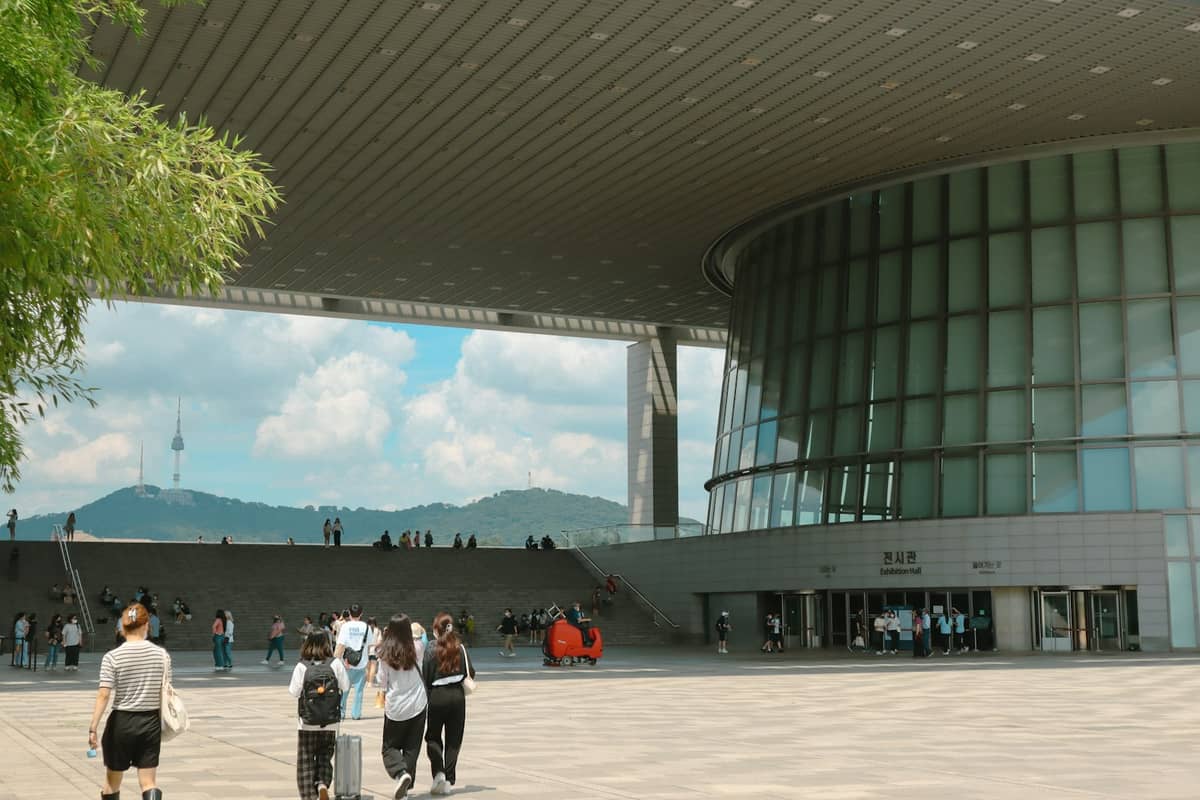
The National Museum of Korea (국립중앙박물관) is the country's premier public museum and one of the largest in Asia by floor area. It sits on a wide, landscaped campus in Yongsan, flanked by an outdoor sculpture garden and a reflecting pond that frames the building's long, low facade against the Namsan ridgeline. The scale alone signals that this is not a place to rush.
The permanent collection spans Korean civilization from the Paleolithic period through the Joseon dynasty and into the modern era. Artifacts include bronze-age relics, celadon ceramics from the Goryeo period, Buddhist sculpture, royal court paintings, gold crowns, and hundreds of objects recovered from ancient tomb sites. The museum holds more than 220,000 items in total, though only a portion are on display at any given time across three floors of the permanent exhibition hall.
Admission to the permanent exhibition hall is free. That makes it one of the most substantive free cultural experiences in Seoul, comparable in scope to national museums in London or Paris that also offer free general admission.
💡 Local tip
Admission closes 30 minutes before the museum's closing time. On Wednesday and Saturday evenings, the museum stays open until 21:00 — making those the best days for visitors whose mornings are taken up elsewhere.
A Brief History: From Colonial Museum to National Institution
The institution traces its origins to December 1, 1915, when a predecessor museum opened within Gyeongbokgung Palace under the Japanese colonial administration. It operated as the Joseon Government-General Museum until Korea's liberation in 1945. The National Museum of Korea was formally established on December 3, 1945, taking over the collections and infrastructure from that colonial-era institution.
The museum moved locations several times over the following decades before settling at its current purpose-built home in Yongsan in 2005. The current building was designed to integrate Korean architectural proportions with contemporary museum function — the long horizontal lines recall the low profile of traditional Korean architecture rather than the soaring vertical ambition of many Western institutions. For those interested in how the city's physical landscape carries historical weight, the broader Yongsan area also rewards exploration: the nearby War Memorial of Korea sits just to the north and addresses a very different chapter of Korean history.
Tickets & tours
Hand-picked options from our booking partner. Prices are indicative; availability and final rates are confirmed when you complete your booking.
DMZ and Lake Majang Suspension Bridge Tour from Seoul
From 57 €Instant confirmationFree cancellationHalf Day DMZ Tour from Seoul, 3rd Tunnel, Observatory and More
From 47 €Instant confirmationFree cancellationSeoul zombie city exploration game and private tour
From 10 €Instant confirmationFree cancellationLuggage Storage in Seoul
From 7 €Instant confirmationFree cancellation
The Permanent Galleries: What You Will Actually See
The permanent galleries are organized across three floors and divided into archaeology, history, and fine arts. The ground floor archaeology section is where most visitors spend the most time: it covers prehistoric Korea through the Three Kingdoms period (Goguryeo, Baekje, Silla) and includes the gold crowns and jewelry recovered from Silla royal tombs in Gyeongju. These objects — delicate gold filigree with hanging jade pendants, made without modern tools — tend to stop people in their tracks.
The second floor holds the calligraphy and painting galleries. Korean ink painting and royal court portraiture are well represented, and the hanging scroll formats create a quieter, more contemplative atmosphere than the ground floor. The third floor covers sculpture and crafts, including the famous ten-story stone pagoda from Gyeongcheonsa Temple, a 14th-century structure that was illegally removed to Japan during the colonial era and returned in 1918. It now stands in a dedicated indoor space where its scale and carved detail can be appreciated without weathering.
English-language labeling is consistent throughout the permanent galleries, though depth of explanation varies by section. Audio guides are available at a separate charge and add significantly to the experience in the fine arts rooms, where context matters more than in the archaeology halls.
ℹ️ Good to know
The outdoor exhibition area opens at 07:00 — earlier than the main building. The reflecting pond and sculpture garden are worth walking through even if you arrive before the doors open.
How the Experience Changes by Time of Day
Weekday mornings between 10:00 and 12:00 are the quietest window. School groups arrive frequently, but they tend to move in clusters through specific rooms rather than saturating the whole building. If you want the Silla gold crown room to yourself, a Tuesday or Thursday morning is your best option. Weekends draw larger general crowds, particularly on Saturday afternoons when families with children use the Children's Museum, which is free but requires a timed ticket reserved in advance.
Wednesday and Saturday evenings, when the building stays open until 21:00, have a markedly different atmosphere. The natural light that floods the building's central atrium through its glass walls softens as the sun sets, and by 19:00 the galleries are noticeably less crowded. The extended evening hours are specifically popular with office workers and couples — the outdoor reflecting pond area is well-lit at night and the surrounding garden paths remain accessible.
Rainy days push visitors indoors and can make the museum feel more crowded than usual, particularly in the popular archaeology galleries. If you visit on a rainy weekend, head directly to the third-floor sculpture rooms first — they are consistently among the least congested areas regardless of conditions.
Getting There and Getting Around
The most straightforward approach is from Ichon Station Exit 2, served by both Seoul Subway Line 4 and the Gyeongui-Jungang Line. From the exit, the museum entrance is a short walk. The route is flat, covered in part, and clearly signed. For visitors already exploring the Itaewon and Yongsan area, the museum fits naturally into a broader day that might also include Leeum Museum of Art further up the hill.
Inside the building, the central atrium acts as the main navigation point. Floor plans in English are available at the information desk near the entrance, and directional signage is clear throughout. The building is large enough that unprepared visitors can feel disoriented on the second and third floors, where gallery wings extend away from the central corridor in both directions. Picking up a printed floor plan is worth the thirty seconds it takes.
Accessibility is well-considered: elevators serve all floors, ramp access is available throughout, and restrooms are accessible and consistently maintained. The museum also publishes visitor guides in English, Korean, and other languages. If you are planning a fuller day in this part of Seoul, the Leeum Museum of Art is a reasonable pairing — smaller in scale but with an exceptional modern and contemporary Korean art collection.
Photography, Practical Logistics, and What to Bring
Photography is permitted in the permanent galleries without flash. The building's architecture creates strong light conditions in the central atrium, particularly in the late morning when sunlight streams through the glass facade. The individual gallery rooms use controlled museum lighting that renders gold and ceramic objects well without harsh shadows — the Silla jewelry cases are among the most photogenic displays in any Seoul museum.
The museum has a large cafeteria on the ground floor and a smaller café near the reflecting pond. Both are functional rather than remarkable. Bringing water is sensible, as the building is large and climate-controlled to museum temperatures, which can feel cool even in summer. Comfortable shoes matter: walking all three permanent floors plus outdoor grounds covers more distance than most visitors expect.
The museum also has a well-stocked gift shop near the main exit, with reproduction prints, ceramics, and design objects based on collection items — generally better quality and more tasteful than the souvenir options you will find in areas like Insa-dong, The museum also has a well-stocked gift shop near the main exit, with reproduction prints, ceramics, and design objects based on collection items — generally better quality and more tasteful than the souvenir options you will find in areas like , though at higher price points.
⚠️ What to skip
The Children's Museum requires timed entry tickets, which are free but must be reserved in advance and often fill up on weekends. If you are visiting with young children, check the museum's official website before your visit.
Honest Assessment: Strengths and Limitations
The National Museum of Korea is genuinely one of Seoul's most rewarding free experiences, particularly for visitors with an interest in Korean history, archaeology, or art. The depth of the permanent collection is hard to overstate, and the free admission removes the calculus of whether the visit justifies its cost.
The museum's main limitation is pacing: it rewards slow, attentive visitors and frustrates those expecting a quick highlights tour. There is no single iconic object that functions as a shortcut to understanding the collection — the value accumulates across rooms and floors. Visitors who are new to Korean history may find the broader museum landscape in Seoul useful context before choosing how much time to allocate here versus at more specialist institutions.
Who might want to skip it: travelers on very tight itineraries who are not already engaged with Korean history will likely find the experience overwhelming rather than illuminating. The museum's scale works against casual browsing. It is also not a good fit for visitors primarily interested in contemporary Korean culture — for that, the MMCA Seoul or Leeum are better choices.
Insider Tips
- Wednesday and Saturday evenings after 18:00 offer the best combination of low crowds and extended hours. The reflecting pond at dusk is worth staying for even after you finish the galleries.
- The Gyeongcheonsa Pagoda on the third floor is frequently overlooked by visitors who exhaust their energy on the ground floor. Budget time for it specifically — the carved Buddhist reliefs on each tier are among the finest examples of Goryeo-period stone carving in any public collection.
- The outdoor grounds open at 07:00, a full three hours before the building. The sculpture garden and pond walk make for an unusually peaceful morning in a city where early-morning calm is not always easy to find.
- Audio guides are available at a fee and are worth considering specifically for the painting and calligraphy galleries on the second floor, where the English wall text is thinner and historical context adds significantly to what you are looking at.
- If you are visiting with children and want the Children's Museum, reserve timed tickets online before you arrive. Walk-up availability on weekends is unreliable.
Who Is National Museum of Korea For?
- First-time visitors to Seoul who want a single, coherent introduction to Korean history and culture
- Travelers with a strong interest in archaeology, ceramics, or Buddhist art
- Families with older children or teenagers who engage well with historical content
- Rainy-day visitors looking for a full-day indoor alternative
- Budget travelers: the free permanent collection is among the best no-cost experiences in the city
Nearby Attractions
Other things to see while in Itaewon & Yongsan:
- Seoul Central Mosque & Itaewon Mosque Area
Built in 1976, Seoul Central Mosque (서울중앙성원) is Korea's first and largest mosque, perched on a quiet hillside above Itaewon. Free to visit and architecturally striking against Seoul's skyline, it offers a genuinely contemplative experience alongside a neighborhood packed with halal restaurants and international culture.
- Leeum Museum of Art
Leeum Museum of Art in Hannam-dong brings together over 15,000 works spanning ancient Korean ceramics to contemporary global art, housed in three architecturally distinct buildings designed by some of the world's most recognized architects. It is a rare institution that rewards both first-time visitors and those who return with purpose.
- War Memorial of Korea
The War Memorial of Korea in Yongsan is one of Seoul's largest and most serious museums, covering the full arc of Korean military history from ancient conflicts through the Korean War and beyond. Admission is free, the outdoor displays alone take an hour, and the indoor galleries reward visitors who give it a full half-day.
- Yongsan Electronics Market
Yongsan Electronics Market is Seoul's sprawling hub for consumer electronics, computer components, cameras, and second-hand tech. Spread across several interconnected buildings in Yongsan-gu, it rewards patient shoppers who know how to navigate it, but can feel overwhelming and dated to those expecting a polished retail experience.