Yaowarat Road: The Full Guide to Bangkok's Chinatown Strip
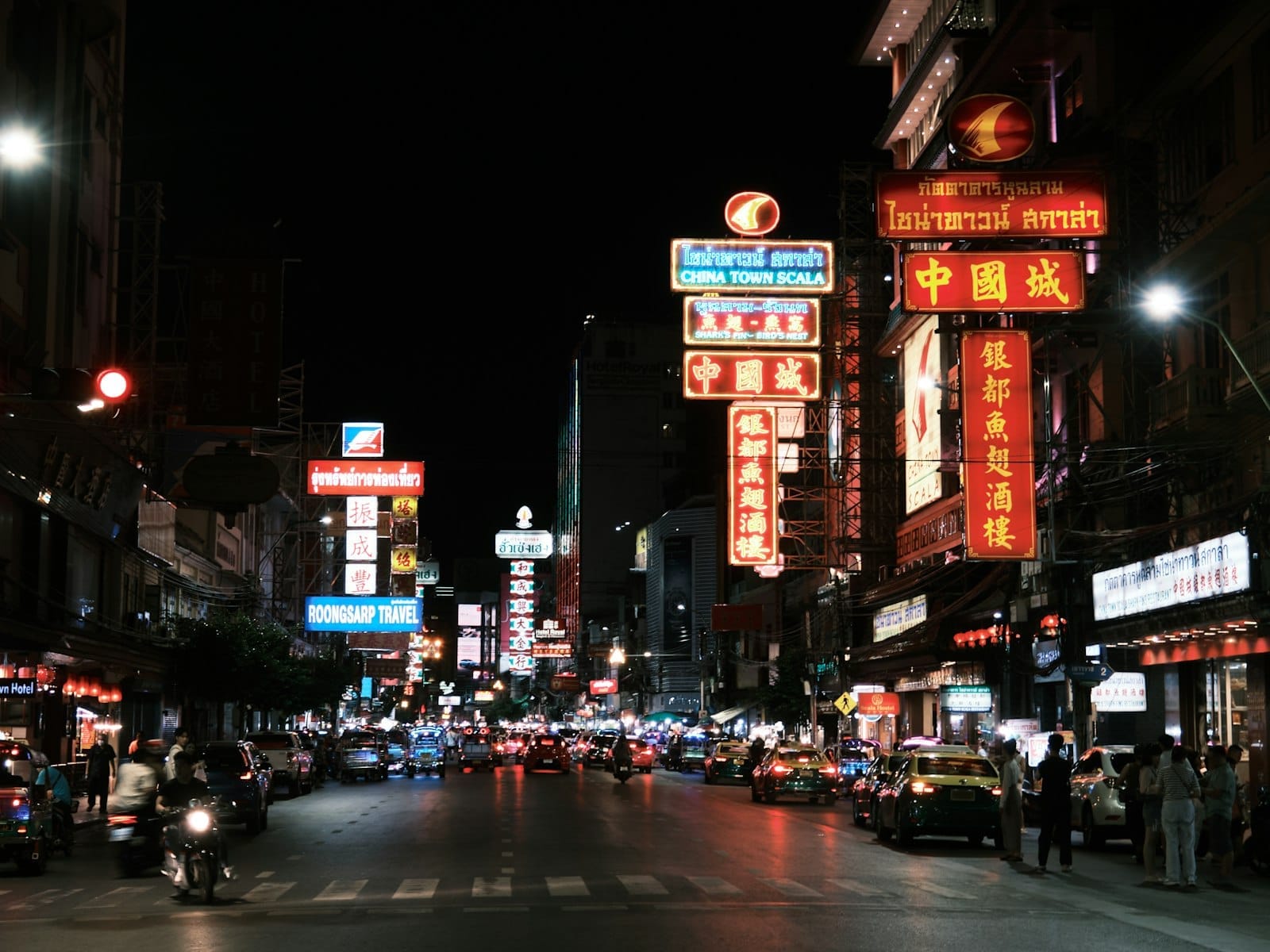
Yaowarat Road is the spine of Bangkok's Chinatown, a centuries-old commercial corridor lined with gold traders, roast duck shops, street food carts, and ornate Chinese shrines. It comes alive after dark when the neon signs ignite and the sidewalks fill with smoke from charcoal grills.
Quick Facts
- Location
- Yaowarat Road, Samphanthawong District, Bangkok
- Getting There
- MRT Wat Mangkon (exit 1, 2 min walk)
- Time Needed
- 2–4 hours, more if dining
- Cost
- Free to walk; street food from 50–200 THB per dish
- Best for
- Night food crawls, Chinese heritage, photography, gold shopping
What Yaowarat Road Actually Is
Yaowarat Road is the main artery of Bangkok's Chinatown, running roughly 1.5 kilometres through the Samphanthawong District between Odeon Circle to the west and the edge of Rattanakosin Island to the east. The road was constructed in 1892 under King Rama V as part of an urban modernisation project, and the surrounding district had already been a Chinese trading quarter for over a century before that.
Today the street functions simultaneously as a working commercial district, a food destination, a gold trading hub, and a living piece of Thai-Chinese cultural heritage. On any given evening, gold shops with floor-to-ceiling glass cases stand shoulder to shoulder with dried seafood wholesalers, traditional apothecaries, roast duck restaurants operating since the 1940s, and mobile carts selling mango sticky rice to tourists and locals alike.
💡 Local tip
The MRT Wat Mangkon station opened in 2019 and transformed access to Yaowarat. Exit 1 drops you directly at the edge of the action. Avoid arriving by taxi on weekend evenings — traffic on Yaowarat Road itself can be nearly stationary.
The Street by Time of Day
Yaowarat Road operates on a different schedule than most of Bangkok. During the day, between roughly 9am and 4pm, it functions as a serious commercial street. The gold shops open early, and you will see Thai and Chinese families moving with purpose between jewellery traders. Wholesale merchants receive deliveries along the side lanes. This is not a tourist atmosphere — it is a working district with a focused energy.
From around 5pm, the character shifts. Street food vendors begin setting up along the pavement, folding tables appear, and the smell of charcoal, star anise, and frying garlic starts layering into the air. The neon signs, which look fairly ordinary in daylight, become something genuinely dramatic at dusk. The red and gold Chinese characters on the shophouse facades catch the light, and the main arch at Odeon Circle anchors the scene with a photogenic anchor point.
By 7–8pm on a Friday or Saturday, the street is at maximum density. Sidewalks are narrow in places and shared between food stalls, diners eating at pavement tables, and a constant stream of pedestrians. It is loud, it smells of grilled seafood and diesel in equal measure, and it demands patience. Weekday evenings are noticeably calmer and arguably a better choice for first-time visitors who want to eat and explore without feeling pressed.
⚠️ What to skip
During Chinese New Year, Yaowarat transforms into one of Bangkok's largest public celebrations, but the crowds are extreme. Roads close to traffic, and the street can become nearly impassable around the main stage areas. Arrive before 6pm or after 10pm for a more manageable experience.
Tickets & tours
Hand-picked options from our booking partner. Prices are indicative; availability and final rates are confirmed when you complete your booking.
Temples of Bangkok and Grand Palace half-day guided tour
From 18 €Instant confirmationFree cancellationDamnoen Saduak floating market and Maeklong railway guided tour
From 36 €Instant confirmationFree cancellationBangkok tuk-tuk night tour with Chinatown street food meal
From 28 €Instant confirmationFree cancellationAfternoon Tea at Hyatt Regency Hotel Bangkok
From 900 €Instant confirmationFree cancellation
Food: The Main Reason Most People Come
The food scene along Yaowarat Road is genuinely serious. This is not street food performed for tourists — it is the real output of a community that has been cooking Teochew and Cantonese food in Bangkok for generations. The most iconic dishes to try include goong ob woon sen (glass noodles with prawns baked in a clay pot), khao man gai (poached chicken with rice), pad see ew with wok hei char from carts that have operated in the same spot for decades, and of course dim sum in the morning hours. For a broader view of Bangkok's Chinese culinary footprint, the Chinatown street food scene extends well beyond Yaowarat Road itself into the surrounding lanes.
T&K Seafood and Mangkorn Khao are two of the most frequently cited restaurants on the strip, both operating from the pavement with tables spilling onto the road. Neither accepts reservations. Expect to queue on busy evenings, and expect to share tables with strangers — that is simply how it works here. The quality justifies the friction.
For dessert, the stretch near Yaowarat Soi 11 has a concentration of vendors selling ba jian (stuffed pancakes), sesame balls, and tong yip (egg yolk sweets). Smell your way to the right stall — the ones frying fresh produce are obvious from fifteen metres away.
Gold Shops and Chinese Commercial Heritage
Yaowarat Road has one of the highest concentrations of gold shops in Southeast Asia. These are not souvenir jewellery stores — they trade in 96.5% pure Thai gold (referred to as thong boran, or ancient gold), priced daily against the gold index. Prices are posted visibly on boards inside. Many of the businesses have operated in the same location across three or four generations, and the shophouse architecture reflects this continuity: tiled floors, wooden counters worn smooth, ceiling fans turning overhead.
Even if you have no intention of buying, walking the gold shop stretch between Odeon Circle and Ratchawong Road offers a window into a form of commerce that has barely changed in a hundred years. The security guards, the hushed negotiations, the careful weighing of pieces — it is a different pace from the food chaos outside.
Temples, Shrines, and Side Lanes
Yaowarat Road is not just a single street. The sois (lanes) branching off it contain some of Bangkok's most atmospheric corners. Chinatown's dense network of lanes holds traditional medicine shops, clan association halls, and several Chinese temples that operate as active places of worship rather than tourist attractions. Incense smoke drifts out of these buildings throughout the day, and the sound of wooden fish drums and chanting occasionally competes with the street noise outside.
Wat Mangkon Kamalawat, located just off Yaowarat Road on Charoen Krung Soi 21, is the most significant Buddhist-Taoist temple in the area and worth a dedicated visit, particularly during morning hours when worshippers are active. Dress modestly if you plan to enter.
The neighbourhood of Talat Noi, reachable on foot by walking south from Yaowarat Road toward the riverside, offers a quieter contrast: narrow alleyways, Portuguese-influenced architecture, and several neighbourhood shrines that see almost no tourist traffic.
Photography and Practical Walkthrough
The standard Yaowarat photo route begins at the Odeon Circle arch, then works east along the main road before turning into the side lanes near Yaowarat Soi 6–11. The neon signs photograph well from around 6:30–7:30pm when there is still ambient light in the sky to balance the artificial glow. Full darkness produces flatter results unless you are working with off-camera flash.
A wide-angle lens or phone camera handles the streetscape better than a telephoto here — the lanes are narrow, and most interesting details are close. The gold shop interiors are dim and often prohibit photography. Ask before shooting inside any temple or shrine.
Accessibility is limited. The main road has pavements, but many stretches of Yaowarat are uneven, partially blocked by vendor carts, and have no dropped curbs at intersections. Wheelchairs and pushchairs will encounter significant friction. The MRT station itself is fully accessible.
ℹ️ Good to know
Yaowarat Road is one segment of a larger Chinatown exploration. Combine it with a walk along Charoen Krung Road or an evening visit to the riverside temples for a full-day itinerary.
Who Should Manage Expectations
Yaowarat Road is frequently described in travel content in ways that imply a discovery — as if it were obscure. It is not. On weekend evenings, it is one of the most heavily trafficked tourist destinations in Bangkok. If you are sensitive to crowds, noise, vehicle fumes, and the particular chaos of a narrow road shared by motorbikes, food carts, and several hundred pedestrians, this will be uncomfortable. It is worth knowing this going in. Travellers looking for a Bangkok street food experience with less congestion might consider exploring the surrounding lanes rather than the main strip.
That said, for what it is, Yaowarat does it well. The food is real, the gold trade is real, the temples are real. The street performs for tourists partly because it has been performing — as a working Chinese commercial district — for well over a century.
Insider Tips
- The best time to visit for food without extreme crowds is a weekday evening between 6pm and 8pm. By 9pm on weekends, simply moving between stalls becomes the challenge.
- Several of the most respected roast duck and dim sum shops are located not on Yaowarat Road itself but on the parallel Charoen Krung Road and in the sois between the two. Walk one block south and explore.
- If you want to photograph the neon signs without crowds in the frame, arrive at first light around 6–6:30am. The signs are still on, the street is empty, and the morning market sellers are just setting up.
- Gold prices on Yaowarat Road are set against the daily Thai gold index and are genuinely competitive — if you are considering buying gold jewellery in Bangkok, this is a legitimate place to do it, not just a tourist experience.
- The MRT Wat Mangkon station has a small food court beneath it that is far less crowded than the street above and serves several of the same dishes at lower prices — useful if queues on the main road are deterring you.
Who Is Yaowarat Road For?
- Food-focused travellers who want to eat Teochew and Cantonese dishes in a neighbourhood context rather than a restaurant setting
- Photographers interested in urban neon, Chinese shophouse architecture, and street-level commerce
- Travellers exploring Thai-Chinese cultural heritage and looking beyond the Grand Palace circuit
- Anyone visiting Bangkok during Chinese New Year who wants to be at the centre of the city's largest celebration
- Shoppers researching gold jewellery in a transparent, index-linked market
Nearby Attractions
Other things to see while in Chinatown (Yaowarat):
- Chinatown Street Food
Yaowarat Road and its surrounding lanes form the spine of Bangkok's most intense street food district. From char-grilled seafood to century-old noodle shops, Chinatown rewards curious eaters who arrive hungry and unhurried.
- Talat Noi
Wedged between the Chao Phraya River and Chinatown's gold shops, Talat Noi is one of Bangkok's oldest surviving neighborhoods. Its layered streets hold Portuguese-influenced shrines, century-old mechanic workshops, and some of the city's most photogenic street art, all within a compact area most tourists walk straight past.
- Wat Mangkon Kamalawat
Wat Mangkon Kamalawat, known in Cantonese as Leng Buai Ia, is Bangkok's most important Chinese Mahayana Buddhist temple. Built in 1871 along Charoen Krung Road, it draws thousands of worshippers daily and reaches spiritual intensity during Chinese New Year. For visitors willing to engage with a genuinely active place of worship, it offers an experience unlike anything else in the city.
- Wat Traimit (Golden Buddha)
Wat Traimit in Bangkok's Chinatown houses the world's largest solid gold Buddha statue, a 5.5-tonne masterpiece of Sukhothai craftsmanship with a remarkable discovery story. The temple complex also holds a museum tracing the history of Bangkok's Chinese community, making it one of the most layered cultural stops in the city.