Wat Mangkon Kamalawat: The Dragon Lotus Temple at the Heart of Bangkok's Chinatown
Wat Mangkon Kamalawat, known in Cantonese as Leng Buai Ia, is Bangkok's most important Chinese Mahayana Buddhist temple. Built in 1871 along Charoen Krung Road, it draws thousands of worshippers daily and reaches spiritual intensity during Chinese New Year. For visitors willing to engage with a genuinely active place of worship, it offers an experience unlike anything else in the city.
Quick Facts
- Location
- 423/3 Mangkon Rd, Chinatown (Yaowarat), Bangkok
- Getting There
- MRT Blue Line Wat Mangkon Station (Exit 1), a 3-minute walk
- Time Needed
- 30–60 minutes
- Cost
- Free entry
- Best for
- Cultural immersion, religious architecture, Chinese New Year visits
What Is Wat Mangkon Kamalawat?
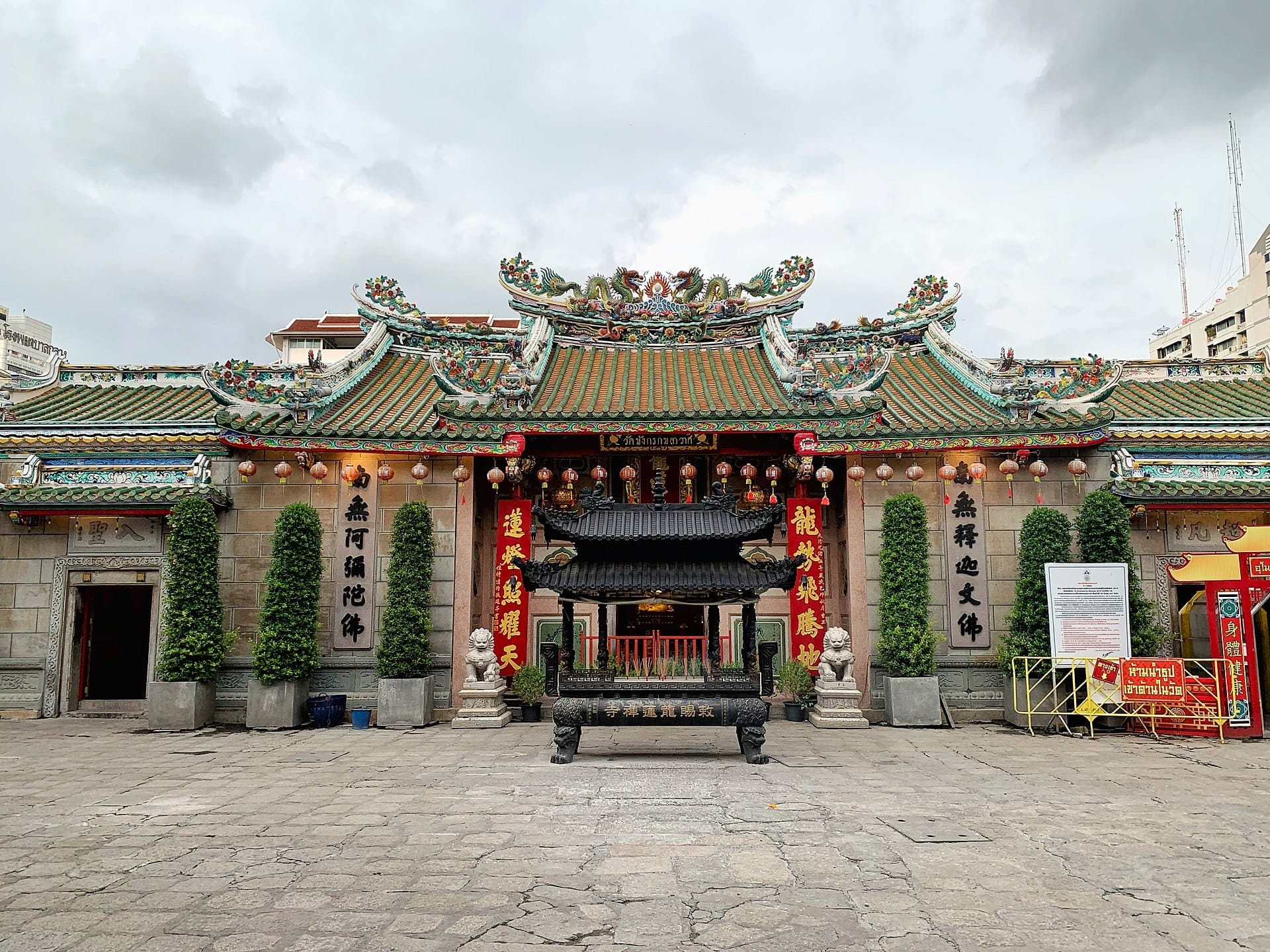
Wat Mangkon Kamalawat translates roughly as the 'Dragon Lotus Temple.' Its Cantonese name, Leng Buai Ia, is the one most older Bangkok Chinese residents still use. Founded in 1871 during the reign of King Rama V, it was built by and for the Teochew Chinese community that had settled along the Chao Phraya River. Today it functions as the largest and most visited Chinese Mahayana Buddhist temple in Thailand, though it is more than a single-religion space: Taoist deities and Confucian shrines share the interior with Buddhist imagery, reflecting the syncretic religious practice common among overseas Chinese communities.
This is not a museum or a heritage site preserved behind barriers. Monks conduct rituals. Families arrive with offerings of fruit and incense. Fortune-tellers work near the entrance courtyard. The temple operates as it has for over 150 years, which is precisely what gives it weight.
Arriving and First Impressions
The temple sits directly on Charoen Krung Road, one of Bangkok's oldest streets. The MRT Wat Mangkon station on the Blue Line, opened in 2019, was named after this temple, placing it at Exit 1 roughly three minutes away on foot. If you approach from Yaowarat Road itself, you will pass through the commercial core of Chinatown, with dried seafood shops, gold traders, and herbal medicine vendors lining both sides of the street.
💡 Local tip
Arrive before 9 AM on a weekday to experience the temple with serious devotees rather than tour groups. The incense smoke is thickest in the early morning and the atmosphere is markedly more concentrated.
The facade is immediately striking: a triple-arched gate in classical southern Chinese temple style, decorated with ceramic tile mosaics, glazed green roof ridges, and a pair of guardian figures flanking the entrance. Dragon motifs appear on the columns and along the rooflines. The building does not announce itself with a large forecourt the way Thai Buddhist temples typically do. Instead, it draws you directly inside.
Tickets & tours
Hand-picked options from our booking partner. Prices are indicative; availability and final rates are confirmed when you complete your booking.
Temples of Bangkok and Grand Palace half-day guided tour
From 18 €Instant confirmationFree cancellationDamnoen Saduak floating market and Maeklong railway guided tour
From 36 €Instant confirmationFree cancellationBangkok tuk-tuk night tour with Chinatown street food meal
From 28 €Instant confirmationFree cancellationAfternoon Tea at Hyatt Regency Hotel Bangkok
From 900 €Instant confirmationFree cancellation
Inside the Temple: Layout and What to See
The interior is organized across multiple halls arranged on a central axis, following traditional Chinese temple architecture. The front hall contains the primary altar. Further halls hold shrines to Guanyin (the bodhisattva of compassion, deeply venerated in Chinese Buddhism), various Taoist gods, and ancestral tablets. The air carries a permanent layer of incense smoke, which gives the interior a grey-gold quality in photographs and makes the gilded statues appear to glow.
The Guanyin shrine typically sees the most sustained devotional activity. Worshippers shake fortune-telling cylinders, light bundles of incense, and present offerings of fresh flowers and fruit. The sound throughout is particular: the low murmur of sutras, the dry rattle of fortune sticks, and the occasional sharp crack of firecrackers set off in the courtyard during auspicious occasions.
The ceilings deserve close attention. The painted woodwork and ceramic ornamental figures along the rooflines represent scenes from Chinese mythology and classical literature. Much of the decorative tile work was produced by Cantonese craftsmen and has not been replaced with modern reproductions, making the building a legitimate artifact of 19th-century overseas Chinese craftsmanship in Southeast Asia.
⚠️ What to skip
Dress modestly: shoulders and knees should be covered. Unlike some Thai temples, there is no sarong rental at the entrance. Come prepared or you may be asked to wait outside.
How the Experience Changes by Time of Day
Early morning, before 9 AM, draws the most dedicated worshippers: elderly residents completing daily rituals, monks in attendance, and the steady rhythm of a space in active use. The incense is freshly lit and the smoke hangs visibly in shafts of early light coming through the entrance gate.
By mid-morning the temple receives tour groups alongside individual visitors. The energy shifts toward observation rather than participation. The commercial stalls near the entrance selling incense, offerings, and lotus flowers are fully operational by then, and the surrounding streets of Chinatown are properly awake.
Late afternoon brings another wave of worshippers stopping in after work or market errands. The light at that hour, entering from the west-facing gate, catches the gilded surfaces differently. The crowds are lighter than at midday but the devotional activity is genuine again. Late evening is possible but most halls reduce activity after sunset.
Chinese New Year and Major Festivals
Wat Mangkon Kamalawat is the focal point of Bangkok's Chinese New Year celebrations, which the city marks with considerable intensity in the Chinatown district. In the days before the lunar new year, the temple and the streets surrounding it become nearly impassable with worshippers, market stalls, and firecracker smoke. Offerings pile up inside the halls. The queue to reach the main altar can stretch out through the entrance courtyard.
The Vegetarian Festival in October is another key period. Chinese residents follow a nine-day vegetarian diet for religious merit, and the streets around the temple fill with stalls selling plant-based versions of traditional dishes. The temple itself sees elevated ritual activity throughout the nine days.
ℹ️ Good to know
If you visit during Chinese New Year, come very early (before 7 AM) or accept that the experience will be one of crowd and spectacle rather than quiet observation. Both are valid, but they are completely different visits.
Wat Mangkon in the Context of Chinatown's Temples
Chinatown contains numerous smaller Chinese shrines and temples, but Wat Mangkon operates on a different scale. It functions as a community anchor, not just a religious building. If you are building a walking route through the area, it pairs naturally with Wat Traimit (the Temple of the Golden Buddha, about a 10-minute walk east), which houses the world's largest solid gold Buddha image and represents a different tradition: Thai Theravada Buddhism rather than Chinese Mahayana.
The stretch of Charoen Krung Road between Wat Mangkon and Yaowarat Road is itself worth walking slowly. The street food scene in Chinatown is among the densest in Bangkok. If you are visiting in the evening and combining the temple with a meal, the area around Yaowarat Road offers roast duck, dim sum, seafood noodles, and mango desserts within a few hundred meters of the temple gate.
For a broader understanding of Bangkok's temple landscape, the best temples in Bangkok covers the full range from Rattanakosin's royal complexes to Chinatown's Chinese Buddhist sites, which helps contextualize what makes Wat Mangkon distinct within the city.
Photography and Practical Notes
Photography is generally permitted inside the temple, but use judgment. Photograph architecture, ceilings, and general atmosphere freely. Avoid pointing a camera directly at individuals in private devotion without acknowledgment. The smoke-filled interior demands a camera that handles low light well. A phone camera will struggle with the contrast between the bright courtyard and the darker inner halls.
The temple has no admission fee. There are no official guides stationed inside, though the incense sellers near the entrance sometimes explain offering customs if asked. Accessibility is limited: the entrance involves a step threshold and the floor surface inside is uneven in sections. Visitors with mobility restrictions should proceed carefully.
Chinatown is walkable from several other significant sites. Yaowarat Road itself runs roughly parallel to Charoen Krung and is the main artery of Bangkok's Chinatown, worth exploring before or after the temple. The narrow lanes between the two streets, known as the sois, contain old shophouses, herbalists, and noodle shops that have operated in roughly the same form for generations.
Insider Tips
- The MRT Blue Line Wat Mangkon station was named after this temple specifically: Exit 1 delivers you within a 3-minute walk, making it one of the most transit-accessible temples in Bangkok.
- Buy a bundle of incense from the vendors outside the entrance (a few baht) before going in. Participating in the offering ritual rather than simply observing changes the experience significantly and is welcomed by the temple.
- The side halls often contain shrines that see less foot traffic than the main altar. Spend time in them: the Guanyin shrine in particular is elaborately detailed and usually quieter than the central space.
- For the best ceiling and decorative detail photography, visit on a bright morning when the natural light from the entrance reaches the painted woodwork without needing flash.
- If you are visiting during a weekday rather than a weekend, the Charoen Krung stretch immediately outside is calmer and the temple proportionally less crowded, even at peak hours.
Who Is Wat Mangkon Kamalawat For?
- Travelers interested in Chinese diaspora culture and Mahayana Buddhist practice
- Architecture enthusiasts drawn to 19th-century southern Chinese temple craft
- Anyone spending a half-day in Chinatown and looking for a meaningful anchor beyond street food
- Visitors timing a trip around Chinese New Year who want the single most important location for the celebration
- Photographers seeking incense-smoke atmosphere and gilded interiors in active use
Nearby Attractions
Other things to see while in Chinatown (Yaowarat):
- Chinatown Street Food
Yaowarat Road and its surrounding lanes form the spine of Bangkok's most intense street food district. From char-grilled seafood to century-old noodle shops, Chinatown rewards curious eaters who arrive hungry and unhurried.
- Talat Noi
Wedged between the Chao Phraya River and Chinatown's gold shops, Talat Noi is one of Bangkok's oldest surviving neighborhoods. Its layered streets hold Portuguese-influenced shrines, century-old mechanic workshops, and some of the city's most photogenic street art, all within a compact area most tourists walk straight past.
- Wat Traimit (Golden Buddha)
Wat Traimit in Bangkok's Chinatown houses the world's largest solid gold Buddha statue, a 5.5-tonne masterpiece of Sukhothai craftsmanship with a remarkable discovery story. The temple complex also holds a museum tracing the history of Bangkok's Chinese community, making it one of the most layered cultural stops in the city.
- Yaowarat Road
Yaowarat Road is the spine of Bangkok's Chinatown, a centuries-old commercial corridor lined with gold traders, roast duck shops, street food carts, and ornate Chinese shrines. It comes alive after dark when the neon signs ignite and the sidewalks fill with smoke from charcoal grills.